The Send Me Tour: Faith, Fire, and a President Who Cannot Be Contained
On a Texas football field, the Secretary of War invoked the prophet Isaiah to sanctify a war Congress has voted to stop. Across three continents, the fires this administration lit are still burning. The question is no longer whether Donald Trump has led the country into its widest theater of armed conflict in a generation. It is whether any constitutional check on him still functions.
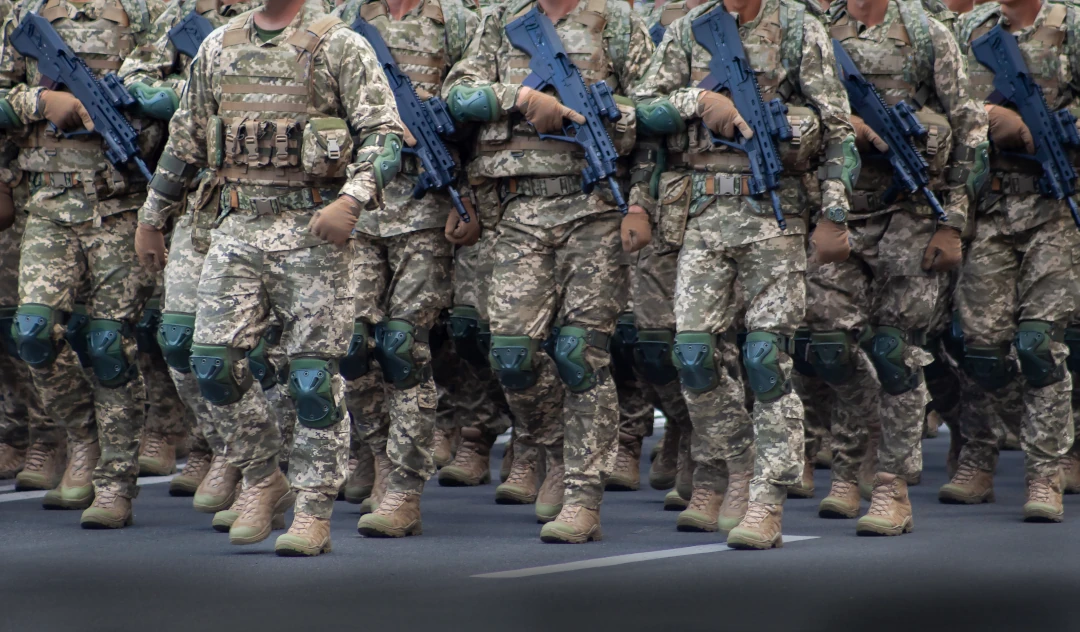
On the morning of September 19, before sunrise, Pete Hegseth stood in front of Texas A&M’s Corps of Cadets and turned a war into a sermon. Two words filled the stadium screen behind him: SEND ME. Then the Secretary of War — the title Trump revived for him in a September executive order — reached for scripture. “If you know your Book of Isaiah, Chapter 6, Verse 8,” he told the assembled cadets, “the Lord said, ‘Whom shall I send?’ Isaiah says, ‘Lord, I am here. Send me…'” From Isaiah he moved to the Redcoats, then to the communists, then to the Islamists, and finally to the young men and women in front of him — the ones who, if his policies hold, will be asked to go and fight.
The tour, which Al Jazeera reports is a calculated response to record-low public support for the Iran war, is not a recruiting drive. It is a theological argument. It says the wars this administration has launched are righteous, that dissent is unfaithful, and that the appropriate posture of a young American is not to question orders but to answer a divine one. It arrives, according to Middle East Eye, as Hegseth’s net favorability has cratered to negative 24 points and the House has postponed articles of impeachment against him until after the November elections.
What Hegseth was blessing at Kyle Field is what critics have begun calling, without hyperbole, the widest arc of simultaneous American armed conflict since the end of the Cold War: an open-ended war with Iran, a regime-change occupation in Venezuela, a Russian war in Ukraine that Washington has by turns fed and starved, and a NATO alliance that senior former diplomats now describe in the past tense. That is the empire the pulpit was built to defend.
I. The Wars, Named Plainly
When President Trump ordered joint U.S.–Israeli strikes on Iran on February 28, 2026, he did so without a congressional vote, without notice to America’s NATO allies, and without a stated end goal. The opening salvo, codenamed Operation Epic Fury, decapitated the Iranian government by killing Supreme Leader Ali Khamenei and pushed the region into what the Congressional Research Service now describes as “a war of attrition.” Six months in, U.S. Central Command has told lawmakers the conflict has cost the American military $43.6 billion, with a Congressional Budget Office analysis projecting an ongoing burn of roughly $3 billion a month.
The casualty ledger is worse than the White House has acknowledged. According to public tallies compiled by Wikipedia’s editors from Pentagon, Israeli, Iranian, HRANA and OCHA figures, the fighting has killed at least 19 to 23 American service members, wounded more than 820, and destroyed or damaged 97 aircraft. Israel counts 40 soldiers and 31 civilians dead. Gulf partners — Saudi Arabia, the UAE, Bahrain, Kuwait, Jordan — have buried their own dead from Iranian retaliatory strikes. Iran, per its own Human Rights Activists News Agency, has lost 3,684 killed and more than 27,000 wounded, with UN humanitarian figures documenting 3,400 civilian dead. The total across 43 affected countries, as of April, was already at least ten thousand souls.
The Iran war was not the only fire. On January 3, 2026, U.S. special forces launched Operation Absolute Resolve in Caracas, seizing President Nicolás Maduro from a compound in a predawn raid and, per the Council on Foreign Relations, effectively converting Venezuela into a de facto puppet state whose oil, budget, and foreign policy are now overseen from Washington. Since September 2, the Navy has struck at least 68 Caribbean vessels the administration labels drug boats — killing more than 230 people, most without judicial process — in an operation the Congressional Research Service and international law scholars have flagged as unauthorized use of lethal force.
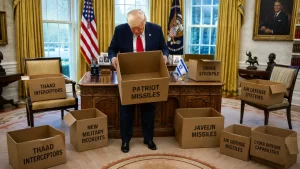
Meanwhile, in Ukraine, four years into Russia’s invasion, the president has swung between pressuring Kyiv toward Moscow’s terms and dangling Tomahawks to prod the Kremlin. As Ukrainian President Volodymyr Zelenskyy prepared to meet Trump in New York this week, CNN reported that Russia had ended a three-day pause with an onslaught that killed five, and that a Russian drone had breached Moldovan airspace and delayed Zelenskyy’s own plane. Ukrainian and NATO officials warn that a prolonged Middle East war has drained the Patriot interceptors Ukraine needs to survive the winter.
$43.6B
U.S. military expenditures on Operation Epic Fury as of September 3, per CENTCOM figures shared with lawmakers. CBO projects roughly $3 billion a month in continued expense.
10,000+
Total dead across 43 affected countries by April, including U.S., Israeli, Iranian, and Gulf-state casualties, per U.N. and independent human-rights compilations covered by CRS.
100+
Venezuelans and Cubans killed in Operation Absolute Resolve, per Interior Minister Diosdado Cabello. Washington has since assumed effective control of the country’s oil sector.
$4.06
Average gallon of gasoline as of late April, up over a dollar since Feb. 28, per AAA data. Headline inflation hit 3.3%, its highest since 2024.
II. Allies Who Stopped Following
The most durable wound of this year is not measured in barrels or bodies. It is measured in trust. Neither NATO as an institution nor its European members were consulted before the strikes on Iran; most were not even informed until American munitions were already in the air. What followed was, as a Small Wars Journal analysis put it, “historic.” Spain’s Prime Minister Pedro Sánchez closed his country’s airspace to U.S. military aircraft involved in the conflict, denouncing the attacks as “reckless and illegal.” France’s President Emmanuel Macron blocked U.S. and Israeli weapons transports from French airspace. Germany’s Defense Minister Boris Pistorius stated flatly: “Germany is not a party to the war. The German Armed Forces will not participate.”
By April, French, British, and Italian assets were quietly withdrawing from a NATO exercise in northern Norway. By May, Washington had begun postponing arms deliveries to Baltic and Scandinavian allies, citing the demands of the Iran theater. By July, Trump had left a NATO summit in Ankara accusing his own alliance of failing him and hinting again at U.S. withdrawal — an act a 2023 statute co-sponsored by his own Secretary of State, Marco Rubio, technically forbids without Congress. Ivo Daalder, President Obama’s former ambassador to NATO, told NPR the damage may be beyond repair: “Something fundamental has broken.“
“Military alliances are, at their core, based on trust: the confidence that if I am attacked, you will come help defend. It’s hard to see how any European country will now be able and willing to trust the United States to come to its defense.”
— Ivo Daalder, Former U.S. Ambassador to NATO, in CNN, April 2, 2026
Analysts at the Carnegie Endowment have begun writing openly about a “European NATO” — an alliance that continues without American leadership. That is not a threat. That is an assessment. It is what serious people say when the working assumption has been thrown out. What the president gained in the war he chose, he has spent from the security architecture three generations of Americans built.
III. The Islamabad Lifeline
Into the vacuum that Washington created, an unlikely broker stepped forward. Pakistan — a country the first Trump administration had publicly derided — began quietly passing messages between Tehran and the White House within days of the February strikes. Field Marshal Asim Munir, Pakistan’s army chief, held direct phone calls with President Trump and shuttled between capitals. On April 11 and 12, Islamabad hosted the highest-level U.S.–Iran talks since 1979, moderated by the Pakistani state. The talks produced the Islamabad Memorandum, signed on June 17 by both presidents, that briefly halted the killing and lifted the naval blockade.
The peace did not hold. By July 8, the ceasefire had collapsed and low-intensity strikes resumed. On September 1, U.S. warplanes hit Iranian targets again; one American munition destroyed a home hosting a wedding, killing five, per Reuters and NPR. In August, Munir returned to Tehran and reported “significant progress” on renewed talks. As of this weekend, per the CRS, Washington and Tehran are again trading limited strikes while the mediators try to restart the clock.
The point here is not that Pakistan is a disinterested peacemaker. It has extracted a great deal from Trump — a nomination for the Nobel Peace Prize, a seat on his “Board of Peace,” oil and cryptocurrency deals, warm words about the field marshal. The point is that when a superpower abandons the diplomacy of a war it started, other actors — not necessarily democracies, not necessarily friends — fill the space. That is what a vacuum looks like. That is what post-American diplomacy looks like. And the United Nations Security Council, whose Resolution 2803 endorsed the Gaza “Board of Peace” the president chairs, has watched this president chair a peace body while prosecuting a war on the country next door.
Get Involved Today
Contribute to our mission and turn your concerns into action.
IV. What the Wars Are Doing to Your Wallet
None of this is abstract. On the day the strikes began, the U.S. national average for a gallon of gasoline was $2.98. Within eight weeks, according to CBS News, it had risen above $4 for the first time in three years. Brent crude spiked to nearly $118 a barrel in late March. By early September, after Iran’s Houthi allies signaled new threats to Red Sea shipping, Brent had rebounded to $109. Consumer price inflation, which had cooled to 2.4 percent in February, jumped to 3.3 percent in March — the sharpest one-month rise since 2022 — before continuing to climb through the summer.
The Federal Reserve Bank of Dallas has quantified what most families can already feel. Its April scenario analysis found that a Strait of Hormuz closure lasting three quarters — a real possibility as fighting resumes — would push core inflation up by three-tenths of a percentage point through the end of 2026 and add as much as a full percentage point to headline inflation. That is the cost of homebuyers being priced out. That is the cost of summer airfare, jet fuel up more than two dollars a gallon. That is the arithmetic of a war Congress never voted for. And it is showing up in credit-card statements, at the pump, and at the grocery store.
Meanwhile, the White House has requested $80 billion in emergency spending to replenish American munitions depleted since February. This is money the president is asking for without accountability. It is money not going to housing, to child care, to health, to the deferred maintenance of American infrastructure. Senator Andy Kim of New Jersey put the case bluntly on the Senate floor: “We can’t keep putting the cost of this war in Iran on American families.”
“The American people were lied to about the war in Vietnam. We were lied to about the war in Iraq. And we are being lied to today about the war in Iran.”
— Sen. Bernie Sanders (I-Vt.), No Kings Rally, March 28, 2026
V. Congress Finds Its Spine, Late
The Democratic response, at first, was one of dazed exhortation. But by mid-March, Senator Tim Kaine of Virginia had moved a War Powers Resolution demanding the president “remove the United States Armed Forces from hostilities within or against Iran, unless explicitly authorized by a declaration of war or a specific authorization for use of military force.” The Senate passed it on June 23 by a vote of 50 to 48, with four Republicans — Rand Paul, Susan Collins, Lisa Murkowski and Bill Cassidy — joining every Democrat but John Fetterman. The House had passed a companion measure 215 to 208. It was, as the Washington Post noted, the first war powers resolution to clear both chambers over a sitting president in modern memory.
Trump ignored it. His administration insists such resolutions do not have the force of law. Senate Minority Leader Chuck Schumer said what the record shows: “Trump won’t brief Congress. Trump won’t defend his deal. Trump won’t end his war.” Kaine’s argument, delivered at the rostrum, was blunter still. Congress, he said, has “the power to declare war, not the president.”
Beyond the war-powers vote, dozens of Democrats introduced or supported articles of impeachment. Representative John Larson of Connecticut filed a resolution over the Iran conflict. Reps. Shri Thanedar of Michigan and Jasmine Crockett of Texas sent letters directly to Vice President J.D. Vance and Trump’s Cabinet urging the invocation of the 25th Amendment. Rep. Jamie Raskin, ranking member on Judiciary, led a virtual briefing on the amendment for the Democratic caucus. House Minority Leader Hakeem Jeffries, characteristically cautious, told Morning Joe: “We’ve ruled nothing out and we’ve ruled nothing in.”
VI. The 25th Amendment Case
In April, after the president threatened publicly to end “a whole civilization” and while the war he started still had no congressional authorization, the case for invoking the 25th Amendment moved from the fringe of Democratic discourse into its mainstream. It has not moved off the table since. What follows is the case as its serious advocates make it — not a prediction of what will happen, but a description of what the Constitution provides for a moment like this one.
What the Amendment Says — and What It Doesn’t
The mechanism. Section 4 of the 25th Amendment, ratified in 1967, allows the vice president together with a majority of the Cabinet (or “such other body as Congress may by law provide”) to transmit a written declaration to Congress that the president “is unable to discharge the powers and duties of his office.” Upon that transmission, the vice president immediately assumes the powers as acting president. If the president contests, the question goes to Congress, which can only sustain the removal by a two-thirds vote of both chambers within 21 days.
Who has called for it. Since April, more than 70 members of Congress have publicly urged the amendment’s invocation, per The Hill and NBC News. Senator Chris Murphy of Connecticut said, “No President in control of his senses would publicly promise to eradicate an entire civilization.” Senator Ed Markey of Massachusetts declared he would “support any avenue to remove Donald Trump from office.” Reps. Ro Khanna, Alexandria Ocasio-Cortez, Ayanna Pressley, Sarah McBride, Melanie Stansbury, Rashida Tlaib, and Maxwell Frost joined the call. Representatives Thanedar and Crockett sent formal letters to Vice President Vance and the Cabinet.
The constitutional argument. The case for Section 4 does not rest on the president’s policy views. It rests on a pattern of conduct that raises legitimate constitutional questions about his capacity to discharge the office as designed: launching a war of choice without notice to Congress or allies, publicly threatening genocide against a nation of 91 million people, ignoring a bicameral war powers resolution, presiding over an alliance system now in observable collapse, and — as Rep. Sarah McBride put it — threatening war crimes that the Rome Statute would recognize as such.
The practical barriers are real. Vice President Vance would have to move first. A majority of a Cabinet the president himself selected would have to concur. Assuming they did, sustaining removal would require 67 senators — a coalition impossible on paper today. Impeachment faces the same math. This is why Speaker Jeffries has been cautious, and why the war powers vote, though passed, has been ignored.
Why the barriers do not extinguish the case. The 25th Amendment was written for a country whose founders knew a single person could not be trusted with the sole decision to make war. The barriers to its use are political. The reasons for its consideration — the ones Rep. Melanie Stansbury named on the floor — are constitutional. “This is why the 25th Amendment and impeachment were created,” she said. “These aren’t policy differences. He is threatening crimes.” What is required, first, is that the case be made openly and repeatedly, in Congress and in the country, until the political math changes or the presidency does. The record shows it can be made. It has been.
VII. What Citizens Can Do Now
The most encouraging fact of this year is that the American public did not passively accept the war it was given. The No Kings movement’s March 28 protests drew, by organizer estimates and independent counts, roughly eight million participants across more than 3,100 events in all fifty states, plus solidarity marches in more than twenty countries. Retired U.S. Navy Lieutenant Richard Anderson, a Vietnam veteran, marched in Durham with a hand-lettered sign that said No more war! Bernie Sanders addressed rallygoers with a warning as blunt as any he has ever delivered. This is a movement that spans generations, spans rural and urban America, and, notably, was ahead of most of Congress.
The concrete tools available to ordinary citizens are unglamorous but real. Call your senators and your representative — not once, but every week — about the pending war powers resolutions and the Cabinet’s constitutional duties under Section 4. Support the No Kings and Indivisible chapters organizing locally. Vote in the November midterms; the House Democratic caucus’s willingness to force an impeachment vote hinges on whether it wins a majority. Register to work the polls. Donate to organizations documenting civilian casualties and legal groups pursuing accountability under international law. If you are a veteran, tell your story publicly — because the story Hegseth was selling in College Station is not the only story of American service, and it must not be the last one told.
None of this is a full answer. It is what an engaged democracy looks like when its constitutional shortcuts are not available. It is the long, unromantic work of a citizenry that will not consent to be governed by fear or by scripture weaponized on a football field.
Editorial Conclusion
A Secretary of War quoting Isaiah to college students is not a religious moment. It is a political weapon aimed at the last remaining moral defense the Constitution provides against unauthorized force. The verse he chose describes a man volunteering. What this administration has practiced is conscription of judgment — of its allies, of its Congress, of its own citizens — into wars none of them chose. The president has bombed Iran without a vote, seized Venezuela without a treaty, alienated NATO without a plan, and threatened genocide without consequence. The Islamabad Memorandum is dead. The war powers resolution is ignored. The impeachment vote has been postponed until after the ballots are counted.
The stakes are not partisan. They are constitutional. If the vice president will not act, if the Cabinet will not concur, if the Senate cannot muster sixty-seven votes — then the check that remains is the one the founders always assumed would remain: an alert public and a real election. Both are now available. Both must be used. What is at stake is not one president’s fitness for office. It is whether the Republic still knows how to say no to a war it did not choose.
Sources & References
- Al Jazeera — “Hegseth kicks off ‘Send Me Tour’ amid Iran war backlash.” aljazeera.com
- Middle East Eye — “Hegseth kicks off ‘Send Me Tour’ in attempt at gaining support for war on Iran.” middleeasteye.net
- Austin American-Statesman — “Pete Hegseth makes College Station stop before Aggies kickoff.” statesman.com
- Times of Israel — “More US troops killed in Iran war than Pentagon has acknowledged — report.” timesofisrael.com
- Small Wars Journal — “The Cost of the Iran War for the United States: A Strategic Blunder in Five Dimensions.” smallwarsjournal.com
- CBS News — “In 8 weeks, the Iran war has dented the U.S. economy. The damage could linger, economists say.” cbsnews.com
- Federal Reserve Bank of Dallas — “Implications of the Iran War for U.S. Inflation.” dallasfed.org
- NPR — “Fallout from the Iran war may include a NATO where the U.S. is no longer its leader.” npr.org
- CNN — “Europe didn’t want an Iran war, yet Trump is saddling it with the consequences.” cnn.com
- Time — “Democrats Demand GOP Leaders End Recess to Stop Trump’s Iran War.” time.com
- The Hill — “Democrats intensify calls to invoke 25th Amendment, impeach Trump over Iran threats.” thehill.com
- NBC News — “Dozens of Democrats call for Trump’s removal after his Iran threats.” nbcnews.com
- CNN — “Senate votes to limit Trump’s Iran war powers in rare rebuke.” cnn.com
- Washington Post — “Senate votes to block Trump from resuming Iran war.” washingtonpost.com
- Al Jazeera — “How Pakistan mediated a US-Iran agreement after more than 100 days of war.” aljazeera.com
- Congressional Research Service — “U.S. Conflict with Iran (Report R48887).” congress.gov
- Council on Foreign Relations — “Instability in Venezuela: Global Conflict Tracker.” cfr.org
- CNN — “Even if it’s real, Trump’s new Ukraine push is already being undermined by events.” cnn.com
- NPR — “U.S. military strikes Iran, while Trump vows more for Tehran’s retaliation.” npr.org
- NPR — “At ‘No Kings’ rallies, anti-Trump protesters speak out against ICE ‘cruelty,’ Iran war.” npr.org
Related News