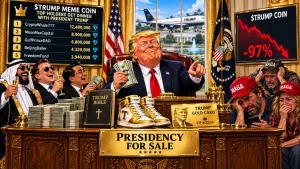
A president bans the digital dollar. His family launches a private one. Congress makes it a required buyer of federal debt. His regulators grant it a bank charter. A foreign sovereign wealth fund pays $500 million for 49% of the family venture, then routes $2 billion through it. The Constitution has a clause for this. It has not been enforced.
Every part of the machine works on its own. Each executive order can be defended on its face, each appointment justified, each piece of legislation praised on its merits. Only when the pieces are laid out together does the design become visible: a private company owned in substantial part by the sitting president’s family has been positioned as a mandated purchaser of United States Treasury debt, granted a federal bank charter for the first time in American history for a president’s family business, and shielded from the one federal database that would have traced its buyers. It happened in nineteen months, in plain sight, at the pace of ordinary administrative decisions.
The story is a policy story on its surface. Underneath, it is a constitutional story. The Framers wrote two clauses — the Foreign Emoluments Clause and the Domestic Emoluments Clause — to prevent exactly the arrangement now in place: a president whose personal income is contingent on decisions made by a foreign sovereign, a state government, or the federal government he heads. This editorial lays out what has been assembled, what it costs the public, and what the Constitution has to say about it. The pieces exist. They were assembled in sequence. And left alone, they will run.
I. The Machinery, Assembled
Start with the appointments. Scott Bessent, confirmed as the 79th Treasury Secretary in January 2025, is best known on Wall Street for his role in the 1992 Soros Fund short of the British pound — the trade that forced the Bank of England to abandon the European Exchange Rate Mechanism and generated more than $1 billion in profits. He returned to Soros Fund Management as chief investment officer between 2011 and 2015 and successfully bet against the Japanese yen during that stint. This is the résumé Donald Trump chose for the person now managing the U.S. dollar.
David Sacks, the venture capitalist named “AI and Crypto Czar” in December 2024, entered the White House with a $200 million portfolio of digital-asset investments held personally and through his firm Craft Ventures. He divested those positions before his start date; the White House then granted him a blanket ethics waiver on March 5, 2025 clearing him to work on regulatory issues directly related to holdings he and his firm continued to retain in private crypto companies. The waiver was issued a month after Trump fired the Senate-confirmed director of the Office of Government Ethics — the independent agency responsible for enforcing federal ethics laws.
Then the executive order. On January 23, 2025, three days after his inauguration, Trump signed “Strengthening American Leadership in Digital Financial Technology,” prohibiting the establishment, issuance, and use of a central bank digital currency within the United States — and, in the same document, committing the administration to “promote the development and growth of lawful and legitimate dollar-backed stablecoins worldwide.” The order closed the door on a public digital dollar and, in the same paragraph, opened it for private ones.
Days earlier, Trump had launched the $TRUMP memecoin through his company CIC Digital LLC. Within weeks, World Liberty Financial — the crypto venture co-founded by Eric Trump, Donald Trump Jr., and Barron Trump, whose affiliated LLC is entitled to 75% of the proceeds from sales of its WLFI token — announced USD1, a dollar-pegged stablecoin backed by U.S. Treasuries and cash equivalents.
II. The Reserve Function, Privatized
In May 2025, at the Token 2049 conference in Dubai, World Liberty co-founder Zach Witkoff — flanked by Eric Trump — announced that USD1 had been chosen to settle a $2 billion investment by Abu Dhabi’s state-backed MGX fund into the crypto exchange Binance. MGX is chaired by Sheikh Tahnoon bin Zayed Al Nahyan, deputy ruler of Abu Dhabi and the United Arab Emirates’ national security advisor. The Wall Street Journal has reported that days before Trump returned to the White House, Eric Trump signed a deal with lieutenants of Sheikh Tahnoon to sell them a 49% stake in World Liberty Financial for $500 million. The MGX transaction placed $2 billion of reserves with USD1’s custodian and boosted the interest income accruing to World Liberty Financial’s owners.
Then came the law. On July 18, 2025, President Trump signed the GENIUS Act, drafted by Senator Bill Hagerty (R-TN). The statute requires every dollar-pegged payment stablecoin issued in the United States to hold reserves in cash and short-term Treasury bills with maturities of ninety-three days or less. Senator Hagerty later stated publicly that he wrote the law in part to “create structural demand for U.S. Treasuries.” A Brookings Institution study projected that stablecoin growth under the GENIUS regime could increase Treasury bill demand by $400 billion to $2.3 trillion by 2030. Every dollar of USD1 in circulation is now, by federal law, a forced buyer of U.S. government debt.
“He wrote the GENIUS Act in part to solidify dollar dominance in digital currencies and to create structural demand for U.S. Treasuries.”
— Sen. Bill Hagerty (R-TN), author of the GENIUS Act
On August 14, 2026, the Office of the Comptroller of the Currency granted World Liberty Trust Company, National Association preliminary conditional approval for a national trust bank charter — the first time in American history that a company owned by the family of a sitting president has been granted federal bank status. The charter will permit World Liberty to issue USD1 directly, custody its own reserves, and settle payments without relying on third-party custodian BitGo. World Liberty’s own website discloses that an entity affiliated with Donald Trump and members of his family owns 38% of the company.
III. What Fell Away
While the private dollar was built up, the mechanisms for tracing who buys it were taken down.
The Corporate Transparency Act, passed in 2020 and effective January 1, 2024, required U.S. companies to report their beneficial owners to the Financial Crimes Enforcement Network — the single federal database designed to unmask domestic shell companies. On March 2, 2025, Treasury Secretary Bessent announced that FinCEN would stop enforcing the beneficial-ownership rule against U.S. companies and U.S. citizens. On August 14, 2026 — the same day the OCC approved the World Liberty bank charter — FinCEN issued a final rule permanently ending BOI reporting for U.S. persons and announced that it would delete previously reported information by U.S. persons from the database.
Meanwhile, the actual dollar has been allowed to weaken. The dollar index, measuring the greenback against a basket of major currencies, has fallen from above 109 in January 2025 to around 99.65 as of late August 2026, its steepest first-half decline since 1973. Gold has surged to record highs, finishing 2025 with an annual gain of roughly 65 percent — its largest since 1979 — and reaching above $4,300 per ounce this summer. The U.S. national debt crossed $40 trillion in mid-August 2026.
Treasury Secretary Bessent has quietly built the Treasury General Account — the government’s checking account at the Federal Reserve — to roughly $950 billion, nearly double the $550–$600 billion target maintained under the Biden administration. On August 19, 2026, the Treasury doubled the size of its long-dated bond buyback program, raising the cap from $2 billion to at least $4 billion per operation. The stated purpose is bond-market liquidity; the effect, in a market of $32 trillion in publicly held debt, is a signal that Treasury is prepared to intervene actively in the long end of the curve.
Nineteen months, in sequence:
$TRUMP memecoin launched through CIC Digital LLC, three days before inauguration.
Eric Trump signs deal with lieutenants of Sheikh Tahnoon bin Zayed to sell 49% of World Liberty Financial for $500 million.
Trump signs executive order banning federal work on a public digital dollar, while committing to promote private dollar-backed stablecoins.
Trump fires the Senate-confirmed director of the Office of Government Ethics.
Treasury announces it will not enforce the Corporate Transparency Act‘s beneficial-ownership rule against U.S. persons.
White House issues blanket ethics waiver to Crypto Czar David Sacks.
Announcement in Dubai that USD1 will settle MGX’s $2 billion investment in Binance.
Trump signs the GENIUS Act, requiring dollar-pegged stablecoins to hold short-term Treasuries as reserves.
OCC grants World Liberty Trust Company conditional national bank charter — a first in U.S. history for a sitting president’s family.
FinCEN issues final rule permanently ending U.S.-person BOI reporting and announces deletion of previously reported records.
National debt crosses $40 trillion for the first time.
Treasury doubles long-dated bond buybacks from $2B to at least $4B per operation.
Get Involved Today
Contribute to our mission and turn your concerns into action.
IV. The Public Cost
Foreign central banks have historically held some $8 trillion in dollar reserves. They earn no fee for this. The benefits — cheaper federal borrowing, lower mortgage rates, stable import prices — are diffused across the entire American public. This is what economists mean when they call the reserve status of the dollar an “exorbitant privilege”: a durable, one-way subsidy paid by the rest of the world to the United States.
Under the GENIUS regime, that reserve function migrates, at the margin, from foreign central banks acting in the public interest to domestic stablecoin issuers required by law to hold short-term Treasuries. Every additional dollar of USD1 in circulation is a forced buyer of U.S. debt whose interest income accrues to World Liberty Financial, of which the Trump family retains 75% of net proceeds. The reserve function that used to generate a public benefit now generates a private fee.
The dollar’s weakness accelerates the substitution. Investors and foreign entities holding depreciating dollars have direct incentive to move into dollar-pegged digital instruments — including the one now backed by a federal charter. Sanctions policy, which cuts adversaries off from the correspondent-banking system, will make the private, federally-chartered digital dollar the path of least resistance for entities seeking dollar exposure without exposure to traditional banks. The FinCEN deletion ensures that the ultimate buyers of USD1, routing through domestic shell companies, cannot be identified.
The public absorbs the cost of a weakened dollar in reduced purchasing power, higher import prices, and higher long-run borrowing costs. One family collects the fee. This is the arithmetic. It does not depend on inferring anyone’s intent.
“President Trump stands alone in having such substantial financial conflicts of interest. For every other executive branch official, it would be a violation.”
— Richard Painter, chief White House ethics lawyer under George W. Bush, NPR, July 2, 2026
V. The Emoluments Clauses
The Constitution names this problem twice. Not once — twice. The Framers wrote a foreign version and a domestic version because they understood that a president’s income sources determine his loyalties. In the more than two hundred and thirty years since those clauses were ratified, no court has ever authoritatively interpreted either one.
Text the Framers wrote to prevent exactly this. Enforcement history that has, so far, allowed it.
The Foreign Emoluments Clause (Article I, Section 9, Clause 8) is unambiguous on its face:
“No Title of Nobility shall be granted by the United States: And no Person holding any Office of Profit or Trust under them, shall, without the Consent of the Congress, accept of any present, Emolument, Office, or Title, of any kind whatever, from any King, Prince, or foreign State.”
The word “emolument,” in the English-language dictionaries of the founding era, meant profit, gain, advantage, or benefit — the broadest possible reading. Edmund Randolph told the Virginia ratifying convention in 1788 that the clause existed “to prevent corruption.” Its enforcement mechanism is textual: Congress, and only Congress, can consent. The clause is self-executing; it requires no statute. But it also requires a Congress willing to invoke it.
The Domestic Emoluments Clause (Article II, Section 1, Clause 7) fixes the president’s compensation at a level set before his term begins and prohibits any additional benefit “from the United States, or any of them.” The purpose is the same as its foreign counterpart: to sever the president’s income from any actor — foreign sovereign, state government, or federal agency — that might use that income to influence him.
The facts, against the text.
In January 2025, an entity connected to Sheikh Tahnoon bin Zayed Al Nahyan — deputy ruler of Abu Dhabi and the United Arab Emirates’ national security advisor — paid $500 million for a 49% stake in the president’s family crypto venture. In May 2025, MGX, a state-backed UAE sovereign fund also chaired by Sheikh Tahnoon, routed a $2 billion Binance investment through the same venture’s stablecoin, generating fees and reserve interest for its owners. Weeks later, the administration agreed to supply the UAE with advanced American AI chips that the same administration had previously restricted over concerns they would be transferred to China. On August 14, 2026, the Office of the Comptroller of the Currency — a bureau of the Treasury, in which the United States government holds regulatory authority — granted the venture a federal bank charter. If those facts do not present textbook Foreign and Domestic Emoluments questions, no set of facts ever will.
The doctrinal vacuum.
Three federal lawsuits were filed during the first Trump administration alleging Emoluments Clause violations:
CREW v. Trump (S.D.N.Y. 2017) was filed on the president’s first day in office by hospitality-industry plaintiffs alleging competitive injury. The Second Circuit reinstated the case in 2019; an en banc panel reversed in 2020; the Supreme Court granted certiorari in September 2020.
District of Columbia and Maryland v. Trump (D. Md. 2017) was brought by state attorneys general over payments received at the Trump International Hotel from foreign diplomats and state governments. The Fourth Circuit twice ruled in favor of the plaintiffs.
Blumenthal v. Trump (D.D.C. 2017) was brought by 215 members of Congress alleging that Trump had received foreign emoluments without their consent. The DC Circuit dismissed it in 2020 for lack of legislative standing, holding — in a legal Catch-22 — that “only an institution can assert an institutional injury,” even though the Foreign Emoluments Clause gives Congress as an institution the exclusive power to consent.
On January 25, 2021 — five days after Trump left office — the Supreme Court vacated the surviving cases as moot and instructed the appellate courts to dismiss them, without ruling on a single substantive question. The Court had also denied review in Blumenthal in October 2020. As the Brennan Center for Justice wrote at the time, the Court’s refusal to rule “may inadvertently encourage another president to brazenly leverage his or her power for profit.” The Congressional Research Service confirmed that most of the lower-court decisions were vacated and retain, at most, persuasive value.
That is the state of the law today. No Supreme Court holding on what an emolument is. No Supreme Court holding on standing to sue a sitting president under the clauses. No Supreme Court holding on whether a president may accept a foreign sovereign wealth fund’s transactions through a company he partly owns. Every lower-court opinion that reached the merits was vacated. The constitutional text remains. The judicial interpretation is a blank page.
“The Supreme Court’s refusal to rule one way or another may inadvertently encourage another president to brazenly leverage his or her power for profit.”
The Supreme Court’s refusal to rule one way or another may inadvertently encourage another president to brazenly leverage his or her power for profit.
Who has raised the alarm this time. Senator Elizabeth Warren (D-MA), ranking member of the Senate Banking Committee, has led ethics inquiries into Crypto Czar David Sacks and warned that the GENIUS Act would let the president and his family “line their own pockets.” Representative Melanie Stansbury (D-NM) co-led Democrats in an ethics investigation of Sacks’ status as a “special government employee.” Former CREW executive director Noah Bookbinder called the first-term arrangements “pervasive corruption”; the second-term arrangements are an order of magnitude larger and now include a federally chartered bank. Former White House chief ethics counsel Richard Painter has stated that Trump’s crypto arrangements would be a criminal violation “for every other executive branch official.”
Why the barrier is legislative, not legal. The federal conflict-of-interest statute, 18 U.S.C. § 208, exempts the president and vice president by construction — a carve-out justified historically only by the assumption that a president would voluntarily place his business interests in a blind trust, as every president from Lyndon Johnson through Barack Obama did. Trump has not. The Foreign Emoluments Clause itself supplies the enforcement mechanism: “without the Consent of the Congress.” Congress could pass a joint resolution tomorrow demanding a full accounting of every foreign-sourced payment to the president or to any business in which he or his family holds a beneficial interest, and prohibiting further receipt without disclosure. Congress has not. That is not a defect in the Constitution. It is a choice by the current majorities in both chambers.
VI. What Must Be Done
The mechanism is now assembled. Left alone, it runs on its own logic. Halting it does not require new constitutional theory or novel legal tools. It requires Congress to do five ordinary things it has, to date, refused to do:
First, invoke the Foreign Emoluments Clause directly. The clause vests the consent power in Congress. A joint resolution demanding a full accounting of every foreign-sourced payment to the president or to any business in which he or his family holds a beneficial interest — with penalties, including impeachment referral, for non-compliance — requires no new legal authority. It requires the political will Congress used to have and has, for now, mislaid.
Second, close the presidential carve-out in 18 U.S.C. § 208 by statute. The exemption of the president and vice president from the federal conflict-of-interest law was defensible only when voluntary divestment was the universal norm. That norm is broken. Congress can restore it in a paragraph.
Third, reinstate the Corporate Transparency Act’s beneficial-ownership reporting requirement for U.S. companies and legally bar FinCEN from deleting the previously collected data. The information Congress required be gathered in 2020 is a public record of the ownership of the American economy; it belongs to the public, not to the administration in office.
Fourth, amend the GENIUS Act to disqualify from federally chartered stablecoin issuance any entity in which the president, vice president, cabinet secretaries, or their immediate family members hold a beneficial interest. This is a routine ethics provision applied to a novel financial instrument. It requires no new theory.
Fifth, confirm a Senate-approved director of the Office of Government Ethics with express statutory authority to review emoluments-clause questions in real time. An ethics office that exists only in name is worse than none: it launders the appearance of oversight without providing any.
Absent these steps, the machinery does not need additional decisions to continue running. It runs on the momentum already given to it. The dollar continues to weaken. The demand for the private dollar-pegged alternative continues to grow. The GENIUS Act continues to compel that alternative to buy Treasuries. The bank charter continues to allow the Trump family firm to issue directly. The database that would identify the buyers no longer exists.
Editorial Conclusion
The Foreign Emoluments Clause was written in 1787 by men who had watched European courts corrupt one another through gifts, offices, and quiet payments. They wrote it broadly and they wrote it plainly, and they placed the consent power in the branch closest to the people. Two hundred and thirty-eight years later, a foreign sovereign wealth fund has paid $500 million for 49% of the president’s family business and routed $2 billion more through its stablecoin. A federal regulator, appointed by the same president, has granted that business a bank charter. The reserve function of the dollar itself has been quietly rerouted through it.
The constitutional text forbidding this is unambiguous. The Supreme Court has never ruled on it. Congress has never invoked it. What is at stake is not the outcome of the next election. It is whether the Emoluments Clauses mean anything at all — and whether the American public still owns the dollar.
Sources & References
- Yahoo Finance / FortuneTrump picks Scott Bessent for Treasury: shorting the pound with Soros
- BritannicaScott Bessent: Treasury Secretary, tariff negotiator, Soros background
- CNBCDavid Sacks sold $200M in crypto before taking White House job
- The LeverTrump issues ethics waiver for AI/crypto czar Sacks
- Banking DiveTrump executive order embraces stablecoins, bars CBDCs
- ReutersTrump’s USD1 stablecoin chosen for $2B Abu Dhabi Binance deal
- ForbesTrump’s stablecoin USD1: Binance holds 87% after founder’s pardon
- Center for American ProgressHow Trump’s $500M UAE crypto deal trades national security for family profit
- Mayer BrownGENIUS Act signed into law — U.S. enacts federal stablecoin legislation
- Brookings InstitutionStablecoins after GENIUS: private money, public debt, and the global dollar
- ABC NewsWorld Liberty Trust granted bank status — unprecedented for a sitting president
- Fox BusinessOCC approves World Liberty Financial national bank charter for USD1
- Office of the Comptroller of the CurrencyCorporate Decision #1385: World Liberty Trust Company charter
- U.S. Department of the TreasuryFinCEN permanently ends beneficial ownership reporting requirements
- FinCENFinal rule ending BOI reporting; announcement of database deletion
- CNN BusinessThe national debt just hit $40 trillion for the first time
- CNBCBessent could tap $1T Treasury General Account to fund bond buybacks
- NPRFormer ethics lawyer Painter: Trump’s crypto is a “clear conflict of interest”
- U.S. Senate Banking Committee (Warren)Warren questions OGE on Crypto Czar Sacks conflicts of interest
- Nextgov / FCWDemocrats launch ethics investigation into Crypto Czar David Sacks
- Citizens for Responsibility and Ethics in WashingtonCREW v. Donald J. Trump — case history and dismissal
- Congress.gov / Constitution AnnotatedForeign Emoluments Clause: three lawsuits, vacated as moot
- Brennan Center for JusticeSupreme Court ducks an opportunity on Trump Emoluments cases
- The HillSupreme Court dismisses emoluments lawsuits against Trump as moot
Related News