A war launched without a declaration. Hundreds of thousands dead from cancelled aid. A press marched to grand juries. A Congress that has abandoned its most solemn duty. The evidence is on the record — and the record demands accountability.
The instinct to look away has become the defining posture of American political life in 2026. Each morning arrives with a new outrage — a rescinded protection, a threatened prosecution of a journalist, a rising casualty count from a war Congress never declared — and each morning the machinery of American accountability grinds a little slower. This editorial is written against that instinct. The record of Donald Trump’s second presidency, now nineteen months old, is not a partisan grievance. It is a documented pattern of conduct that spans the criminal, the constitutional, and the humanitarian. It has produced verifiable deaths in the tens of thousands at home and the hundreds of thousands abroad. It has broken laws written, in some cases, by conservatives themselves. And it has done so with the knowing acquiescence of a Congress that continues to insist there is nothing it can do.
There is something it can do. There is a great deal it can do. This piece lays out what the case looks like when the facts are assembled in one place — and why prosecution, at the state level and eventually at the federal level, is not a political preference but a constitutional necessity.
Before we proceed, a word of caution about what this editorial is and is not. It is an opinion piece, written from an unambiguously progressive perspective. It is grounded in reporting from Reuters, the Associated Press, the Washington Post, CNN, the New York Times, congressional press releases, peer-reviewed medical journals, and legal analysis from Yale, NYU, and other law schools. Every statistic and every quotation below is sourced. Reasonable people will disagree about the political framing. The underlying facts are not seriously in dispute.
I. The Iran War: Illegal at Its Inception, Criminal in Its Execution
On February 28, 2026, without a declaration of war from Congress and without a specific authorization for the use of military force against Iran, U.S. and Israeli forces began what has become known as the 2026 Iran War. The opening hours of the campaign included a strike on an all-girls school in Minab, southern Iran, that killed roughly 160 civilians, 120 of them schoolchildren, according to ABC News reporting compiled six months into the conflict.
Six months later, per that same reporting, at least 18 U.S. service members have been killed and more than 750 wounded. The Center for American Progress, drawing on Department of Defense figures and independent monitoring by the Iranian Human Rights Activists News Agency (HRANA), estimates at least 1,701 Iranian civilians killed, including 307 children, from February through early April alone. Wikipedia’s ongoing casualty tally, drawing on multiple national and NGO sources, places total Iranian fatalities at 3,468 or higher. In the same period, 190 people were killed in U.S. strikes on boats accused of drug or logistical activity, according to reporting compiled by The Nation.
The war’s legal problems are not marginal. They are fundamental, and they are named.
Oona Hathaway, professor at Yale Law School and director of its Center for Global Legal Challenges, told the Christian Science Monitor that Trump’s public order to bomb “every” Iranian bridge and power plant, if carried out, “would constitute a violation of the core principles of international humanitarian law, which, first and foremost, is the obligation not to target civilians and civilian objects.” Retired Lt. Col. Rachel VanLandingham, a professor at Southwestern Law School and former Air Force judge advocate, was even more direct: to “wage total war against an entire country — in his term, ‘the civilization’ of Iran — is, of course, strictly prohibited.”
Secretary of Defense Pete Hegseth’s public statement that U.S. forces would grant “no quarter, no mercy for our enemies” is not merely rhetorical excess. As legal scholars writing at Just Security have noted, ordering denial of quarter is expressly prohibited under the laws of war, and the statement likely violates the U.S. War Crimes Act, 18 U.S.C. § 2441 — a statute passed by a Republican Congress in 1996.
“To wage total war against an entire country — in his term, ‘the civilization’ of Iran — is, of course, strictly prohibited.”
— Lt. Col. Rachel VanLandingham (Ret.) · Southwestern Law School · to the Christian Science Monitor, April 2026
The domestic law problems are equally severe. Article I, Section 8 of the Constitution vests the power to declare war in Congress. The War Powers Resolution requires the president to seek authorization within 60 days of introducing forces into hostilities. Neither has been done for the Iran war. On June 4, 2026, the House passed a bipartisan resolution 215–208 seeking to halt further military action; Trump called the vote “meaningless” and berated the four Republican signers.
II. Ukraine Abandoned, Russia Rewarded
Since the day Trump returned to office, no new U.S. military aid package for Ukraine has been approved. According to the Center for Strategic and International Studies, the 2026 Pentagon budget cuts funding for weapons purchases on behalf of Ukraine outright; Secretary Hegseth became the first American defense secretary to skip the Ukraine Defense Contact Group in Brussels since Russia’s 2022 invasion began. In March 2025, following a public Oval Office confrontation with Ukrainian President Volodymyr Zelensky, the administration paused all military aid and intelligence support for over a week.
The consequences are measurable. Ukrainian civilian casualties surged 26 percent in 2025, according to Action on Armed Violence data: 14,775 casualties, including 2,250 deaths and 12,525 injuries, as Vladimir Putin escalated bombing campaigns of Ukrainian energy infrastructure through a winter of American disengagement. Reuters investigations found that at least 40 percent of U.S.-funded programs supporting war-crimes accountability and rule-of-law work in Ukraine were terminated or allowed to expire, effectively kneecapping the international effort to prosecute Russian officials for the torture, sexual violence, and forced deportation of Ukrainian children documented across 230,000 open investigations.
The moral question is stark. When the United States promises support for a democracy under invasion, and then withdraws that support without warning, the resulting deaths are not incidental. They are the predictable consequence of a policy choice.
III. Death by Decree — At Home and Abroad
The most staggering death counts of the Trump presidency have come not from the battlefield but from the budget. Two distinct policy actions — the July 2025 passage of the One Big Beautiful Bill Act (OBBBA) and the January 2025 shutdown of USAID — have combined, on peer-reviewed and congressionally cited estimates, to produce a projected death toll in the millions.
The One Big Beautiful Bill Act: A “death panel” by another name
Signed into law in July 2025, the OBBBA imposes what Fierce Healthcare characterizes as a nearly $1 trillion cut to federal Medicaid over ten years, primarily through the first-ever national Medicaid work requirements and reduced federal funding. The Congressional Budget Office estimates that 7.6 million Americans will lose coverage as a direct result; another 4 million could become uninsured if the Affordable Care Act’s premium subsidies are allowed to expire.
Health economists at Yale and the University of Pennsylvania, asked by the Senate Finance and HELP committees to model mortality effects, produced numbers that should have stopped the bill in its tracks. Rachel Werner of Penn LDI told congressional staff that “if 7.7 million people are going to lose their Medicaid coverage, that is going to result in 11,300 deaths per year.” A subsequent Penn analysis, factoring in dual-eligible seniors and the wider cascade of cuts, put the total closer to 51,000 preventable deaths per year. A study published in JAMA Health Forum in July 2025 projected the cuts would cause more than 1,000 additional deaths and nearly 100,000 more hospitalizations every year, with 1.6 million Americans delaying needed care.
These are not partisan estimates. They come from the peer-reviewed literature, from institutions that have modeled Medicaid mortality for decades. Even Senator Thom Tillis, a North Carolina Republican, asked his fellow senators on the floor before the vote: “What do I tell 663,000 people in two years, three years, when President Trump breaks his promise by pushing them off of Medicaid because the funding’s not there anymore?” He voted no. Most of his caucus did not.
USAID: The invisible mass casualty event
On January 24, 2025, four days after inauguration, the Trump administration issued a stop-work order that halted USAID programs worldwide overnight. Recipients — from HIV clinics in South Africa to malnutrition programs in Sudan to malaria prevention across sub-Saharan Africa — were cut off without transition. Elon Musk, then a close adviser, would soon publicly boast that USAID had been put “through the woodchipper.”
The mortality consequences are now being counted. The ImpactCounter project, run by Boston University epidemiologist Brooke Nichols, estimates that more than 762,000 people have died from the USAID cuts, including over 500,000 children. Congressional Democrats led by Reps. Brad Sherman and Gregory Meeks put the figure at approximately 600,000, “about two thirds of them children,” in a formal congressional investigation request.
The projected long-term toll is worse. A study published in The Lancet, and covered by CNN in February 2026, projects global aid cuts could lead to at least 9.4 million additional deaths by 2030. A related analysis co-authored by the UCLA Fielding School of Public Health puts the projected death toll at 14 million by 2030, including 4.5 million children under age five. Study co-author Davide Rasella of the Barcelona Institute for Global Health described the scale of the shock as “comparable to a global pandemic or a major armed conflict.”
3,468+ Iranian dead, 18 U.S. troops killed
14,775 casualties in 2025, +26%
11,300–51,000 excess U.S. deaths/year
762,000 already dead; 14M projected by 2030
IV. Public Health as a Political Prop
On August 10, 2026, Trump signed an executive order calling for the combined measles-mumps-rubella vaccine to be split into three separate shots and for childhood vaccinations to be spaced further apart — a direction contradicted by the CDC’s own guidance, which states there is “no published scientific evidence” of benefit from separating the combination MMR vaccine. Trump publicly described the MMR shot as “quite lethal,” a claim for which no scientific evidence exists.
The public health consequences of the administration’s anti-vaccine orientation are no longer theoretical. According to public health researcher Tara C. Smith writing for MS NOW, between 2000 and 2024 the United States recorded a total of 4,485 measles cases. Since January 2025 alone, there have been more than 5,000 confirmed cases — including two unvaccinated child deaths in Texas in 2025, one adult death in New Mexico, and two additional deaths in Pennsylvania’s Lancaster County in August 2026. Endemic measles, eliminated from the United States in 2000, is on the verge of returning.
These deaths are individually small numbers set against Medicaid or USAID totals. They are morally significant precisely because they are preventable. A child dead of measles in 2026, in a country that eliminated the disease during the Clinton administration, is a policy artifact.
V. Rule by Decree: The Assault on the Separation of Powers
Trump has signed 49 executive orders in 2026 alone, according to the Federal Register, on top of the record-shattering pace set in 2025. Individually, executive orders are a normal instrument of governance. Cumulatively — and combined with the administration’s public theory of what a president may unilaterally do — they represent something historically novel.
Political scientist Desmond King, writing in the Political Science Quarterly in Spring 2026, describes the Trump administration’s approach as “governance by decree,” established through six developments: increased unilateralism, aggressive norm-testing, entrenchment of unitary executive theory as jurisprudence, judicial upholding of executive power, tepid legislative oversight, and the appointment of loyalists across independent agencies. Law professors Adam Cox and Trevor Morrison of NYU, writing at Just Security, put it more bluntly: “Trump’s recent actions appear to assert an authority to override or ignore federal legislation whenever it interferes with his policy aims.”
The federal courts have resisted, sometimes successfully. On December 23, 2025, the Supreme Court in a 6–3 decision refused to allow Trump to federalize Illinois National Guard troops for deployment in Chicago over Governor J.B. Pritzker’s objection, finding the administration had failed to satisfy the statutory conditions for invoking Title 10. Federal judges in Los Angeles and Portland reached similar conclusions. The Campaign Legal Center and States United Democracy Center have documented a steady stream of losses for the administration on election-related executive orders that trespassed on state and congressional authority.
But the courts alone cannot save a constitutional order in which Congress has ceased to exercise its own powers. The framers designed a legislature that would jealously guard its prerogatives against executive encroachment. What we have instead is a legislature — its majority obedient, its minority outnumbered — that has treated Trump’s expanding decrees as facts of nature rather than usurpations to be contested. The result is a de facto system of rule by executive order, ratified by legislative inaction.
Get Involved Today
Contribute to our mission and turn your concerns into action.
VI. The Free Press Under Federal Boot
On January 14, 2026, FBI agents searched the home of Washington Post reporter Hannah Natanson — a rare and intimidating action against a working journalist. Later that same month, independent reporters Don Lemon and Georgia Fort were arrested while covering protests, Fort at her own home in the suburbs of St. Paul, Minnesota. Amnesty International’s Americas director described the scene as “the kind of scenario familiar to journalists working under repressive governments.”
The escalation has continued. In April 2026, Trump publicly told journalists to “give up” a source in a leak investigation “or go to jail.” In July, the administration served subpoenas on New York Times reporters covering security concerns around a Qatari-donated Air Force One aircraft — subpoenas delivered by federal agents to reporters’ homes. Times deputy general counsel David McCraw responded: “The appearance of federal law enforcement agents on the doorstep of news reporters should shock the conscience of any American who believes in the Constitution and the press freedom it protects.”
FCC Chairman Brendan Carr, an administration appointee, has repeatedly warned that broadcasters running “hoaxes and news distortions” — meaning coverage critical of the administration — should expect complications at license renewal. Trump himself has publicly stated that “fake news” outlets should be considered to be committing treason. The Committee to Protect Journalists has condemned the pattern as a direct threat to the public’s right to know. The Reuters Institute’s June 2026 Digital News Report recorded the sharpest documented decline in U.S. press-freedom standing since it began tracking the metric.
“The appearance of federal law enforcement agents on the doorstep of news reporters should shock the conscience of any American who believes in the Constitution and the press freedom it protects.”
— David McCraw · Deputy General Counsel, The New York Times · July 2026
VII. Markets, Manipulation, and Personal Benefit
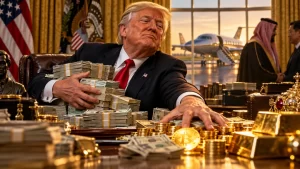
On April 9, 2025, at 9:37 a.m. Eastern time, Trump posted on Truth Social: “THIS IS A GREAT TIME TO BUY!!! DJT.” Roughly four hours later, at 1:18 p.m., he announced a 90-day pause on most of the reciprocal tariffs he had imposed a week earlier. The S&P 500 posted its largest single-day gain since World War II, closing up 9.5 percent. Trump Media & Technology Group — ticker: DJT — surged.
Senate Democrats led by Chuck Schumer, Elizabeth Warren, Ron Wyden, and Adam Schiff formally requested that the SEC investigate whether the sequence constituted market manipulation and whether administration insiders — including members of the Trump family — traded on advance knowledge of the pause. “It is unconscionable,” the letter stated, “that as American families are concerned about their financial security during this economic crisis entirely manufactured by the President, insiders may have actively profited from the market volatility.” No definitive finding has been issued; the SEC under the current administration is not expected to pursue one.
What is not in dispute: the president of the United States publicly told the world to buy stocks four hours before executing a market-moving policy reversal known only to himself and a small circle. Whether or not this meets the statutory threshold for market manipulation, it is precisely the kind of conduct securities law was written to prevent — and precisely the kind of conduct the SEC would investigate aggressively if it involved any American other than the sitting president.
VIII. The Path to Accountability: Who, How, When
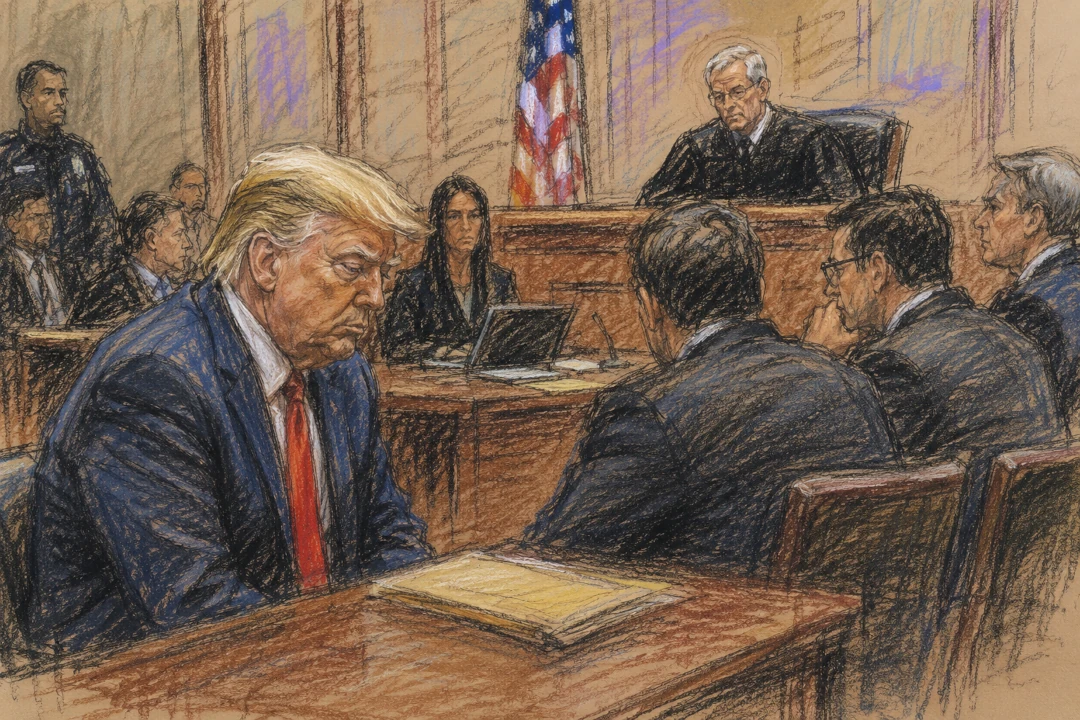
Any honest discussion of prosecution must confront a hard fact: while Trump sits in the Oval Office, federal criminal charges are effectively off the table. A 2000 Office of Legal Counsel memo, still binding on the Justice Department, holds that a sitting president cannot be federally indicted. The Supreme Court’s 2024 decision in Trump v. United States further immunized presidents from criminal prosecution for a broad category of “official acts.” These two barriers, taken together, mean federal accountability must wait until January 20, 2029, at the earliest.
But they do not close the door. Several avenues remain open — and several actors have standing to act now.
State prosecutors, now
State attorneys general are not bound by DOJ policy. Democratic state AGs, led by figures such as Letitia James of New York, have already investigated and successfully prosecuted Trump entities for financial fraud. State-level investigations into tariff-related insider trading — for which Senator Schumer and colleagues have formally urged the National Association of Attorneys General to open inquiries — can proceed regardless of Justice Department posture.
Federal prosecutors, in 2029
The statute of limitations for most federal offenses is five years, which is why the question of a 2029 successor Justice Department matters enormously. The War Crimes Act charges tied to Iran, potential Hatch Act and ethics violations, obstruction of justice claims tied to the retribution campaign against former FBI and DOJ officials — all of these can and should be preserved for prosecution once immunity lifts. A future attorney general has both the legal authority and, in our view, the constitutional duty to pursue them.
International accountability, contingent and imperfect
The International Criminal Court remains an option for the Iran-related conduct, though as Bloomberg has noted, the United States is not a member state and the current administration has actively sanctioned ICC officials. This path is diplomatically fraught but legally available for conduct on the territory of member states.
Congress, on impeachment and the 25th Amendment
Impeachment remains constitutionally available to a Democratic House majority should one emerge from the 2026 midterms. But there is a second, distinct mechanism that Congress has left unbuilt for fifty-eight years — and it is time to build it.
The unfinished mechanism the Framers of the 25th Amendment intended us to use
Ratified in 1967, the 25th Amendment provides an orderly constitutional response to presidential incapacity. Section 4 empowers the Vice President and “a majority of either the principal officers of the executive departments or of such other body as Congress may by law provide” to declare that the president is unable to discharge the powers and duties of the office. In fifty-eight years, no Congress has ever created that “other body.” Rep. Jamie Raskin (D-Md.), Ranking Member of the House Judiciary Committee, introduced legislation on April 14, 2026, to finally do so — establishing a Commission on Presidential Capacity that would serve as the legislative counterpart to the Cabinet.
Fifty House Democrats have signed on. They are joined by a growing chorus: Rep. Raja Krishnamoorthi (D-Ill.), who called for immediate invocation after Trump’s April 6, 2026 Truth Social post threatening that “a whole civilization will die tonight” if Iran did not comply with a deadline; Senator Ed Markey (D-Mass.), who publicly demanded the same; and Reps. Eric Swalwell, Sydney Kamlager-Dove, and Yassamin Ansari. In April 2026, Senators Sheldon Whitehouse and Jack Reed entered into the Congressional Record a statement from 36 physicians — neurologists, psychiatrists, and cognitive-disorder specialists from Harvard, Tufts, Columbia, and George Washington — warning of the president’s “rapidly worsening, reality-untethered, increasingly dangerous decline” and calling for removal “with the greatest urgency.”
The constitutional case is not partisan invective. It is the specific claim, made by named specialists, that a president who publicly threatens the extinction of civilizations, who orders the U.S. military to commit conduct his own legal advisers describe as war crimes, and who launched a war lasting six months and counting without congressional authorization has demonstrated an inability to safely discharge the office — of a kind the amendment’s authors anticipated but never expected Congress to leave unaddressed.
The practical barriers are real and worth stating honestly. Vice President JD Vance and the Trump cabinet — Attorney General Pam Bondi, Defense Secretary Pete Hegseth, Homeland Security Secretary Kristi Noem — are political loyalists unlikely to invoke Section 4 against the president who appointed them. Even Raskin’s Commission bill faces effectively no path through a Republican House. The Senate would require a two-thirds supermajority to confirm any 25th Amendment removal.
But these barriers are political, not constitutional. They do not negate the analysis; they underline its urgency. The framers of the 25th Amendment created Section 4 precisely because they anticipated moments when a president would be incapable of recognizing his own incapacity — and precisely because they trusted future Congresses to do the work of building the mechanism. The 118th Congress will not. A subsequent one may. The case for capacity review is on the record. Whether the country ever acts on it is a question of will, not of law.
IX. The Top Reasons — Distilled
Assembled in one place, the strongest and most legally cognizable grounds for prosecuting Donald Trump are these:
Unauthorized war, potential war crimes
Mass foreseeable deaths from cancelled aid
Retribution prosecutions of officials
Attacks on the free press
Potential market manipulation
Illegal deployments of military force
There are also honest counterarguments a fair-minded reader should consider. Prosecution of a former president is a genuinely destabilizing act. It sets a precedent successors will use. It risks converting the criminal justice system into an instrument of political revenge, which is precisely the accusation the Trump administration itself now levels against the Biden-era investigations. Those concerns are not trivial. They deserve to be weighed openly.
Our answer is this: the alternative to prosecution is not stability. The alternative is a settled American norm that a president who commits crimes in office, who orders conduct that his own military lawyers identify as violations of the law of war, who oversees policies that produce hundreds of thousands of foreseeable deaths, faces no consequences of any kind once his term expires. That is not the rule of law. That is impunity dressed as prudence.
X. A Note on Leadership, Fitness, and What the Record Shows
Nothing in the foregoing depends on a psychiatric diagnosis, and this editorial makes none. But the pattern of conduct itself — the public threats to bomb every bridge and power plant in a country of 90 million; the Truth Social post declaring “a whole civilization will die tonight”; the profane and rambling remarks at the Easter Egg Roll that Rep. Raskin cited in his April 10 letter to the White House physician; the mid-conflict absence of a clear strategy that Senator Chris Coons publicly criticized in Secretary Hegseth — is itself a leadership record. It is the record of a presidency in which the Commander-in-Chief has, on multiple occasions, publicly threatened conduct his own senior military lawyers cannot lawfully carry out. It is a record that would end the career of a general, a corporate executive, or a hospital administrator. It has been treated, in Washington, as the ordinary weather of the second Trump term.
That treatment is the failure. Not merely of one party or one branch, but of a political culture that has decided the extraordinary must be endured because the mechanisms for responding to it have grown unfamiliar with use.
Editorial Conclusion
The evidence assembled in the public record — from peer-reviewed medical journals, from Supreme Court dockets, from congressional press releases, from the reporting of the Washington Post and Reuters and CNN — is not the case for a political grievance. It is the case for the ordinary operation of American law against a president who has treated ordinary law as advisory.
State attorneys general should proceed now. A future Justice Department should preserve every actionable charge. Congress should build the 25th Amendment commission it has left unbuilt for fifty-eight years. And the American public should stop pretending that the exhaustion of watching this presidency is the same thing as an excuse for not acting on what it has shown us.
The republic is not owed to us. It is maintained, or it is lost. The choice, in this instance, is ours.
Editor’s note · This is an opinion editorial written from a progressive perspective. All quotations are drawn from documented public statements; all statistics are drawn from named studies and news reports linked in the Sources section. Reasonable people may disagree about the framing. The underlying facts are not seriously in dispute.
Sources & References
- ABC News — US marks 6 months of war with Iran: What it means for Americans and what’s ahead
- Center for American Progress — Fact Sheet: Costs of the Trump Administration’s War in Iran
- Wikipedia (compiled sources) — 2026 Iran War — casualty tallies and belligerents
- Christian Science Monitor — Iran war: Do Trump’s threats to Iran amount to a war crime?
- Washington Post — With threat to destroy Iran’s “civilization,” Trump fuels war crime fears
- The Nation — Trump’s Disregard for International Humanitarian Law Won’t End When the Iran War Does
- CSIS — Aid Cuts Make Peace Negotiations in Ukraine Less Likely
- Kyiv Post / IfW Kiel — US Cuts Leave Ukraine Aid at Record Low
- Yahoo News / AOAV — Ukraine’s civilian casualties surged 26% as Trump talked about peace
- U.S. News / Reuters — How Trump’s Ukraine Aid Cuts Undermine Justice for Russian War Crimes
- Penn LDI — House Bill Seen Causing 51,000 Preventable Deaths Annually
- NBC News — Another report suggests Medicaid cuts could lead to thousands of deaths
- Rep. Brad Sherman — One Year After Trump’s USAID Shutdown: Sherman, Meeks lead all Foreign Affairs Dems
- UCLA Fielding / The Lancet — USAID cuts may lead to more than 14 million deaths globally by 2030
- CNN — Global aid cuts could lead to 9.4 million deaths by 2030
- CIDRAP / ImpactCounter — Death toll from USAID cuts crosses 762,000
- MS NOW — America beat measles once. RFK Jr. is making it harder to do so again
- U.S. News — Calling the Shots: How RFK Jr. Is Influencing America’s Vaccine Playbook
- Just Security — Trump’s Dictatorial Theory of Presidential Power
- Political Science Quarterly — Governing by Decree: The Trump Presidency and the Decline of Legislating Together
- Campaign Legal Center — Can President Trump Do That?
- NBC News — Supreme Court rejects Trump’s bid to deploy National Guard in Illinois
- Amnesty International USA / CPJ — On World Press Freedom Day, Journalists Face Increased Pressure
- Committee to Protect Journalists — CPJ condemns Trump administration’s intimidation tactics over US war coverage
- Poynter — What 100+ federal actions reveal about the Trump administration’s campaign against the press
- Sen. Elizabeth Warren / Senate Banking — Warren, Schumer, colleagues call on SEC to investigate Trump tariff market manipulation
- Rep. Jamie Raskin / House Judiciary Democrats — Raskin introduces Commission on Presidential Capacity legislation (25th Amendment, Section 4)
- Rep. Raja Krishnamoorthi — Krishnamoorthi Calls for Trump’s Removal Under 25th Amendment
- The Hill — Concerns Grow Over Trump’s Mental Fitness for Presidency (36 physicians in Cong. Record)
- Bloomberg — Why Trump’s Iran Threats Raise War Crime Concerns
Related News