The Dust Bowl Returns — and Washington Isn’t Listening
Australia’s ABC is warning of a global famine spiral. The USDA is forecasting the smallest US winter wheat harvest in six decades. And a president who traded away food-buying leverage for tariff points seems not to have noticed. The most consequential story of the year is unfolding on the back pages.
The warning did not come from Washington. It came from Sydney. On August 25, Ian Verrender, chief business correspondent for the Australian Broadcasting Corporation, published an analysis titled “Climate, wars and fuel shortages foster famine fears” — a plain-language accounting of a crisis American media has been reporting only in fragments. A “deadly trifecta,” Verrender wrote, of soaring input costs, disrupted trade routes, and a shifting climate is squeezing global food exporters just as a supersized El Niño gathers strength. Two wars — one in the Middle East, one in Eastern Europe — are strangling the movement of grain from the northern hemisphere’s most recent harvest. And the United States, one of the world’s two anchor wheat producers, is heading into a harvest the Great Plains has not seen in generations.
The story is not that this crisis is a secret. The USDA has published every number. Newsweek reported in July that America’s total wheat harvest is on track for its lowest level in roughly 150 years. Farm Progress, agricultural trade press, and the Union of Concerned Scientists have all sounded the alarm. The story is that this crisis — the food supply of hundreds of millions of people, the price of bread on American shelves, the credibility of American leadership abroad — has been buried by a political press covering the White House like a reality show. It is not a coverup. It is worse. It is a national failure of epic proportion.
I. A Warning From Abroad, Ignored At Home
Verrender’s piece did not use the phrase “worse than the Great Depression.” He drew a more precise and more damning comparison. The US Great Plains, he wrote, is “scene of the great US dust bowl during the 1930s depression, again experiencing a severe and debilitating drought.” Together, the United States and Canada account for between 25 and 30 percent of global wheat exports. Together, Russia and Ukraine account for almost a third of the global wheat trade — and Black Sea shipments have now ground to a halt after Russian attacks on Ukraine’s port at Odesa were answered by Ukrainian strikes on Russia’s export terminals at Novorossiysk. Europe’s alternative route, the Danube, has been rendered impassable by drought. France and Germany, hobbled by extreme summer heat, are producing less. Australia’s total winter crop, according to the Australian Bureau of Agriculture and Resource Economics and Sciences, is expected to fall 21 percent from last year.
The alarming part is not any single one of these facts. It is that they are happening simultaneously, in every major wheat-producing region on earth, in the same year, with no buffer to absorb the shock.
“A deadly trifecta of higher input costs, disrupted trade routes, and a changing climate has combined to drastically reduce food supply, particularly grains and especially wheat.”
— Ian Verrender, ABC News (Australia), August 25, 2026
II. America’s Worst Wheat Harvest Since 1965
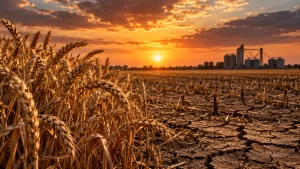
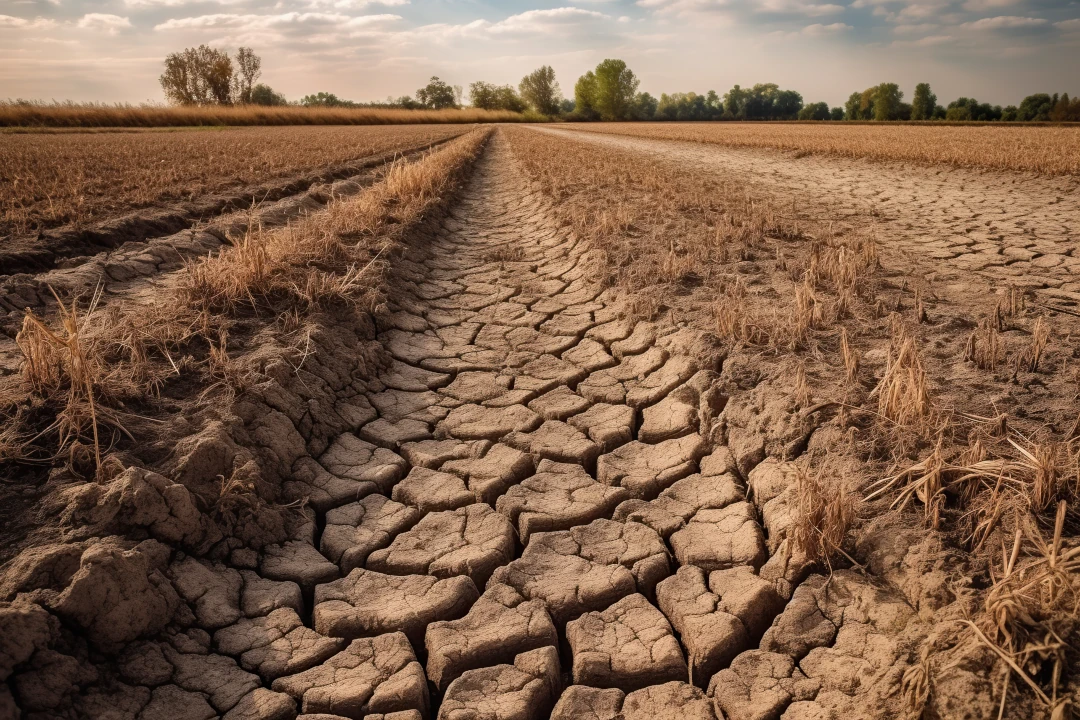
The numbers from the Department of Agriculture’s own analysts are staggering. In May, the USDA shocked commodity traders when it forecast the 2026–27 winter wheat harvest at 1.048 billion bushels — down 25 percent from the prior year and the smallest since 1965. Hard red winter wheat, the workhorse variety grown across western Kansas, eastern Colorado, and the Oklahoma and Texas Panhandle, was pegged at 514.8 million bushels: a 36 percent collapse. The June USDA Wheat Outlook confirmed the crop is on track to be the smallest hard red winter wheat harvest since 1957–58. Sixty-three percent of US winter wheat production was inside a designated drought zone in early June. Kansas yields are projected to average just 37 bushels per acre, down from 51 the prior year. In parts of the state, farmers are simply walking away from fields.
Romulo Lollato, wheat specialist at Kansas State University, told the High Plains Journal that much of the wheat he inspected was “very short” — a textbook sign of drought stress — and had been further battered by an April freeze and a May freeze on top of the dry conditions. The National Oceanic and Atmospheric Administration confirmed that the twelve months from May 2025 to April 2026 were the warmest such period ever recorded in the United States.
III. The President Who Cornered the Market — And Broke It
The most infuriating part of Verrender’s ABC analysis was not weather. It was policy. Donald Trump, he reported, used tariff threats to force Bangladesh, Indonesia, and Israel to preferentially purchase US wheat as an offset to avoid tariffs on their own exports. Indonesia agreed to purchase up to two million tonnes of US wheat annually in exchange for having its tariff rate cut to a still-punishing 19 percent. Bangladeshi officials are already attempting to renegotiate. These are not trade deals. They are food-supply hostages.
The cruelty of the arrangement becomes obvious the moment the crop fails. Countries that agreed to buy US wheat now cannot shop the open market for cheaper alternatives — they are locked in at whatever price a shrunken US supply commands. Indonesia is already under acute economic pressure. Bangladesh imports a substantial share of the calories that feed 170 million people. Trump did not just fail to prepare the country for a food crisis. He engineered a system in which vulnerable trading partners will pay premium prices for grain that in some cases will not exist.
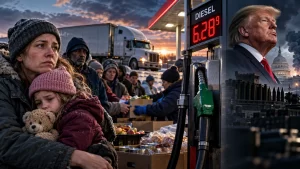
The Iran war has done the rest. The closure of the Strait of Hormuz choked the global supply of refined fuel and urea fertilizer for much of the year. Ukraine’s continued bombardment of Russian oil refineries has taken one of the world’s largest diesel suppliers off the market — diesel being the primary fuel for the tractors, harvesters, and trucks that make agriculture possible. American farmers now confront simultaneous cost spikes on fuel, fertilizer, seed, and labor, at the exact moment their crops are failing.
Get Involved Today
Contribute to our mission and turn your concerns into action.
IV. The Democratic Response — and the Republican Sabotage
Congressional Democrats have been fighting a two-front war: to preserve the food-safety-net programs that would blunt a price shock, and to move a Farm Bill that reflects the actual conditions farmers face. They have been losing both.
The 2025 Republican reconciliation package — the so-called “One Big Beautiful Bill Act” — enacted $186 billion in cuts to the Supplemental Nutrition Assistance Program, the largest reduction in SNAP in the program’s history. When the Senate Agriculture Committee attempted this summer to move a Farm Bill draft that did not restore those cuts, every Democrat on the committee voted no, and the bill failed. In the House, Rep. Angie Craig of Minnesota and Rep. Chellie Pingree of Maine led the fight to strip pesticide-industry liability shields and restore nutrition funding. The Farm, Food, and National Security Act of 2026 (H.R. 7567) passed the House 224–200 in April, with 14 Democrats supporting and three Republicans opposing — and it remains stalled.
The Trump administration’s response has been to shovel money at the politics of the problem while ignoring its substance. In December, Secretary of Agriculture Brooke Rollins announced $12 billion in one-time “Farmer Bridge Payments” aimed principally at row-crop farmers hurt by the president’s own tariff wars. “This country and our farm economy is facing a crisis that we inherited,” Rollins told reporters — a statement whose second half is now provably false. The crisis was manufactured, in significant part, by the tariffs, the Iran war, and the deregulation of climate policy that this administration itself pursued.
“The challenges farmers face continue to go unanswered by Congress and this administration.”
— Farm Aid, “Tracking the Farm Economy in Crisis,” July 2026
V. What Americans Should Actually Expect
Let us be precise about what is coming, because the honest picture is bad enough without embellishment. The United States is not facing a famine in the sense that word properly means: mass starvation of its own population. What the United States is facing is a sharp, sustained, multi-year rise in the cost of basic staple foods, arriving at a moment when the government has just gutted the program that protects the poorest Americans from that shock. The USDA’s own Food Price Outlook now projects farm-level wheat prices to rise 17.1 percent in 2026. Overall grocery inflation is running at 2.7 to 2.9 percent, roughly average — but the wheat surge, the beef surge (up 16 percent from September 2024 to September 2025 on cattle-herd contraction), and the effect of the tariffs are only beginning to hit shelves.
The famine risk is real. It just does not live in Kansas. It lives in the Sahel, in North Africa, in Bangladesh, in Yemen, in Sudan, in the countries the World Food Programme has already flagged as vulnerable. When the poorest wheat-importing nations lose access to cheap grain because Trump has cornered supply for Indonesia and Bangladesh under duress, and the harvest turns out to be a quarter smaller than expected, the humanitarian consequences will be measured in lives.
What the average American household can expect, by contrast, is what the reporting supports:
For households, the practical preparations are unglamorous and old-fashioned: build a modest pantry of shelf-stable staples (rice, dried beans, oats, canned protein) before prices climb further; know the location and hours of the nearest food pantry and community fridge in case a neighbor needs the referral; check SNAP eligibility if your household income has changed, because the reduced program still exists and is worth applying to. Community-supported agriculture subscriptions and farmers’ market relationships insulate against supermarket volatility. Political pressure on Congress — for the Farm Bill, against the SNAP cuts, for climate-adaptive farm investment — is preparation of a different kind, and equally practical.
A President Who Cannot See the Crisis He Created
The 25th Amendment to the Constitution, ratified in 1967 in the shadow of the Kennedy assassination, provides in Section 4 that the vice president and a majority of the Cabinet — or a body Congress designates — may declare that a sitting president is “unable to discharge the powers and duties of his office,” transferring authority immediately to the vice president. It has never been formally invoked. It was designed for exactly the situation in which a president’s conduct raises grave doubts about his capacity to govern.
Democratic lawmakers have already reached for it repeatedly this year on grounds unrelated to food supply. In January, Sen. Ed Markey (D-Mass.) called for its invocation after Trump’s Greenland outburst. In April, Rep. Yassamin Ansari (D-Ariz.), Rep. Melanie Stansbury (D-N.M.), Rep. Sydney Kamlager-Dove (D-Calif.), Rep. Eric Swalwell (D-Calif.), and Rep. Raja Krishnamoorthi (D-Ill.) all publicly demanded the Cabinet act after Trump’s threats against Iranian civilian infrastructure. “The 25th Amendment exists for a reason,” Ansari wrote. Krishnamoorthi cited “a dangerous pattern of reckless escalation, erratic decision-making, and general conduct that raises grave questions about his fitness to discharge the duties of the presidency.” Stansbury’s four words were the plainest of them all: “The emperor has no clothes.”
The food crisis extends and sharpens the same argument. A president who negotiates two-million-tonne wheat purchase agreements with vulnerable nations without knowing whether his own country can supply the grain has demonstrated an inability to hold two facts in mind at once. A president who launches a war that closes the Strait of Hormuz — the choke point through which most global fertilizer flows — without accounting for what happens to American farmers who need urea has demonstrated an inability to plan more than one policy move ahead. A president who governs by tariff threat while the country’s own breadbasket withers has demonstrated an inability to see the country he is supposed to lead. These are not policy disagreements. They are indicia of incapacity.
The constitutional case is straightforward. The practical case is nearly impossible. Section 4 requires Vice President J.D. Vance and a majority of a Cabinet Trump personally selected to declare him unable to serve. That will not happen. If it did, the Amendment allows the president to contest it, forcing a two-thirds vote in both chambers to sustain — a bar the current Congress cannot clear. None of this changes the fact that the case exists, on the record, and grows stronger with each avoidable catastrophe. A functioning constitutional culture requires that the argument be made even when the mechanism cannot be operated. Silence about a president’s incapacity is not neutrality. It is complicity.
VI. The Bottom Line
The story of the 2026 harvest is not a story about weather. Weather is the trigger. The story is about a governing coalition that dismantled climate policy, launched a war that broke the fertilizer supply chain, coerced hungry countries into locked-in wheat contracts, cut $186 billion from the food safety net, and then continued its palace intrigue while the fields dried out. The story is about an opposition that has been fighting the right fights on the Farm Bill and SNAP but has been outvoted and outmaneuvered. And the story is about an American press that has not yet found the collective will to treat food security as the front-page emergency it is.
Editorial Conclusion
A hungry world is not a stable world. A president who cannot see the crisis he helped author is not a president meeting the minimum requirements of the office. The constitutional remedies for presidential incapacity exist because the Framers knew a moment like this could arrive.
Congress must pass a real Farm Bill. The SNAP cuts must be reversed. The tariff regime must end. And the citizens of this republic must remember what the 25th Amendment was written for, so that when the mechanism can be operated, the country still recognizes the reason to reach for it.
Sources & References
- ABC News (Australia) — Ian Verrender, “Climate, wars and fuel shortages foster famine fears,” Aug. 25, 2026. abc.net.au
- Newsweek — “America’s wheat harvest set to fall to lowest level in 150 years,” July 2026. newsweek.com
- USDA Economic Research Service — “Wheat Outlook: June 2026.” ers.usda.gov
- Farm Progress — “USDA forecasts smallest US winter wheat crop since 1965,” May 22, 2026. farmprogress.com
- Union of Concerned Scientists — Rachel Cleetus, “Widespread Record US Drought Threatens Rural Livelihoods and Food Affordability,” May 8, 2026. blog.ucs.org
- ABARES — Australian Crop Report, June 2026. agriculture.gov.au
- Insurance Journal — “Wheat Crops Wither, Herds Thin as Spring Drought Deepens,” May 5, 2026. insurancejournal.com
- Stock Journal (Australia) — “Aussie farmers warn wheat will be hard hit by urea crisis,” March 2026. stockjournal.com.au
- USDA ERS — Food Price Outlook, Summary Findings (August 2026 update). ers.usda.gov
- NPR — “Trump administration announcing $12 billion in one-time payments to farmers,” Dec. 8, 2025. npr.org
- Civil Eats — “House Agriculture Committee Advances a Farm Bill Proposal,” March 5, 2026. civileats.com
- Farm Aid — “Tracking the Farm Economy in Crisis,” July 2026. farmaid.org
- Farm Aid — “The Latest Updates on the Farm Bill.” farmaid.org
- Congress.gov — H.R. 7567, Farm, Food, and National Security Act of 2026. congress.gov
- PBS NewsHour — “Could the 25th Amendment be invoked against Trump? Here’s how it works,” April 6, 2026. pbs.org
- TIME — “What to Know About the 25th Amendment as Lawmakers Call for Trump’s Removal.” time.com
- Office of Rep. Raja Krishnamoorthi — “Krishnamoorthi Calls for President Trump’s Removal Under 25th Amendment,” April 7, 2026. krishnamoorthi.house.gov
- Raw Story — “Panicked farmers engulfed in ‘crisis’ as they stare down years of pain due to Trump,” August 2026. rawstory.com
Related News