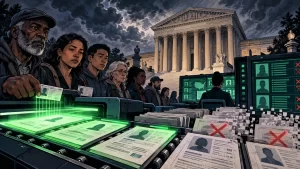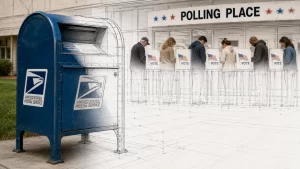
A man who pleaded guilty to breaking into elections websites was standing outside a Minneapolis polling place this month — wearing the seal of the United States Department of Justice. He was not a rogue. He was a preview.
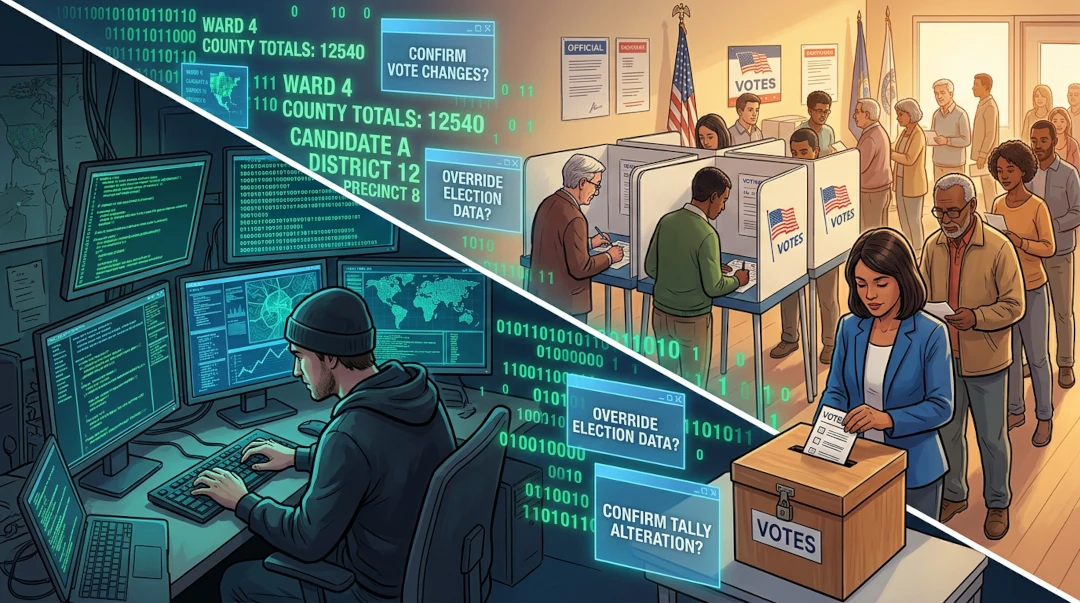
Ten years ago, a Florida man named David Michael Levin used an SQL-injection attack to break into the Lee County Supervisor of Elections website, harvested administrator credentials, then logged in and roamed the site as though he owned it. He also broke into the Florida Division of Elections website. He pleaded guilty, served twenty days in jail, and did two years of probation. He later told a reporter he had been “curious about the integrity of elections.” That word — integrity — would eventually become his ticket back in.
This month, according to reporting by Democracy Docket, Levin appeared on video outside a Minneapolis polling place at Powderhorn Park Recreation Center, standing alongside William F. Mohrman, a senior counsel in the Justice Department’s Civil Rights Division Voting Section. A local election judge approached the two men, checked their credentials, and reminded them that federal observers were required to stand at least a hundred feet from the polling place. They complied, eventually. But the image had already been captured: a man who had once been prosecuted for hacking Florida’s election infrastructure was now, apparently, monitoring Minnesota’s elections on behalf of the federal government.
The Department of Justice will not confirm Levin’s employment. His name does not appear in the department’s court filings. But his social-media accounts show him standing in front of a DOJ flag beside a woman whose outfit matches what Assistant Attorney General Harmeet Dhillon wore at a July 8 Civil Rights Division swearing-in ceremony — a ceremony at which Dhillon herself announced that more than one hundred new attorneys and staff had been brought aboard.
He was not a rogue. He was a preview.
I. The Hire and What It Signals
Levin’s apparent arrival at the Civil Rights Division does not exist in isolation. It is the natural product of a division that has been systematically remade. According to CBS News, more than seventy percent of the Civil Rights Division’s career staff have taken early retirement or resigned since Dhillon assumed control. The vacuum has been filled by ideological loyalists whose backgrounds share a common thread: hostility to the 2020 election result, and enthusiasm for the President’s theory that American elections are riddled with fraud.
Consider Levin’s partner at the Minneapolis polling place. William F. Mohrman is not a routine civil-rights lawyer. He is the attorney who represented Derek Chauvin, the former Minneapolis officer convicted of murdering George Floyd. He also worked, on behalf of the Trump campaign, to overturn Wisconsin’s 2020 presidential election. He is now a senior counsel in the very Voting Section that is supposed to enforce the Voting Rights Act. His acting chief, as documented by the Global Project Against Hate and Extremism, is Eric Neff, a Trump appointee who is directing the Section’s election-denial litigation.
David Michael Levin
Pleaded guilty in 2016 to unauthorized computer access at Florida election sites; used SQL injection to steal administrator credentials. Apparently now with the DOJ Civil Rights Division. (Democracy Docket)
William F. Mohrman
Represented Derek Chauvin; worked to overturn Wisconsin’s 2020 result for the Trump campaign. Now a senior counsel in the DOJ Voting Section. (The New Republic)
AAG Harmeet Dhillon
Trump’s handpicked head of the Civil Rights Division. Longtime supporter of the President’s 2020 fraud claims. Has swapped out career staff for over 100 new political hires. (Democracy Docket)
0 – 23
The DOJ’s record in federal court on its lawsuits seeking states’ unredacted voter files. Judges keep rejecting the department’s legal theory. (Democracy Docket)
This is the office — hollowed of career expertise, restaffed by loyalists, defended by attorneys with records of election subversion — that is now preparing to blanket the country with a thousand federal monitors on Election Day.
II. The Thousand-Monitor Army
On August 18, in an interview with Bloomberg, Assistant Attorney General Dhillon casually announced that the Justice Department would deploy roughly one thousand election monitors across the country for the November midterms. She called the number “probably going to be a historic number for a Republican administration,” and framed the whole thing as routine: “This is something that DOJ does.”
It is not something the DOJ does. Under the Biden administration, the department sent 289 monitors to the 2022 midterms and roughly 700 to the 2024 presidential election. The Trump DOJ is proposing to more than triple the 2022 figure and eclipse a presidential-year deployment — in a midterm cycle, from a Civil Rights Division so understaffed after resignations that it cannot possibly staff the operation from within. The department has already acknowledged it will have to recruit federal employees from elsewhere to volunteer.
That is the pool from which people like David Michael Levin will be drawn. It is why his presence in Minneapolis this month is not an anecdote; it is a template.
“I think, unfortunately, it appears there may be a coordinated effort to try to interfere in the 2026 midterms. I think we’ve got a president that can’t get over the fact that he lost in 2020 and now in kind of a Nixonian effort is going to try to do everything he can to make sure he doesn’t get another beating in 2026.”
— Sen. Mark Warner (D-Va.), Vice Chair, Senate Intelligence Committee
Dhillon herself has been unusually candid about what will guide the monitors’ targeting. She has said the department is looking at jurisdictions where officials are “refusing to clean up their voter rolls,” and where DOJ believes there is “a problem with some election officials” — almost invariably, in the department’s telling, Democratic ones. The department has already announced primary-season monitors in fifteen jurisdictions concentrated in Democratic-leaning states, including Michigan, Minnesota, and Virginia. Election officials in Hennepin and Ramsey counties, Minnesota, declined to allow federal personnel inside polling places, forcing them to observe from outside restricted areas.
III. The Broader Campaign Against the Ballot
The Levin story lands inside a broader pattern that the Brennan Center for Justice has documented in exhaustive detail. In a July 2026 report titled “The Trump Administration’s Campaign to Undermine the Next Election,” the Center concluded that the executive branch itself has become a threat to free and fair elections — a distinction unprecedented in modern American history. The Center for American Progress identified fifteen interlocking tactics, all pointing in the same direction.
Each of these actions, defended in isolation, has a plausible-sounding cover. Combined, they form a machine. The department that used to enforce the Voting Rights Act now sues states for their voters’ personal data. The FBI, which used to protect elections, now raids election offices. The Supreme Court, which used to be a brake on partisan overreach, has become an accelerant. And the men on the ground in Minneapolis this month included one who once hacked an elections website and one who tried to overturn Wisconsin’s presidential vote.
IV. What This Means for the Ordinary American
Ask a person in Detroit or Milwaukee or Phoenix what they want from their government on Election Day, and the answer is almost universal: to walk into a polling place, cast a ballot, and have it counted. The Trump administration’s program — whether measured by the Levin hire, the voter-data grab, the mid-decade gerrymanders, or the monitor army — is calculated to interfere with each of those steps.
The partisan geometry is unsubtle. The DOJ has sued at least eighteen states for their voter files, all but one of them states President Trump lost in 2020. The primary monitors this summer were sent to jurisdictions disproportionately in Democratic-led states. The Texas gerrymander was drawn to dilute Black and Latino voting power in the Rio Grande Valley and around Houston. The redistricting arms race that followed, as Brookings has documented, is disproportionately harming minority communities across the South.
For a Black voter in Fulton County whose 2020 ballot was among the 600 boxes seized by federal agents in January — ballots long since counted, certified, and audited — the message is one of intimidation. For a Latina voter in South Texas whose district was redrawn to make her vote worth less, the message is one of erasure. For a first-time voter in Minneapolis whose polling place is now visited by a federal employee with a documented history of hacking election systems, the message is one of surveillance. And for an election worker anywhere in this country — already departing the profession in droves under a hail of threats — the message is that the federal government is now on the side of the people making the threats.
Get Involved Today
Contribute to our mission and turn your concerns into action.
V. The World is Watching
The international observer community has been signaling alarm about the direction of American democracy for years. Historian Timothy Garton Ash, writing in The Guardian, described the 2026 midterms as the moment to begin “Operation Save US Democracy,” warning that once a liberal democracy erodes, “it’s very difficult to restore.” The Brennan Center reports that the Trump administration has degraded federal infrastructure for detecting and countering foreign election threats, leaving states to prepare largely on their own against Russia, China, and Iran.
That is the paradox the world is watching: an administration that claims to be defending election integrity has systematically dismantled the actual federal defenses against election interference — while inventing a domestic threat, unsupported by evidence, that just so happens to justify federal boots in Democratic-leaning polling places. Allied democracies that have long looked to the United States for democratic leadership are now, quietly and not so quietly, reorganizing themselves for a world without it.
VI. The Democratic Response
Congressional Democrats are not sitting still. In April, Senate Democratic Leader Chuck Schumer and Sen. Alex Padilla of California — the ranking member of the Rules Committee and California’s former Secretary of State — launched the Senate Democrats’ Election Protection Task Force, working with former Attorney General Eric Holder, election lawyer Marc Elias, Ian Bassin of Protect Democracy, Skye Perryman of Democracy Forward, and election-law expert Norm Eisen.
In June, Padilla and Schumer announced the first-ever Senate Election Observer Program, training Senate staff as official congressional observers to document any voter interference, threats against election workers, or misinformation on Election Day. In July, Padilla introduced the SHIELD Our Elections Act, which would restrict the seizure of ballots and election equipment before certification, extend the statute of limitations for election-related crimes, and create a private right of action for state attorneys general and voters to enforce federal anti-interference laws. The Democratic National Committee has sued the DOJ under the Freedom of Information Act, seeking records on any planned pre-certification ballot seizures. Common Cause and the ACLU have sued to block the department’s national voter database.
Sen. Peter Welch of Vermont has demanded detailed answers from Dhillon about who is receiving voter data disclosed by the Civil Rights Division. Michigan Secretary of State Jocelyn Benson, a Democrat, has told Politico that everything the country lived through in 2020 “was the beginning — not the end — of this multi-year effort to dismantle democracy in America.” Arizona Secretary of State Adrian Fontes has filed public-records requests to force disclosure of why DOJ deployed monitors to three counties in his state’s primary.
These are real actions with real legal teeth. But they are also defensive. The Trump administration is executing an offense that spans the executive branch, and no single lawsuit or press release will unwind it. The only durable check — the only tool the Framers actually built for this — runs through the ballot box in November and the Constitution itself.
The 25th Amendment and a President Who Will Not Stop
Section 4 of the Twenty-Fifth Amendment provides a constitutional mechanism for removing a sitting president who is “unable to discharge the powers and duties” of the office. It requires the Vice President and a majority of the Cabinet — or of “such other body as Congress may by law provide” — to transmit a written declaration of inability. Power then transfers immediately to the Vice President as Acting President. The provision has never been invoked.
It is being discussed with growing seriousness. In April, more than eighty-five House and Senate Democrats called for Trump to be impeached or removed through the 25th Amendment after he publicly threatened that a “whole civilization will die tonight” if Iran did not meet an ultimatum. Rep. Jamie Raskin, the ranking Democrat on the House Judiciary Committee, introduced legislation to create the “other body” Congress is empowered to designate under Section 4. Reps. Raja Krishnamoorthi, Mike Quigley, Alexandria Ocasio-Cortez, Ro Khanna, Diana DeGette, Yassamin Ansari, and Sen. Ed Markey have all publicly called for its invocation.
The constitutional argument is not psychiatric. It is functional and institutional: a president who orders the deliberate corruption of federal election administration — who installs a convicted election hacker among federal election monitors, who orders mid-decade gerrymanders to shield his party from accountability, who has his Justice Department raid the offices of officials who ran the 2020 election he lost — is not discharging the duties of the office. He is dismantling them. The oath of office requires the President to “preserve, protect and defend the Constitution.” A campaign to subvert the constitutional process by which the people choose their representatives is the precise opposite of that duty.
The practical barriers are real and should be named honestly. Section 4 requires the Vice President and a Cabinet majority. Vice President JD Vance shows no interest. The Cabinet was assembled precisely for loyalty and would not act. Congress’s power to designate an “other body” requires legislation the current Republican Congress will not pass. The tool exists on paper; the political will to reach for it does not.
But the constitutional case does not evaporate because the politics are hard. The Framers built the Twenty-Fifth Amendment because they anticipated presidents unfit to serve. The record being built now — in Democracy Docket, in the Brennan Center, in Senate letters, in federal court dockets — will not disappear. It is the record on which future accountability, whether through the 2026 midterms, through impeachment, or through the ordinary courts, will be built. Naming what is happening is itself a democratic act.
VII. What Trump’s Priorities Actually Are
Judge a leader by what they build. Donald Trump is building three things simultaneously: a Justice Department staffed with people who tried, in one way or another, to overturn the 2020 election; a national voter database compiled by suing thirty states into surrendering the personal information of their citizens; and a paramilitary-scale federal presence at Democratic-leaning polling places on Election Day. He is not building infrastructure to defend elections from Russia, China, or Iran. He is dismantling that infrastructure. He is not building trust in American democracy. He is actively corroding it, in primetime, with claims his own intelligence community will not corroborate.
What this says about his leadership is what he keeps telling us it says. He does not intend to accept an unfavorable midterm result. He never accepted the last one he lost. The Levin hire is small in the scheme of things — one man, one polling place, one Minneapolis morning. But it is small in the way a canary is small. It tells you what the mine is full of.
Editorial Conclusion
An administration that hires a man convicted of hacking election websites to monitor elections has told you what it thinks elections are for. It thinks they are its property.
The 2026 midterms will not be a normal election. They will be the first test of whether an American federal government committed to subverting the vote can be defeated by the vote itself. Every institution that still functions — the courts that keep ruling against the DOJ’s voter-data crusade, the Senate Democrats building an observer program, the state and county officials who have refused to hand over voter files, the journalists at Democracy Docket and the Brennan Center who keep dragging this into the light — must hold. And every citizen who can vote, must.
The Republic does not defend itself. It has never defended itself. It is defended by people who show up. Show up.
Sources & References
- Democracy DocketExclusive: Trump DOJ appears to have hired lawyer convicted of hacking election sites to check ‘integrity’ (Aug. 21, 2026)
- Democracy DocketDOJ is 0–23 in court, so now it’s sending 1,000 monitors to the polls (Marc Elias, Aug. 2026)
- BloombergDOJ Plans to Deploy 1,000 Monitors to Watch Midterm Elections
- CBS NewsJustice Department to send a record 1,000 monitors to polling places for midterms
- NOTUSDOJ Plans to Deploy a ‘Historic Number’ of Midterm Election Monitors
- Common DreamsTrump DOJ Hires Lawyer Convicted of Election Hacking to Voting Rights Division: Report
- The New RepublicWhy Is the DOJ Working With a Man Convicted of Hacking Election Sites?
- MS NOWThe DOJ plans to send out 1,000 election monitors in November. Is that normal?
- Democracy DocketDemocrats sue Trump DOJ for records on potential ballot seizures in midterms
- Courthouse News ServiceDemocrats sue DOJ over midterm ballot seizure plans
- ACLU / Protect DemocracyVoting rights groups sue DOJ to block national voter surveil-and-purge database
- NPRThe Justice Department has now sued 18 states in an effort to access voter data
- Brennan Center for JusticeThe Trump Administration’s Campaign to Undermine the Next Election
- Brennan Center for JusticeThreat of Foreign Influence on U.S. Elections Remain as Federal Defenses Recede
- Center for American ProgressThe Trump Administration Is Interfering in the 2026 Midterm Elections
- Center for American ProgressTrump Ordered Texas To Gerrymander 5 New Republican-Leaning Districts
- Democracy DocketSCOTUS Allows Texas to Use Racially Gerrymandered Map in 2026 Midterms
- Public CitizenCivil Wrongs: Meet the Attorneys Harmeet Dhillon Installed to Turn the Civil Rights Division Against Its Mission
- Global Project Against Hate & ExtremismTrump’s Elevation of Election Deniers to Key Positions Threatens Fair Elections
- Senate DemocratsSchumer & Padilla Launch First-Ever Senate Election Observer Program
- Sen. Alex PadillaPadilla Unveils Legislation to Counter Trump’s Attacks on American Elections (SHIELD Act)
- Sen. Peter WelchLetter from Sen. Welch to AAG Dhillon on the DOJ Voting Section (May 6, 2026)
- AxiosHouse Democrats file long-shot 25th Amendment bill targeting Trump
- Rep. Raja KrishnamoorthiKrishnamoorthi Calls for President Trump’s Removal Under 25th Amendment
- Rep. Mike QuigleyQuigley Calls for Trump’s Removal Under 25th Amendment
- Democracy Now!Trump’s Election Integrity Speech Lays Groundwork for Midterm Interference: Ari Berman
Related News