The East Room Deception: How a Recycled Speech Became a Blueprint for 2026
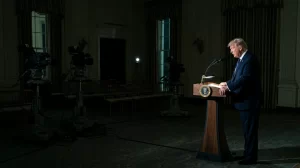
On Thursday night, from a room built for statecraft, the President of the United States delivered twenty-five minutes of grievance, innuendo, and long-debunked claims — and told the American people it was a bombshell. It was not. It was a plan.
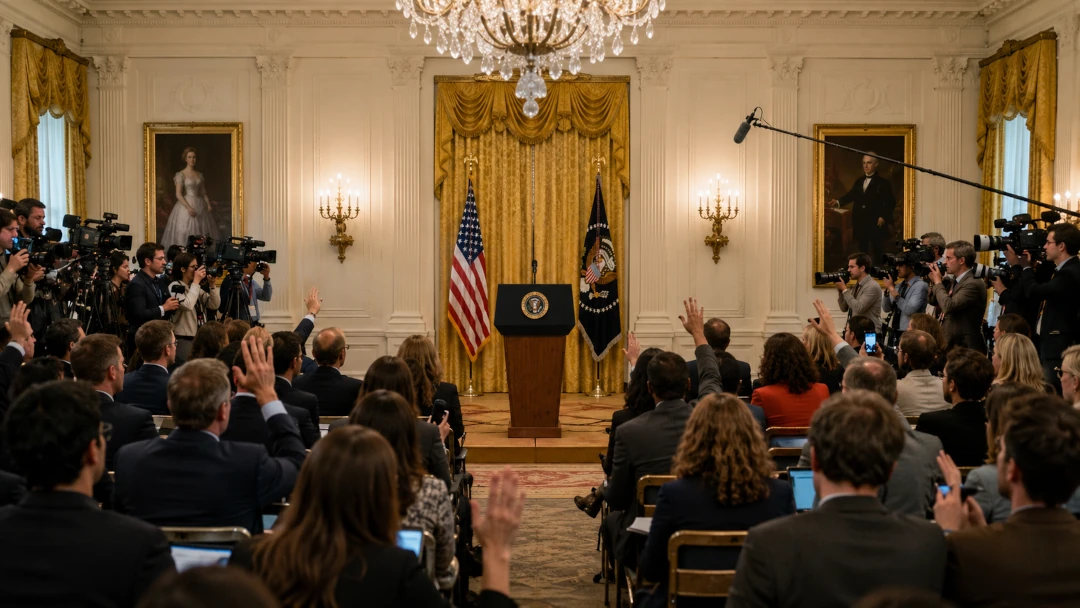
There is a peculiar arithmetic to a Donald Trump presidency: whenever he holds power, the electoral system he presides over is somehow always in crisis, always vulnerable, always on the verge of being “stolen” by his opponents. When he is out of office, the same system that put him back in the White House functions perfectly. This is not a coincidence. It is a strategy. And on Thursday night, from the East Room of the White House, the President made that strategy plainer than he ever has before.
In a hastily promoted primetime address that NPR reported was pitched as a revelation about “shocking vulnerabilities in our election infrastructure,” Trump spent roughly twenty-five minutes recycling accusations his own first administration debunked, misreading years-old intelligence assessments, and unveiling a suspiciously precise number — 270,000 alleged noncitizen voters — that not a single state election official could explain or verify. He then closed the speech by demanding Congress pass the SAVE America Act, the legislation that would nationalize proof-of-citizenship requirements at the ballot box.
The staging was constitutional. The content was campaign. And the timing — less than four months before the 2026 midterms — was the tell.
I. The Speech, and What Was Actually in It
Let us be precise about what the President said, because precision is what he is counting on his audience to abandon. According to the detailed reporting from Votebeat, a nonpartisan elections newsroom, Trump alleged four principal things: that America’s voting machines are vulnerable to hacking; that China illicitly acquired the data of 220 million U.S. voters; that 270,000 noncitizens are registered to vote nationwide; and that a six-year-old voter-registration incident in Muskegon, Michigan is proof of a broader cover-up. He supported these claims by declassifying a set of intelligence documents, some still redacted, that election officials said “did not fully back up” what he was telling the country.
Take the claims in turn. On voting-machine vulnerabilities, election-security expert Geoff Hale of the Center for Democracy & Technology told Votebeat that everyone in the field already knows the technology has weaknesses — that is why nearly all Americans now vote on systems requiring a voter-verifiable paper ballot, so any digital compromise leaves a physical trail. Pam Smith of Verified Voting noted the President had conflated public-facing election websites, which can be probed, with the tabulation systems that actually count votes, which cannot be manipulated at scale.
On China, the reporting is more damning still. Reuters reported that the very CIA document Trump cited said Beijing “does not currently intend to covertly interfere to try to sway the outcome of the election.” Another declassified document stated that vote-tabulation systems would be difficult to manipulate on a wide enough scale to affect results. In other words: the intelligence Trump held up as proof of Chinese interference explicitly said the opposite of what he claimed it said.
“Trump’s shocking “bombshells” about China are totally bogus. Our intelligence agencies unanimously agreed that China did not even try to change a single vote in the 2020 election.”
— Sen. Mark Warner (D-Va.), Vice Chair, Senate Intelligence Committee — July 16, 2026
On the 270,000 noncitizen voters, Nevada Secretary of State Cisco Aguilar, who leads the Democratic Association of Secretaries of State, told reporters his office had received no methodology, no list, no evidence. Pennsylvania’s Republican Secretary of the Commonwealth, Al Schmidt, issued a statement saying his state welcomes DHS sharing its methodology so the numbers can be reviewed — a diplomatic way of saying that the administration produced a headline number without producing the evidence to support it. Arizona’s Adrian Fontes summarized what the entire community of election administrators saw: zero new facts, zero new evidence, a repackaging of grievances his colleagues have been debunking for six years.
And on Michigan? The Muskegon case Trump described as a buried cover-up was in fact reported at the time by local outlets, referred to the FBI in March 2021, and — most importantly — resolved before a single fraudulent vote could be cast, because a local clerk noticed the irregularities and flagged them. Michigan Attorney General Dana Nessel’s office said Thursday night the case was a “perfect example of the system working exactly as it should.” The President turned a story about election integrity succeeding into a story about elections being rigged.
II. A Pattern, Never a Discovery
Here is the pattern American voters should be forced to look at squarely: election problems, in Donald Trump’s telling, are always vast, always urgent, and always emerging in precisely the moments his political power depends on them being urgent.
“Find 11,780 Votes”
The March 2021 Assessment
Mail-Ballot Restrictions
Neutralizing the Watchdog
The point is not that Donald Trump has a peculiar interest in election security. It is that he consistently uses the language of election security to justify actions that would concentrate control of elections in the executive branch. The Constitution, as U.S. District Judge Indira Talwani wrote in blocking the mail-ballot order, does not grant the President any specific powers over elections. It reserves that authority to the states and Congress. The President keeps trying anyway.
Get Involved Today
Contribute to our mission and turn your concerns into action.
III. A Timeline That Ends in November
To understand Thursday’s speech as an isolated event is to miss it entirely. It is one node in a lattice of actions taken since January.
“Trump’s primetime speech isn’t simply about relitigating his defeat in the 2020 election; it’s about undermining the 2026 election before a single vote has been cast.”
— Senate Minority Leader Chuck Schumer — Senate Floor, July 16, 2026
IV. What This Says About the Presidency Itself
Set aside for a moment the political implications and ask a simpler question: what is the President of the United States doing? Not what should he be doing — a war in Iran is entering its fifth month, inflation and consumer confidence continue to worry Republicans in the Senate, and his own approval sits near the lows of his second term. What is he actually doing with his time?
He is holding primetime addresses to inflate the significance of documents that say the opposite of what he says they say. He is dispatching his Justice Department to threaten Republican secretaries of state with prosecution. He is issuing executive orders the courts strike down as unconstitutional, then issuing new versions of the same orders. He is dismantling the bipartisan commission responsible for helping states run secure elections — and simultaneously accusing states of running insecure elections.
This is not the pattern of a president fulfilling the duties of the office. It is the pattern of a man whose primary occupation is his own political survival, and whose secondary occupation is arranging the machinery of American democracy around that priority. The Democratic governors of all twenty-four Democratic-led states issued a joint statement after the speech accusing the President of trying to “intimidate and silence voters.” Al Jazeera’s coverage noted that critics called the speech misleading and light on evidence. Even Republican staff members traveling with the National Association of Secretaries of State — whose annual meeting was under way at Mount Rushmore during the address — reportedly compared the speech to a child’s make-believe.
A White House defense of the speech does exist and deserves acknowledgment. Press Secretary Karoline Leavitt insisted the President’s claims would be backed by facts and evidence provided that evening. The Trump administration has framed all of this — the executive orders, the DOJ probes, the primetime speech — as an effort to compel federal agencies to enforce existing laws barring noncitizens from voting. Republicans have long argued that any elevation of concern about election security, no matter how thin the evidence, is worthwhile insurance. Voters who agree with them will not be moved by anything written above. But the President’s own election officials, his own intelligence documents, his own courts, and his own party’s state-level administrators are telling a different story, and the ordinary rules of evidence apply to presidents too.
The Word the Drafters Left Undefined
The Twenty-Fifth Amendment to the United States Constitution, ratified in 1967, provides in Section 4 that the Vice President and a majority of the Cabinet may transmit to Congress a written declaration that the President is “unable to discharge the powers and duties of his office.” Upon that declaration, the Vice President immediately assumes the powers of the presidency as Acting President.
The critical word is unable — and its companion, inability — and the drafters of the Amendment left it undefined on purpose. As PBS NewsHour has documented, the framers of the Amendment declined to enumerate specific triggering conditions because they recognized that inability could take forms the future would produce that they could not foresee. Physical incapacity is the paradigm case. It is not the exclusive case.
Members of Congress Who Have Made the Case
Calls for invocation have grown across 2026. In April, following the President’s Truth Social post threatening the annihilation of an “entire civilization,” Rep. Raja Krishnamoorthi formally called on Vice President Vance and the Cabinet to invoke Section 4, citing “erratic decision-making” and “grave questions about his fitness.” Sen. Ed Markey, Rep. Ro Khanna, Rep. Robert Garcia, Rep. Melanie Stansbury, Rep. Eric Swalwell, Rep. Sydney Kamlager-Dove, and Rep. Yassamin Ansari have made similar public calls in the months since, according to Newsweek’s running list.
The Constitutional Argument
A president who uses the powers of his office not to execute the laws but to systematically undermine the very electoral process that grants those powers legitimacy is not, in any meaningful sense, discharging the duties of the office. To be “able” to serve as president is, at minimum, to be capable of upholding the Constitution one has sworn an oath to preserve. Presenting the American public with declassified documents that say the opposite of what the President says they say — from the White House itself — is not a lapse of judgment. It is a failure of the discharge that Section 4 was written to address.
The Barriers, Honestly Named
Section 4 has never been invoked in American history. It requires the affirmative action of the Vice President and a majority of the Cabinet — officials chosen by, loyal to, and serving at the pleasure of the very President they would remove. Vice President JD Vance has shown no public inclination toward such an act. A two-thirds vote of both chambers of Congress would be required to sustain the removal against the President’s expected objection. The political path is, at present, a wall.
Why the Wall Does Not Erase the Case
The Constitution does not become inoperative because its remedies are politically inconvenient. The drafters of the Twenty-Fifth Amendment left inability undefined precisely so that future Americans, confronted with forms of presidential unfitness they could not name in advance, would not be able to argue that the text did not cover them. A president who spends a primetime address preparing the country to disbelieve the results of the next election — an election he is constitutionally obligated to help administer faithfully — has provided, in the plainest possible terms, evidence that the discharge of his duties has failed. That the political system may lack the courage to act on that evidence is a statement about the political system. It is not a statement about the Constitution.
V. What Is Actually Being Rehearsed
Return to Thursday night. Notice what was not said. The President did not allege that a single vote had been altered. He did not allege that any specific election result had been changed. He did not present evidence of widespread fraud in any election — including the 2024 election that he himself won. He described a system as “catastrophically short” of the standard required, without connecting that description to any actual outcome anywhere.
Why? Because Thursday’s speech is not a prosecution. It is a rehearsal. It is the establishment of a background hum of doubt against which a future outcome can be contested. If Republicans lose the House in November, the story is already in place: the machines were vulnerable, China was in the wires, the noncitizens were on the rolls, the deep state was covering it up, the President himself warned you in July. As CNN’s takeaways noted, it is not difficult to imagine what Trump might say after the 2026 election if his party loses. He has now, on national television, said most of it in advance.
The other function of the speech is legislative pressure. Trump closed by demanding Congress pass the SAVE America Act, which would require Americans to produce proof-of-citizenship documents to register to vote. Election experts and civil-rights organizations have documented, at length, that voter fraud by noncitizens is extremely rare, and that documentary-citizenship requirements disproportionately burden women who have changed their names through marriage, elderly Americans who no longer have birth certificates, low-income Americans without passports, and voters of color. If the Senate refuses to pass it — as it has so far — Trump will have a second story available: the Democrats blocked election security, so whatever happens in November is their fault.
Editorial Conclusion
What happened Thursday night was not a national-security briefing. It was a president using the East Room of the White House as a soundstage to pre-litigate an election that has not yet occurred, in a country whose own state election officials — Republican and Democratic alike — say the claims he made are not supported by the evidence he cited.
This is what a slow-motion assault on the legitimacy of American democracy looks like when it is conducted from the office charged with defending that democracy. The Twenty-Fifth Amendment does not solve that assault by itself, and no serious observer expects Vice President Vance to act against the president who chose him. But the Constitution names the condition — inability to discharge the powers and duties of the office — because the framers knew that the machinery of self-government could be turned against itself, and they refused to leave the language too narrow to name it when it happened.
It is happening. The November midterm elections will be the first real test. Every governor, every secretary of state, every judge, every member of Congress, every voter is now on notice about what is being prepared. The question is not whether the President has warned us. He has. The question is whether the country will act on the warning.
Sources & References
- NPR — After Years of False Claims on Voting, Trump to Give an Address on Election Integrity (July 16, 2026)
- Votebeat — ‘Zero New Facts’: Teased as a Bombshell, Trump Election Speech Underwhelms Election Officials (July 17, 2026)
- ABC News — Trump to Give Primetime Speech on 2020 Election: Sources (July 16, 2026)
- Al Jazeera — Key Takeaways From Donald Trump’s Controversial Speech on Election Security (July 17, 2026)
- Reuters via Yahoo News — Trump Accuses China of 2020 Election Interference, Contradicting U.S. Intel (July 16, 2026)
- CNN Politics — 5 Takeaways From Trump’s Primetime Speech on Elections (July 16, 2026)
- Office of the Director of National Intelligence — Intelligence Community Assessment: Foreign Threats to the 2020 U.S. Federal Elections (March 2021)
- CNN — Fact Check: 10 of the Lies Trump Used to Try to Overturn His Georgia Defeat
- Brennan Center for Justice — Trump Administration Escalates Election Meddling by Seizing 2020 Voting Records in Georgia (February 2026)
- NBC News — Judge Blocks Trump’s Executive Order on Mail Voting (June 25, 2026)
- Washington Post — Court Blocks Trump’s Executive Order Limiting Mail Ballots (June 25, 2026)
- Democracy Docket — Judge Rejects Trump Administration Bid to Pause Blocking Attack on Mail Voting (July 2026)
- Votebeat — Trump Move to Neutralize Election Administration Agency Creates a Chilling Effect (July 13, 2026)
- Votebeat — Pennsylvania’s Top Election Official Responds to Trump Administration Warning of Criminal Prosecution (July 15, 2026)
- Deadline — ABC, NBC and CNN Won’t Carry Trump’s Speech on Their Linear Networks (July 16, 2026)
- PBS NewsHour — Could the 25th Amendment Be Invoked Against Trump? Here’s How It Works (April 2026)
- Newsweek — Lawmakers Demand 25th Amendment Be Invoked Against Donald Trump: Full List (April 2026)
- Office of Rep. Raja Krishnamoorthi — Krishnamoorthi Calls for President Trump’s Removal Under 25th Amendment (April 7, 2026)
- Votebeat — Noncitizen Voting Is Rare, Research Shows (April 28, 2025)
Related News