Rigged By Design: Trump’s Two-Front Assault on the Census and the Ballot
In the same fortnight the Commerce Department quietly deleted its ban on political interference at the Census Bureau, a Postal Service whistleblower revealed a rushed, untested system that could throw out thousands of mail ballots in a single batch. Taken together, these are not accidents. They are the architecture of a rigged election.
There are two ways to steal an election. One is to change the votes after they are cast. The other, subtler and far more durable, is to change the numbers that decide whose votes count in the first place. In the last two weeks of August 2026, the Trump administration made unmistakable moves on both fronts — quietly rewriting the rules of the U.S. Census Bureau while simultaneously bulldozing a new, untested ballot-screening system through the U.S. Postal Service, weeks before the midterm elections. The through line is not confusion. It is intent.
On August 18, the Census Bureau published a seven-page report — with no named author, no listed division, no citations that a career civil servant would recognize — asserting that “more than 24,000 noncitizens” cast illegal ballots in the 2020 election. The next day, August 19, the Commerce Department, which oversees the Census Bureau, quietly revised its internal scientific integrity policy and removed the language explicitly banning political interference. The two events happened one day apart. NPR’s Hansi Lo Wang was the first to document the sequence, and it does not read like coincidence.
Two weeks later, on August 31, Senator Richard Blumenthal (D-Conn.) released an anonymous federal whistleblower’s disclosure alleging that the U.S. Postal Service — under pressure to implement one of President Trump’s mail-voting executive orders — had built a ballot-verification “Portal” in roughly three months for a job that normally takes nine to twelve, defied court orders in the process, and adopted a “zero percent failure rate” rule under which a single flagged ballot in a batch of ten thousand would cause the entire batch to be rejected. Voters, the whistleblower warned, may never even learn that their ballot was thrown out.
The Census manipulation and the USPS sabotage are being reported as separate stories. They are not. They are two moves on the same board.
I. The Quiet Deletion at Commerce
The revision at the Commerce Department was small in wordcount and enormous in consequence. The prior version of Departmental Administrative Order 216-23, updated in January 2025 during the final days of the Biden administration, said explicitly that scientific findings at agencies under Commerce — including the Census Bureau, the Bureau of Economic Analysis, and the National Oceanic and Atmospheric Administration — “are not suppressed, delayed, or altered for political purposes and are not subjected to inappropriate influence.” That sentence, along with the framing of “protection from inappropriate influence” as a “hallmark of scientific integrity,” is gone.
Nancy Potok, a former deputy director of the Census Bureau who has spent years tracking the government’s post-2020 effort to build durable guardrails against political meddling in federal data, told NPR that the removal is not a technicality. It is, she said, a substantive change that eliminates the guardrails against political interference in the department’s statistical products.
“There’s room for interference because the way that the new rule is structured leaves lots of opportunities to put pressure on staff to act in a certain way, to decide things in a certain way or to come to certain conclusions. It certainly seems like the guardrails, if they are still there at all, they are much weaker than they used to be.”
— Beth Jarosz, Vice President, Association of Public Data Users
The reason the change is so alarming is that the Census Bureau does not deal in ordinary numbers. It produces the numbers on which the country runs — the population counts used to allocate House seats, redraw congressional maps, calculate electoral votes, and distribute more than $2.8 trillion in annual federal funding. When the guardrails around that agency come down, everything downstream — schools, hospitals, highways, Medicaid, Pell Grants, veterans’ housing — becomes vulnerable to being reshaped for partisan advantage.
II. The Unauthored Report That Started It
The trigger for the policy revision, on the evidence of the timeline alone, appears to be the Census Bureau’s August 18 report on noncitizen voting. The document is titled “Noncitizen Voting in the 2020 Election, A Beginning Analysis.” It is seven pages long. It has no listed authors. It lists no division of the bureau. It does not identify the data scientists who conducted the record-matching. It contains no discussion of variance, bias, or margin of error — omissions that would flunk any freshman statistics course.
NPR reported, citing a Census Bureau employee who feared retaliation, that the analysis was not conducted by career civil servants. Instead, the team behind it included individuals affiliated with the America First Policy Institute — a Trump-aligned think tank founded by veterans of his first administration. In a plain reading of federal law, that is precisely the kind of “inappropriate influence” that the deleted language was designed to prohibit.
Robert Santos, the Census Bureau’s director under President Biden and a nominee widely respected across the statistical community, minced no words. He has publicly called on the bureau to remove the report from its website and has been unusually blunt for a former director: “The scientific reputation of the bureau has been beyond reproach. And as long as that document sits on the Census Bureau’s website, that’s no longer the case.”
Amy O’Hara, formerly chief of the bureau’s Center for Administrative Records Research and Applications and now director of Georgetown University’s Massive Data Institute, called the report “a hijack by the White House” of the bureau’s data infrastructure — infrastructure, she pointed out, that private-sector partners and state governments have shared with the bureau under strict confidentiality agreements. She warned it was “unthinkable that the carefully negotiated, curated and stewarded data could be exposed for political” ends.
The number itself — “over 24,000” alleged noncitizen votes out of more than 128 million records — is 0.02 percent. In a normal statistical report, that number would come wrapped in caveats about false-positive rates in record matching. In this report, it does not. Trump immediately amplified the figure on Truth Social with the words “I WON THE ELECTION!” and predicted the number would “explode” as more records were processed. That, not scientific integrity, was the point.
What Was Removed
The Commerce Department’s January 2025 scientific integrity policy explicitly banned attempts to shape or interfere with data collection “against well-accepted scientific methods.” That language is now gone from the August 2026 revision.
Who Wrote the Report
The unauthored Census report on noncitizen voting was reportedly produced by a team that included individuals affiliated with the America First Policy Institute — a Trump-aligned think tank, not career federal statisticians.
What the Bureau Controls
Census Bureau data guides the allocation of more than $2.8 trillion in annual federal funding, plus the 435 seats of the U.S. House of Representatives and every Electoral College vote.
What Comes Next
The Census report calls itself a “beginning analysis.” The administration is also pushing a citizenship question test for the 2030 count and considering excluding some noncitizens from apportionment — moves the Supreme Court rejected in 2019.
III. The Postal Service Sabotage
While the Census Bureau was quietly being reshaped from within, the U.S. Postal Service was being weaponized from above. In March 2025, President Trump issued the first of two executive orders that seek to remake federal elections by fiat. The most sweeping demand: that USPS refuse to deliver mail-in ballots to any voter not on a list of “confirmed U.S. citizens” compiled by the Department of Homeland Security. The Brennan Center called this what it is — a straightforward attempt to seize control of an authority the Constitution gives to states and Congress, not the President.
Federal courts agreed. U.S. District Judge Indira Talwani, ruling in the case brought by the League of Women Voters of Massachusetts, blocked the key provisions of the order in June 2026. On August 24, the U.S. Supreme Court paused Talwani’s ruling on standing grounds — over a dissent by Justices Sonia Sotomayor and Elena Kagan, who noted the decision “merely postpones adjudication” and did not endorse the constitutionality of the order. On August 27, Judge Talwani issued a new temporary restraining order. The litigation is ongoing.
The whistleblower’s disclosure to Senator Blumenthal, released the following week, describes what the Postal Service was doing while all of this was in the courts. The picture is not one of a cautious bureaucracy waiting for legal clarity. According to the disclosure, USPS began building its ballot-verification Portal on or around June 15, 2026 — roughly three-and-a-half months before it was meant to launch, and less than four months from the midterms. A system of that complexity, the whistleblower said, normally takes nine to twelve months. Internal team members reportedly described the effort with a phrase Senator Blumenthal chose to quote directly to the Postmaster General: a “shit show.”
“This is not just incompetence, it is designed malfunction. And it is malign, designed malfunction in a way that clearly reveals a political purpose: depressing the vote.”
— Senator Richard Blumenthal (D-Conn.), Ranking Member, Senate Permanent Subcommittee on Investigations
Two features of the system, if the whistleblower’s account is accurate, are especially damning. The first is the zero-percent failure rate: if a single ballot in a batch of ten thousand cannot be verified — a mismatched name, a misprinted barcode, a middle initial the state didn’t upload — the entire batch is rejected. Not the one bad ballot. All ten thousand. The second is that voters and even state officials would have no clear appeal process; the rule, per Blumenthal’s letter, “vaguely states” that they will be “informed of the escalation procedures should they decide to challenge a rejection.” Many voters, the whistleblower warned, would not learn their ballot had been thrown out until it was too late.
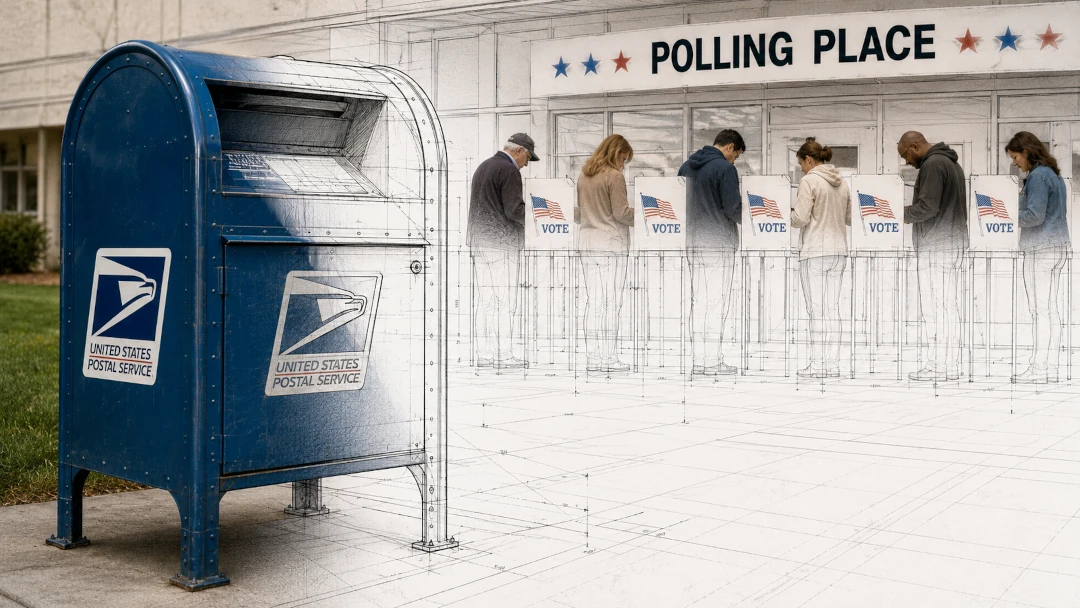
Federal law requires states to begin sending ballots to military and overseas voters 45 days before Election Day — that window opens later this month. North Carolina began mailing ballots to voters on September 5. Roughly 47 million Americans — 30 percent of the 2024 electorate — cast their votes by mail. The system that will decide whether those ballots ever reach voters was built in three months, in defiance of court orders, with a fail-safe designed to reject them by the thousand.
Timeline · The Squeeze Play
Get Involved Today
Contribute to our mission and turn your concerns into action.
IV. What a Rigged Census Actually Costs You
It is easy for a story about administrative orders and statistical policy to feel abstract. It is not. Census numbers are the operating system of American federalism. They allocate the 435 seats of the House of Representatives among the states, which in turn determines every state’s Electoral College count. They draw the congressional districts and state legislative maps under which every American votes. And they set the formulas that direct more than $2.24 trillion in annual federal spending — Medicaid reimbursements, SNAP allocations, highway funding, Pell Grants, school lunch programs, community development block grants, veterans’ housing, rural hospital support, disaster relief.
A rigged count is not a rounding error. As the Project On Government Oversight has documented, even small distortions “have the potential to disrupt the equitable allocation of resources” and can “deny communities their rightful portion of federal funding.” When the Census Bureau produced a report designed to make it easier to exclude noncitizens from congressional apportionment counts — which the Fourteenth Amendment plainly requires to include the “whole number of persons in each state” — it wasn’t a data question. It was a redistricting weapon. The Brookings Institution, hardly a leftist outfit, has been warning for years that the citizenship question campaign is aimed at shifting redistricting to a “citizen voting age population” basis that would durably advantage Republican and non-Hispanic white voters.
Consider what the two moves accomplish together. The USPS system reduces the number of ballots that get counted this November. The Census manipulation reduces the number of people who count over the next ten years. One controls turnout. The other controls representation itself. For the average American, the consequences are neither abstract nor academic: fewer dollars for the hospital in your county, fewer seats for your state in Congress, a school district running on population figures that were cooked upstream, and a ballot that may never leave a Postal Service sorting facility because someone in another state uploaded the wrong list.
V. Congress Moves — What Democrats Are Doing
To their credit, congressional Democrats have not been silent. Senator Richard Blumenthal, ranking member of the Senate Homeland Security Permanent Subcommittee on Investigations, sent the whistleblower disclosure directly to Postmaster General David Steiner along with a demand for documents and answers by Friday. In the House, Ranking Member Robert Garcia of the Oversight and Government Reform Committee and Ranking Member Joe Morelle of the Committee on House Administration have formally requested that USPS Inspector General Tammy Hull open an independent investigation into the ballot-screening system.
In July, Garcia and Morelle led 169 members of Congress in a public-comment letter urging USPS to reject the proposed rule outright. In February, they led 68 lawmakers in demanding answers about USPS preparedness for the 2026 elections and the potential for delayed mail-in ballot delivery in rural communities. This is the pattern of a caucus that has been sounding the alarm for months. What is different now is that a federal whistleblower is on the record, and the ballots start moving in weeks.
The state-level litigation continues. Twenty-three states and the District of Columbia sued to block Trump’s mail-voting order. Voting rights coalitions led by the League of Women Voters, the Campaign Legal Center, and the ACLU have filed parallel challenges. The Brennan Center for Justice has called both the 2025 and 2026 executive orders “unlawful principally because the president lacks any authority to run elections.”
What Democrats do not currently have is a governing majority. Republicans control the House, the Senate, and — with the Supreme Court’s August 24 order clearing the way for the mail-voting policy on standing grounds — an ideological majority on the Court. Congressional oversight, whistleblower disclosures, and litigation are the tools they have. Whether they are enough depends on whether courts move quickly enough, whether inspectors general remain independent, and whether the public understands what is being done in its name.
VI. How Trump Is Responding
The White House’s response to the whistleblower disclosure was terse and dismissive. In a statement to NBC News, the administration disputed the allegations without engaging their substance. A USPS spokesperson said only that the agency was “carefully reviewing the concerns” and that the Portal would soon be made available “to election officials who voluntarily wish to familiarize themselves with the platform” — language that suggests the deployment is going forward.
Trump himself has offered no substantive defense. His posture, consistent with his handling of the noncitizen voting report, is amplification: taking numbers his administration produces through opaque or partisan processes, broadcasting them on Truth Social, and using them to demand new voting restrictions from Congress. On the Census report, he did not defend the methodology. He simply declared victory in an election he lost by seven million votes, and predicted the number would “explode.” That is not the behavior of an executive interested in accurate data. It is the behavior of a leader who understands that in a media environment shaped by his platform, the appearance of evidence is enough.
Commerce Secretary Howard Lutnick, whose department oversees both the Census Bureau and the scientific integrity policy that was just rewritten, has offered no public explanation for the change. Neither the Census Bureau nor the Commerce Department responded to NPR’s requests for comment on the deletion. The America First Policy Institute, whose personnel were reportedly involved in producing the noncitizen voting report, has not answered questions about who those individuals were or in what capacity they worked with the bureau — though it did celebrate the report on social media, praising its commitment to “maximizing transparency.”
The pattern, taken as a whole, is unmistakable. When institutions constrain the President, the President reaches for tools to remove the constraints — the scientific integrity policy in this case, and the courts, the Postal Service, and independent federal statisticians as the broader pattern. When career professionals object, they are bypassed, ignored, or, as with the anonymous Census employee who spoke to NPR, forced to speak on condition that their name never appears.
When Corrupting the Numbers Becomes Incapacity to Discharge the Office
The Twenty-Fifth Amendment, ratified in 1967, provides in Section 4 that the Vice President and a majority of the Cabinet — or, alternatively, “such other body as Congress may by law provide” — may declare in writing to the leaders of both houses of Congress that the President “is unable to discharge the powers and duties of his office.” When such a declaration is transmitted, the Vice President immediately assumes those powers as Acting President. The framers who drafted it were plainly thinking of medical incapacity. But the operative constitutional text is broader: it turns on inability to discharge the powers and duties, and those duties include the faithful execution of the laws and the preservation, protection, and defense of the Constitution.
A sustained, systematic effort to corrupt the U.S. Census Bureau — a body created by Article I, Section 2 of the Constitution — and to seize from the states and Congress an election authority the Constitution reserves to them, is not a policy disagreement. It is a refusal to discharge one of the foundational duties of the office. That is the constitutional case, and it is why Rep. Jamie Raskin (D-Md.), ranking member of the House Judiciary Committee, introduced legislation in April 2026 — co-sponsored by 50 House Democrats — to create the “other body” contemplated by Section 4: a bipartisan Commission on Presidential Capacity to Discharge the Powers and Duties of Office.
Raskin is not alone. Rep. Raja Krishnamoorthi (D-Ill.) called publicly for Vice President JD Vance and the Cabinet to invoke the Twenty-Fifth Amendment following Trump’s April threats against Iran. Rep. Eric Swalwell (D-Calif.), Rep. Sydney Kamlager-Dove (D-Calif.), Rep. Yassamin Ansari (D-Ariz.), and Senator Ed Markey (D-Mass.) have all urged invocation over separate episodes of erratic conduct. The Census manipulation and USPS sabotage — episodes of deliberate constitutional overreach rather than moments of instability — deepen, rather than replace, that case.
The practical barriers are not small. Section 4 requires the Vice President’s participation; Vance is unlikely to move against the President who chose him. A Section 4 invocation can be contested by the President, at which point two-thirds of both chambers must vote to sustain the removal — an all-but-impossible threshold in a Republican-controlled Congress. Raskin’s commission bill will not pass the current House. These are real obstacles.
But the fact that a remedy is politically hard does not mean the underlying case is weak. The framers wrote Section 4 as a safeguard, not a promise. Its existence sets a constitutional standard by which a President’s conduct can be measured, whether or not the votes exist on any given afternoon to enforce it. A leadership that will not stop a coordinated corruption of the census and the ballot is a leadership that has, by the plain meaning of the text, failed to discharge the powers and duties of the office. Congress’s role — and history’s — is to say so out loud, on the record, and to build the record now for the accountability that must eventually come.
Editorial Conclusion
You cannot separate the deletion at Commerce from the sabotage at the Postal Service, and neither can be dismissed as bureaucratic bumbling. One rewrites the map of American political power for a decade. The other rewrites the rules of the ballot in the eight weeks before an election. This is not incompetence, and it is not policy. It is an administration methodically dismantling the two systems — the census and the vote — on which representative government depends. The whistleblowers have spoken. The former directors have spoken. The judges, before the Supreme Court paused them, spoke. It is now on Congress, on the courts still hearing the cases, and on every voter who receives a ballot this fall to refuse to accept a democracy engineered to reject them. The Constitution does not defend itself.
Sources & References
- NPR — Trump officials cut political interference ban after unusual Census Bureau report (Hansi Lo Wang, Aug. 31, 2026).
- Democracy Docket — USPS rush to implement Trump order could cause ‘catastrophic failure’ of mail voting (Sept. 1, 2026).
- NPR — A Census Bureau report on noncitizen voting has ties to a Trump-aligned think tank (Aug. 24, 2026).
- NPR — Experts raise alarms over Census Bureau report Trump is touting on noncitizen voting (Aug. 19, 2026).
- U.S. Senate — Blumenthal press release and letter to Postmaster General Steiner.
- House Oversight Democrats — Garcia and Morelle demand USPS IG investigation.
- NBC News — Whistleblower says USPS mail ballot system is flawed and untested.
- Votebeat — USPS whistleblower says rushed mail ballot systems could disenfranchise voters.
- Brennan Center for Justice — Analyzing the President’s Executive Order on Mail Voting.
- PBS News — Whistleblower: Postal Service’s work to comply with Trump order is rushed and sloppy.
- Peterson Institute (PIIE) — Political meddling at the Census Bureau damages the entire US statistical system.
- CNN — Experts slam Trump’s unusual new census report as a ‘hijack by the White House’.
- POGO — Census Matters: Why an Accurate Count Is Essential to Funding Our Communities.
- U.S. Census Bureau — Census Data Guide More Than $2.8 Trillion in Federal Funding (FY 2021).
- House Judiciary Democrats — Raskin introduces legislation establishing independent commission on presidential capacity.
- CBS News — Supreme Court allows Trump to implement key parts of mail voting order.
- Talking Points Memo — A new draft rule for the census seeks sweeping changes to how political power is allocated.
- The Hill — Whistleblower warns of potential USPS system failure for midterms.
Related News