Scare Force One: A President’s Fear of Flying Became a War on the Free Press
The Secret Service told Donald Trump his gifted Qatari jet wasn’t safe enough to bring him home. When reporters printed that inconvenient fact, federal agents showed up at their doors. This is not national security. This is a strongman using the Justice Department as a personal grievance machine — and the constitutional silence around him is deafening.
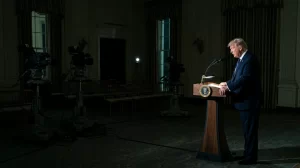
The story that made Donald Trump lose his composure this month was not a story about him at all. It was a story about a plane. Specifically, it was reporting by The New York Times and MS NOW’s Carol Leonnig, later confirmed by wire services around the world, that the president had abandoned his beloved Qatari-gifted 747-8 on the return leg from a NATO summit in Turkey because the Secret Service was worried the refurbished jet lacked the missile-defense countermeasures found on the older Air Force One. The president, in short, was too afraid to fly the plane he had been publicly boasting about for a year. And when the country found out, his administration did not respond with facts. It responded with federal agents.
Within seventy-two hours of the initial reports, four Times journalists — Julian E. Barnes, Eric Lipton, Tyler Pager, and Eric Schmitt — opened their doors to federal officers holding grand jury subpoenas. The subpoenas, issued by U.S. Attorney for the Southern District of New York Jay Clayton, ordered the reporters to testify in Manhattan about an “alleged violation of federal criminal law.” The administration insists the target is the leaker, not the press. But a subpoena served on a journalist at his own front door does not care about that distinction. It has already done its work.
This is the story of how a bruised presidential ego became a constitutional emergency in less than a week — and why the silence from most of the Republican Party, the tepid response from Democratic leadership, and the deliberate looking-away by Vice President JD Vance and the Cabinet raise questions that reach far past this single episode.
I. The Story They Did Not Want You to Read
The facts are not seriously in dispute. Qatar’s royal family gifted the Trump administration a $400 million Boeing 747-8, which the Air Force spent additional public money to hastily retrofit so the president could use it before his replacement aircraft from Boeing arrived. That new jet made its international debut at the NATO summit in Turkey. But when it came time to leave — with the United States and Iran exchanging fresh strikes over the Strait of Hormuz — the president did not board the Qatari plane. He boarded the older, decades-old VC-25A. His public explanation was that he wanted American troops in the United Kingdom to get a look at the shiny new aircraft. That was not the real reason.
According to reporting from the Times and MS NOW, and corroborated by CBS News, PBS, and Al Jazeera, the Secret Service urged the switch because the retrofitted Qatari jet lacked some of the anti-missile and defensive systems standard on the older presidential aircraft. In the middle of a shooting confrontation with Iran, the plane the president had spent months hyping was, in the view of his own protective detail, not the safer option. That is a story of public interest by any journalistic standard. It concerns hundreds of millions of taxpayer dollars, a foreign gift from a nation with a complicated relationship to U.S. adversaries, and the operational security of the office of the presidency itself.
II. The Communications Director as Attack Dog
The White House response was not a fact-based rebuttal. It was a personal assault. White House Communications Director Steven Cheung took to X and singled out Leonnig — not the Times, not the wire services, not the multiple other outlets that ran the same reporting — and called her a liar, a “complete fraud,” and dismissed her reporting as “complete Fake News.” Cheung did not, at any point, dispute the underlying claim that the Qatari jet lacked defensive systems present on the older aircraft. He simply attacked the messenger by name.
“Carol Leonnig is a liar and this article is complete Fake News… Carol is not a real journalist. A complete fraud.”
— Steven Cheung, White House Communications Director, on X — July 2026
The New Republic and Mediaite both observed the obvious hole in Cheung’s tantrum: he never actually rebutted any specific fact in Leonnig’s reporting. He called it fake, but offered no factual correction. And when the Times ran essentially the same story, all Cheung mustered was a boilerplate statement calling the new plane a “state-of-the-art aircraft.” That is not a denial. That is a talking point issued by someone who knows the underlying reporting is accurate and is looking for a woman reporter to make into a target instead.
This is a pattern. It is not a slip. The point of naming Carol Leonnig, of calling her a fraud on a platform with hundreds of millions of users, is to make the next reporter — and the reporter after that — think twice before pursuing a story that might embarrass the man in the Oval Office. Cheung’s job in that moment was not to inform the public. It was to intimidate the fourth estate.
III. From Insults to Federal Agents at the Door
Verbal attacks are one thing. Federal law enforcement at a journalist’s home is another. Within days of the initial reports, U.S. Attorney Jay Clayton — Trump’s own appointee in the Southern District of New York — issued grand jury subpoenas to Barnes, Lipton, Pager, and Schmitt. The Justice Department has framed the move as a leak investigation targeting the government official who spoke to the reporters, not the reporters themselves. But that framing collapses the moment you look at the timeline.
Anatomy of an Escalation
Trevor Timm, executive director of the Freedom of the Press Foundation, told The Intercept that the timeline told the story: the subpoenas landed less than two days after the story published, and only hours after FBI Director Kash Patel reportedly met with Trump at the White House. Every honest reading points in the same direction. This was retaliation for embarrassment. National security was the label on the box. Personal grievance was inside it.
The Times’ Own Counsel
David McCraw
Called the appearance of federal agents at reporters’ doors something that should “shock the conscience” of any American who believes in the Constitution, and later accused the DOJ of moving in “bad faith to punish The Times.” (CBS News)
Press Freedom Foundation
Seth Stern & Trevor Timm
Stern said the government’s national-security claim is really about protecting its “reputational security.” Timm said all evidence points to Trump ordering the subpoenas for retribution over the plane debacle. (The Hill, The Intercept)
Reporters Committee
Bruce D. Brown
Said the subpoenas break from longstanding DOJ practice of using reporters only as a last resort after all other investigative avenues have been exhausted. (CBS News)
International Press Institute
John Daniszewski
Warned that the American news media faces an “unprecedented threat” and called on both Democrats and Republicans to defend press freedom as a founding democratic principle. (IPI)
Get Involved Today
Contribute to our mission and turn your concerns into action.
IV. The Tough-Guy Costume and the Cost to Ordinary Americans
Every public act of this presidency is filtered through a fantasy version of masculinity. The president must be brave. He must fly the new plane. He must not flinch at Iran. When the real man behind the fantasy proves too nervous to board a jet without the newest missile defenses, the response cannot be honest — because honesty would puncture the costume. So the target becomes the reporter who saw through it.
This matters to ordinary Americans in ways that go far beyond one plane. When a president uses the Department of Justice as a personal reputation-management service, three things happen at once. First, the flow of accurate information to the public dries up, because sources who might otherwise tell reporters the truth about waste, corruption, or dangerous decisions in the executive branch begin to weigh federal prosecution against public duty. Second, the concept of “national security” is degraded into a magic phrase the government can invoke whenever it wants to punish critics — which means, over time, no one takes it seriously when a real threat emerges. Third, and most importantly, the citizens of a republic lose the ability to know what their government is doing with their money and in their name. That is not a partisan concern. That is the concern.
“The appearance of federal law enforcement agents on the doorstep of news reporters should shock the conscience of any American who believes in the Constitution and the press freedom it protects.”
— David McCraw, Senior Vice President and Deputy General Counsel, The New York Times
V. The Silence That Should Not Be — And the Voices That Are
In a healthy republic, the sight of federal agents delivering subpoenas to journalists’ homes would produce something close to a bipartisan uprising. What we got instead was a Republican Party that overwhelmingly chose to say nothing. As of this writing, there is no meaningful statement of concern from the Senate Majority Leader, no floor speech from the Speaker of the House, no organized pushback from the members of the party who once styled themselves as First Amendment absolutists. The chairs of the relevant judiciary and intelligence committees have not called hearings. On this, the party is a collective shrug.
The Democratic response has been better, though still uneven. Senate Judiciary Democrats, led by Amy Klobuchar of Minnesota and joined by California’s Alex Padilla and every other Democrat on the committee, wrote to Attorney General Pam Bondi in the spring demanding answers about her rescission of the Biden-era protections for journalists — the very rescission that made these subpoenas possible. During Jay Clayton’s confirmation hearing this week, Vermont’s Senator Peter Welch tried to pin down Acting Deputy Attorney General Todd Blanche on whether the goal was to force reporters to reveal sources; Blanche’s dodging non-answer told the country everything. But House Minority Leader Hakeem Jeffries has been notably quieter than the moment demands.
The most useful legislative response has come from Representative Jamie Raskin of Maryland, who introduced the Commission on Presidential Capacity to Discharge the Powers and Duties of the Office — a body explicitly contemplated by the text of the 25th Amendment itself. The bill has no realistic path to passage in a Republican-controlled Congress. But it names the constitutional question everyone else is trying not to name.
VI. A Constitutional Question the Framers Left Open on Purpose
Which brings us to the amendment. Every serious editorial on this presidency must eventually confront it — not as a partisan cudgel, but as the plain text of the founding document under which we live.
“Unable to Discharge the Powers and Duties of His Office”
Section 4 of the 25th Amendment permits the Vice President and a majority of the Cabinet — or, critically, “such other body as Congress may by law provide” — to declare a sitting president “unable to discharge the powers and duties of his office.” Upon that declaration, the Vice President immediately becomes Acting President. If the president contests the finding, Congress decides by a two-thirds vote of both chambers.
The word “unable” is the entire question. The framers of the amendment — a bipartisan group led by Senator Birch Bayh in 1965 — considered defining the term and chose not to. As legal scholars including Stanford’s Michael McConnell and the drafters themselves have explained, the ambiguity was deliberate: they understood that the ways in which a president might become “unable” to fulfill constitutional duties could not be listed in advance, and that fixing the term to any specific list — coma, stroke, dementia — would leave future generations without recourse in cases the framers could not foresee.
The Progressive Constitutional Case
A president who directs the Justice Department to punish journalists for accurate reporting about his own security posture, who cannot separate the wound to his pride from the duties of his office, who treats the First Amendment as an obstacle to be overcome rather than an oath to be kept — is that president fully “able” to discharge the constitutional powers of the presidency? The powers themselves include an oath to preserve, protect, and defend the Constitution. The First Amendment is part of that Constitution. There is a coherent constitutional argument that a president systematically at war with a core protection he has sworn to defend is, in the meaningful sense of the amendment, unable.
Who Has Named the Question
Representative Jamie Raskin introduced the Commission on Presidential Capacity bill in April 2026 precisely to activate the amendment’s “other body” clause. Senators Sheldon Whitehouse and Jack Reed entered into the Congressional Record a statement by 36 physicians — from Harvard, Tufts, Columbia, and George Washington — expressing concerns about the president’s fitness. The International Bar Association has published its own analysis of the constitutional mechanism.
The Honest Practical Barriers
We will not pretend this is easy. Section 4 has never been invoked in American history. It requires Vice President JD Vance and a majority of a Cabinet composed entirely of Trump loyalists to move first — and neither will. Raskin’s commission bill will not pass a Republican House. Even if the amendment were triggered, sustaining it requires a two-thirds vote of both chambers, which is politically unattainable at this moment. Any honest editorial must say that plainly.
Why That Does Not End the Argument
The framers wrote a constitutional standard, not a political prediction. The fact that today’s Republican Party will not act on the amendment does not mean the amendment does not apply. The purpose of naming the standard is to hold it up against the conduct — so that history, the voting public, and the officials whose oaths require them to act can see clearly what the Constitution asks of them and what they chose to do instead. Constitutional accountability does not require immediate removal to be real. It requires clarity. And on the record before us, the clarity is this: a president who deploys federal agents against reporters because he was embarrassed by an accurate story is not exercising the powers of his office. He is abusing them.
Editorial Conclusion
A frightened man in the Oval Office is not, in itself, a constitutional crisis. A frightened man in the Oval Office who sends federal agents to journalists’ homes because they wrote down what frightened him — is. The plane can be replaced. The reporters can fight the subpoenas in court. What cannot be replaced is the ordinary American’s right to know what the government is doing with their money, in their name, and in their defense.
Silence in this moment is not neutrality. It is consent. And consent is what tyrants require.
Sources & References
- The Hill — Secret Service Advised Trump Not to Fly Qatari-Gifted Air Force One
- The Hill — Trump Administration Subpoenas NYT Reporters After Air Force One Story
- CBS News — Several NYT Journalists Issued Subpoenas After Air Force One Reporting
- PBS NewsHour — NYT Reporters Subpoenaed — Press Freedom Concerns
- PBS NewsHour — NYT Files Motion to Quash Subpoenas
- NBC News — NYT Motion to Quash — DOJ Bad Faith Allegation
- NPR — DOJ Subpoenas NYT Reporters Over Air Force One Reporting
- Al Jazeera — Trump Administration Subpoenas NYT Reporters Over Coverage
- The Intercept — Jay Clayton Won’t Tell Congress Whether Trump Ordered the Subpoenas
- The New Republic — Trump Team Fumes as Real Story on New Air Force One Gets Out
- Mediaite — MS NOW Stands by Its Reporting After Cheung’s Attack
- Raw Story — White House Goes Berserk at Pulitzer-Winning Reporter’s Air Force One Story
- Alternet — White House Goes Ballistic on MS NOW Report
- Yahoo News / AFP — Scare Force One: Security Questions Swirl Over Trump’s New Plane
- IPI — International Press Institute Condemns Subpoenas of NYT Reporters
- Padilla Senate Office — Senate Judiciary Democrats Letter to AG Bondi on Journalist Subpoena Policy
- The Hill — Rep. Raskin Introduces Bill to Assess President’s Fitness Under the 25th Amendment
- International Bar Association — Legal Analysis: President Trump and the 25th Amendment
- The Conversation — What Is the 25th Amendment and Could It Be Used to Remove Trump?
- The Hill (Opinion) — Concerns Grow Over Trump’s Mental Fitness — 36 Physicians Weigh In
Related News