Marco Rubio Promises to Tear Down the World’s Only Court for Genocide — “Brick by Brick.”
The Secretary of State announced today a “whole-of-government” campaign to dismantle the International Criminal Court. Behind the sovereignty rhetoric is a simpler idea: that Americans, and their allies, should be beyond the reach of law. That is not conservatism. That is the posture of a rogue state.
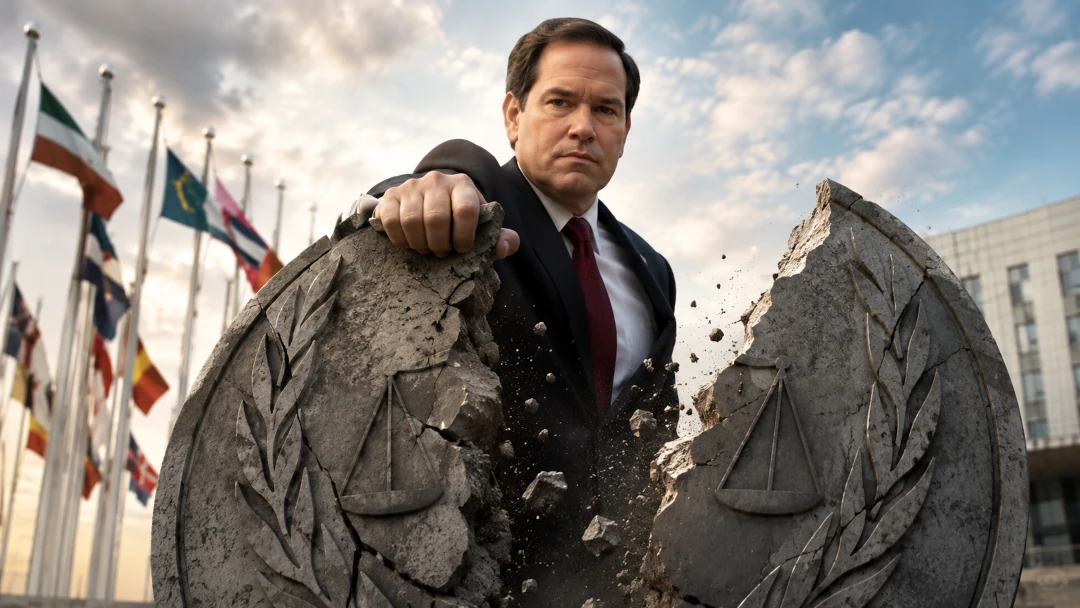
On Monday morning, Secretary of State Marco Rubio issued what he framed as a declaration of war — not on a country, but on a court. In a Wall Street Journal op-ed, a video statement, and a State Department press release moving in unison, Rubio announced a “whole-of-government response to systematically disable” the International Criminal Court, and promised that Washington would work with any willing ally to dismantle the tribunal “brick by brick, if necessary.” Reuters, which broke the underlying policy story, reported that a State Department official confirmed a menu of coercive tools now on the table: travel bans, visa revocations, expanded sanctions on ICC personnel and affiliated organizations, and diplomatic pressure on other nations to withdraw from the court entirely.
The messaging was tightly coordinated. Rubio’s op-ed argued that “sovereign states over globalism” is the animating principle. His video, amplified on the Trump administration’s social media channels and echoed on the President’s own Truth Social account, accused the court of “waging a war against our country, not with bullets or missiles, but with statutes, compacts, and the force of so-called international law.” State Department spokesman Tommy Pigott told reporters that “no diplomatic option will be off-limits in the campaign to dismantle the threat posed by the ICC to Americans.” President Trump himself, whose personal grievance with the court dates to its 2020 investigation into alleged U.S. war crimes in Afghanistan, has spent months priming the ground.
Read carefully, the argument the administration is making is not that the ICC has done something wrong. It is that no court — anywhere — should ever be permitted to examine American conduct, no matter what that conduct is. That is a radical claim. It is also a confession.
I. What the ICC Actually Is — and Why It Exists
The International Criminal Court was born from the ashes. It is the permanent successor to the Nuremberg and Tokyo tribunals and to the ad hoc courts convened for the Balkans and Rwanda. Adopted in 1998 through the Rome Statute and operational since July 2002, the ICC exists to prosecute four crimes so grave that the world’s states agreed no border should shield them: genocide, crimes against humanity, war crimes, and the crime of aggression. It is a court of last resort. Under the doctrine of complementarity, it can act only when a national judiciary is unwilling or unable to prosecute the offense itself.
Some 125 nations are members. As the Council on Foreign Relations notes, that includes every one of America’s closest democratic allies — Britain, Germany, France, Canada, Japan, Australia, South Korea. The court has convicted warlords, indicted a sitting Russian president over the abduction of Ukrainian children, and pursued cases against African militia leaders, Sudanese officials, and — most explosively — issued arrest warrants against Israeli Prime Minister Benjamin Netanyahu and Hamas commanders alike for alleged crimes in Gaza.
Rubio insists Americans should not “have to” know the names of the court’s judges. The reverse is true. In a century that has already produced Bucha and Rafah and the killing fields of Darfur, the ICC is the single institution the international community built specifically so that the powerful cannot murder civilians with impunity. To wave that away as “so-called international law” is to signal, plainly, that impunity is again on the menu.
“The ICC seeks to become the unaccountable arbiter of a new global law — empowered to prosecute and arrest our citizens at will and existentially threaten American sovereignty. We will teach the ICC the full meaning of American resolve.”
— Secretary of State Marco Rubio, official State Department post, July 13, 2026
II. Why the Administration Is Really Doing This
Sovereignty is the sales pitch. Self-protection is the product. Reuters reported earlier this year, and reaffirmed in its July 13 dispatch, that a central purpose of the ICC sanctions regime is to head off “any future attempts to hold him or his officials accountable for U.S. military action overseas.” That is not our characterization. That is the paper of record’s reporting, sourced to administration officials.
Kenneth Roth, the former executive director of Human Rights Watch, was blunt in his response to Rubio’s op-ed: the Secretary “can’t even make an honest case for attacking the International Criminal Court,” Roth wrote, noting that the court acts only on the territory of states that have accepted its jurisdiction. Raed Jarrar of Democracy for the Arab World Now (DAWN) put it in historical terms: “It is not the ICC that Rubio is dismantling brick by brick, but the rules-based international order that grew out of the ashes of World War II.” The ACLU’s Jamil Dakwar has spent much of the year pressing the Inter-American Commission on Human Rights to examine a U.S. lethal-strike policy that ACLU lawyers say has already killed more than 156 people in Caribbean maritime interdictions.
Al Jazeera identified the specific fears behind the campaign — the administration is anticipating scrutiny of the U.S.-Israel war with Iran, the strikes on alleged drug-smuggling vessels in the Caribbean, and the extraordinary abduction of Venezuelan leader Nicolás Maduro. These are not the fears of a government confident in the legality of its conduct.
III. Who Is Being Named, and What They Are Doing
Marco Rubio
The Secretary of State authored the July 13 Wall Street Journal op-ed and video message, personally pledging to dismantle the ICC and pressuring allies to abandon it. The Hill covered his announcement.
Tommy Pigott
State Department spokesman who told reporters “no diplomatic option will be off-limits” in the campaign. See the official State Department release.
Todd Blanche
Acting U.S. Attorney General who wrote to ICC President Tomoko Akane in late June, calling the court “increasingly lawless and illegitimate.” Al Jazeera reported on the letter.
Donald Trump
Signed the February 2025 executive order sanctioning the court, and continues to amplify anti-ICC messaging on Truth Social. His hostility, per Reuters, dates to the ICC’s 2020 Afghanistan probe. Full Reuters coverage.
IV. How We Got Here — A Timeline
V. What This Means for the Average American
It is fair to ask what a court in The Hague has to do with a family in Cleveland, or Phoenix, or Hartford. The honest answer is: quite a lot.
First, an American passport is a global instrument. It works because the world grants it standing. Every time Washington announces that international law does not apply to its own conduct, we invite reciprocity. When Russia detains American journalists, when China holds American executives, when authoritarian regimes disappear American dual nationals — the moral force the United States has historically used to demand their release rests on the premise that the rule of law is universal. Rubio’s op-ed explicitly rejects that premise.
Second, the ICC was never going to knock on an ordinary American’s door. But its very existence has, for two decades, been a deterrent against the kinds of atrocity crimes that pull the United States into wars — wars that our children and grandchildren pay for, in dollars and in flag-draped coffins. Weakening the court makes those wars more likely, not less.
Third, and most immediately: the sanctions the administration is now expanding have already been used to punish U.S. citizens and human rights groups on American soil. As the ACLU has documented, a federal court has already found that the ICC sanctions regime likely violates the First Amendment rights of American advocates who work on international justice. A campaign advertised as protecting American sovereignty is being used to punish Americans for their speech.
“When the world’s most powerful country aims to dismantle the world’s only permanent international court, it sends the message that the powerful are above the law.”
— Raed Jarrar, Advocacy Director, Democracy for the Arab World Now (DAWN)
VI. The Company We Are Now Keeping
The list of nations that reject the ICC’s authority is short and telling. It includes Russia, China, Israel, North Korea, and Iran. It does not include a single one of America’s peer democracies. The United Kingdom, France, Germany, Canada, Japan, Australia, and South Korea are all members. Ukraine ratified the Rome Statute during its ongoing defense against Russian invasion — a country under attack by an ICC-indicted war criminal chose to join the court, not flee it.
By declaring war on the ICC, Rubio and Trump are not asserting American exceptionalism. They are asserting a narrower doctrine: American impunity. The distinction matters. Exceptionalism has, at its best, meant that the United States held itself to higher standards than the world required. Impunity means holding itself to no standards at all. That posture — that certain state actors are simply beyond legal accountability — is the defining feature of a rogue nation, not a democratic one.
When 79 governments, including our closest treaty allies, jointly warned that the U.S. sanctions “erode the international rule of law” and “increase the risk of impunity for the most serious crimes,” they were not making a diplomatic gesture. They were telling us what we look like from the outside. What we look like is a country abandoning the very legal order it helped build after Nuremberg — an order underwritten by American blood and American conviction.
Get Involved Today
Contribute to our mission and turn your concerns into action.
VII. What Rubio’s Leadership Tells Us
Secretary Rubio was, once, a defender of international law when Russia annexed Crimea, when China detained Uyghurs, when Nicolás Maduro murdered protesters in Venezuela. That Rubio is gone. In his place is a Secretary of State who accuses the world’s foremost war-crimes tribunal of being “backed and run by a powerful network of leftist nongovernment organizations, smug globalists, and hostile Third World governments.” That is not the language of a diplomat. It is the language of a partisan pundit — and it is now the official voice of the United States abroad.
The priorities revealed by Monday’s announcement are clarifying. There is time and diplomatic capital to launch a global campaign against the court that prosecutes genocide. There is not, apparently, comparable time or capital being spent to end the war in Sudan, to hold accountable those responsible for the murder of American journalists overseas, or to defend Americans held hostage abroad. What Rubio has chosen to prioritize is protection — of the President, of the President’s allies, of the President’s freedom of action — over the country’s traditional interests. That is a failure of leadership. It is also a warning.
When “Unable to Discharge the Powers and Duties of His Office” Means Exactly What the Framers Wanted It to Mean
Section 4 of the Twenty-Fifth Amendment provides that whenever the Vice President and a majority of the Cabinet (or of another body Congress designates) transmit a written declaration that the President is “unable to discharge the powers and duties of his office,” the Vice President immediately assumes those powers as Acting President. If the President contests the determination, a two-thirds vote of both chambers of Congress is required to sustain the transfer.
Here is the crucial legal point, and one that too few commentators note: the amendment nowhere defines “unable” or “inability.” The drafters — including Fordham law professor John D. Feerick, the amendment’s preeminent living commentator — did that on purpose. As the National Affairs analysis of the drafting record puts it, “This vagueness was intentional. Rather than provide a detailed standard that tried to anticipate every sort of presidential-inability case in advance, Section 4 relied on its designation of a decision-maker and its provision of a process to keep its use properly confined.” Scholars uniformly agree: the framers refused to reduce inability to a purely medical standard because they understood that the ways a presidency can fail are more varied than any medical textbook can catalogue.
“While the amendment’s framers generally contemplated Section 4’s employment in the case of the President’s mental or physical incapacitation, they also expressly disclaimed any intent to define ‘inability.’ They purposefully set forth a flexible standard intentionally designed to apply to a wide variety of unforeseen emergencies.” — Fordham Law School’s Feerick Center, in its authoritative Reader’s Guide to the amendment
The names already on the record. Representative Jamie Raskin (D-MD), the ranking member of the House Judiciary Committee, introduced legislation in April 2026 — co-sponsored by fifty House Democrats — establishing the very Commission on Presidential Capacity that Section 4 contemplates. Senator Richard Blumenthal has publicly called on the Cabinet to invoke it. Representatives Sydney Kamlager-Dove and Yassamin Ansari and Senator Ed Markey did the same after Trump texted the Norwegian prime minister that America intended to take Greenland because Trump had not won a Nobel Prize. These are not fringe voices. They are duly elected federal officials responding to a documented pattern of conduct.
The constitutional argument. An “inability to discharge the powers and duties” of the presidency need not be a coma. It can be a persistent inability to faithfully discharge those duties — including the Article II obligation to “take Care that the Laws be faithfully executed.” When a president uses the machinery of state to shield himself from any and all legal accountability, at home or abroad, that is not the exercise of the office. It is the corruption of it. Weaponizing American diplomacy to dismantle the world’s only court for genocide — as an anticipatory defense against being investigated for one’s own conduct — is not a policy dispute. It is a symptom.
The practical barriers, honestly named. Section 4 has never been invoked. It requires action by the Vice President and a Cabinet majority, both of which now consist entirely of political loyalists. Republican control of Congress makes the two-thirds threshold politically impossible today. Raskin’s commission bill will not pass this session. None of this changes the constitutional case. The founders of the amendment built a mechanism precisely for the moment when the ordinary safeguards of impeachment fail. That the safeguards are hard to trigger is not an argument against invoking them — it is an argument for building the political majorities that make invocation possible. The moral case does not depend on this month’s vote count. It depends on whether we are still a country that believes no person, and no president, is above the law.
VIII. The Stakes, Named Plainly
What the administration announced today is not an incremental foreign-policy adjustment. It is a public declaration that the United States will lead the effort to destroy the primary international institution for prosecuting the crimes the world agreed, after 1945, no country should ever commit again. It is being pursued because the President and his Secretary of State fear — reasonably — that the court might one day examine their own conduct.
The rule of law does not survive on autopilot. It survives because citizens, judges, journalists, lawmakers, and yes, sometimes international courts, insist on it. The Trump administration has now insisted on the opposite. The question that remains is what the rest of us — Congress, the courts, the allies, the electorate — will insist on in return.
Editorial Conclusion
A country that dismantles the world’s court for genocide because it fears being investigated is not exercising sovereignty. It is confessing to something. The Twenty-Fifth Amendment was written in language deliberately capacious enough to reach a president whose conduct in office has itself become the emergency. The framers left “inability” undefined because they understood what this generation is being forced to learn: that a presidency can fail not only when the man is incapacitated, but when the office is. The remedy is hard. The stakes are the Republic itself.
Sources & References
- Reuters via U.S. News — “Trump Administration Launches Effort to Isolate International Criminal Court” (July 13, 2026)
- CNN — “Rubio vows to ‘dismantle’ International Criminal Court” (July 13, 2026)
- U.S. Dept. of State — Official press release announcing the campaign (July 13, 2026)
- The Hill — “Marco Rubio vows diplomatic campaign to ‘dismantle’ ICC in escalating row”
- Al Jazeera — “Trump administration vows to ‘disable’ International Criminal Court”
- Common Dreams — “Rubio Threatens to ‘Teach the ICC’ — Which Prosecutes War Crimes — the ‘Full Meaning of American Resolve'”
- DAWN — DAWN statement on Rubio’s WSJ op-ed
- Amnesty International — “What Do the Trump Administration’s Sanctions on the ICC Mean for Justice and Human Rights?”
- ACLU — “The Targeted Chaos of Trump’s Attacks Against International Human Rights Law and Justice”
- ACLU — Court finds ICC sanctions likely violate advocates’ First Amendment rights
- NBC News — “79 countries condemn Trump’s ICC sanctions”
- HRDAG — “Trump Administration’s Sanctions on the ICC are an Attack on the Rule of Law”
- Council on Foreign Relations — Backgrounder: “The Role of the ICC”
- Britannica — “International Criminal Court: Definition, History, Purpose”
- UN — “The Role of the ICC in Ending Impunity and Establishing the Rule of Law”
- The Hill — “Raskin introduces bill to assess president’s fitness under 25th Amendment” (April 14, 2026)
- Just Security / Fordham — “The 25th Amendment: A Reader’s Guide”
- National Affairs — “The Limits of the 25th Amendment”
- Al Jazeera — Blanche letter to ICC president (July 2, 2026)
Related News