Pool Street: What the Bluey Pajamas Saw
A father in Biddeford. A father in Houston. Six days apart. Eleven bodies since January. A president who cannot — or will not — stop it. A victim who’s last words were ‘I tried to stop.’
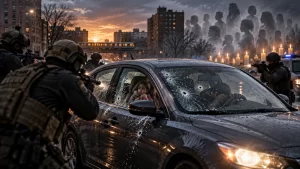
Joan Sebastian Guerrero was twenty-six years old. He was Colombian. He held a Social Security number and, according to the Maine Immigrants’ Rights Coalition, authorization to work in the United States. He was heading to his job on Monday morning, July 13, 2026, when three vehicles carrying vested men converged on him on Pool Street in Biddeford, Maine. His three-year-old daughter was in the car. She was wearing Bluey pajamas. She watched her father die.
A witness to the incident, Daniel Boucher, told the Press Herald, “He was bleeding profusely from the head.” Boucher went on to say, “He was talking. He said, ‘I tried to stop.’”
Homeland Security Secretary Markwayne Mullin told Sen. Angus King, according to the senator’s own account, that Guerrero was not the intended target of the operation. The federal agents were not wearing body cameras. Guerrero’s alleged offense: attempting, according to the Maine Attorney General’s Office, “to flee in a vehicle in the direction of the officer.” The witnesses at the bus stop across the street, where local children wait each morning, tell a different story. So does the neighbor who watched from her window.
This is the second fatal ICE shooting in six days. This is at least the eleventh fatal shooting involving ICE or Border Patrol since President Trump’s second inauguration. And this is the pattern: every one of these deaths comes with a rehearsed government statement, a claim of self-defense, an assertion that the person “rammed” or “accelerated toward” or “weaponized” a vehicle. In case after case, the video — when it exists — contradicts the government’s account.
The response from the White House has been silence, deflection, and celebration of ICE. The response from the American public has increasingly been that this is not law enforcement. It is something else.
I. What Happened on Pool Street
The Biddeford shooting occurred shortly after sunrise on Monday. Biddeford Police were called to the scene near Hill Street and Pool Street, where they confirmed that ICE personnel were involved. Maine House Speaker Ryan Fecteau, a Democrat from Biddeford, was the first elected official to break the news publicly: “A person was killed. ICE was involved.”
Within hours, hundreds of Mainers had assembled in Mechanics Park. They marched up Main Street to the local office of Republican Sen. Susan Collins, banging on the door, chanting “Vote her out.” Signs read “ICE Out Now,” “This is the government our founders warned us about,” and — damningly — “ICE, Trump’s army of thugs, are not welcome in Maine.” Collins herself called for a “full and impartial investigation.” Democratic Gov. Janet Mills said she had been briefed and that Maine State Police were coordinating with the state attorney general.
Six days earlier, in Houston’s Magnolia Park neighborhood, another father died. Lorenzo Salgado Araujo, fifty-two years old, had lived in the United States for thirty-five years. He had built hundreds of houses. His three sons were U.S. citizens. He was, according to his son, weeks away from a work permit — “we dotted every ‘i,’ crossed every ‘t.'” On the morning of July 7, unmarked SUVs pursued the white van in which he was driving a work crew to a construction site. An ICE officer shot him through a passenger window. The three men in the van told an attorney that the officer who fired was not in front of the vehicle. He was not in danger. Rep. Sylvia Garcia, briefed by the acting ICE director, has confirmed Salgado Araujo was not the target of the operation.
“We are never going to forget that his blood is on Donald Trump’s hands. We are not at war. Lorenzo Salgado Araujo was not a casualty. He was a human being who was murdered by our government.”
— Rep. Christian Menefee (D-TX) · Houston vigil, July 11, 2026
Two fathers. Two states. Both were not the target. Both are dead. And both are simply the latest names in a list that grows with a rhythm no republic should tolerate.
II. The Roll Call — Every Name We Know
The Trump administration’s second-term immigration crackdown has produced, by NBC News’s careful accounting, at least twenty-one shootings and ten fatalities through the end of June — before Salgado Araujo and Guerrero were killed. Some of the dead were undocumented. Some were U.S. citizens shot in their own hometowns. One was a bystander struck by a driver fleeing an ICE pursuit. The government has resisted independent investigation of every single case.
Ruben Ray Martinez, 23
A U.S. citizen from San Antonio, shot at close range by a Homeland Security Investigations agent during a traffic stop. ICE claimed he “intentionally ran over” an agent. Bodycam video obtained by CBS shows his brake lights on when the shots were fired. His killing was concealed for eleven months.
Silverio Villegas González, 38
Shot by an unnamed ICE officer while trying to leave a traffic stop in the Chicago suburbs. He had lived in the United States for nearly twenty years. His was the third fatal ICE shooting of Trump’s second term.
Keith Porter Jr., 43
Shot to death on New Year’s Eve by an off-duty ICE agent. The circumstances remain contested; no known video exists. Named by Rep. Delia Ramirez among the dead the agency has “lied about” and “avoided accountability” for.
Renée Nicole Good, 37
Mother of three. Killed by ICE officer Jonathan Ross, who fired multiple shots into her Honda Pilot. The family’s autopsy showed three gunshot wounds including one to her head. Video contradicted Trump’s claim that she “viciously ran over” the officer. Sec. Kristi Noem publicly branded her “a domestic terrorist.”
Alex Jeffrey Pretti, 37
ICU nurse at the Minneapolis VA. He was filming a masked federal operation and moved to help civilians being pepper-sprayed when Border Patrol agents tackled him. Ten shots in five seconds. Gov. Tim Walz called it “a campaign of organized brutality against the people of our state.”
Dr. Linda Davis, 52
A veteran special-education teacher on her morning commute. Killed when a driver fleeing an ICE traffic stop crashed into her car less than half a mile from her school. The Chatham County no-chase policy exists precisely to prevent such deaths. ICE ignored it.
Lorenzo Salgado Araujo, 52
Construction contractor, 35 years in Houston, three U.S.-citizen sons, close to obtaining legal status. Shot through the abdomen through a passenger window by an ICE officer who was not in front of the van. Witnesses have called the government’s account “a lie.”
Joan Sebastian Guerrero, 26
Colombian father, work-authorized, Social Security number, three-year-old daughter present. Not the target of the ICE operation. Killed on his way to work on a residential street four blocks from Sen. Susan Collins’s office. The agents were not wearing body cameras.
These are only the fatal encounters that have surfaced. Sec. of State Shenna Bellows, a Democratic candidate for Senate, put the running tally at “at least the 11th fatal shooting involving ICE or Border Patrol under Trump.” Nirav Shah, a Democratic Senate candidate in Maine and former CDC official, told reporters that an estimated eight to ten people have been killed by federal law enforcement in this term alone. The Martinez killing was hidden from the public for eleven months. Rep. Ramirez’s question is the correct one: “How many other killings are they concealing?”
III. How ICE Learned to Kill With Impunity
To understand what is happening, one must understand what ICE has become under this administration. It is not the immigration enforcement bureaucracy of prior administrations. It is a heavily-armed, mask-wearing federal police force that has been given a monthly arrest quota, told to prioritize deportation numbers over targeting, and shielded from every mechanism of accountability that ordinarily attends the use of lethal force.
Consider the practices that police experts have publicly condemned:
The masks. Historically, American law-enforcement officers concealed their faces only during undercover work. Law enforcement experts told CNN that ICE’s routine masking is unprecedented. Human Rights Watch reported in December that a federal district judge, ruling in a challenge to the practice, wrote plainly: “ICE goes masked for a single reason — to terrorize Americans into quiescence.” Boston Mayor Michelle Wu described her constituents’ fear of “getting snatched off the street by secret police.” Former acting ICE director John Sandweg has warned that masking creates active danger: bystanders reasonably believe they are witnessing kidnappings. CNN documented at least twenty-four criminal impersonations of ICE agents in 2025 alone — kidnappings, sexual assaults, robberies — enabled directly by the masking policy.
The unmarked vehicles. In case after case — Salgado Araujo in Houston, Martinez in South Padre, Good in Minneapolis — the ICE officers were driving unmarked rental cars, without visible emergency lights, without clear identification of themselves as law enforcement. A reasonable driver has no way to distinguish an ICE pursuit from an armed carjacking. When the driver responds as any human would — by trying to escape — they are shot, and the shooting is called self-defense.
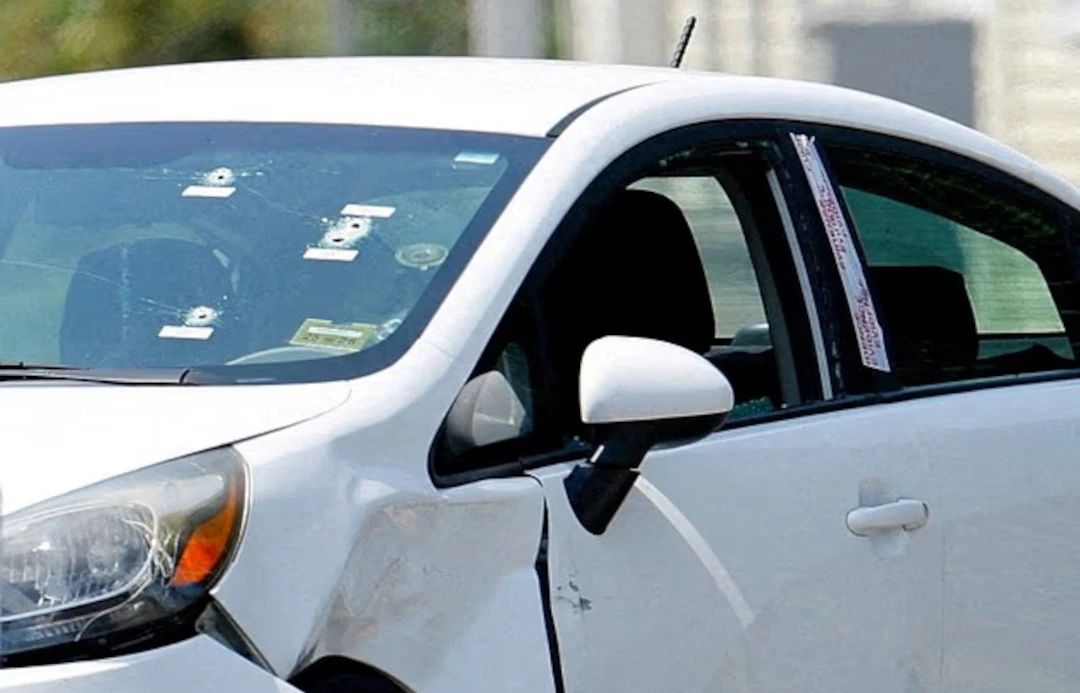
The vehicular shootings. For over three decades, American policing has moved toward strict prohibitions against firing into moving vehicles. It is a foundational modern-policing rule: it endangers bystanders, endangers other officers, and almost never stops the vehicle. ICE has abandoned this consensus. In Good’s case, the officer stood in front of a car and shot the driver. In Martinez’s case, the officer fired at close range through the driver’s window while the brake lights were on. In Salgado Araujo’s case, the officer fired through a passenger window at a driver who was not driving at him.
The body-camera failure. After the Minneapolis killings, then-Sec. Kristi Noem publicly pledged to deploy body cameras across ICE field offices. Congress appropriated twenty million dollars for the initiative. Six months later, the agents in Biddeford were not wearing body cameras. Noem was fired in March, replaced by former Sen. Markwayne Mullin. The promise died with the transition, and no one in the administration has demanded it be honored.
“ICE has been out of control since Trump took office, and now we’re potentially seeing the devastating and tragic consequences here in Maine. Enough is enough. We cannot hand over a blank check to an agency that is operating without common-sense accountability while our neighbors are being terrorized.”
— Shenna Bellows, Maine Secretary of State · July 13, 2026
IV. Six Months, Eleven Bodies
The pace itself is worth pausing on. Compress the timeline and the pattern becomes unmistakable:
Between February and July, this administration arrested ten thousand people in a single five-day operation at the end of June. The federal government’s own data show that a majority of people ICE has arrested under this administration have no criminal convictions. This is not the “worst of the worst” policy the White House claims. This is a dragnet, executed by armed and masked men who have been made to understand that shooting first will be forgiven.
Get Involved Today
Contribute to our mission and turn your concerns into action.
V. What the President Has Said — and Has Not Said
The measure of a president is not only what he does, but what he refuses to do. Since the killings began, President Trump has:
Personally repeated the false claim that Renée Good “viciously ran over” an ICE officer — a claim contradicted by video evidence. Fired his Homeland Security secretary in March not for the killings but because the resulting protests were politically inconvenient. Allowed the body-camera initiative he inherited to quietly die. Continued to describe ICE’s work as heroic while eight named victims accumulated and while the internal watchdog documentation of the Martinez cover-up went ignored.
He has not visited a single family. He has not fired a single agent. He has not directed the Department of Justice to open an independent, transparent investigation into any of the fatalities. He has not, so far as the public record shows, spoken the names of any of the dead.
By contrast, consider the elected officials from both parties who have said something. Sen. Susan Collins, a Republican, is calling for a full and impartial investigation. Rep. Chellie Pingree, a Democrat, asked pointedly: “Why are you in Maine?” Sen. Patty Murray of Washington has demanded that Sec. Mullin be hauled before Congress “to answer for every shooting.” Rep. Joaquin Castro of Texas has demanded full disclosure about the Martinez killing and its concealment. Rep. Sylvia Garcia has secured the acknowledgment that Salgado Araujo was not the target. Rep. Gabe Amo of Rhode Island called ICE, on the House floor, “Trump’s army of authoritarian masked men.”
Even Sen. Angus King, an independent, was reduced on Monday to publicly reporting that the DHS secretary had told him — almost casually — that the man his agents killed was not the intended target. There was no formal accounting. There was no White House statement. There was, in Maine on Monday, no evident concern from the President of the United States that another American community’s morning had ended with a young father dead in the street.
This silence is not accidental. It is the policy.
VI. The Constitutional Question
Which brings us to the harder question. It is easy to say ICE is out of control. It is harder to name the man who is refusing to control it, and to say what our constitutional order provides when he refuses.
“Unable” was left undefined on purpose.
Section 4 of the Twenty-Fifth Amendment, ratified in 1967 after the assassination of President Kennedy, provides that when the Vice President and a majority of the principal officers of the executive departments — or another body Congress may by law provide — transmit to the Speaker of the House and the President pro tempore of the Senate a declaration that the President is “unable to discharge the powers and duties of his office,” the Vice President immediately assumes those powers as Acting President.
The words “unable” and “inability” are never defined in the text. That was deliberate. As PBS NewsHour has documented, the amendment’s drafters chose intentionally vague language to permit application beyond obvious physical incapacity. Rep. Richard Poff of Virginia, one of the principal architects, testified that Section 4 was designed to apply not only when a president “was unconscious or otherwise unable to make or communicate a decision,” but also when “the President, by reason of mental debility, is unable or unwilling to make any rational decision, including particularly the decision to stand aside.”
“unable or unwilling to make any rational decision” — Rep. Richard Poff, one of the drafters of the 25th Amendment, on the meaning of Section 4
What this framework asks of us now. A president who cannot — or, in Poff’s careful phrasing, will not — discipline an armed federal agency that has killed at least eleven people in eighteen months; who cannot cause the body-camera program his own department was funded to deploy actually to be deployed; who cannot direct an independent investigation of a single one of the killings; who repeats his agency’s factually false accounts of shootings even after video contradicts them; who cannot bring himself to speak the names of the American citizens and legal residents his government has killed on American streets — that is a president whose ability to discharge the executive duty of “taking care that the laws be faithfully executed” is in serious constitutional doubt.
The named voices already raising this. Rep. Jamie Raskin (D-MD), ranking member of the House Judiciary Committee, has introduced legislation to establish a Commission on Presidential Capacity to Discharge the Powers and Duties of Office — the very “other body” Section 4 contemplates. Congress has never established that body. It has been a fifty-eight-year omission. In April, TIME magazine documented a growing chorus of Democratic lawmakers explicitly invoking Section 4 in response to the President’s conduct.
The honest assessment of the practical barrier. Section 4 requires the Vice President and a Cabinet majority to move first. Under this Vice President and this Cabinet, that will not happen — not because the constitutional case is weak, but because political loyalty and the possibility of being fired outrun institutional duty. A president can override the initial declaration by writing that “no inability exists,” and only a two-thirds supermajority of both houses of Congress can then override that. The mechanism was built to be hard to use for a reason.
Why the barriers do not negate the case. The moral and constitutional argument is not defeated by the political improbability of its remedy. That Section 4 is unlikely to be invoked does not mean it should not be invoked. It means we are living in a period when the amendment’s drafters would have said the country is in exactly the danger they wrote it to address — and the country’s political leaders, including the officials sworn to defend the Constitution, are choosing not to defend it. Raskin’s commission — a permanent, non-partisan body of independent capacity to assess presidential fitness — is the minimum legislative response. Its passage should be a litmus test for every member of Congress who claims to take an oath seriously.
VII. What This Tells Us About Leadership
Presidents are judged, in the end, by what they choose to notice. This one has chosen not to notice a mother of three shot in her SUV. Not to notice a VA nurse shot ten times in five seconds. Not to notice a Georgia teacher on her way to work. Not to notice a construction contractor bleeding out on a Houston sidewalk with three American sons at home. Not to notice, this morning, a Colombian father killed in front of his toddler in Maine.
He has chosen to notice, instead, the poll numbers of the deportation program. The immigration arrest totals. The applause from the base. This is what his priorities are. This is what he leads with. And the cost of it — the cost paid in coffins from Los Angeles to Biddeford — is not merely eleven dead Americans and legal residents. The cost is the transformation of a federal agency into something Americans have historically only feared in other countries, and the erosion of the compact that says the government of the United States may not shoot its people in the street.
A president unable to see this problem is a president unable to fix it. A president unwilling to fix it is, in the drafters’ own words, unable within the meaning of the amendment. There is no third category.
Editorial Conclusion
Say their names. Ruben Ray Martinez. Silverio Villegas González. Keith Porter Jr. Renée Nicole Good. Alex Jeffrey Pretti. Dr. Linda Davis. Lorenzo Salgado Araujo. And now, on Pool Street in Biddeford, Joan Sebastian Guerrero — whose three-year-old daughter, in Bluey pajamas, will remember this Monday for the rest of her life.
The agency that killed them cannot be reformed while the man responsible for it refuses even to see it. The Constitution provides for exactly this circumstance. Congress must pass the Raskin commission, and every American who has ever taken pride in the phrase “a government of laws, not of men” must demand accountability that reaches all the way to the desk that continues to sign the orders.
This is no longer a debate about immigration policy. It is a debate about whether the United States will remain a country where the government does not kill its people with impunity. A president who cannot answer that question with action has answered it with silence — and the drafters of the 25th Amendment told us, in plain words, what silence of that kind means.
Sources & References
- Boston Globe — Man shot and killed by ICE agents in Biddeford, Maine, was not target of immigration operation, officials say
- Boston Globe — Maine leaders react as person is killed in Biddeford; lawmaker says ‘ICE was involved’
- The Daily Beast — How ICE Killed Innocent Dad in Front of Daughter, 3, Exposed
- Portland Press Herald — Biddeford shooting victim was not ICE’s intended target, officials say
- MS NOW — ICE agent involved in shooting in southern Maine, according to local police
- Maine Morning Star — Hundreds protest fatal ICE shooting in Biddeford
- WGME — ICE-involved shooting in Biddeford leaves young man dead
- Bangor Daily News — ICE agents involved in fatal Biddeford shooting, lawmaker says
- ABC7 Los Angeles — Lorenzo Salgado Araujo, Mexican builder fatally shot by ICE officer, is mourned
- PBS NewsHour — A Mexican father was shot and killed by an ICE officer. His son is demanding an independent probe
- HuffPost — ‘A Lie’: Witnesses Dispute Trump Admin Account Of Fatal ICE Shooting
- Texas Tribune — ICE agent fatally shoots migrant in Houston
- The Hill — ICE shooting in Houston sparks outrage over Trump’s immigration policies
- Houston Public Media — Fatal ICE shooting in Houston comes amid sharp surge in Trump’s deportation push
- NBC News — List: ICE and Border Patrol shootings as Trump doubles down on immigration enforcement
- CBS News — Bodycam video contradicts ICE claims in fatal shooting of U.S. citizen Ruben Ray Martinez
- Common Dreams — ‘How Many Other Killings Are They Concealing?’ ICE Shot Ruben Ray Martinez in Texas Last March
- Truthout — Calls for Accountability Mount in ICE Shooting of Ruben Ray Martinez
- Ms. Magazine — The Cruel and Unusual Killings of Renée Good and Alex Pretti
- Al Jazeera — Federal agents in Minneapolis shoot dead US citizen Alex Pretti
- PBS NewsHour — Cherished teacher Linda Davis mourned after deadly crash with driver fleeing ICE
- NPR — Months after the ICE shootings in Minnesota, a federal probe remains elusive
- Human Rights Watch — US: Masked Federal Agents Undermine Rule of Law
- CNN — ICE agents are carrying out Trump’s immigration crackdown behind masks
- Nolo — Can ICE Agents Legally Wear Masks?
- Rep. Amo Statement — Statement on Second Fatal Shooting by Trump’s Out-of-Control ICE Agents
- Rep. Castro Press Release — Castro Demands Full Disclosure on Ruben Ray Martinez Cover-Up
- House Judiciary Democrats — Raskin Introduces Legislation Establishing Commission on Presidential Capacity
- National Constitution Center — Text of the 25th Amendment
- PBS NewsHour — Could the 25th Amendment be invoked against Trump? Here’s how it works
- TIME — Can the 25th Amendment Be Used to Remove Trump From Office?
- Minnesota Reformer — Feds turn over evidence in killings of Renée Good, Alex Pretti
Related News