The Speaker Said the Quiet Part Aloud: “I Run the Protection Program.”
At a Faith & Freedom Coalition gala on Friday, the second-in-line to the presidency told a roomful of donors he is personally running interference for Donald Trump, his family, his Cabinet, and his contributors. He used a phrase usually heard from the witness side of a federal mob trial. He has also taken an oath to the Constitution he is now openly subordinating.
Speaker Mike Johnson did not misspeak. Standing before the Faith & Freedom Coalition’s “Road to Majority” conference on Friday, June 26, the Louisiana Republican abandoned the careful euphemisms his predecessors used to describe partisan loyalty and reached instead for the vocabulary of organized crime. “If we lose the midterms,” he warned a room of conservative donors, “these Democrats will turn every committee of Congress into an investigative body, and they’ll go after the president’s family, the cabinet, his donors, friends, half of you in this room will be targeted.” Then, by every account, he went off-script. As MSNOW’s Steve Benen reported, the Speaker leaned in and added the line that has reverberated through the weekend: “I run the protection program. I’ll take care of you.”
This is not subtext. It is not a gaffe. It is the second-most powerful elected official in the United States — the man who would assume the presidency if both Donald Trump and JD Vance were incapacitated — announcing to a room of moneyed allies that the chief function of the House of Representatives, under his gavel, is to shield the executive branch from scrutiny.
The reaction was immediate and clarifying. Rep. Alexandria Ocasio-Cortez told MSNBC’s Jen Psaki that Johnson was describing, plainly, “a model of extortion in American politics.” Rep. Mike Levin of California put it more bluntly: the Speaker of the House had just spoken “like a guy guarding an operation that can’t survive daylight.” Rep. Jamie Raskin observed dryly that he agreed Johnson “runs the protection program” for MAGA violators. Even the House Homeland Security Committee Democrats — usually the most procedural account on the platform — replied: “We are the Homeland Security Committee Democrats and we approve this message.”
1. A Phrase Borrowed From the Mob
“Protection program” is not a term of art in American legislative practice. It is a term of art in racketeering. In the ordinary criminal idiom, a protection program is what the boss runs for the people who kick up: pay, comply, stay loyal, and the muscle of the organization will keep you safe from the consequences of what you have done. Benen, who has covered Capitol Hill for nearly two decades, called the phrase “more commonly associated with organized crime” and noted that even cynics expected GOP leaders to be “a bit more subtle about their anti-oversight posturing.”
The substance of the threat matched the form. Johnson explicitly named the categories he would shield: the president’s family, his Cabinet, his donors, his friends. None of these are constitutional offices. None of them have any privilege against congressional inquiry beyond what the law affords any citizen. The Speaker was not promising to defend executive privilege or push back on overreach. He was promising to keep the lights off.
“You don’t need a ‘protection program’ for people who did nothing wrong. You need one when you’re afraid of what the books would show. Congress is supposed to be a check on power, not the muscle protecting it.”
— Rep. Mike Levin (D-Calif.), June 27, 2026
2. The Oath He Took
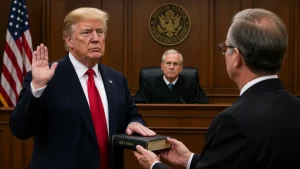
When Mike Johnson was sworn into the 118th Congress, and again as Speaker, he raised his right hand and recited the words prescribed by 5 U.S.C. § 3331, the federal oath of office that flows directly from Article VI, Clause 3 of the Constitution. The text is not ambiguous: “I do solemnly swear (or affirm) that I will support and defend the Constitution of the United States against all enemies, foreign and domestic; that I will bear true faith and allegiance to the same; that I take this obligation freely, without any mental reservation or purpose of evasion; and that I will well and faithfully discharge the duties of the office on which I am about to enter.”
The phrase to dwell on is “without any mental reservation or purpose of evasion.” It was added to the oath during the Civil War, when Congress was sorting out who could be trusted not to use federal office to advance the Confederacy. The Library of Congress’s legal historians note that the language was meant to foreclose precisely the kind of arrangement Johnson described on Friday — an officeholder whose true allegiance runs not to the Constitution but to a faction, a patron, or a “protection program.” The Speaker’s loyalty, as a matter of law, is owed to the document. What he confessed on Friday is that it is owed somewhere else.
Article I of the Constitution does not give Congress the explicit word “oversight.” It does something more powerful: it makes oversight inseparable from every other legislative function. As the Supreme Court has held since the 1920s, Congress cannot appropriate funds, write laws, raise armies, declare war, confirm officers, or impeach without knowing what the executive is actually doing. To abandon oversight is to abandon the legislative power itself. To brag about abandoning it is to invert the system James Madison defended in Federalist No. 51, in which “ambition must be made to counteract ambition.” Johnson’s ambition is being made to serve another man’s.
3. The Evidence Around Him
Friday’s speech was not an outlier. It was an admission. For eighteen months, congressional Republicans have already been operating a de facto protection program: investigations of executive-branch conduct have evaporated; subpoena power has been holstered; the Department of Justice has stood up an $1.8 billion “anti-weaponization” fund to compensate Trump allies who claim the previous administration mistreated them. Briefings inside the White House Counsel’s office, recently reported by The Washington Post, are now reportedly devoted to preparing political appointees for the oversight they may face if Republicans lose the House. Johnson’s pledge was simply to make sure those briefings remain hypothetical.
Ocasio-Cortez
Called Johnson’s remarks a public confession of “a model of extortion in American politics” — a system in which “you can commit whatever crime, and so long as you pay a check to us, we will protect you.” Common Dreams →
Levin (Calif.)
Said the Speaker “just talked like a guy guarding an operation that can’t survive daylight,” adding that Johnson “is a total disgrace to the office. November can’t come fast enough.” Daily Kos →
Raskin (Md.)
Replied: “I agree that you ‘run the protection program’ and ‘take care’ of all MAGA violators!” — flipping the Speaker’s own admission into a charge of obstruction. Daily Kos →
Homeland Security Dems
Confirmed Johnson’s warning was an accurate description of their plans: “We are the Homeland Security Committee Democrats and we approve this message.” Raw Story →
4. What the World Sees
The international consequences of Friday’s remarks will outlast the news cycle. In March, the Sweden-based V-Dem Institute — which maintains the largest global dataset on democratic governance, drawing on more than 4,200 country experts — reclassified the United States as an “electoral democracy” rather than a liberal democracy, the first such demotion in fifty years. Its director, Staffan I. Lindberg, described the speed of American backsliding as “unprecedented in modern history,” driven by precisely the dynamics Johnson named on Friday: rule of law deterioration, the politicization of oversight bodies, and the dismantling of internal checks.
Freedom House’s 2026 country report gave the United States its lowest score (81) since the index began using a 100-point system in 2002. The Financial Times democracy index ranked the first year of Trump’s second term as a steeper democratic decline than Hungary under Orbán, Turkey under Erdoğan, or Russia under Putin within their first years in power. Writing in Verfassungsblog, scholars studying the V-Dem data warned that what is collapsing is not American electoral machinery but American constitutionalism — the substrate of checks, balances, and oversight that distinguishes a democracy from a state that merely holds elections.
When the Speaker of the House announces, on camera, that he runs a protection program for the executive branch, that data point goes into the next report. It becomes a citation. It becomes a textbook example of legislative authoritarianism — the use of an elected legislature, with the trappings of democratic procedure, to shield power from accountability. It is read in Brussels, in Berlin, in Seoul, and in Brasília, and it tells our allies what kind of partner the United States is becoming.
Get Involved Today
Contribute to our mission and turn your concerns into action.
5. A Question of Leadership
It is fair to ask what Mike Johnson’s remarks reveal about Donald Trump. The Speaker did not invent the “protection program.” He was hired into it. The presidency he serves is the source of the threat: a chief executive whose family, Cabinet, donors, and circle of friends require a designated congressional shield because of what those people have done and continue to do. A leader who commands the loyalty of others by ensuring their impunity is not exercising leadership in any constitutional sense. He is running a patronage network and calling it a government.
This is the leadership question that should haunt every member of Congress this weekend. The Constitution does not contemplate a presidency that must be quarantined from oversight in order to function. It contemplates a presidency that operates under continuous scrutiny — by the press, by the courts, and above all by the legislature — because the framers understood, as Madison wrote, that “the accumulation of all powers, legislative, executive and judiciary, in the same hands… may justly be pronounced the very definition of tyranny.”
What the drafters refused to define — and why that silence speaks now
The mechanism. Section 4 of the Twenty-Fifth Amendment empowers the Vice President, together with a majority of the Cabinet (or a body Congress designates by law), to declare in writing that the President “is unable to discharge the powers and duties of his office.” The Vice President then becomes Acting President. If the President contests the declaration, Congress must resolve the question within twenty-one days; a two-thirds vote of both chambers is required to keep the President sidelined.
The deliberate ambiguity. The drafters refused to define the words “unable” or “inability.” The Yale Law School Rule of Law Clinic, working with the late Senator Birch Bayh — the amendment’s lead Senate sponsor — and with Professor John D. Feerick, its principal drafter, concluded the omission was intentional. The framers, in Feerick’s words, made “a judgment that a rigid constitutional definition was undesirable, since cases of inability could take various forms not neatly fitting into such a definition.” They built a flexible standard precisely so that future generations would not be forced to recognize only the categories of crisis a 1965 Senate subcommittee could imagine.
The drafters who said it plainly. Rep. Richard Poff of Virginia, the House manager of the amendment, told colleagues that Section 4 applied not only when a president was physically unconscious, but when a president, “by reason of mental debility, is unable or unwilling to make any rational decision, including particularly the decision to stand aside.” Senator Bayh, the architect of the amendment, defined inability as “an impairment of the President’s faculties” such that he cannot make or communicate rational decisions about his own capacity to discharge the office.
The named voices already invoking it. In April, Senator Chris Murphy of Connecticut and other Democrats publicly called for the Vice President and Cabinet to consider Section 4 following Trump’s public threats to attack civilian infrastructure abroad. They were ridiculed. They were also reading the amendment as its drafters wrote it.
An honest assessment of the barriers. The path is, in practice, blocked. Vice President JD Vance is a Trump loyalist; the Cabinet is staffed by men and women whose careers depend on the president’s favor; congressional Republicans, as Johnson has now confessed in public, are operating a protection program rather than an oversight one. Yale’s Harold Hongju Koh has cautioned that the amendment was “not written as a simple vote of no confidence” and that its drafters did not intend to “collapse the distinction between genuine inability and ordinary political disagreement.” The supermajority requirements were placed there precisely to prevent political weaponization.
Why the barriers do not negate the case. The barriers are political, not constitutional. They do not mean the standard has not been met; they mean the people who would have to act will not. When a president’s leadership has so deteriorated that the Speaker of the House publicly announces a “protection program” to insulate the executive from the oversight the Constitution requires, that is itself evidence of an inability — not a medical one, but a constitutional one — to discharge the duties of the office in the manner the framers designed. The drafters left “inability” undefined because they understood that history would produce conditions they could not name in advance. We are living in one of them. The moral and constitutional case for accountability does not disappear because the men with the keys refuse to use them. It simply transfers, with full force, to the voters in November.
“Mike Johnson paints this as though it’s some partisan witch hunt. But if you don’t want to be prosecuted for crimes, don’t do crimes. And he’s talking about running a protection racket.”
— Rep. Alexandria Ocasio-Cortez, June 27, 2026
6. What This Says About His Priorities
The Speaker of the House has two constituencies. The first is the constitutional order he swore to defend. The second is the political coalition that elevated him to the gavel. On Friday, in front of cameras and donors, Mike Johnson chose. He chose audibly, deliberately, and without the cover of euphemism. He told his audience that his function — the function of the entire majority he leads — is to ensure that no consequences attach to anyone in the president’s circle, including, he said, “half of you in this room.”
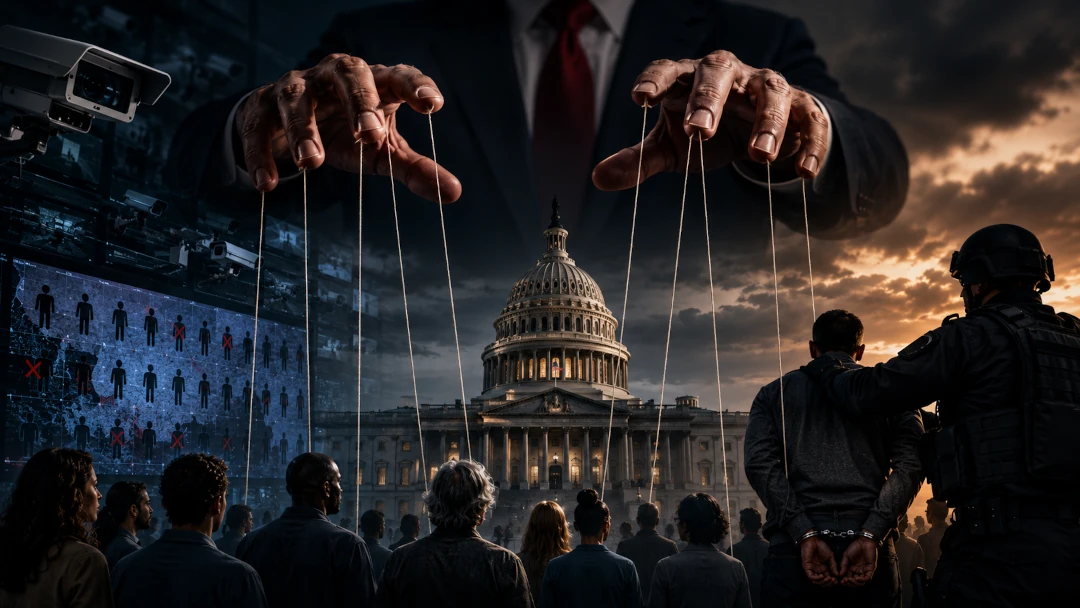
That is not a partisan statement. It is an institutional one. It is the announcement that the legislative branch, as currently led, has ceased to function as a coequal check on the executive and has reassigned itself as the executive’s shield. It is a confession that the people who run the House of Representatives understand themselves to be in possession of information, evidence, and conduct that would not survive scrutiny — and have decided, as their core electoral pitch, to prevent the scrutiny.
This is what democratic backsliding looks like when it is no longer a euphemism in an academic journal. It looks like a Speaker borrowing a phrase from organized crime and applying it to the United States government, and his donors laughing instead of leaving.
Editorial Conclusion
The Speaker of the House does not get to run a protection program. He gets to run the people’s chamber, under the oath he took, in service of the Constitution he swore to defend without mental reservation or purpose of evasion. The moment he announces that his job is to shield the president, his family, his Cabinet, his donors, and his friends from oversight, he has admitted — in his own words, on his own video — that he is no longer doing the job the office requires.
The 25th Amendment was written so that the country would not be governed by an executive incapable of discharging the duties of the office. Its drafters left “inability” undefined on purpose. They could not have anticipated this specific failure, but they did anticipate that we would face failures they could not name. What they wrote into the Constitution was a standard — and the standard has been met long before the question of whether the political path is open.
The path that remains open is the ballot. In November, the voters of this country will decide whether the House of Representatives belongs to the people or to a protection program. There is no third option, and there is no more time to pretend there is.
Sources & References
- MSNOW / Maddow Blog‘I run the protection program’: Johnson vows to shield Trump and his allies from scrutiny — Steve Benen
- Raw StoryMike Johnson’s off-hand admission ‘I run the protection program’ raises eyebrows
- Reuters / AOLMike Johnson warns roomful of conservatives to reelect Republicans or face prison
- Common DreamsAOC to Johnson and Trump: ‘If You Don’t Want to Be Prosecuted for Crimes, Don’t Do Crimes’
- Daily KosMike Johnson runs the GOP Protection Program — including Levin and Raskin reactions
- U.S. House of Representatives HistoryOath of Office — Text, History, Article VI Clause 3
- Cornell Legal Information Institute5 U.S. Code § 3331 — Oath of Office
- Library of CongressOath of Office — In Custodia Legis (legal history of the oath)
- Library of Congress · Federalist PapersFederalist No. 51 — Madison on Checks and Balances
- Wikipedia (Encyclopedic Overview)Congressional Oversight — constitutional foundations and Supreme Court doctrine
- Congressional Research ServicePresidential Disability Under the Twenty-Fifth Amendment — CRS R45394
- Constitution Annotated · Congress.govOverview of the Twenty-Fifth Amendment: Presidential Vacancy and Disability
- Yale Law SchoolRule of Law Clinic — Reader’s Guide to the 25th Amendment
- Just Security · Yale LawHow the Twenty-Fifth Amendment Applies Today — Harold Hongju Koh & Bruce Swartz
- Fordham Law NewsThe 25th Amendment Makes Presidential Disability a Political Question — John D. Feerick
- PBS NewsHourCould the 25th Amendment be invoked against Trump? Here’s how it works
- PolitiFactSen. Chris Murphy and other Democrats call for 25th Amendment consideration
- V-Dem Institute (Univ. of Gothenburg)Democratic Backsliding Reaches Western Democracies — U.S. Decline “Unprecedented”
- Freedom HouseUnited States: Freedom in the World 2026 Country Report
- VerfassungsblogLosing Liberal Democracy: V-Dem’s Warning for the United States
- National Constitution CenterUnderstanding the Constitution’s 25th Amendment
Related News