Held Hostage at the Capitol: Trump Cancels Signing of the Largest Housing Bill in a Generation to Force Through Voter Suppression
A bipartisan housing affordability law — years in the making, passed by veto-proof margins, backed by his own administration — was sitting on a signing desk in Statuary Hall. The President walked away from it on Truth Social. The signing desk stayed empty. American families looking for a home are now collateral in a separate fight to restrict who can vote.
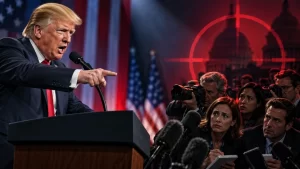
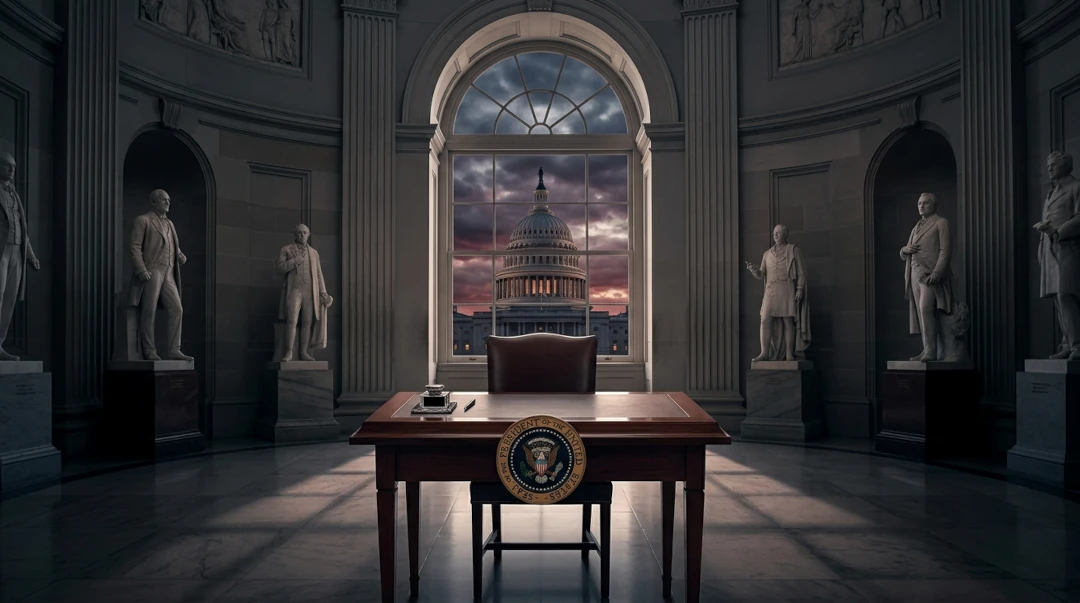
The signing desk was already in place. The Seal of the President sat at center stage in Statuary Hall. Speaker Mike Johnson and Senate Majority Leader John Thune had spent the morning trumpeting what was, by any honest measure, the biggest bipartisan legislative win of the year — the 21st Century ROAD to Housing Act, the largest federal housing affordability package in decades, passed in the House 358 to 32 and in the Senate by an overwhelming bipartisan margin. The President was scheduled to walk in at noon and sign it into law. Then, three hours before the ceremony, Donald Trump posted on Truth Social that the signing was cancelled. He would not sign a law to help Americans buy homes, he announced, until Congress first passed a separate bill making it harder for them to vote.
The post landed mid-press conference. House Republican leadership was still onstage at the Capitol selling housing affordability — the very issue voters list at the top of every poll heading into the 2026 midterms — when the President of their own party publicly walked away from their bill. Senate Minority Leader Chuck Schumer said Trump was “making such a fool of himself” by refusing to sign a measure to make housing more affordable. Representative Jason Crow of Colorado put the political diagnosis on X in one line: “Donald Trump doesn’t care about lowering costs for you.”
That sentence is going to follow this presidency for a long time. It should. Because what happened today is not a tactical maneuver, not creative legislative leverage, not even ordinary cynicism. It is the President of the United States holding affordable homes hostage to a voter-suppression bill that has nothing whatsoever to do with the price of a house in Phoenix or Atlanta or New York. And it raises a constitutional question that this country can no longer politely defer.
1. The Bill on the Desk
The legislation Trump refused to sign is not a partisan trinket. The 21st Century ROAD to Housing Act is the product of years of negotiation between Senate Banking Chair Tim Scott, a South Carolina Republican, and Ranking Member Elizabeth Warren, a Massachusetts Democrat — two senators who agree on roughly nothing else. On the House side, Financial Services Chair French Hill of Arkansas and Ranking Member Maxine Waters of California shepherded the companion legislation. The bill incorporates provisions from more than 60 measures introduced in the House and Senate, including 36 with bipartisan sponsors, according to the nonpartisan Bipartisan Policy Center.
What does it actually do? It restricts large institutional investors — the private-equity giants buying up entire blocks of single-family homes — from continuing to outbid working families in cash. It removes the outdated chassis requirement on manufactured homes, a regulatory relic that housing policy experts estimate adds five to ten thousand dollars to the cost of every unit. It creates a $200 million Innovation Fund for local governments that actually build housing. It streamlines NEPA reviews for federally supported housing, raises the Public Welfare Investment cap on bank affordable-housing investments from 15 to 20 percent, and creates a “pattern book” grant program of pre-approved designs so builders aren’t stuck waiting eighteen months on plan review.
Senator Warren, in an interview with NPR, framed it bluntly: “It has just been more than 30 years since the federal government has done anything but sit by and say, ‘Damn, the price of housing sure has gone up.’ Finally, we are actually moving.” The Trump administration itself issued a Statement of Administration Policy expressing support for the updated bill back in March. The President’s own appointees vetted it. His own party’s leadership scheduled the signing ceremony. It cleared both chambers by margins that, as Schumer noted on the floor, are large enough to override a veto.
And then, hours before noon today, the man whose signature was the only thing standing between this bill and law decided he would rather use it as a bargaining chip.
“The President is refusing to sign it. Donald Trump doesn’t care about lowering costs for you.”
— Rep. Jason Crow (D-Colo.), on X, June 24, 2026
2. The Hostage Demand
What Trump wants, in exchange for letting Americans have more affordable housing, is the SAVE America Act — the Safeguard American Voter Eligibility Act. The bill would impose sweeping new documentary-citizenship requirements on voter registration, requirements that voting rights advocates, the League of Women Voters, the Brennan Center, and Democratic lawmakers have repeatedly identified as a form of voter suppression, particularly burdensome on married women whose current ID does not match their birth certificate, on rural voters without easy access to passports, and on naturalized citizens.
The SAVE Act has stalled in the Senate because it cannot clear the 60-vote filibuster threshold. Trump’s response, posted again today, has been to demand that Majority Leader Thune abolish the filibuster outright — a step Thune has repeatedly refused to take and which, in any case, he does not have the Republican votes to do. Speaker Johnson has floated jamming the SAVE Act through reconciliation, the budget mechanism normally reserved for tax and spending matters, despite the fact that an elections bill plainly does not belong there.
So the President’s ultimatum is this: rewrite Senate rules, or strong-arm an elections bill into a budget process where it doesn’t belong, or American families don’t get the housing bill. The framing in his own Truth Social post is unmistakable. He labeled the SAVE Act a “National Emergency.” He labeled the housing bill, in his own words this morning, of “minor importance.”
That is a confession. The cost of housing in this country is not, in this President’s stated estimation, a serious matter. Restricting who gets to vote is.
3. The Cost to American Families
What does “minor importance” actually mean in dollars and households? According to the real estate brokerage Redfin, cited by NPR, a family now needs roughly $117,000 a year to afford the typical home on the market — almost $30,000 more than the median U.S. household earns. The dream of homeownership, in the words of Amanda Crist of Greater Nashville Realtors, has become for millions of Americans “simply just that — a dream.”
The bill on the desk is not a magic wand. It will not lower mortgage rates overnight. But it is the most serious federal response to the housing affordability crisis in three decades. Every day Trump sits on it is a day:
Estimated per-unit savings on manufactured homes once the obsolete chassis requirement is removed — savings that cannot reach buyers until the President signs. NPR / NerdWallet analysis.
Share of single-family rental homes owned by institutional investors in Jacksonville, Florida — a concentration the bill is specifically designed to curb. GAO / CBS News.
Growth in investor-owned single-family homes in Dallas from 2018 to 2024. Phoenix saw a 114 percent increase. Families with mortgages are losing to private-equity cash offers. CBS News.
Roughly how much a typical American family earns below the $117,000 annual income now required to buy the typical home on the U.S. market. Redfin / NPR.
The share of the cost of building a single-family home — and up to 40 percent for multifamily construction — that comes from regulation. The ROAD Act explicitly targets these costs. Sen. Thune, Senate floor.
None of this is hypothetical. None of it is “minor.” It is the difference between a young couple in upstate New York being outbid by an LLC headquartered in Delaware and a young couple closing on their first house. The President was handed the pen to sign this into law. He posted instead about voter ID.
4. The Party Trapped By Its Own President
Spare a moment, if you can, for the Republican members of Congress watching this unfold. The 21st Century ROAD to Housing Act was supposed to be their answer on cost of living heading into November. Speaker Johnson and Leader Thune scheduled the Statuary Hall ceremony because they wanted the photo. They wanted vulnerable House members posing next to the President, holding up a pen, with a banner about affordability. Instead, the press conference was overtaken by reporters reading aloud from the President’s Truth Social feed.
This is what Republican lawmakers in 2026 have learned to expect: that the President will, without warning, light their best legislative work on fire because something else has caught his attention. In May, Trump shocked the Senate by telling his own nominee for Director of National Intelligence, Jay Clayton, not to show up for his Senate confirmation hearing. He has ignored Republican senators’ requests for a briefing on a memorandum of understanding he signed with Iran. Senator Rick Scott of Florida — not Leader Thune — was the one who had to extend the invitation for Trump to attend today’s Senate GOP lunch, in a deliberate break from custom.
The GOP cannot say any of this publicly with the force it would deserve. But the votes told the story today. 358 to 32 in the House. Veto-proof in the Senate. As Schumer pointed out, “even if Trump decides to veto it, there are probably enough votes in both houses to override that veto.” Republican members of Congress voted, in overwhelming numbers, against the position their own President took three hours later on social media.
That is not a unified party. That is a hostage situation with a party caucus inside.
Get Involved Today
Contribute to our mission and turn your concerns into action.
5. A Timeline of the Last 72 Hours
The Senate passes the 21st Century ROAD to Housing Act by a wide bipartisan margin. Senator Tim Scott, Senate Banking Chair, calls it “the largest housing legislation in decades.”
The House passes the same bill, 358 to 32. Speaker Johnson and Leader Thune announce a Wednesday signing ceremony in Statuary Hall.
House Republican leadership begins a press conference at the Capitol promoting the housing bill as a centerpiece achievement on affordability.
Trump posts to Truth Social: “Today’s Housing News Conference and Signing is hereby cancelled until such time as we pass the desperately needed SAVE AMERICA ACT, which I consider to be a National Emergency.”
The signing desk sits empty in Statuary Hall. Reuters photographer Elizabeth Frantz captures the image: a Presidential Seal, a chair, no President.
Trump arrives at the Capitol for the Senate GOP lunch, invited by Sen. Rick Scott, not Leader Thune. He does not address the housing bill or the SAVE Act with reporters. He takes no questions.
“Families are struggling to afford a home. Stop the nonsense and sign the BIPARTISAN bill.”
— Rep. Sharice Davids (D-Kan.), on X, June 24, 2026
“Unable to discharge the powers and duties of his office” — and what the drafters meant by leaving “unable” undefined.
Section 4 of the Twenty-Fifth Amendment provides that when the Vice President and a majority of the Cabinet — or a majority of “such other body as Congress may by law provide” — declare in writing that the President is “unable to discharge the powers and duties of his office,” the Vice President “shall immediately assume the powers and duties of the office as Acting President.” Congress then resolves the question by a two-thirds vote.
The Amendment never defines “unable.” That is not a drafting oversight. As PBS NewsHour documented in its analysis of the provision, legal experts agree the drafters used “intentionally vague and open-ended language” because they recognized they could not predict every scenario in which a president might be deemed disabled. Representative Richard Poff of Virginia, one of the principal House architects of the amendment, explicitly said on the floor that Section 4 covered not only physical incapacity but also cases in which “the President, by reason of mental debility, is unable or unwilling to make any rational decision, including particularly the decision to stand aside.”
A president who treats a $200 million housing innovation fund as “minor” and a voter ID bill as a “National Emergency” is not making a policy judgment. He is making a category error about what an emergency is.
Today’s events are exactly the kind of conduct the open-ended text was written to encompass. The President of the United States cancelled, on social media and without consulting his own party’s leadership, the signing of a law that his administration itself supported, that passed by veto-proof margins, that addresses what every poll shows is the top concern of American voters — in order to leverage an unrelated elections bill that cannot pass on its own. He labeled the housing bill “of minor importance.” He labeled a voter ID bill a “National Emergency.” That is not a hard political calculation. It is an inversion of the basic concept of national interest.
Representative Jamie Raskin, Ranking Member of the House Judiciary Committee, introduced legislation in April 2026 establishing the Commission on Presidential Capacity to Discharge the Powers and Duties of Office — the standing body that Section 4 explicitly authorizes Congress to create and that Congress has never created in the nearly 60 years since ratification. “Public trust in Donald Trump’s ability to meet the duties of his office has dropped to unprecedented lows,” Raskin wrote. Representative Maxine Waters — who, not incidentally, is the ranking Democrat on the very Financial Services Committee that wrote the housing bill Trump just refused to sign — has also called for Section 4’s invocation. The watchdog group Common Cause has formally demanded the Cabinet act.
An honest accounting must also state what stands in the way. Vice President Vance and a Cabinet hand-picked for loyalty will not invoke Section 4. Constitutional scholars, including Professor Michael Gerhardt of the University of North Carolina, have cautioned that the amendment was meant for genuine incapacity, not for “misconduct that the president might have committed.” Section 4 has never, in the history of the Republic, been invoked. The political math, today, is what it is.
But the political math does not erase the constitutional question, and it does not erase the textual one. The drafters wrote “unable” without a definition because they trusted the Republic to recognize inability when it saw it. They created a permanent body Congress was supposed to stand up and never did. The barrier is not the Constitution. The barrier is institutional cowardice. The case for invocation does not depend on whether Mike Johnson or J.D. Vance has the courage today. It depends on whether the conduct on the public record — the impulsive cancellation, the inversion of priorities, the “minor importance” label slapped on the single biggest housing law in thirty years — constitutes, on its face, an inability to discharge the duties of the office. By the plain language the drafters chose, and by the standard Representative Poff articulated, it does.
6. The Verdict
Behind the constitutional argument is a smaller, sharper one about character. The President of the United States was handed a chance, today, to sign into law the most consequential housing affordability legislation in a generation. The legislation was bipartisan. It was supported by his own administration. It would have cut thousands of dollars off the cost of a manufactured home for the families who buy them. It would have curbed the private-equity firms outbidding working families in cash for the houses on their own block. It was, by any conventional metric, a political gift.
He refused it. He refused it because a separate fight, about who in this country gets to vote, is more important to him than whether a family in Phoenix or Atlanta or Hopewell Junction can close on a starter home. That is not a competing priority. That is a confession of priority. And it is on the public record now, in his own words, in his own post, on the morning his own party’s leadership was at a podium selling his bill.
Editorial Conclusion
A President who labels the largest housing affordability law in thirty years “of minor importance” and a voter-restriction bill “a National Emergency” has told the country, in his own voice, what he believes the country is for. He believes it is for him.
The Twenty-Fifth Amendment’s drafters left the word unable undefined on purpose, so that a future generation could recognize a presidency that had lost the thread without waiting for a doctor’s note. This is what they were preparing for. Congress should stand up the Commission on Presidential Capacity the Amendment explicitly authorizes. The House and Senate should pass the housing bill into law over the President’s signature or over his veto. And the country should stop pretending that holding the homes of working Americans hostage to a voter-suppression bill is normal Presidential conduct. It is not. It never was.
Sources & References
- NBC News — Trump cancels plan to sign major housing bill as he fights with Congress over the SAVE Act
- CBS News — Trump cancels bipartisan housing bill signing, reiterates demand for SAVE America Act
- NPR — Congress passes the largest housing affordability bill in decades — and Trump cancels the signing
- The Hill — Trump cancels housing bill signing over Senate inaction on SAVE Act
- PBS NewsHour — Trump says he won’t sign major housing bill until Congress passes SAVE Act
- CNBC — Trump cancels signing of bipartisan housing bill, demanding SAVE Act
- CNN Business — Trump cancels signing of largest housing affordability bill in a generation
- CNBC — House passes affordable housing bill, sends it to Trump’s desk
- The Hill — Senate overwhelmingly passes sweeping bipartisan housing affordability bill
- TIME — The Five Republican Senators Who Voted Against the Bipartisan Housing Affordability Bill
- Bipartisan Policy Center — What’s in the 21st Century ROAD to Housing Act? (Section-by-section explainer)
- Senate Banking Committee — U.S. Senate Passes Chairman Scott’s 21st Century ROAD to Housing Act
- Sen. John Thune — The 21st Century ROAD to Housing Act Makes Life More Affordable for Americans (Senate floor remarks)
- Affordable Housing Finance — Congress Passes 21st Century ROAD to Housing Act
- National Low Income Housing Coalition — House Passes Amended Bipartisan “21st Century ROAD to Housing Act”
- PBS NewsHour — Could the 25th Amendment be invoked against Trump? Here’s how it works
- Library of Congress · Constitution Annotated — Overview of the Twenty-Fifth Amendment: Presidential Vacancy and Disability
- House Judiciary Democrats — Ranking Member Raskin Introduces Legislation Establishing Independent Commission on Presidential Capacity
- International Bar Association — Comment and analysis: President Trump and the 25th Amendment
Related News