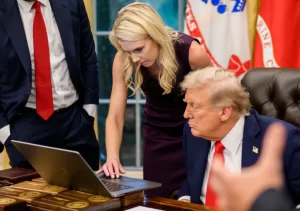
The Guru in the Briefing Room
The Washington Post’s 25,000-page investigation into Tulsi Gabbard’s alleged decades-long submission to a Hare Krishna cult leader is also an indictment of the president who handed her the keys to America’s intelligence apparatus — and of a vetting machine that did not care to look.
For nearly seventeen months, the person sitting atop America’s eighteen intelligence agencies — with statutory access to the most sensitive secrets the United States possesses — was, according to a year-long investigation by The Washington Post, allegedly receiving political and policy direction from the leader of a breakaway Hare Krishna sect that former members have described as a cult. That person was Tulsi Gabbard. The president who put her there was Donald Trump. And the most damning fact in this entire affair is not what Gabbard did. It is what the man in the Oval Office did not do, did not ask, and to this hour will not say.
On June 21, the Post’s Jon Swaine published the results of a year-long examination of roughly 25,000 pages of internal emails, memos, and transcripts provided by Rebecca Saltzburg, a former member of the Science of Identity Foundation who had worked on several of Gabbard’s congressional campaigns. The documents, the Post reported, originated from a domain reserved for the office of Chris Butler — the reclusive seventy-eight-year-old whom Gabbard once publicly described as her guru and whom former adherents have for years portrayed as a deity-figure with absolute authority over his followers’ lives.
The Post compared the contents of those memos against Gabbard’s voting record, her introduced legislation, her press releases, and her national television appearances. The parallels were, in Swaine’s word, unmistakable. In thirty-two television interviews between 2014 and 2016 that aligned with Butler-attributed memos, the Post and a colleague found that Gabbard echoed the memos’ language almost verbatim twenty-four times. In the remaining eight, she used different words to push the same ideas. A 2014 memo pressed her to introduce legislation penalizing nations whose citizens had fought for the Islamic State. A statement followed the next day. A bill followed a week after that.
1. The Memos and the Method
Swaine did not simply take Saltzburg’s word for any of this. The Post commissioned a stylometric analysis — a statistical comparison of word choice, idiosyncratic vocabulary, and sentence structure — measuring the memos against Butler’s own 7,000-page archive of recorded lectures, against the writings of Gabbard’s father Mike Gabbard, and against the writings of Sunil Khemaney, the Butler aide who has claimed authorship of the memos himself. As American Kahani summarized, the analysis pointed strongly at a single speaker who was far more likely to be Butler than the other two men. Nonstandard words that appeared in both the memos and Butler’s lectures — including “duplistic” and “judgmentalism” — were among the fingerprints.
One memo from the trove, labeled internally as Wolf Blitzer talking points for a CNN appearance, contained a specific phrase about Gabbard having been disinvited from a debate. Hours later, on air, Gabbard used nearly identical language. The pattern repeats across dozens of broadcasts. The memos do not read as suggestions. They read as scripts.
Roughly 25,000 pages of emails, attached memos, and meeting transcripts spanning roughly 2011 through 2017, provided to the Post by a former Science of Identity Foundation member.
Statistical analysis of word choice and syntax against Butler’s 7,000-page lecture archive pointed to Butler as the likely author, despite an aide’s claim to have written the memos himself.
Across thirty-two TV interviews between 2014 and 2016, the Post documented twenty-four near-verbatim echoes of memo language, with the remaining eight pushing identical ideas in paraphrased form.
The investigation also documented dozens of fake social media accounts, some with stolen avatar photographs, used to defend and elevate Gabbard online during her congressional years and, according to the reporting, again after her May resignation.
2. The Pattern Was Knowable. The Senate Knew.
None of this material should have been a surprise to the United States Senate. As the Honolulu Civil Beat reported in the run-up to Gabbard’s confirmation, both The Wall Street Journal and The New York Times had previously examined her affiliation with the Science of Identity Foundation. Former adherents of the sect had reached out to lawmakers with concerns. Larry Pfeiffer, the director of the Michael V. Hayden Center for Intelligence, Policy, and International Security at George Mason University, told the Civil Beat at the time of her nomination that any question of undue influence over a Director of National Intelligence — from a religious figure, a corporate figure, or a foreign figure — raises legitimate questions about that official’s ability to function as an impartial broker of intelligence. He was telling Republican senators in advance what the Post would later document in detail.
And yet, on February 12, 2025, the United States Senate confirmed Gabbard as Director of National Intelligence by a vote of 52 to 48. Every Senate Democrat and both independents voted no. Every Republican except Mitch McConnell of Kentucky voted yes. McConnell, alone among Republicans, issued a statement citing what he called a history of alarming lapses in Gabbard’s judgement. His colleagues — including the so-called moderates, Susan Collins of Maine and Lisa Murkowski of Alaska — looked at the same record and voted to install her at the top of the intelligence community anyway.
“No one knows who this guru really is, what his connections are and where the instructions came from. We need answers.”
— Senate Minority Leader Chuck Schumer (D-NY), responding to the Post investigation
That demand from Senate Minority Leader Chuck Schumer, reported by MS NOW, captures the heart of the matter. Gabbard had access. She had clearances. She received the President’s Daily Brief. She presided over the agencies that handle human-intelligence collection, signals intercepts, and covert action. If the Post’s documentary record means what it appears to mean, then for the better part of a year and a half, a man none of us elected and none of us can identify with confidence — a man whose followers, according to former members cited by a 2017 New Yorker examination, sprinkled his nail clippings on their food to demonstrate devotion — had a recurring back-channel into the head of American intelligence.
3. A Timeline of What Was Visible
The narrative that this story arrived from nowhere is contradicted by the public record. Each red flag listed below was reported in mainstream outlets before Gabbard’s confirmation. Each was available to every senator who voted yes.
Late 1970s
Chris Butler breaks from the mainstream Hare Krishna movement and founds the Science of Identity Foundation in Hawaii.
2002
At twenty-one, Tulsi Gabbard is elected to the Hawaii state legislature — the youngest person to win public office in the state’s history. Both parents hold senior positions in Butler’s organization.
2013
Gabbard arrives in the U.S. House. According to the Post’s documents, internal memos directing her policy and messaging begin to flow from a domain associated with Butler’s office.
2014
A memo presses for legislation penalizing countries whose citizens fought for ISIS. Gabbard issues a statement the next day and introduces a bill a week later.
2014–2016
Across thirty-two televised interviews aligned with memo content, Gabbard echoes the memos’ language nearly verbatim twenty-four times and pushes identical ideas in the remaining eight.
January 2025
Senate confirmation hearing. Gabbard’s ties to SIF are not raised by a single senator on the record, despite reporting in The Wall Street Journal and The New York Times.
February 12, 2025
The Senate confirms Gabbard 52–48. Mitch McConnell is the only Republican to vote no.
May 20, 2026
The Post formally informs Gabbard’s office it intends to publish.
May 22, 2026
Forty-eight hours later, Fox News reports Gabbard is stepping down, citing her husband’s cancer diagnosis.
June 21, 2026
The Washington Post publishes Swaine’s nine-thousand-word investigation.
June 30, 2026
Gabbard’s resignation as Director of National Intelligence takes formal effect.
Get Involved Today
Contribute to our mission and turn your concerns into action.
4. The President’s Silence Is the Story
In a functioning administration, an investigation of this magnitude — the alleged secret manipulation of the nation’s intelligence chief by a private religious leader — would prompt an immediate, public, and detailed response. There would be a statement from the press secretary. There would be a referral. There would, at a minimum, be a White House counsel’s office reviewing what materials Gabbard had access to and whether any of it could have flowed in directions her oath did not permit. There would be a Senate Intelligence Committee briefing. There would be, in short, governance.
None of that has happened. As The New Republic noted, Gabbard’s former colleagues across the Trump administration have been almost completely silent on the Post’s reporting. The president himself has said nothing on the substance. The defense has come largely from a Gabbard spokesperson’s blanket characterization of the reporting as anti-Hindu bigotry — a charge the Post and outside commentators including The Atlantic’s Anne Applebaum and former Washington Post reporter Marc Fisher rejected as a category error, because the question raised by the documents is not whether Gabbard practices Hinduism but whether a private actor was running directives into her congressional office through a clandestine memo system.
The silence is its own answer. Even some of the president’s own loyalists understand it as such. Laura Loomer, the right-wing activist closer to the Trump operation than most White House staff, used the Post’s reporting to argue publicly that the president had been failed by aides who concealed opposition research from him. Whether one believes Loomer’s characterization is beside the point; her instinct that this was a vetting catastrophe is correct. So is the implication that the catastrophe rests, finally, with the man who made the appointment.
A president who hands the leadership of the nation’s intelligence community to a person with these documented affiliations — and then, when the documentation is published, declines to address it, declines to order a damage assessment, and declines to defend his own appointment with a single public sentence — is telling the country something. He is telling the country that the question of whether American intelligence has been compromised does not interest him enough to merit comment. That is not a partisan characterization. It is a description.
5. A Pattern, Not an Anomaly
The Gabbard appointment did not happen in a vacuum. It is consistent with a Cabinet-construction pattern in which loyalty has been treated as a controlling qualification and independent scrutiny of nominees has been actively suppressed. Senator John Cornyn of Texas — a Republican, not a critic from the left — told Semafor this month, in remarks cited by The New Republic, that talking with the president has ceased to be useful because the president reverses himself based on whoever spoke to him most recently. Cornyn was referring directly to the chaos surrounding the Director of National Intelligence succession — the cancellation, hours before a scheduled hearing, of the confirmation for Gabbard’s intended replacement.
This is the leadership style that put Gabbard at the head of American intelligence. It is the same leadership style that, since April, has produced rhetorical threats against foreign civilian populations, public attacks on the Pope, and the introduction by House Judiciary Committee Ranking Member Jamie Raskin of legislation to establish a permanent Commission on Presidential Capacity under the long-dormant Section 4 authority of the 25th Amendment. More than seventy lawmakers, across both parties, have called for the amendment to be invoked since April, according to reporting by NBC4 Washington. The Gabbard revelation is not a separate scandal. It is another data point in the same record.
What the framers chose not to define — and why it matters now
The operative phrase of Section 4 is precise and, by deliberate design, undefined. It empowers the Vice President and a majority of the Cabinet — or “such other body as Congress may by law provide” — to declare in writing that the President “is unable to discharge the powers and duties of his office.” The amendment never defines “unable.” It never defines “inability.” The principal Senate drafter, Birch Bayh of Indiana, and the constitutional scholars who shaped the text in 1965 understood exactly what they were doing. A formal definition would have hardened the standard into a checklist that no real-world crisis would fit. They left it open on purpose, trusting future officeholders to recognize incapacity when the country was looking at it.
The case being made by Representative Raskin and the fifty co-sponsors of his commission legislation is not that the president is medically incapacitated in some narrow physiological sense. It is that the totality of the record — the threats against civilizations, the rhetorical instability documented by members of his own party, the demonstrated unwillingness to engage with national-security crises that erupt within his own Cabinet — speaks to an inability to discharge the office’s powers and duties in the constitutional sense. The Gabbard episode fits the pattern in a particular and damaging way: it is direct evidence that the president is unwilling or unable to perform the most basic vetting function of the executive branch, and unwilling to take corrective action even when the failure is laid out in nine thousand published words by the country’s paper of record.
Are there practical obstacles to invoking Section 4? Yes. The amendment requires the Vice President’s concurrence and either a Cabinet majority or the body Congress has never formally created. With a loyalist Cabinet and a Republican-controlled Congress, the political pathway is steep. But the practical obstacles do not extinguish the constitutional argument. They simply explain why Raskin’s bill exists — to construct the standing body the amendment contemplates but Congress has, for fifty-nine years, neglected to provide. The framers’ choice to leave “inability” undefined was a gift to a future Congress willing to act. The question is whether this Congress will accept it.
6. What the Country Is Owed
There are now specific, concrete questions that the public is owed answers to. Did Gabbard, in her capacity as Director of National Intelligence, continue to receive directives of any kind from Chris Butler, from the Science of Identity Foundation, or from any of their intermediaries? A damage assessment, conducted by personnel outside Gabbard’s former chain of command, must say so on the record. What intelligence products did she request, summarize, or relay to outside contacts during her tenure? The Senate Intelligence Committee, regardless of which party holds the gavel, has both the authority and the duty to ask. What did the White House counsel’s office know about Gabbard’s SIF ties before her nomination, and what — if anything — did it do about that knowledge? And what does it say about the vetting process that the most consequential national-security appointment of the term went to a person whose alleged decades-long influencer had been the subject of mainstream press scrutiny for more than a decade?
These are not partisan questions. They are governance questions. The Senate Republicans who confirmed Gabbard — and especially the senators who positioned themselves publicly as institutionalist moderates — owe the country a direct answer about whether, in light of the Post’s reporting, they regret their votes. Steve Benen put the question plainly: do those fifty-two senators still believe their February 2025 vote was a good idea? Their silence in the days since June 21 is the only answer they have so far offered.
Editorial Conclusion
The Washington Post’s investigation will be remembered as a profile of one extraordinarily influential person and the obscure religious leader who allegedly shaped her. But the more consequential indictment is institutional. It is an indictment of a president who treated the leadership of American intelligence as a patronage appointment, of a Senate majority that confirmed a nominee whose vulnerabilities were a matter of public record, and of a national-security apparatus that has now spent nearly a year and a half operating under a director of questionable independence.
The Twenty-Fifth Amendment exists for a reason. Its drafters left “inability” undefined because they understood that the failures of presidential capacity that most endanger a republic are rarely the ones a doctor can diagnose. A president who cannot, or will not, see the difference between a Director of National Intelligence and a campaign donor — and who, when shown the difference, has nothing to say — is exhibiting the kind of inability the framers wrote the amendment to address. The republic does not have the luxury of pretending otherwise.
Sources & References
- The Washington Post — Jon Swaine, “Tulsi Gabbard, her guru and the mysterious messages that helped shape her political career” (June 21, 2026)
- The New Republic — “Team Trump Quiet Over Explosive Tulsi Gabbard Cult Revelations”
- HuffPost — “‘Unmistakable’ Links Between Tulsi Gabbard And Shadowy Cult-Like Group”
- The Daily Beast — “Tulsi Gabbard Hit With Wild Secret Cult Allegations”
- Newsweek — “Who Is Chris Butler? Hare Krishna Guru Linked To Tulsi Gabbard”
- Mediaite — “Tulsi Gabbard ‘Guru’ Story Sends Shockwaves”
- Mediaite — “Laura Loomer Sounds Alarm Over Trump’s Vetting Practices”
- American Kahani — “The Washington Post’s Bombshell Investigation Into a Hindu Guru’s Alleged Grip on Tulsi Gabbard”
- Honolulu Civil Beat — “Tulsi Gabbard Met With Bipartisan Skepticism In Confirmation Hearing”
- CNN — “Senate votes to confirm Tulsi Gabbard as director of national intelligence” (Feb. 12, 2025)
- U.S. Senate — Roll Call Vote 50, Confirmation of Tulsi Gabbard as DNI (Feb. 12, 2025)
- MS NOW (MaddowBlog) — Steve Benen, “Tulsi Gabbard and Senate GOP face difficult new questions”
- House Judiciary Committee Democrats — Raskin Introduces Commission on Presidential Capacity (April 14, 2026)
- Axios — “House Democrats file long-shot 25th Amendment bill targeting Trump”
- Axios — “House Democratic leadership signals sudden openness to 25th Amendment push”
- NBC4 Washington — “What is the 25th Amendment? Calls grow for it to be invoked against Trump”
- TIME — “Can the 25th Amendment Be Used to Remove Trump From Office?”
- National Constitution Center — Text and Annotations of the 25th Amendment
- Mediaite — “Tulsi Gabbard’s Entire Career Was Guided By an ‘Eccentric Religious Leader'”
Related News