The Watergate Law They Want to Bury
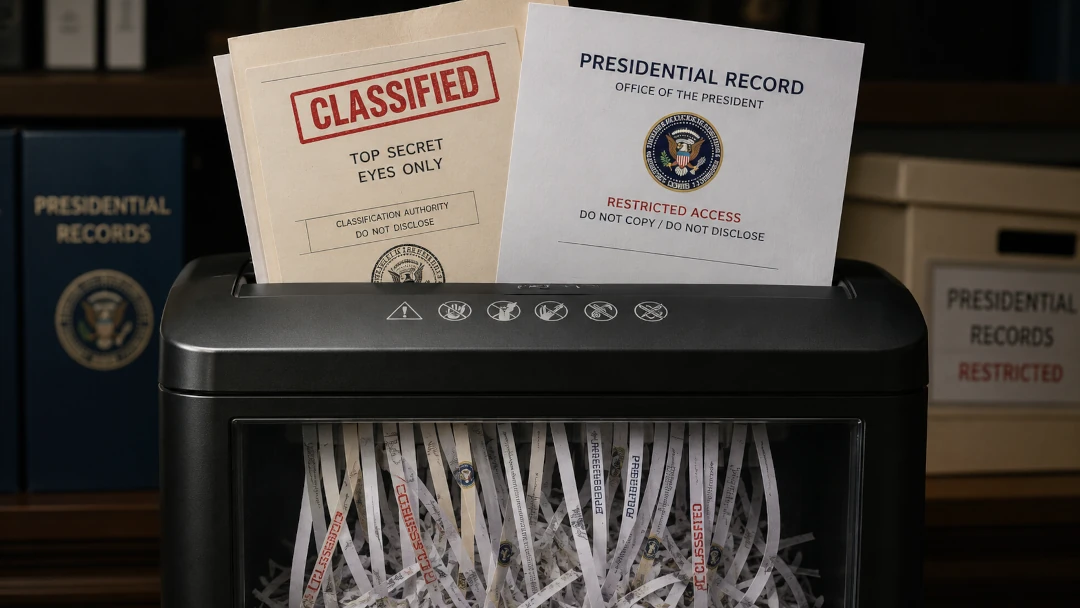
The Trump Justice Department has unilaterally declared the Presidential Records Act unconstitutional. The move is less a legal argument than a confession — that this presidency intends to leave no paper trail, no accountability, and no successor able to understand what was done in the people’s name.
On April 1, 2026, the Office of Legal Counsel at the Department of Justice quietly issued a 52-page memorandum announcing that the Presidential Records Act — the keystone of post-Watergate transparency, enacted in 1978 in the smoking aftermath of Richard Nixon’s resignation — is unconstitutional. The opinion, signed by Assistant Attorney General T. Elliot Gaiser, a former clerk to Justice Samuel Alito, concluded with a sentence whose audacity has barely been registered in our national conversation: that the President, by virtue of this in-house lawyering, “need not further comply” with the law. With those nine words, the Trump administration declared itself the sovereign arbiter of which acts of Congress bind the presidency. It is one of the most radical assertions of executive supremacy in the modern history of the republic, and it has been treated, in many quarters, as a footnote.
It is not a footnote. It is the architecture of unaccountability.
The Presidential Records Act exists for a single, unambiguous reason: because Richard Nixon tried to take his White House tapes home with him. Congress acted in 1978, four years after Nixon’s resignation, to establish in statute what the country had just learned the hard way — that the records of a presidency belong to the American people, not to the man who happens to occupy the office. Every president since Ronald Reagan has lived under that obligation. Every one has complied. Until now.
1. The Opinion and What It Actually Says
Gaiser’s opinion advances two arguments, both of them constitutional novelties. First, that Congress lacks any enumerated power to enact a records-preservation statute touching the presidency. Second, that even if such a power could be located, the Act improperly “aggrandizes” the legislative branch at the expense of executive autonomy. Christopher Fonzone, a former head of OLC, wrote in Just Security that the opinion arrived as “a bolt of lightning unanticipated by any Executive Branch or Supreme Court opinion or even contemporary legal scholarship.” That is the polite way of saying it was invented out of thin air.
Jonathan Shaub, a law professor at the University of Kentucky who previously worked in both OLC and the White House Counsel’s Office, told CNN he had never in his career heard the suggestion that the Presidential Records Act was unconstitutional in its entirety. The Supreme Court already settled the underlying question in Nixon v. Administrator of General Services in 1977, when it upheld an even more aggressive predecessor statute against Nixon’s own separation-of-powers challenge — and notably, Nixon never even attempted the argument Gaiser now makes, that Congress lacks affirmative power to legislate in this area at all. Dan Jacobson, the lawyer representing the American Historical Association in its suit against the administration, put it plainly to NPR: the OLC memo simply declares the Supreme Court “wrong” and proceeds as if a 49-year-old precedent had never been issued.
This is not legal reasoning. It is legal demolition.
“His attack on the Presidential Records Act is an attempt at post facto vindication for having taken public property to Mar-a-Lago.”
— Tim Naftali, Former Director, Nixon Presidential Library
2. The Mar-a-Lago Subtext No One Should Forget
The opinion did not arrive in a vacuum. In 2023, Donald Trump was indicted on 37 — and later 40 — felony counts for retaining classified national-defense documents at his Florida residence after his first term ended, and for allegedly obstructing the government’s effort to retrieve them. Photographs of cardboard boxes stacked in a Mar-a-Lago bathroom became, briefly, the visual shorthand for a presidency that refused to acknowledge any distinction between public records and personal property. The case was dismissed by Judge Aileen Cannon in 2024 on grounds unrelated to the underlying conduct, and was formally dropped after Trump’s reelection. The president’s defense at the time was precisely the theory the OLC has now elevated into Justice Department doctrine: that under his reading of the Presidential Records Act, the documents were his to keep.
That theory has now been retroactively blessed by the very Justice Department once tasked with prosecuting him for it. Gary M. Stern, who served for 26 years as general counsel of the National Archives — the very office that spent months in 2021 trying to retrieve the boxes from Palm Beach — wrote in The Washington Post that the OLC opinion represents an attempt to dismantle the very legal framework he spent his career implementing. Donald Sherman, president of Citizens for Responsibility and Ethics in Washington, characterized the opinion as part of the administration’s “ongoing and escalating assault on transparency and oversight.” This is not the language of a partisan reflex. It is the consensus reaction of the people who have spent their professional lives inside the machinery this president has now decided to break.
3. The Stakes for Accountability
The Presidential Records Act is the spine of post-presidential accountability in this country. Strip it away, and a great deal of what Americans have come to take for granted vanishes with it. The administration has indicated it will create a “voluntary” recordkeeping policy of its own design — which is to say, no policy at all, since no enforcement mechanism existed under the original law and there is certainly none under whatever replaces it. The consequences, while latent, are catastrophic.
FOIA Access Eliminated
Under the existing law, presidential records become accessible via Freedom of Information Act requests five years after a president leaves office. Without the Act, that public window may simply close. CNN reports the administration may even apply the new theory retroactively to records from Trump’s first term.
Historical Record Destroyed
Matthew Connelly, a Columbia University historian, told NPR that Americans rely on presidential papers to understand events like the Cuban Missile Crisis. Without preservation, future generations may never know what their government did in their name.
Encrypted Messaging Loophole
The lawsuit filed by American Oversight and the American Historical Association notes that existing safeguards against the use of personal email, text messaging, and encrypted apps for official business may no longer apply.
Precedent for Successors
The legal theory will outlive Trump. Once OLC has declared the Act unconstitutional, every future president — Republican or Democrat — inherits a framework in which White House records can be designated “personal” and walked out the door. As NOTUS reports, the White House could now create its own selective system.
4. A Pattern, Not an Incident
The OLC opinion is the latest entry in what has become a recognizable sequence. Within his first weeks back in office, the president fired National Archivist Colleen Shogan, who had not even been in the role when the Archives sought the return of his documents in 2021. As NPR noted, the administration has, over the past year, “bulldozed through multiple restraints on his power” — firing inspectors general, dismantling agencies, declaring emergencies to impose tariffs and mobilize troops. The records opinion belongs to that pattern. It is what the architecture of personal rule looks like when it is being built in plain sight.
Get Involved Today
Contribute to our mission and turn your concerns into action.
5. What This Says About Priorities
It is worth pausing on what this episode reveals about the priorities and judgment of the man in the Oval Office. The administration that produced this opinion is the same one that, in recent weeks, has threatened the annihilation of “a whole civilization” on social media, picked a public quarrel with the Pope of the Catholic Church, and circulated AI-generated images of the president as a Christ figure. In the same month it told the world that an act of Congress designed to prevent another Nixon was unconstitutional, it also picked fights with the Vatican and threatened to start a war over a deadline measured in hours.
These are not unrelated phenomena. They are the same disposition expressed in different keys. A president who believes himself unbound by the recordkeeping laws of the United States is the same president who believes himself unbound by the war powers of Congress, the diplomatic conventions of the West, and the rhetorical limits that have governed every previous occupant of his office. The records opinion is not an isolated legal maneuver. It is a statement of personality: I owe you nothing. Not the documents, not the explanation, not the history itself.
“This latest case is just another example of the utter contempt with which they hold not just history but the rights of their fellow citizens to hold them to account.”
— Matthew Connelly, Columbia University Historian
6. The Failure of Leadership
Leadership of a constitutional republic is not the assertion of personal will. It is the acceptance of structured limits in exchange for legitimacy. The Founders did not give us a strong executive because they trusted any particular executive; they gave us a strong executive bound by law because they trusted no one. The Presidential Records Act is one of the small, prosaic instruments by which that bargain is maintained. It says: You may have the power, but the record of your use of it belongs to us. A president who rejects this premise is not a strong leader. He is a man who has confused the office for himself.
That confusion is itself the problem. Every official act of the past sixteen months — the executive orders, the firings, the unilateral declarations of emergency, the personal vendettas conducted from the official account of the President of the United States — has shown a person who experiences constitutional limits as personal injuries. This is not a temperament suited to the office. It is a temperament that requires the office be reshaped around it. And when the reshaping requires that an act of Congress be declared a dead letter by the President’s own lawyers, the proper word for what is happening is not “policy disagreement.” It is incapacity to discharge the duties of the office as the Constitution defines them.
When a President’s Conduct Becomes a Question of Capacity
Section 4 of the Twenty-Fifth Amendment, ratified in 1967, provides that the Vice President and a majority of the Cabinet — or such other body as Congress may by law provide — may declare a president “unable to discharge the powers and duties of his office,” whereupon the Vice President immediately assumes the role of Acting President. The “other body” provision is the constitutional hinge that Congress has, for fifty-eight years, never bothered to walk through.
It is being walked through now. On April 14, 2026, Rep. Jamie Raskin (D-MD), ranking Democrat on the House Judiciary Committee, introduced the Commission on Presidential Capacity Act, with 50 Democratic co-sponsors, to constitute the body the amendment contemplates. Sens. Ed Markey (D-MA), Chris Murphy (D-CT), and Rep. Ro Khanna (D-CA) have separately called for the amendment to be invoked. Senate Minority Leader Chuck Schumer has done so as well. More than 85 House and Senate Democrats endorsed either impeachment or 25th Amendment proceedings after the president’s “civilization will die” threats against Iran.
The constitutional argument is straightforward: a president who has lost the capacity to distinguish his office from himself — who declares that laws governing his official conduct are unconstitutional because they constrain him — has demonstrated, in the relevant sense, an inability to “discharge the powers and duties” of an office defined by its constraints. This is not a partisan reading. It is what the amendment was drafted to address.
The Honest Assessment of Obstacles
None of this will happen tomorrow. Vice President JD Vance is a Trump loyalist who has shown no interest in such a step. Republicans hold both chambers of Congress and would refuse to convene any commission. Raskin’s bill faces a near-certain veto if it ever reached the desk. The political path is steeply uphill, and pretending otherwise would be a disservice to the seriousness of the moment.
And yet — the practical barriers do not negate the case. They define it. The Twenty-Fifth Amendment exists precisely so that when a president becomes a danger to the constitutional order, the country has a tool that does not require waiting for the next election. The fact that today’s particular Vice President will not use it does not mean the predicate for its use is absent. It means the institutional courage to act on the predicate is absent. Those are different problems, and confusing them is how republics die.
7. What Is To Be Done
The lawsuit filed by the American Historical Association and American Oversight is the appropriate first response, and it deserves the full weight of the historical and legal communities behind it. The complaint asks a federal court to declare the Presidential Records Act constitutional, to block the administration from relying on the OLC memo, and to require compliance with the law as written. Senate Democrats led by Sens. Gary Peters (D-MI) and other signatories have demanded the White House produce its records-retention protocols. These are the proper, ordinary, legal instruments of accountability.
But the political response must match the constitutional one. The Raskin bill should be cosponsored, debated, and forced to a floor vote regardless of its likelihood of passage. The country must see the names of the members who refuse to support even the procedural mechanism that the Constitution itself contemplates. The presidency cannot be permitted to declare the laws of the United States dead letters by memorandum, and the political branches cannot be permitted to receive that declaration in silence.
Editorial Conclusion
The Presidential Records Act is the law that came out of Watergate. Declaring it unconstitutional by in-house memo is not a legal opinion — it is the announcement of a presidency that intends to leave the country no way of knowing what it did.
The fight to preserve the Act is the fight to preserve the principle that government records belong to the governed. The fight over the 25th Amendment is the fight to preserve the principle that the office is larger than the man. They are the same fight. And they will not be won by waiting.
Sources & References
- CBS NewsJustice Department says law requiring president to turn over records is unconstitutional
- NBC NewsTrump doesn’t have to turn over presidential records, Justice Department says
- The Washington PostJustice Dept. says the Presidential Records Act is unconstitutional
- The Washington Post · OpinionI know the Presidential Records Act well. Now Trump is calling it unconstitutional. — Gary M. Stern
- CNN PoliticsTrump’s DOJ tells Trump he can hold onto government docs when he leaves office
- NOTUSJustice Department Says the Presidential Records Act Is Unconstitutional
- NPRHistorians sue DOJ over presidential records opinion
- American Historical AssociationAHA Files Lawsuit to Defend the Presidential Records Act
- CBS NewsLawsuit challenges DOJ memo that declared records law unconstitutional
- ABC NewsSenate Democrats press White House over loosened record-keeping policy
- Just SecurityThe Presidential Records Act is Constitutional — Christopher Fonzone
- The HillDOJ concludes presidential records requirement unconstitutional
- AxiosTrump DOJ says he’s not required to turn over presidential records
- Department of JusticeOLC Slip Opinion: Constitutionality of the Presidential Records Act (Apr. 1, 2026)
- House Judiciary DemocratsRaskin Introduces Legislation Establishing Commission on Presidential Capacity
- AxiosHouse Democrats file long-shot 25th Amendment bill targeting Trump
- NBC NewsDozens of Democrats call for Trump’s removal after his Iran threats
- Common Dreams‘We Are at a Dangerous Precipice’: Raskin Bill Would Create Commission to Examine President’s Fitness
Related News