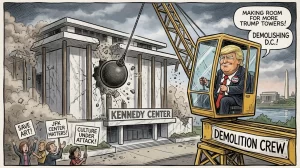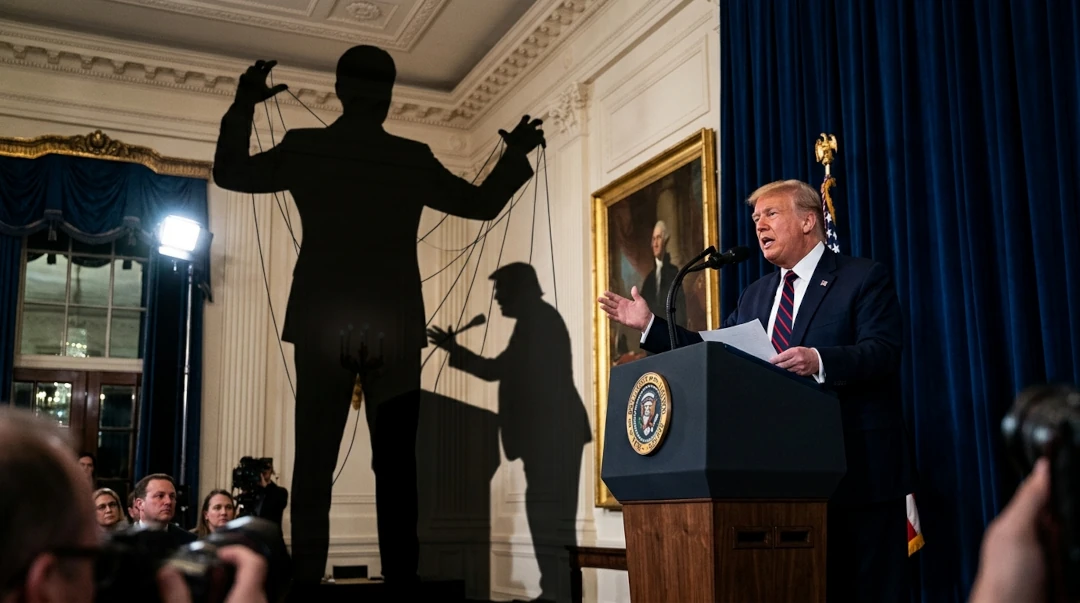
ProPublica calls OMB Director Russell Vought a “shadow president.” CNN calls Stephen Miller “the prime minister.” A foreign leader boasts he can move the U.S. military. Meanwhile, the man Americans actually elected posts AI Grim Reaper videos of his own budget chief. If the presidency has been outsourced, so has accountability.
On the second day of the October 2025 government shutdown, President Donald Trump did not go before the cameras to explain the crisis he had helped precipitate. He posted an AI-generated video set to Blue Öyster Cult’s “(Don’t Fear) The Reaper.” The star of that video was not Trump. It was his budget director, Russell Vought, dressed as the Grim Reaper, stalking Washington. The clip went viral. It also inadvertently confirmed what months of reporting had already made clear: the person driving the second Trump administration’s most consequential decisions is not, in any meaningful sense, the president.
Vought is the director of the White House Office of Management and Budget — a title so bureaucratic it functions as camouflage. Beneath it, ProPublica reporter Andy Kroll spent a year documenting what officials inside and outside the administration have told him plainly. In the phrase that gave his co-published New Yorker profile its title, Vought is Trump’s shadow president — the man who freezes the money, fires the workers, dissolves the agencies, and, when necessary, tells Congress that its votes are essentially advisory.
This is not, on its own, unusual for a chief of staff or a senior adviser. Presidencies have always had powerful lieutenants. What is unusual — and what makes the shadow presidency a constitutional question rather than a personnel one — is the combination of three things: a president visibly detached from the details of his own government, a lieutenant with an explicit theory that the presidency should be functionally unbounded, and a Congress that has, so far, chosen not to notice.
I. What “Shadow President” Actually Means
The phrase entered mainstream circulation in October 2025, when ProPublica and The New Yorker jointly published Kroll’s investigation, based on interviews with dozens of officials and thousands of pages of internal emails. On NPR’s Fresh Air, Kroll told host Terry Gross that Vought is the architect behind the administration’s decision to dismantle federal agencies, slash foreign aid, pause or cancel over $400 billion for infrastructure and clean energy projects in blue states, end the Justice Department’s independence from the president, and stuff much of the “One Big Beautiful Bill” with cuts the public never voted on.
The label was not invented by ProPublica’s headline writers. Democracy Now! quoted Kroll calling Vought “the driving force behind the shutdown” and “basically a second commander-in-chief.” Even Senate Majority Leader John Thune, a Republican, was reported by Politico to have told fellow lawmakers during budget negotiations, “We don’t control what he’s going to do.” That is a sitting majority leader saying — of an unelected appointee — that Congress no longer controls the disposition of the money it appropriates.
Kroll’s reporting also surfaces Vought’s own philosophy in his own words. He believes, as he has said in speeches and writings, that the United States has descended into a “post-constitutional” order that requires “radical constitutionalists” to break it open. At a Center for Renewing America event in 2023, Vought told the audience:
“We want the bureaucrats to be traumatically affected. When they wake up in the morning, we want them to not want to go to work, because they are increasingly viewed as the villains. We want to put them in trauma.”
— Russell Vought, Center for Renewing America, 2023, on video obtained by ProPublica
Vought said this before he was renominated to run OMB. The Senate confirmed him anyway. What he described — the deliberate psychological demoralization of career civil servants — is not a personnel philosophy. It is a governance philosophy, and it has been in operation since January 2025.
II. The Vought Doctrine, in Receipts
The clearest measure of a shadow president is not what he is called, but what he moves without a vote. In Vought’s case, the receipts are public and enormous.
Blue-State Energy
Vought announced on X on the first day of the shutdown that he was cancelling nearly $8 billion in clean energy projects — listing only states with Democratic senators that Trump did not win.
NYC Infrastructure
Also on shutdown day one, Vought froze roughly $18 billion for the Hudson Tunnel and Second Avenue Subway, citing a “DEI” pretext. Both are in the home state of Senate and House minority leaders.
Army Corps Cuts
On October 17, 2025, Vought announced the cancellation of $11 billion in Army Corps of Engineers projects in Baltimore, New York, San Francisco, and Boston — Democratic-run cities, all four.
USAID “Pocket Rescission”
In August 2025, Vought oversaw the pocket rescission of $4.9 billion for USAID — an unusual maneuver that Government Executive reported drew bipartisan calls of illegality from appropriators.
Congressional Districts Hit
House Appropriations Ranking Member Rosa DeLauro documented that Vought’s $8 billion energy cancellation impacted 136 congressional districts — 108 Democratic and 28 Republican — despite the Energy Department remaining fully funded.
Federal Workforce
ProPublica documented that Vought has, per Kroll’s reporting, “terminated tens of thousands of federal workers” and, during the shutdown, used it as a pretext to fire thousands more — the trauma promise made operational.
None of this required Trump. The president did not draft the memos, negotiate with agency counsels, or select the targeted congressional districts. He posted a Grim Reaper video. Vought handled the rest. The House Committee on Appropriations minority has now formally accused Vought of unlawful impoundment — a practice the Supreme Court, the Government Accountability Office, and the Justice Department’s own Office of Legal Counsel have all rejected.
III. The Shadow Cabinet Widens
If Vought were the only figure operating as a de facto principal, this would be alarming. He is not. Two other figures — one inside the White House, one in a foreign capital — are performing versions of the same role, in different domains.
Stephen Miller, the Deputy Chief of Staff for Policy and Homeland Security Advisor, has been called by CNN’s own reporting “the prime minister” inside Trump circles. The metaphor is not decorative. CNN documented that Miller has “accumulated such sprawling influence over the administration’s activities” that he now directs, or co-directs, the federal deployment of National Guard troops to Democratic-run cities including Chicago, Portland, and, in talks, New Orleans. Rolling Stone described Miller more starkly as “America’s — if not the world’s — most powerful unelected bureaucrat,” writing that “nearly all” of the second-term policy machinery bears Miller’s authorship, not the president’s. PBS News’s Washington Week devoted a full episode to Miller’s expanded portfolio, now including foreign policy.
Benjamin Netanyahu, the prime minister of Israel, operates the shadow role from outside the government entirely. Foreign Policy magazine reported that Trump publicly said something last month “no U.S. president has ever said publicly” about an Israeli leader: that Netanyahu “will do whatever I want him to do” on Iran. That framing obscures the reverse pull. Al Jazeera documented that Netanyahu has for months been actively pushing the United States toward broader military action against Iran, in “stark opposition” to Trump’s own stated foreign policy priorities. The Times of Israel reported that pro-Netanyahu Israeli media have openly attacked the U.S. officials — including Vice President JD Vance — whom they blamed for restraining Trump. When a foreign leader’s domestic press pressures American cabinet officials into decisions of war and peace, the executive branch has, in a real sense, been ported abroad.
None of these three figures was elected to the American presidency. Two hold appointive posts, one holds none. Together, they now shape U.S. federal funding, U.S. domestic military deployments, and U.S. policy in a hot regional conflict. The person on the ballot in November 2024 is, in this arrangement, more mascot than commander.
“I don’t think you can take in the full sweep of what this administration has done in less than a year and not come away with thinking that chaos is a goal, and certainly an outcome that serves Vought and his team’s larger agenda of putting cracks in the federal government.”
— Andy Kroll, ProPublica, on NPR’s Fresh Air, Oct 30, 2025
IV. A Chronology of Erosion
Vought is renominated and confirmed as OMB director despite Sen. Jeff Merkley and Sen. Patty Murray warning the Senate Budget Committee that he intends to pursue unconstitutional impoundment of funds appropriated under the Inflation Reduction Act and Infrastructure Investment and Jobs Act.
The White House submits a “pocket rescission” request to freeze $4.9 billion in USAID funding until it expires — a legal maneuver appropriators of both parties call unlawful.
The federal government shuts down. Within hours, Vought announces the cancellation of $18 billion in New York City infrastructure and $8 billion in energy projects — targeting only states that voted for Kamala Harris.
Vought announces cancellation of $11 billion in Army Corps of Engineers projects in Baltimore, New York, San Francisco, and Boston.
NPR’s Fresh Air airs Terry Gross’s interview with ProPublica’s Andy Kroll, describing Vought as a “shadow president” whose team treats “chaos” as an operational goal.
Trump posts on Truth Social that if Iran does not reopen the Strait of Hormuz, “a whole civilization will die tonight, never to be brought back again.” More than 80 House Democrats, including Rep. Ro Khanna, Sen. Ed Markey, Rep. Eric Swalwell, Rep. Sydney Kamlager-Dove, and Rep. Yassamin Ansari, call for the 25th Amendment to be invoked.
Get Involved Today
Contribute to our mission and turn your concerns into action.
V. What This Costs Every American
It is tempting to treat the shadow presidency as a Washington abstraction — a status game between political scientists and White House watchers. It is not. The consequences arrive as line items in ordinary lives.
When Vought freezes the Hudson Tunnel project, construction workers in New Jersey lose weeks of paychecks. When he cancels $8 billion in clean energy funding across 136 congressional districts, the small solar installers who had already signed contracts absorb the loss and, in many cases, close. When the Army Corps cancels flood-mitigation work in Baltimore or Boston, the next storm reaches homes that would otherwise have been protected. When the federal workforce is deliberately traumatized — Vought’s word, not ours — Social Security checks arrive late, veterans’ claims stall, food inspectors don’t inspect, and air traffic controllers stretch shifts that federal safety rules were designed to prevent.
The Harvard Law Review documented in February 2026 that legal challenges to these impoundments are proceeding in courts, but noted that even a favorable ruling can leave funds “tied up for months on end” before relief. Meanwhile, the money is gone from the communities that need it, and the political message — cooperate with the administration or your infrastructure stops — is received.
On foreign policy, the cost is measured in something even harder to quantify: the confidence of allies and the calculations of adversaries. When Trump posts about ending civilizations while a foreign leader publicly boasts of steering U.S. military decisions, the deterrent value of American seriousness — the reason presidents traditionally speak with care — is spent down. Every threat becomes a coin toss. Markets react. Enlisted service members deploy on missions whose strategic logic no one in the chain of command can fully explain, because the strategic logic is being written by advisers whose loyalties are not exclusively to the United States.
VI. What This Says About the Man on the Ballot
There is a compassionate framing of Donald Trump’s second term that his own supporters occasionally offer: that the president is “letting his people work.” There is an accurate framing, and it is different. A president who has genuinely delegated does not need to post AI Grim Reaper videos of the delegates. A president who is genuinely in command does not, on Easter morning, threaten annihilation of a foreign civilization and then, hours later, announce a two-week ceasefire, as Newsweek documented. A president who is genuinely running a coherent foreign policy does not require his Vice President to be publicly attacked by allied media for the crime of preferring restraint.
What the shadow presidency reveals about Trump’s leadership is not that he is a passive delegator. It is that he is an unreliable focal point around whom other, more disciplined actors have organized. Vought supplies the ideological engine, the impoundment strategy, the personnel purge. Miller supplies the domestic enforcement apparatus and the militarization of American cities. Netanyahu supplies the foreign policy pressure. Trump supplies the signature, the pardon power, and the rally crowds. The arrangement works, for its participants, precisely because the president is not attending closely enough to say no.
This is what “priorities” look like in a shadow presidency: the priorities are not the president’s. They are the priorities of whichever unelected principal has the most efficient path to the pen. That is not leadership. It is the outsourcing of leadership. And when the outsourced leadership belongs to a self-described “radical constitutionalist” who has already told the country he considers the constitutional order defunct, the question of removal becomes less rhetorical.
“Unable to Discharge the Powers and Duties of His Office”
The mechanism. Section 4 of the Twenty-Fifth Amendment allows the Vice President, together with a majority of the Cabinet, to transmit to Congress a written declaration that the President is unable to discharge the powers of the office. Upon that declaration, the Vice President immediately assumes those powers as Acting President. Congress then decides whether the incapacity persists. Section 4 has never been invoked. It exists precisely for a moment like this one.
Who has called for it. Following Trump’s April 2026 Truth Social post threatening the destruction of an entire civilization, more than 80 House Democrats — including Sen. Ed Markey of Massachusetts, Rep. Ro Khanna of California, Rep. Eric Swalwell, Rep. Sydney Kamlager-Dove, and Rep. Yassamin Ansari of Arizona — formally called on Vice President Vance and the Cabinet to invoke Section 4. In January 2025, similar calls followed Trump’s Greenland threats, and a handful of Never Trump Republicans — including former Rep. Joe Walsh — joined them. As Yahoo News summarized, the coalition is broader than partisans and includes lawmakers who explicitly warned service members that they “do not have to follow illegal orders.”
The constitutional argument. “Inability” was not defined by the amendment’s drafters to mean coma or unconsciousness. It was drafted, as PBS News documents, in the aftermath of Kennedy’s assassination to cover the full range of situations in which a president cannot reliably discharge the office’s duties. A president who publicly threatens genocide, then walks it back within hours; whose most consequential decisions on federal spending, domestic troop deployments, and foreign war are being taken by unelected principals; and whose own budget director is described across the political press as a “shadow president,” is, on any honest reading of the text, a president whose ability to discharge the powers of the office is impaired.
The practical barriers. They are real. Section 4 requires Vice President Vance and a majority of a Cabinet composed of loyalists — the same Cabinet, in most cases, that Vought has helped populate. Even PBS’s own analysis calls Section 4 invocation, in this environment, “highly unlikely.” Congress could impeach; Congress has not. The political cost of removal is enormous.
Why the barriers do not negate the case. The purpose of a constitutional accountability mechanism is not to be politically convenient. It is to exist, in the public record, as the standard against which conduct is measured. Every day the shadow presidency operates without the Cabinet acting is a day the country is told, implicitly, that this arrangement is normal. It is not normal. Naming it — repeatedly, in the press, on the floor of Congress, in Article III courts — is the first step toward reasserting the ordinary constitutional expectation that the presidency belongs to the person elected to it.
VII. The Editorial Judgment
What is at stake in the shadow presidency is not partisan advantage. It is the basic premise of representative government: that the person who holds the Article II powers is the person the country voted for, and that when that person is not, in a meaningful sense, exercising those powers, the Constitution provides a remedy. The 25th Amendment is that remedy. It was ratified in 1967 by a country that had just watched a president shot in Dallas and understood, viscerally, that “the presidency” and “the president” are not always the same thing.
They are not the same thing now. The shadow presidency is not a metaphor. It is an operating structure, documented on the record by ProPublica, NPR, CNN, PBS, the House Appropriations Committee, the Harvard Law Review, and the president’s own social media feed. Every American who cast a vote in November 2024 — for either candidate — is entitled to know that the person they voted for or against is the one actually running the government. That entitlement is, at the moment, unhonored.
Editorial Conclusion
A country cannot be led by a “shadow president,” a “prime minister” who was never elected, and a foreign prime minister who boasts he decides American military policy. That is not a presidency. It is a franchise, operated in Trump’s name by people whose loyalties the voters did not weigh.
The Twenty-Fifth Amendment exists for exactly this failure. Vice President Vance and the Cabinet will not invoke it — everyone knows that. That fact does not settle the constitutional question. It settles the political one. The constitutional question is whether the country will keep pretending that the man posting Grim Reaper videos at 4 a.m. is the one exercising the powers of the presidency. He is not. And a republic that refuses to name that, out loud, is a republic negotiating the terms of its own end.
Sources & References
- ProPublica — Andy Kroll, “What You Should Know About Russ Vought, Trump’s Shadow President,” Oct 2025.
- ProPublica Events — “The Shadow President — Featured Story,” 2025.
- NPR Fresh Air — Terry Gross with Andy Kroll, “Who’s the Man Behind President Trump’s Dismantling of the Federal Government?,” Oct 30, 2025.
- NPR Fresh Air — “The ‘Shadow President’ Dismantling the Government,” Oct 30, 2025.
- Democracy Now! — “Shadow President: Project 2025 Architect Russell Vought Is Using Shutdown to Gut Federal Agencies,” Oct 21, 2025.
- WBUR On Point — “How Russell Vought’s ‘radical constitutionalism’ could spark a constitutional crisis,” Feb 12, 2025.
- HuffPost — “‘Put Them In Trauma’: Inside A Key MAGA Leader’s Plans For A New Trump Agenda,” Oct 2024.
- CNBC — “Trump administration cancels nearly $8 billion in climate funding to blue states: Vought,” Oct 1, 2025.
- CBS News — “Government shutdown begins as White House moves to cut billions in funding,” Oct 2, 2025.
- The Daily Beast — “Trump’s Budget Goon Ramps Up War With Blue States,” Oct 2, 2025.
- House Appropriations (D) — “Trump and Vought Terminate Blue State Energy Projects,” Oct 2025.
- House Appropriations (D) — “Impoundment: Unlawful Stealing of Funds Promised to Americans,” 2026.
- Harvard Law Review — “Challenging Politically Discriminatory Funding Cuts,” Feb 2026.
- Government Executive — “Trump moves to unilaterally withhold funds, drawing bipartisan calls of illegality,” Aug 29, 2025.
- CNN Politics — “Stephen Miller emerges as key architect of Trump’s offensive on Democratic cities,” Oct 11, 2025.
- Rolling Stone — Jamie Sicherman, “Stephen Miller Is Leading Donald Trump’s Reign of Terror,” Sept 15, 2025.
- PBS News — “Stephen Miller’s influence on the Trump administration,” Feb 4, 2026.
- Foreign Policy — Aaron David Miller, “A Trump Deal With Iran Could Spell Trouble for Israel’s Netanyahu,” June 1, 2026.
- Al Jazeera — “Netanyahu pushes for more strikes on Iran, clashing with Trump’s priorities,” Dec 26, 2025.
- Newsweek — “Lawmakers Demand 25th Amendment Be Invoked Against Donald Trump: Full List,” Apr 2026.
- Time — “What to Know About the 25th Amendment as Lawmakers Call to Invoke It,” Apr 2026.
- Yahoo News — “Calls to Invoke the 25th Amendment Grow After Trump Threatened to Destroy ‘Whole Civilization’ in Iran,” Apr 2026.
- PBS NewsHour — “Could the 25th Amendment be invoked against Trump? Here’s how it works,” Apr 2026.
Related News