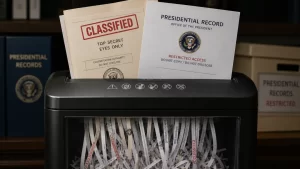
A ProPublica investigation traces a record-breaking Pentagon loan back to a single phone call from Peter Navarro — and to a venture firm where Donald Trump Jr. is a partner. Behind the rare-earth jargon lies a familiar story: a president whose office has become a profit center, and a constitutional system being asked, once again, whether it still knows how to say no.
When the Pentagon announced last November that it would lend a record $620 million to Vulcan Elements — a two-year-old North Carolina startup with fewer than 50 employees — the official line was that nothing about the deal was unusual. The president’s eldest son, the Pentagon insisted, played no role. Vulcan’s founder told reporters his company received no political favoritism. The White House declared it was simply working “at Trump Speed” to secure America’s rare-earth supply chain. The transaction, in other words, was patriotism dressed in spreadsheets.
That story collapsed on May 28, when ProPublica reporter Robert Faturechi published interviews and Defense Department records showing that the request to send hundreds of millions of dollars to Vulcan came directly from Peter Navarro — President Trump’s senior counselor for trade and manufacturing, a man who served prison time for defying a January 6 subpoena, and a self-described close friend of Donald Trump Jr.
Three months before the Pentagon announced the loan, Trump Jr.’s venture capital firm, 1789 Capital, had quietly taken an undisclosed stake in Vulcan. After the deal was unveiled, the company’s valuation jumped roughly tenfold — from about $200 million to around $2 billion. Of the dozens of companies the Pentagon was then considering for similar funding, Vulcan was the only one initiated by a top aide to the president. ProPublica’s reporting marks the first time a federal contract has been directly linked to White House intervention in this administration. It will almost certainly not be the last.
1. The Phone Call
According to ProPublica’s sources inside the Pentagon’s Office of Strategic Capital — the obscure division created under the Biden administration to fund critical-mineral and military-technology firms — Navarro’s request did not come with the usual paperwork of an arms-length policy decision. It came as an instruction. Companies under consideration for OSC funding are normally vetted over many months. Vulcan was pushed through in a matter of weeks, with staff working late nights “because they were told it was a White House priority.”
“The call came from the White House,” one of the officials told ProPublica. “We have to get this done.”
“The call came from the White House: We have to get this done.”
— Defense Department official involved in the Vulcan loan, to ProPublica
That single sentence is the bone marrow of the story. It is the language of fiat, not of due diligence. Of dozens of companies seeking federal capital, one was selected not by a procurement officer reading a vetted application but by a White House adviser making a phone call. The companies that hired lobbyists and waited their turn — like the Nevada tungsten miner whose CEO told ProPublica, “we’re hopeful you don’t need to be chums with Trump Jr. to get a project across” — were apparently asking the wrong question. The right question was: do you know the right people?
2. The Beneficiary
1789 Capital, the venture firm named for the year the U.S. Constitution took effect, joined a $65 million funding round for Vulcan in August 2025. Trump Jr. has described himself, in his own words to the Financial Times, as “very involved in the strategic decisions regarding where to invest our resources” at the firm. Neither 1789 nor Vulcan has publicly disclosed the size of the stake. Three months later, the Pentagon committed $620 million in loans to that same company, took a $50 million equity position, and added $50 million in Commerce Department incentives — a federal package worth more than three times Vulcan’s pre-deal valuation.
Around the time the deal was being engineered, the closeness of the Navarro–Trump Jr. relationship was on open display. A week before the Vulcan announcement, Trump Jr. hosted Navarro on his streaming show “Triggered,” calling him “my boy” and urging his nearly two million subscribers to buy Navarro’s new book. Navarro, in turn, dedicated that book to a small circle of friends who had “my back when it was against the wall.” Trump Jr. was on the list. None of this is illegal. All of it is the texture of a transaction in which the public’s $620 million was, at minimum, traveling along familiar grooves of personal loyalty.
The evidence is not buried. It is sitting in plain sight:
In August 2025, 1789 Capital — where Trump Jr. is a named partner — joined a $65 million funding round for Vulcan Elements. No public record exists of any conflict-of-interest review or recusal tied to that stake.
Peter Navarro, a senior White House adviser and friend of Trump Jr., personally initiated the Pentagon loan request — the only deal among dozens under review to be launched from inside the White House.
Trump’s Executive Order 14241 waived the independent technical review normally required before public money flows to a mineral project. Vulcan was approved without it.
Estimates of Vulcan’s valuation jumped from roughly $200 million to around $2 billion after the deal — a tenfold gain for every investor in the firm, Trump Jr.’s included.
At least four companies in 1789 Capital’s portfolio have received federal contracts or awards from the Trump administration in 2025, totaling more than $735 million.
House Republicans blocked a Democratic motion to subpoena Trump Jr.; the Pentagon’s response to the Senate inquiry did not address how Vulcan was selected.
Richard Painter, who served as chief White House ethics lawyer under President George W. Bush, did not mince words when ProPublica asked him about the arrangement. White House aides, Painter said, should not be intervening in federal lending decisions that financially benefit the president’s family. The money at stake, he reminded the country, is not the president’s. It is ours.
“This is our money they’re spending. This is corruption we pay for.”
— Richard Painter, former Chief White House Ethics Lawyer, Bush Administration
3. A Timeline of How the Deal Got Done
What the public was told about Vulcan and what actually happened are not the same story. Reconstructed from ProPublica’s reporting, congressional letters, and Pentagon press releases, the chronology reads less like a vetting process than a fast-track:
Get Involved Today
Contribute to our mission and turn your concerns into action.
4. The Pattern Behind the Deal
It is tempting to treat the Vulcan loan as a one-off — a single bad decision in a Pentagon office still finding its footing. ProPublica itself notes that this is the first contract directly linked to White House intervention. But the broader landscape, documented across nearly two years of reporting by the New York Times, CNN, CNBC, and others, suggests a system not of isolated favors but of converging incentives.
The Times has reported on Trump-linked firms winning Pentagon drone contracts and on the administration’s crypto venture, World Liberty Financial, structured to enrich the Trump family directly. A leaked headhunter presentation reported by the Times pitched Wall Street executives on joining the Pentagon by promising future access to “royal families and foreign sovereign contacts.” The Office of Strategic Capital’s lending authority, meanwhile, has been expanded from roughly $1 billion to $200 billion — a two-hundredfold increase in the size of the lever that Peter Navarro just demonstrated he can pull from his office.
Unusual Machines, a Florida drone-parts manufacturer where Trump Jr. sits on the advisory board and holds shares disclosed in SEC filings, is reportedly also under review for a Pentagon loan. According to House Natural Resources Democrats, at least four companies in 1789 Capital’s portfolio have already received federal contracts or awards totaling more than $735 million.
What is being described here is not a glitch in the procurement system. It is the procurement system being put to a new purpose.
5. The National Security Cost
None of this would matter quite so much if Vulcan were merely a vanity loan to a friend of the president’s. The cruel irony is that the underlying policy goal — breaking China’s stranglehold on the rare-earth supply chains that the U.S. military depends on to build Tomahawk missiles and F-35s — is one of the few priorities that genuinely commands bipartisan support. As ProPublica notes, China produced the world’s entire supply of samarium as of last year, and recently restricted exports of some rare-earth metals. The cost of getting this wrong is measured in jets that don’t fly and missiles that don’t guide.
That is precisely what makes the Vulcan story so damaging. Senators Warren, Blumenthal, and Kim warned in their original letter that conflicts of interest in this program could result in “a waste of taxpayer dollars and a threat to national security.” The fear is not abstract. The Pentagon has already discovered post-announcement that Vulcan’s partner, ReElement, may not actually be able to deliver — concerns that, had a full vetting taken place rather than a rushed loyalty run, might have surfaced before $700 million was put in play. When the same office hands a record loan to one company because the White House said so, every other applicant — including ones with sounder technology and no political connections — is implicitly told to stop bothering with the front door.
A Nevada tungsten miner who hired a lobbyist to navigate the program told ProPublica, with quiet resignation, that “a lot of what it is, is who you know.” His company had already been rejected. He still hoped to find a way back in. This is how merit dies — not in a single decision, but in the slow recognition by every honest competitor that merit is no longer the operative criterion.
A president who cannot tell the difference between the treasury and the family ledger has not, in any meaningful sense, “discharged” the powers of the office.
The Twenty-Fifth Amendment, ratified in 1967 after the Kennedy assassination, was written with a specific worry in mind: a president physically or mentally “unable to discharge the powers and duties” of office. Under Section 4, the Vice President and a majority of the Cabinet — or another body designated by Congress — can declare the president incapacitated and transfer power to the Vice President. The president can contest the declaration; Congress then has 21 days to resolve the dispute by a two-thirds vote in each chamber.
Strictly read, the Twenty-Fifth Amendment is a medical and operational instrument, not an ethics statute. It is not the remedy the Framers — or the 1967 Congress — designed for self-dealing. The constitutional tools more directly applicable to the conduct ProPublica describes are older and, in some ways, stronger:
The Emoluments Clauses
Article I, Section 9 (the Foreign Emoluments Clause) and Article II, Section 1 (the Domestic Emoluments Clause) forbid a sitting president from accepting payments, benefits, or other consideration from foreign states or from any U.S. government beyond his fixed salary. Funneling federal loans toward companies in which the president’s family holds equity is, at minimum, the kind of indirect benefit those clauses were written to prevent.
Impeachment
Article II, Section 4 makes “Treason, Bribery, or other high Crimes and Misdemeanors” grounds for removal. The Founders’ debates make clear that using the office for private financial gain sits squarely inside the original meaning of that phrase. Impeachment is the document’s first answer to corruption.
Where the 25th Amendment Re-enters
The honest case for invoking — or at least taking seriously — Section 4 is not that cronyism is a synonym for incapacity. It is that a presidency organized around family enrichment, allergic to disclosure, and willing to bypass technical review on hundred-million-dollar national-security decisions raises a question the Amendment was designed to answer in a broader sense: can this officeholder still discharge the duties of the presidency? The duty is not just to remain conscious. It is to act in the interest of the United States rather than the Trump Organization, the Trump family, or 1789 Capital.
Lawmakers from both parties have invoked the 25th Amendment in recent years amid concerns about presidential capacity and conduct. Sens. Elizabeth Warren, Richard Blumenthal, and Andy Kim, and Reps. Maxine Dexter and Jared Huffman, have so far pursued the more conventional levers — letters, subpoenas, demands for accounting. Republicans, who control both chambers, have blocked nearly every one. That is the practical barrier any 25th Amendment effort would also face, multiplied: Section 4 requires a Vice President and Cabinet willing to act against the president who appointed them.
Why the Barrier Doesn’t End the Argument
The constitutional case is not made stronger or weaker by the political odds against it. The Framers did not write the Emoluments Clauses, the Impeachment Clause, and the Twenty-Fifth Amendment as predictions about what Congress would actually do. They wrote them as standards — public yardsticks against which any presidency could be measured. The Vulcan deal fails the yardstick. That failure should be named, documented, and entered into the record, regardless of whether the current Senate is interested in reading it.
6. What This Says About the Leadership
It is sometimes argued that critiques like this one mistake political style for constitutional crisis — that every administration steers contracts toward friends, that every president’s family profits in soft, plausibly-deniable ways, that the Vulcan deal is, at worst, the same old Washington in a louder suit. That argument deserves a direct answer.
The difference here is not that a presidential family is benefiting. The difference is that the benefit is being engineered from inside the White House, by a named senior counselor, in the largest single loan ever issued by the relevant Pentagon office, on behalf of a firm with no peer-reviewed application on file, after the president personally waived the technical-review requirement that would have applied. It is the difference between a leak and a faucet.
What this episode reveals about leadership is not complicated. A president faithfully discharging his oath of office does not let his trade adviser place phone calls that turn his son’s venture firm into a $2 billion fund. He does not waive the technical-review requirements designed to keep weak rare-earth projects out of the U.S. defense industrial base. He does not allow his Defense Department to fast-track a deal because the call “came from the White House.” He recuses, divests, or — at absolute minimum — invites scrutiny rather than blocking subpoenas.
None of that has happened. What has happened instead is a steady drip of disclosures, each one met with the same boilerplate: that no preferential treatment was given, that no political connection played any role, that everyone involved acted in the best interest of the American people. The boilerplate has now been contradicted by the Pentagon’s own internal records.
Editorial Conclusion
The $620 million loan to Vulcan Elements is not a scandal because a startup got money. It is a scandal because the United States Treasury was used as a venture-capital exit for the president’s son.
The Constitution provides three answers to a presidency that confuses public office with private fortune: the Emoluments Clauses, impeachment, and — in the broader sense — the Twenty-Fifth Amendment’s insistence that the duties of the office actually be discharged. None of those instruments are self-executing. They require a Congress, a Cabinet, and a Vice President willing to be more loyal to the document they swore an oath to than to the man who signed their commissions.
The Republic does not survive on the assumption that everyone in power will eventually do the right thing. It survives only when the people demand they do it now.
Sources & References
- ProPublica — “The White House Intervened to Get a $620 Million Deal for a Company Tied to Donald Trump Jr.” (Robert Faturechi, May 28, 2026)
- U.S. Department of Defense — “Office of Strategic Capital Agrees to Joint $700M Conditional Loan Commitment” (press release)
- CNN — “Report: White House intervened to get $620 million deal for company tied to Donald Trump Jr.” (video segment)
- Salon — “White House intervened to get a $620 million deal for a company tied to Donald Trump Jr.”
- Talking Points Memo — “The White House Intervened to Get a $620 Million Deal for a Company Tied to Donald Trump Jr.”
- WRAL / Associated Press — “White House intervened to get $620 million deal for company tied to Donald Trump Jr.”
- U.S. Senate (Warren) — “Warren, Blumenthal, Kim Sound Alarm on Potential for Donald Trump Jr.-Linked Companies to Profit Off Department of Defense Contract Awards, Loans” (Jan. 23, 2026)
- U.S. Senate — Follow-up letter from Sens. Warren and Blumenthal to Defense Secretary Hegseth on Trump Jr. conflicts of interest (PDF)
- U.S. Senate (Warren) — “Following Armed Services Committee Hearing, Warren Questions Hegseth on Trump Family Pentagon Contracts”
- CNN Business — “Democratic senators sound the alarm on Pentagon backing firms linked to Donald Trump Jr.”
- CNBC — “Republicans block Democratic push for Trump Jr. subpoena over $620M Pentagon deal”
- CNBC — “Pentagon has no plan to stop Trump sons profiting from defense contracts: Warren, Blumenthal”
- U.S. House (Dexter) — “Dexter Moves to Subpoena Donald Trump Jr. for $670 Million Taxpayer-Funded Deal”
- House Natural Resources Democrats — “Natural Resources Democrats Force Vote to Subpoena Donald Trump Jr.”
- Bloomberg — “Pentagon Doubts Over Rare-Earths Deal Provoke White House Clash”
- The New York Times — Trump-linked drone firms and Pentagon contracts
- The New York Times — “Trump’s Crypto Venture, World Liberty Financial”
- The New York Times — Leaked Pentagon-recruitment pitch promising Wall Street access
- The New York Times — “China’s Dominance of Samarium and Other Rare Earths”
- The New York Times — “China Announces Rare-Earth Export Controls”
Related News