When the Safety Net Snaps: 770,000 Children Cut Off, and a President Calls It a Record
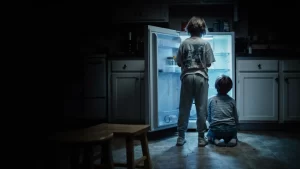
Republicans promised the food-stamp overhaul would not touch the vulnerable. A year on, nearly half a million households with children disagree — and the administration is treating their hunger as a campaign trophy.
They told us, on the record, that the children would be protected. Rep. Glenn “GT” Thompson of Pennsylvania, chair of the House Agriculture Committee, said his party’s overhaul of the Supplemental Nutrition Assistance Program would “restore integrity” and serve “the most vulnerable among us, including children.” Rep. Dusty Johnson of South Dakota was even more specific. “If you have young children at home,” he assured colleagues during floor debate, “your benefits are unaffected by this bill.” Rep. John Rose of Tennessee called the legislation a “historic accomplishment” that would protect “those in need.”
None of that was true. ProPublica reported this morning that at least 776,134 children have been kicked off SNAP in just the twelve states that report participation data by age — the children making up a staggering 46% of everyone purged from the rolls in those states. The independent Center on Budget and Policy Priorities reached the same conclusion last month. Nationwide, 4.3 million fewer Americans were receiving food assistance in February 2026 than the year before, according to USDA’s own figures.
Three of the lawmakers who looked into a camera and promised those children would be safe — Thompson, Johnson, and Rose — did not respond to ProPublica’s questions about their statements. The lawmakers chose silence. The administration chose celebration.
“When children are not healthy, this affects children today and it affects them throughout their lifetimes. Hunger during early childhood is like a brain injury.”
— Dr. Mariana Chilton, Child Hunger Expert, University of Massachusetts Amherst
1. The Promise Was Specific. The Betrayal Is Specific.
Throughout 2024, candidate Donald Trump repeated some version of the same line: he would not touch the safety net. Asked on Fox News’ Sean Hannity show whether he would touch Medicare or Medicaid, he said “none of that stuff is going to be touched.” In a January 2025 Oval Office statement, he was even broader: “We’re going to love and cherish Social Security, Medicare, Medicaid. We’re not going to do anything with that, other than if we can find some abuse or waste.” On NBC’s Meet the Press, the president-elect told viewers, “we’re not touching Social Security.”
SNAP was not the marquee promise — but the entire architecture of those reassurances was that working families and the vulnerable would be spared. The Washington Post documented in April the steady erosion of those guarantees across multiple programs. The One Big Beautiful Bill Act, signed in July 2025, was the legislative vehicle for the breach. It cut $187 billion from SNAP over a decade — a roughly 20% reduction in the program — by tightening work-reporting rules, pushing administrative and benefit costs onto states, and imposing new paperwork demands the Congressional Budget Office never expected states to be able to handle.
The mechanism of harm was not, mostly, an outright eligibility ban for children. The mechanism was bureaucratic strangulation. As Katie Bergh of the Center on Budget and Policy Priorities put it, children are now “collateral damage.” Parke Wilde, a food economist at Tufts, was blunter: the new rules create “a temptation for the states to bump off working families,” whose volatile incomes make accurate benefit calculation harder. Whether children were the stated target is, at this point, a footnote. They are the result.
2. A ‘Record’ Built on Empty Cupboards
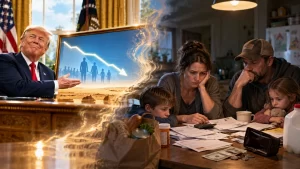
The president has not been quiet about it. In his February 24, 2026 State of the Union address, he told a joint session of Congress that “in one year we have lifted 2.4 million Americans, a record, off of food stamps.” By May, the boast had grown to nearly five million. A White House op-ed in April framed the drop as proof the government was finally working.
The CBO has been clear about what is actually happening. The decline is not the byproduct of families climbing into prosperity. It is the predictable product of new paperwork rules, expanded work-reporting requirements, and an enforcement regime designed to maximize attrition. When Rep. Jim McGovern, a Massachusetts Democrat, pressed Agriculture Secretary Brooke Rollins at a recent House hearing on the 700,000-children figure, Rollins simply denied the number, claiming without evidence that most of those cut off had been “fraudulent” — and dismissing the nonpartisan Center on Budget and Policy Priorities as not nonpartisan. ProPublica independently verified the analysis. The Secretary of Agriculture went on the record calling hundreds of thousands of hungry children a fraud statistic.
Children dropped from SNAP rolls across just twelve states that report by age. The true national number is unknown — the USDA has not detailed the figure. [ProPublica]
Drop in child SNAP recipients in Arizona since July 2025 — 205,223 fewer children. St. Mary’s Food Bank in Phoenix reports a 15% surge in visits this year. [ProPublica]
Share of SNAP applicants who could not reach a state worker by phone in March 2026, up from 61% in November — bureaucratic strangulation by design. [MA DTA]
Fewer Americans receiving SNAP nationwide in February 2026 versus February 2025. The president calls this a “record.” [USDA FNS]
3. Hunger Is a Health Crisis — and Doctors Have Said So for Years
For the medical community, none of this is theoretical. The American Academy of Pediatrics has been on the record for more than a decade: SNAP is, in their words, “medicine for food insecurity.” Children in food-insecure households are sicker more often, recover more slowly, are hospitalized more frequently, and face heightened risks of developmental delay, cognitive impairment, and lasting cardiometabolic disease.
In a February 2026 paper in the AAP journal Hospital Pediatrics, physicians warned explicitly that the 2025 Budget Reconciliation Act’s SNAP changes would directly degrade child health outcomes, noting CBO projections that 96,000 children would lose or see reduced benefits in an average month — a floor, not a ceiling, that the ProPublica reporting has already shattered. Dr. Mariana Chilton at UMass Amherst, one of the country’s leading scholars on childhood hunger, has been blunt: this is “a public health crisis in the making,” and the long-run cost of treating its consequences will dwarf any short-term federal “savings.”
The healthcare system is not an abstraction here. It is a chain of consequences that will land in emergency rooms, school nurses’ offices, NICUs, behavioral health clinics, and primary-care practices in every state. A Commonwealth Fund analysis projected that the combined Medicaid and SNAP cuts would eliminate roughly 477,000 healthcare jobs in 2026 alone — hospital staff, pharmacists, nursing-home workers, clinicians — even as demand for their services rises because food-insecure patients are sicker. Rural hospitals, already operating on thin margins, will absorb more uncompensated care just as their state revenues drop. Some will close. The Food Research and Action Center put it plainly: “Rural hospitals and clinics see higher uncompensated care costs as food insecurity worsens chronic illness.”
Get Involved Today
Contribute to our mission and turn your concerns into action.
4. Why This Reaches the Family That Has Never Touched SNAP
It is tempting, especially for households well above the eligibility line, to assume this is someone else’s policy. It is not. SNAP is not a welfare program that exists in a sealed compartment; it is structural plumbing in the American economy. Every dollar of benefits generates an estimated $1.50 to $1.80 in economic activity during a downturn. When tens of billions of those dollars disappear from grocery aisles, the consequences move through farmers, wholesalers, truckers, retailers, and the local tax bases that fund schools, libraries, and roads.
FRAC’s economic modeling projects that state income-tax revenues will fall by $3.7 billion in 2026 alone, that farmers will lose roughly $24 billion in household-food sales over a decade, and that small grocers in SNAP-heavy regions could see sales decline by as much as 8.7% on average over nine years. The Commonwealth Fund estimates a total of 888,000 jobs lost in 2026 across health care, retail, construction, and manufacturing — across every household in the affected geographies, not only those receiving benefits.
Children dropping off SNAP also lose automatic certification for free school meals through a process called direct certification, which means hungry children show up to classrooms in districts that suddenly have to choose between feeding more kids on a smaller per-pupil budget or cutting other services. School performance suffers. Behavioral problems rise. Eventually the bill arrives — in special education spending, in juvenile justice, in young adults who never quite recover their footing. The Commonwealth Fund’s projection of $8.8 billion in lost state and local tax revenue is a number every homeowner should look at twice. That gap will be closed somehow. It will be closed in your property tax bill or in the services those taxes used to fund.
“For every one meal provided by a food bank, SNAP provides nine. Charity cannot meet the growing need. We are watching the federal government deliberately design a system that pushes eligible families off, and pretend the result is a triumph.”
— Food Research and Action Center, April 2026 Analysis
5. Geography of Cruelty
The harm is not distributed evenly. It is concentrated, and the pattern is consistent. The deepest losses are in states that combine high rural poverty, limited state-agency capacity to handle new paperwork burdens, and political leadership disinclined to backfill cuts from state coffers. Arizona has lost more than half its child SNAP caseload. Louisiana has lost 22%. Rural counties in both states are home to grocery stores operating on margins so thin that even a few percentage points of SNAP-revenue decline can close the doors — leaving food deserts where there used to be a grocery.
The state cost-shift makes the geography worse. Beginning in October 2026, states begin paying 75% of administrative costs, up from 50%. Beginning October 2027, states will pay a share of benefits themselves, calibrated to an “error rate” the USDA itself describes as “largely unintentional” — meaning a state with an inattentive caseworker or a confused applicant can be financially punished for what is, by USDA’s own definition, not fraud. As The Pew Charitable Trusts reported, the rebalancing is the biggest structural change to SNAP since Lyndon Johnson signed the program into law. Several states are already openly discussing whether they can afford to continue participating at all.
Trump signs the One Big Beautiful Bill Act, cutting $187 billion from SNAP over a decade. Republican backers insist children and vulnerable populations will be untouched.
During the federal shutdown, the administration refuses to use available contingency funds to continue SNAP. A Rhode Island federal judge orders payment, accusing the White House of withholding food benefits “for political reasons.”
In the State of the Union, Trump calls the loss of 2.4 million SNAP recipients “a record” — framing collapsing participation as personal achievement.
The Washington Post documents Trump’s retreat from multiple campaign promises to protect entitlements and family programs.
Center on Budget and Policy Priorities reports 700,000 fewer children on SNAP. Secretary Rollins later denies the figure and labels recipients “fraudulent.”
ProPublica publishes confirmed analysis: 776,134 children off SNAP in twelve reporting states. The president boasts on social media.
6. Congress Watches the House Burn
The legislative response has been almost ornamental. In the House, Reps. Jim McGovern, Shontel Brown, and Jahana Hayes introduced the Hunger Free Future Act in spring 2025; it has gathered cosponsors but cannot pass a Republican-controlled chamber. In November 2025, lawmakers introduced the Restoring Food Security for American Families and Farmers Act (H.R. 6088) to repeal the cost-shift. It, too, has gone nowhere. The 2026 Farm Bill, signed earlier this spring, locked in the SNAP cuts even as a sizable bipartisan minority — including 137 House members who signed a letter opposing related pesticide-liability provisions — registered formal objections.
Republican leadership has been disciplined and silent. Senate Agriculture Republicans, when pressed about Rollins’s “fraudulent” characterization of SNAP recipients, declined comment. The three House Agriculture Committee Republicans who promised on the floor that children would not be touched — Thompson, Rose, Johnson — have not retracted. They have not apologized. They have not engaged with the data. They have moved on to other business.
This is the part of the story that should disturb voters across the political spectrum. The lawmakers who made specific, verifiable promises about specific, verifiable populations have not been called to account by their own party. The institutional machinery for holding power accountable — committee oversight, floor questioning, public hearings — has gone almost entirely unused. A line was crossed; the line-drawers were not informed.
The 25th Amendment, the Constitution, and a President Who Cannot Tell Suffering From Success
The Twenty-Fifth Amendment, ratified in 1967, was a direct response to the Kennedy assassination and a recognition that the Constitution had been silent for too long on presidential incapacity. Section 4 provides that the Vice President and a majority of the Cabinet may declare in writing to Congress that the President is “unable to discharge the powers and duties of his office,” at which point the Vice President becomes Acting President. It has never been formally invoked.
It has, however, been called for. In April 2026, Rep. John Larson of Connecticut filed articles of impeachment and simultaneously called on the Cabinet to invoke the 25th Amendment, citing what he called the president’s escalating instability. Sen. Ed Markey of Massachusetts, Reps. Ro Khanna of California, Yassamin Ansari of Arizona, Eric Swalwell of California, and Sydney Kamlager-Dove of California have all publicly called for invocation. Rep. Jamie Raskin of Maryland, one of the country’s foremost constitutional scholars in Congress, filed legislation in April to create a commission to assess whether the amendment should be invoked.
The constitutional argument these lawmakers advance is not narrowly about SNAP. It rests on a pattern: a president who publicly celebrates the loss of food benefits for children as a “record” he personally achieved; who watches his Agriculture Secretary call hungry families “fraudulent” on camera and does not correct her; who repeatedly broke explicit campaign promises about protecting the vulnerable without seeming to recognize the broken promise as morally significant; whose public statements have included threats to “annihilate” entire civilizations and impulsive policy reversals that have alarmed allies, the military, and large parts of his own party. Constitutional scholars across the political spectrum read Section 4 as concerning the capacity to discharge the duties of the office — including, by traditional reading, the duty to act with reasonable judgment on behalf of the American people.
An honest assessment of the barriers: Section 4 has never been used and will almost certainly not be used here. Vice President J.D. Vance, by every public account, supports the president; the Cabinet was selected for loyalty; and the original drafters of the amendment, including former Sen. Birch Bayh, repeatedly emphasized that it was designed for incapacity, not for policy disagreement. Even Democrats who have called for its invocation acknowledge the political reality.
The barriers do not negate the case. They reframe it. The 25th Amendment is unlikely to be invoked — but the underlying constitutional concern it raises is real and it deserves a public reckoning. The duties of the presidency, as enumerated in Article II, include the obligation to “take Care that the Laws be faithfully executed.” When the Secretary of Agriculture publicly mischaracterizes hundreds of thousands of hungry children as fraud, and the President publicly celebrates their loss as a record, that obligation has not been faithfully executed. Whether Congress chooses to enforce that obligation through impeachment, through oversight, or through the next election is a political question. The constitutional question — whether this is what we mean by faithful execution of the duties of the office — answers itself.
Editorial Conclusion
This is not a story about line items in a budget. It is a story about a country that, faced with a documented increase in child hunger of historic proportions, watched its government respond with a victory lap.
The lawmakers who promised the children would be protected have not corrected the record. The Secretary of Agriculture has called those children “fraudulent.” The President has called their suffering “a record.” Congress has the tools — committee subpoenas, appropriations leverage, oversight hearings, the power of the purse, and ultimately the ballot — to demand accountability for promises broken in writing and on camera. It has not used them.
The democratic stakes are simple. A constitutional republic cannot survive a leadership class that experiences the suffering of its own citizens as a public-relations success. The food a child eats at age three is not a partisan question; it is a measurement of whether this government is willing to honor its most basic obligation to the most defenseless people it governs. By that measurement, today, the United States has failed. The next year is the country’s chance to decide whether the failure is the policy or the people who built it.
Sources & References
- ProPublica — More Than 770,000 Children Are No Longer Receiving SNAP Benefits After Trump Changes Federal Food Program (Nicole Santa Cruz, June 17, 2026)
- ProPublica — “The Alarm Bell”: Arizona’s Drop in SNAP Participation Signals Nationwide Impact
- Center on Budget and Policy Priorities — Sharp Drop in Number of Children Receiving SNAP Under New Federal Law
- USDA Food and Nutrition Service — SNAP National Participation Data (February 2026)
- Massachusetts Department of Transitional Assistance — DTA Performance Scorecards
- USDA — SNAP Quality Control and Error Rates
- Washington Post — Trump backs off campaign promises to protect Medicare, help with child care
- ABC News / Good Morning America — Here are the times Trump has said he wouldn’t cut Medicaid
- NBC News / Meet the Press — Trump says ‘we’re not touching’ Social Security
- International Business Times — ‘That’s a Record’: Trump Boasts of His Food-Stamp Cuts as 770,000 Children Dropped Off the Rolls
- KFF Health News — The Nation’s Largest Food Aid Program Is About To See Cuts
- American Academy of Pediatrics — SNAP Is Medicine for Food Insecurity (Pediatrics)
- AAP Hospital Pediatrics — Addressing Food Insecurity Through Hospital-Community Partnerships in a Changing Policy Landscape
- Commonwealth Fund — How Potential Federal Cuts to Medicaid and SNAP Could Trigger the Loss of a Million-Plus Jobs
- Food Research & Action Center — SNAP Cuts in OBBBA/H.R.1: Billionaires Win, Working Families Lose
- Food Research & Action Center — A Deliberate Policy Design for Decline in SNAP Participation
- Pew Charitable Trusts — As SNAP Changes Shift Food Assistance Costs, States Face New Choices
- Recorder (Greenfield, MA) — McGovern co-sponsors bill to stop ‘backdoor’ SNAP cuts
- First Focus on Children — Children Need Congress to Reverse the SNAP Cost Shift to States
- Newsweek — Lawmakers Demand 25th Amendment Be Invoked Against Donald Trump: Full List
- Office of Rep. John Larson — Larson Files Articles of Impeachment, Calls for 25th Amendment
- Axios — House Democrats file long-shot 25th Amendment bill targeting Trump
- PBS NewsHour — Could the 25th Amendment be invoked against Trump? Here’s how it works
- CBS News — Judge orders Trump administration to fully fund SNAP benefits for November
Related News