The Tarp Presidency: What a Covered-Up Memorial Tells Us About a President Who Cannot Lose Gracefully
A federal judge ordered Donald Trump’s name removed from the Kennedy Center. The administration obeyed only after midnight — and then hung a tarp where the letters used to be. The legal filings reveal more than vanity. They reveal an executive branch losing its grip.
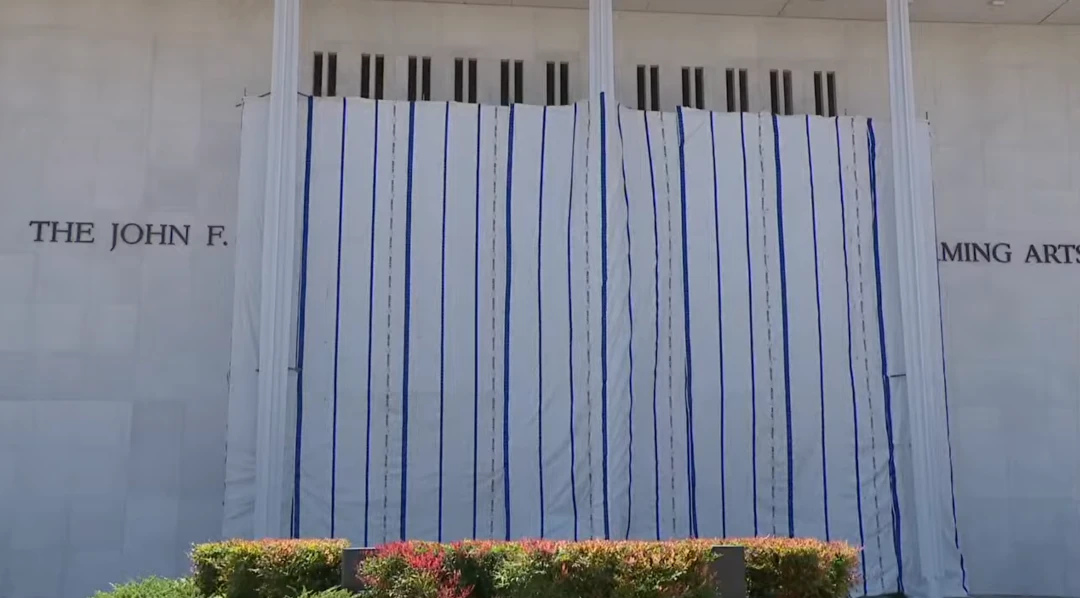
At 3:10 a.m. on Saturday, June 13, neon-vested workmen pulled the bronze letters spelling “Donald J. Trump” off the marble facade of the John F. Kennedy Center for the Performing Arts. They worked behind a tarp. They worked in the dark. They worked hours past the court-ordered deadline. And when the sun came up over the Potomac, the public found that the tarp had not come down — it had only grown wider. Five days later, it is still there, weatherproofed against the rain, manned by three security guards, and hiding from the American people the part of the building where the Kennedy name belongs by law.
The simplest reading is the correct one. A president who calls himself the apex of American power is so unable to absorb the loss of a vanity inscription that he is using federal scaffolding to conceal a national memorial from its citizens. This is not the act of a confident leader. It is the act of a man who cannot tolerate the sight of his own defeat. And the legal record now suggests that defeat is the only thing he is generating.
1. How a Sign Came Down at Three in the Morning
The chain of events is short and damning. In December 2025, the Kennedy Center’s hand-picked board — a body Trump remade by firing trustees and installing himself as chairman earlier in the year — voted to rename the venue “The Donald J. Trump and the John F. Kennedy Memorial Center for the Performing Arts.” Rep. Joyce Beatty of Ohio, an ex-officio trustee, sued. In a 94-page opinion issued May 29, U.S. District Judge Christopher Cooper held that the renaming was unlawful, that the board had overstepped its statutory authority, and that the planned two-year closure of the Center was the product of “an ill-informed and seemingly preordained decision.” He gave the defendants fourteen days to take the lettering down and to fix the website.
For two weeks, almost nothing happened. Then, on the day of the deadline — June 12 — the Justice Department asked Judge Cooper for a stay. He refused. The administration ran to the D.C. Circuit. A three-judge panel including Trump’s own 2017 appointee, Judge Gregory Katsas, rejected the request without explanation. As the sun went down, scaffolding rose. As night fell, a tarp went up. And in the small hours of Saturday morning, the bronze was finally pulled from the marble — not in the daylight, not at a press conference, but in the dark, where no camera could capture the moment a court told a sitting president no.
2. The Tarp Is the Tell
By Monday morning, the sign was gone. The tarp was not. A weatherproof canvas still hung across the facade where the Kennedy name should be visible to every tourist crossing the New Hampshire Avenue plaza. Three security officers patrolled fence barricades blocking pedestrian access to the area. The Kennedy Center spokesperson said the tarp would remain while crews performed “maintenance on the marble and soffit panels” — declining to specify when, or whether, the public would again be permitted to see a building that belongs to them.
The Kennedy Center’s founding statute, lawyers note, governs what cannot be added to the structure. It says nothing about what must be visible — an oversight Congress made because no one in 1958 imagined a president would weaponize a covering against a memorial named for a murdered predecessor. Nathaniel Zelinsky, the attorney representing Beatty, was blunt. The tarp, he told the Washingtonian, is “vintage Donald Trump: hiding a national memorial because he can’t get his way.”
“At best, this is a kind of malicious compliance that’s an attempt to evade the spirit of the court’s decision. It’s vintage Donald Trump: hiding a national memorial because he can’t get his way.”
— Nathaniel Zelinsky, counsel for Rep. Joyce Beatty
There may be no legal remedy for the tarp. Sean Marotta, an appellate lawyer who closely follows the D.C. Circuit, conceded as much: “I’m not sure there’s a legal right to have them take it down.” But the absence of a courtroom remedy is not the absence of a meaning. Tarps are what a child throws over a board game they have lost. Tarps are what a man uses when he has been told, by the United States judiciary, that he cannot have what he wants — and refuses to look at the building until the building agrees to be his.
3. The Brief That Read Like a Truth Social Post
If the tarp is the visible symptom, the appellate filing is the diagnostic image. Late on the afternoon of June 12, Assistant Attorney General Brett Shumate — the head of DOJ’s Civil Division — filed an emergency motion for a stay pending appeal at the D.C. Circuit. The brief is sixty pages. The first six are, in the words of Marotta, “an introduction that sounds like a Truth Social post.”
Three full pages contain not a single paragraph break. The text claims that Trump’s renaming has rescued the Center from being “a bankrupt eyesore that, for years, will [sic] look like nothing more than an abandoned hulk.” It calls Rep. Beatty, the duly-appointed plaintiff in the case, “a troublemaking appointment, from the beginning of her tenure!” It veers into long passages about renovations that are not even being appealed. It introduces — for the first time, with no foundation in the trial record — a brand-new entity called “The Trump Kennedy Center for the Performing Arts Foundation,” and asserts the existence of bylaws under which the removal of Trump’s name would trigger a clawback of hundreds of millions of dollars.
Zelinsky, for the plaintiff, says his team has never heard of this foundation. It might, he allows, be “totally made up.” If it is real, then the brief is essentially telling a federal court that if the judges do not allow the President to violate the law, he will personally engineer the financial destruction of the institution he is statutorily charged to protect. It is, on its face, a constitutional extortion attempt — filed under a Department of Justice signature block.
And here is the second tell. The brief carries exactly one signature: Shumate’s. On a filing of this magnitude, a half-dozen career line attorneys would normally co-sign. Not one did. This is not for lack of pressure: Attorney General Pam Bondi issued a memo at the start of Trump’s second term threatening “discipline and potentially termination” for any attorney who refused to sign a brief on political grounds. The career lawyers risked their jobs to keep their names off this document. They knew what it was.
4. The Anomalies, Counted
5. A Timeline of a Constitutional Tantrum
Get Involved Today
Contribute to our mission and turn your concerns into action.
6. A Pattern, Not a Stunt
A reader sympathetic to the President might say: it’s a sign. It’s a tarp. Why does any of this matter? It matters because the Kennedy Center episode is not a deviation. It is a high-resolution miniature of a presidency that has spent eighteen months substituting personal grievance for institutional duty.
The Center is, by statute, a national memorial. Its board is a fiduciary body. The President’s own appointees were obligated to evaluate his renaming and closure proposals on the merits. The record demonstrates they did not — Beatty’s counsel documented in court that the supposed “one-year review” cited by Trump produced no report and consulted no outside expert during the entire period. Judge Cooper’s opinion, read carefully, is not principally about a name. It is about a board that abandoned its statutory duty because the President wanted it to.
The brief, the tarp, the 3 a.m. compliance, the phantom foundation, the abandoned career attorneys — these are not isolated absurdities. They are the operating system of an administration in which fidelity to the President’s mood has replaced fidelity to the Constitution. The same posture that hides a memorial behind a tarp is the posture that issued the public threat in April that “a whole civilization will die tonight, never to be brought back again” if Iran’s leadership did not meet a unilateral deadline. The same impulsiveness that produces a brief reading like a Truth Social post is the impulsiveness that produces foreign policy by ultimatum. The vessel cannot be partitioned. There is no “petty” Trump and “presidential” Trump. There is only the one man, and what he is doing at the Kennedy Center is what he is doing everywhere.
The Constitution Already Anticipated This
Section 4 of the 25th Amendment, ratified in 1967 in the wake of President Kennedy’s assassination, allows the Vice President — acting together with either a majority of the Cabinet, or with the concurrence of a body Congress establishes by law — to declare the President “unable to discharge the powers and duties of his office.” That phrase is not limited to comas and surgery. It contemplates incapacity of any kind that materially impairs the President’s ability to perform his constitutional functions.
Congress has never created the alternative body. That failure is what Rep. Jamie Raskin (D-MD), ranking member of the House Judiciary Committee, set out to fix on April 14, 2026, when he introduced the Commission on Presidential Capacity to Discharge the Powers and Duties of Office Act, with 50 House Democrats as original co-sponsors. The bill would create a 17-member bipartisan commission empowered to conduct the medical and functional assessment the Amendment explicitly anticipates. Co-sponsors include Rep. John Larson (D-CT), who simultaneously filed articles of impeachment and called publicly on Vice President J.D. Vance and the Cabinet to act, and Rep. Seth Moulton (D-MA), who joined as an original cosponsor citing the constitutional necessity of the body.
Raskin’s stated justification identifies the constitutional argument with precision: “Public trust in Donald Trump’s ability to meet the duties of his office has dropped to unprecedented lows as he threatens to destroy entire civilizations, unleashes chaos in the Middle East while violating Congressional war powers, aggressively insults [Pope Leo XIV] and sends out artistic renderings online likening himself to Jesus Christ. We are at a dangerous precipice, and it is now a matter of national security for Congress to fulfill its responsibilities under the 25th Amendment.”
The Practical Barriers
Honesty requires conceding the political mathematics. The bill will not pass a Republican-controlled House. The Vice President is unlikely to invoke Section 4 against the man who selected him. The Cabinet is staffed almost entirely by loyalists, several of whom were specifically chosen because they had demonstrated a willingness to subordinate institutional roles to presidential mood. Sean Marotta noted that even the Kennedy Center brief was filed by a single political appointee precisely because career lawyers refused. The same dynamic obtains at scale across the executive branch.
Why the Barriers Do Not Negate the Case
The 25th Amendment was never designed to be easy. It was designed to be available. Raskin’s bill is, in the first instance, a Congressional record-builder: it institutionalizes the question of presidential capacity as a matter of constitutional process rather than partisan slogan. The Kennedy Center episode is now part of that record. So is the Iran ultimatum. So is the brief that no career attorney would sign. The case is being assembled in the public sphere, in court filings, and in the documented behavior of a President whose capacity to act within the constraints of law is — at minimum — a legitimate subject of constitutional inquiry. The framers of the Amendment did not require certainty before action. They required only that the constitutional machinery exist. Raskin’s bill is the missing gear.
7. What Leadership Looks Like, and What This Is Instead
A president interested in the Kennedy Center’s restoration would have welcomed Joyce Beatty’s questions about the closure plan, because a fiduciary welcomes scrutiny of fiduciary decisions. A president interested in the institution’s finances would have produced the supposed one-year review, because honest evidence does not need to be invented later in an appellate brief. A president interested in the rule of law would have complied with Judge Cooper’s order without theatrics, because compliance with a judicial decision is what makes a president a president rather than a king.
None of those things happened. What happened instead was the firing of the trustees, the installation of himself as chairman, the renaming of the building, the unannounced shutdown, the lawsuit, the loss, the appeal, the loss, the emergency stay, the loss, the 3 a.m. removal, the tarp, and the brief that no career lawyer would sign. The pattern is the point. Each step represents not a strategic decision but a refusal to accept a constraint. The constraint here is small — a memorial cannot be renamed for a sitting president by board fiat. The reaction is enormous. Multiply that ratio across foreign policy, immigration, congressional oversight, judicial review, and the routine business of government, and you have a presidency in which every modest “no” produces an outsized institutional convulsion.
This is what the constitutional question is really about. It is not whether Donald Trump is sometimes erratic, sometimes coherent, sometimes lucid in a meeting. It is whether the structural pattern of his decision-making — the inability to absorb adverse outcomes, the substitution of personal feeling for institutional duty, the willingness to deploy federal scaffolding to hide a memorial from the public — constitutes an inability to discharge the powers and duties of the office. That is the question Section 4 was written to answer. Raskin’s bill is, finally, the mechanism for asking it formally.
Editorial Conclusion
A tarp is not a policy. It is a confession. The President of the United States lost a routine administrative-law case about a building’s name, and his response was to hide the building from its citizens, file a court brief that career lawyers would not sign, and threaten the financial destruction of the very institution he is legally bound to protect.
The Kennedy Center belongs to the American people. So does the Constitution. The mechanisms it provides — Section 4 of the 25th Amendment, judicial review, congressional oversight — are not partisan instruments. They are the architecture of self-government. When a President’s capacity to function within that architecture is in serious public doubt, Congress is not exceeding its authority by asking the question. It is exercising it.
Take down the tarp. Sign the bill. Let the country see the memorial — and the President — as they actually are.
Sources & References
- AOL / Washingtonian — “The Kennedy Center Legal Situation Keeps Getting Weirder” (June 16, 2026)
- Washingtonian — Sylvie McNamara, original report on the appeal and tarp (June 16, 2026)
- CBS News — “Judge blocks closure of Kennedy Center and orders removal of Trump’s name”
- NPR — “Kennedy Center removes Trump’s name from building” (June 13, 2026)
- CNN Politics — “Kennedy Center says it has fully removed Trump’s name from its building”
- CNBC — “Trump name must be removed from Kennedy Center as appeals court rejects delay”
- ABC News — “Kennedy Center misses deadline to remove Trump’s name”
- News From The States — “Kennedy Center facade blocked from public view by tarp” (June 15, 2026)
- WTOP News — “PHOTOS: What’s under the tarp? Kennedy Center facade covered”
- PBS NewsHour — “Trump’s name removed from the Kennedy Center building following court-ordered deadline”
- NBC News — “Judge temporarily halts Kennedy Center closure and orders removal of Trump’s name”
- Office of Rep. Joyce Beatty — Press release on Cooper ruling
- Office of Rep. Joyce Beatty — Counsel statement on court-ordered disclosure
- Law Dork (Chris Geidner) — “Trump will be petty” analysis of the litigation
- Law and Chaos — “At The Kennedy Center, It’s Curtains For Trump” by Liz Dye
- Office of Rep. Jamie Raskin — Press release on Commission on Presidential Capacity Act
- Common Dreams — “Raskin Bill Would Create Commission to Examine President’s Fitness”
- The Hill — “Concerns Grow Over Trump’s Mental Fitness for Presidency”
Related News