The Superpower That Sailed Away
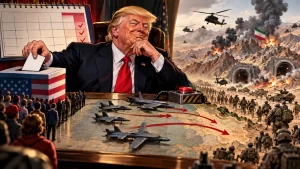
As the last U.S. aircraft carrier leaves the western Pacific and Xi Jinping openly courts the Global South as the stable alternative to American power, Donald Trump is preoccupied with a ballroom, a triumphal arch, and a war he cannot end. The abandonment is not theoretical. It is happening now — in the Sea of Japan, in the Strait of Hormuz, and in the ruined East Wing of the White House.
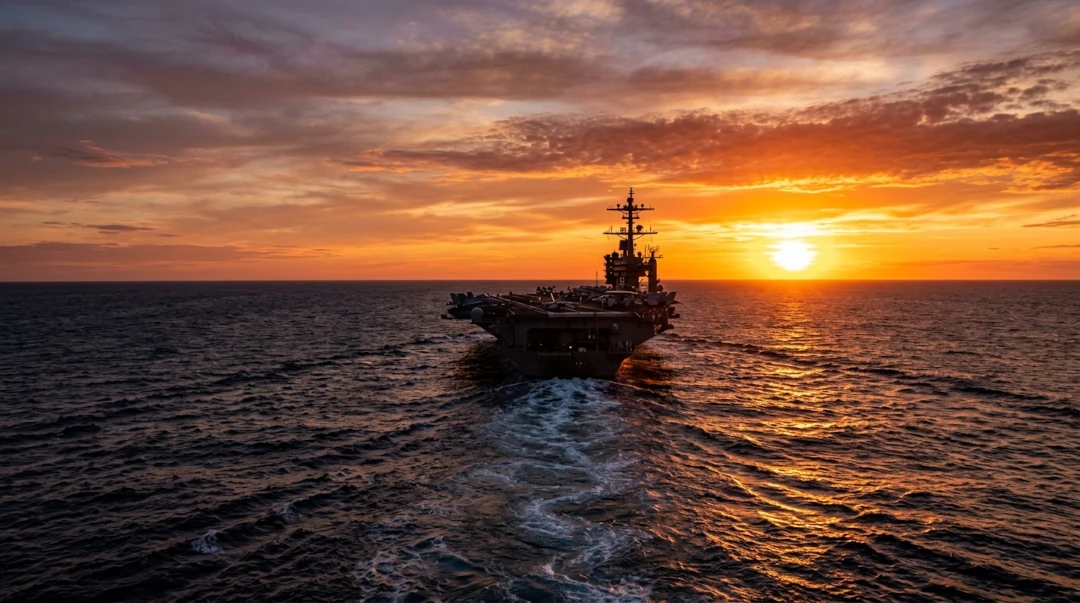
There is a particular kind of imperial rot that announces itself not in a single battle lost but in the sudden, quiet emptiness of a sea. On August 15, the Associated Press reported what naval planners had been dreading for months: the USS George Washington, the last American aircraft carrier operating in the western Pacific, is being pulled from its Yokosuka-based patrol and sent instead to the Middle East, where the USS Abraham Lincoln has been at sea for more than 250 days supporting Donald Trump’s open-ended war with Iran. For a period of weeks or months, the Pacific — the theater the Pentagon has identified for a decade as the most consequential in the world — will contain no U.S. supercarrier at all.
The historical significance of that fact is difficult to overstate. Since 1945, an unbroken forward American naval presence in East Asia has been the load-bearing beam of the postwar order — the tacit guarantee that undergirded Japan’s rearmament restraint, South Korea’s democracy, Taiwan’s continued existence, and the freedom of navigation on which roughly a third of global maritime commerce depends. That beam has been removed. And it has been removed not by a great-power adversary or a diplomatic reversal, but by the sheer administrative incapacity of an American presidency that has run its own carriers into the ground while its Commander-in-Chief pushes for a $400 million private ballroom and a 250-foot triumphal arch on the National Mall.
The removal was not a strategic decision. It was the mechanical consequence of exhaustion. As PBS reported, the Lincoln’s May return home was cancelled to keep it flying combat missions over Iran; the Washington is now being sent as its relief. The Navy has eleven carriers on paper. It typically deploys two or three. The war Trump has refused to conclude, combined with a parallel operation to seize Venezuela and open-ended patrols in the Caribbean, has stretched that architecture past its designed limits. Bryan Clark of the Hudson Institute, a former Navy submariner, told the AP the obvious: the U.S. is no longer “the big dog in the western Pacific.”
I. The Empty Ocean
Into that vacuum has sailed, quite literally, the Chinese and Russian navies. From July 6 through mid-July, Beijing and Moscow conducted “Joint Sea-2026,” a live-fire exercise off Qingdao that concluded with a joint patrol in the western Pacific. As Stars and Stripes reported, the exercise coincided with the People’s Liberation Army Navy test-firing a strategic missile from a nuclear-powered submarine into the Pacific — a test that landed inside the South Pacific Nuclear Free Zone and drew formal protests from Japan, Australia, and New Zealand. The 2025 iteration of the same drill — Joint Sea-2025 — had been held in the Sea of Japan, where, per USNI News, Russian and Chinese aircraft rehearsed the destruction of a simulated enemy submarine and shelled a mock amphibious landing force. The exercises are annual; what has changed is that no American carrier is watching them anymore.
Grant Newsham, a retired Marine colonel with the Japan Forum for Strategic Studies in Tokyo, put the strategic reading in plain terms to Stars and Stripes: China has been clear about its intentions — to dominate the region and drive the Americans out. Every incremental Chinese and Russian gesture in these waters is now being read by Manila, Tokyo, Seoul and Taipei as an answer to a question Washington is no longer bothering to ask.
The Xi Jinping state visit scheduled for September 24 — the first Chinese state visit to Washington since 2015 — was intended to be the diplomatic centerpiece of Trump’s second term. According to the South China Morning Post, Chinese officials preparing the summit are describing a Trump administration so disorganized that no U.S. agency has assumed responsibility for hosting the trip, and no meaningful deliverables have been agreed. The Epoch Times, citing sources within the Chinese Communist Party’s foreign affairs apparatus, has reported that Beijing has prepared cancellation as one option on the table. On August 18, Bloomberg reported that Xi will decline to address the UN General Assembly during the trip — a signal that Beijing has already downgraded the visit’s symbolic weight before Trump can. The presumptive superpower is being managed by the challenger.
II. Xi’s Sermon
Xi Jinping has read the moment and named it. In his virtual address to the BRICS summit last September — a speech Chinese state media have since amplified across the Global South — Xi framed the current international order as a contest between multilateralism and what he called, without ever using the word “America,” an unnamed hegemon. The Chinese government’s official translation is worth quoting on the record: hegemonism, unilateralism, and protectionism are getting more and more rampant, and trade wars and tariff wars waged by “some country” are disrupting international trade rules.
“Hegemonism, unilateralism, and protectionism are getting more and more rampant. Trade wars and tariff wars waged by some country severely disrupt the world economy.”
— Xi Jinping, virtual BRICS Summit, September 8, 2025
No serious reader in any foreign ministry took “some country” to mean anything but the United States under Donald Trump. What Xi was offering — with China as the presumptive host of a widening BRICS+ coalition that now includes Iran, the UAE, Egypt, Ethiopia, Indonesia, and Saudi Arabia observing — was an alternative table around which the world can sit. The invitation is now being answered in ways Washington cannot claw back overnight: Russia and China now settle roughly ninety percent of bilateral trade in rubles and yuan; Project mBridge and BRICS Pay have processed more than $55 billion in cross-border central-bank transactions since November 2025. The dollar is not being toppled. It is being routed around.
The economic message from Xi is inseparable from the military one. In the same week the George Washington was departing the Pacific, Trump announced a new posture toward South Korea in which continued U.S. troop protection was made conditional on Seoul’s cooperation with unrelated administration objectives — an approach that the Congressional Research Service noted has raised the specter of American abandonment across the region. Earlier this year, House Armed Services Chairman Mike Rogers (R-Ala.) and Senate Armed Services Chairman Roger Wicker (R-Miss.) — both Republicans — issued a rare bipartisan rebuke warning the White House against abandoning the NATO Supreme Allied Commander post and Pacific troop buildup plans. Their warning was ignored.
Get Involved Today
Contribute to our mission and turn your concerns into action.
III. The Silence on the Hill
What has Congress done? Almost nothing. The Iran war is now approaching its sixth month — a war begun, as Rep. Jamie Raskin (D-Md.) has correctly noted, without a congressional declaration and in continuing violation of the War Powers Resolution. There has been no floor vote to authorize it. There has been no serious oversight hearing on the collapse of forward-deployed carrier presence. The House Armed Services Committee has held no televised session on the mental-health crisis aboard the USS Abraham Lincoln, where Sen. Richard Blumenthal (D-Conn.) has now had to send his own letter to Secretary Hegseth and Acting Navy Secretary Hung Cao demanding answers about basic supplies, water, plumbing, sailor safety, and reports of multiple overboard attempts.
The Democratic leadership’s response has been to give speeches and issue statements. Senate Minority Leader Chuck Schumer and House Minority Leader Hakeem Jeffries — under whose stewardship Senate Democrats capitulated to end last year’s shutdown without meaningful concessions — have declined to force the confrontation their constituents plainly demand. The party’s own base has noticed. An Our Revolution survey published in November found that ninety percent of respondents want Schumer to step aside as Senate leader and seventy-seven percent would back a primary challenge to Jeffries. Sen. Elissa Slotkin (D-Mich.) has publicly called for “significant new leadership” and told SiriusXM that “the old models are no longer working.” Rep. Seth Moulton (D-Mass.) has said flatly it should not be Chuck Schumer.
The criticism is not merely generational. It is substantive. Progressives inside and outside the caucus have documented what the leadership’s calendar reveals: too much time cultivating large-dollar donors, too much time triangulating on issues where the moral answer is obvious, too little time using the leverage Congress actually possesses — appropriations, subpoena, motions to compel — to end a war it never authorized. When the president’s own party in the House and Senate armed services committees is writing letters warning him against dismantling NATO and the Pacific, and the opposition party is holding book tours, the constitutional oversight system is not merely broken. It has been abandoned.
The tacit enablers stretch further. Cabinet officers who know better sit silent. The Vice President — the constitutional first mover under the 25th Amendment’s Section Four — has not so much as hinted at the possibility of using it. Republican senators who once described this president in private as a danger have chosen the ballroom over the Constitution. Every day they do so, the erosion accelerates.
IV. The Ballroom and the Arch
To understand what has replaced governance at the White House, one need only walk to where the East Wing used to stand. It is now a construction pit. In October 2025, the administration demolished the historic East Wing to make way for a $400 million neoclassical ballroom Trump has personally championed, with capacity for 999 guests and bulletproof glass on all sides. The project is being financed by “private donors” — a euphemism that in practice has meant seven- and eight-figure contributions from Google (as part of a lawsuit settlement), Booz Allen Hamilton, Lockheed Martin, Palantir, and NextEra Energy, among others. Donors will reportedly have their names etched in the stone. On August 7, the U.S. Court of Appeals for the D.C. Circuit ruled the ballroom’s above-ground construction requires congressional approval. Trump has vowed to appeal to the Supreme Court and continue underground work in the meantime.
Adjacent to the ballroom project is the president’s proposed 250-foot “Triumphal Arch,” to be built at West Potomac Park across from the Lincoln Memorial. Trump has called it, in a Truth Social post, the greatest and most beautiful triumphal arch anywhere in the world. The Commission of Fine Arts — now composed entirely of members Trump appointed after firing the previous six commissioners in October 2025 — has approved the concept design. The National Park Service has warned it intrudes on the viewsheds of protected historic properties. Trump has said construction will begin within two months.
“They’re using this as part of the narrative to demonstrate to the Philippines, Japan, Indonesia and others that the U.S. is not the big dog in the western Pacific anymore.”
— Bryan Clark, Hudson Institute, on the carrier withdrawal (AP)
The juxtaposition is not editorial ornament. It is the material fact: while sailors on the Abraham Lincoln go 250 days without shore leave, while at least one has gone overboard and been recovered by helicopter, suffering what has been called a mental-health case, while families told Acting Secretary Cao and Vice Admirals Verissimo and Cahill at a San Diego town hall that leadership had “broken trust,” the Commander-in-Chief is auditioning bulletproof glass and stone-carved donor recognition. A president who cannot sustain a single carrier crew at sea has decided the more urgent business of the Republic is his monument.
V. What Comes Home
None of this is confined to a map. The retreat abroad is landing, hard, in American kitchens and paychecks. The nonpartisan Tax Foundation has calculated that Trump’s tariffs — the “tariff war” Xi named without naming — amounted to an average tax increase of $1,000 per U.S. household in 2025 and will rise to $1,300 in 2026 if the policies stay in place. The Center for American Progress documents that electricity prices rose 2.5 times the annual inflation rate in 2025 — the sharpest annual increase since December 2014 — and that 1.4 million fewer Americans have enrolled in ACA marketplace plans as insurers priced in tariff impacts.
Tourism has cratered. The U.S. Travel Association reports international inbound visits fell 5.5 percent in 2025 to 68.3 million, and the decline has continued into 2026 — with January posting a 4.8 percent year-over-year drop, the ninth straight month of decline. The World Travel and Tourism Council concluded that the United States was the only country among 184 destinations analyzed to see international visitor spending fall in 2025, a loss Fortune quantified at more than $14 billion. Canadian tourism — historically the single largest source of foreign visitors — dropped roughly twenty percent. The Skift index found forty-six percent of surveyed travelers said they were less likely to visit the U.S. because of Trump. The 2026 World Cup, which was supposed to be a boon, is now casting shadows on hotel projections in Los Angeles, Miami, and New York.
The social costs travel with the economic ones. A society that abandons its allies teaches its own citizens that solidarity is optional, and that the strong owe nothing to the weak. A president who abandons his own sailors — leaving them at sea until they go overboard — is teaching precisely the same lesson at home to teachers, veterans, disabled workers, immigrant families, and everyone else who was told to trust the government’s word. The BRICS competitor Xi is building overseas is answered domestically by the erosion of American civic trust. Both are downstream of the same failure of stewardship.
The 25th Amendment Question
The Twenty-Fifth Amendment, ratified in 1967 in the wake of the Kennedy assassination, provides in Section 4 that whenever the Vice President and a majority of the principal officers of the executive departments transmit their written declaration that the President is “unable to discharge the powers and duties of his office,” the Vice President immediately assumes those powers as Acting President. The President may contest the finding, at which point Congress decides — a two-thirds vote of both chambers is required to keep the transfer in place. It was not written for a comatose president. It was written for exactly the ambiguous cases in which a president’s capacity to perform the constitutional duties of the office has become the central question of national security.
That is the question now on the table. On April 10, 2026, House Judiciary Ranking Member Rep. Jamie Raskin (D-Md.) wrote to White House Physician Capt. Sean Barbabella demanding a comprehensive cognitive and neurological evaluation of the President and full public disclosure of the findings. Four days earlier, Rep. Raja Krishnamoorthi (D-Ill.) had called on Vice President J.D. Vance and the Cabinet to immediately invoke Section Four to remove the President from office. Rep. Jasmine Crockett (D-Tex.) sent a parallel letter to the Vice President the same day, writing that it had become indisputably apparent the President is deranged, likely suffering from dementia. On April 14, Raskin introduced legislation to establish a bipartisan independent commission — the mechanism the Amendment itself expressly authorizes Congress to create — to assess presidential fitness.
The constitutional argument is direct. The powers a president must be capable of discharging include the sustained direction of the armed forces, the coherent conduct of foreign relations, and the faithful execution of the laws. A president who allows the Navy to run one of its own carriers into a mental-health crisis without correction, who cedes the Pacific theater by administrative default, who cannot organize the reception of a foreign head of state to which he himself invited the visitor, and whose energies are visibly consumed by a private ballroom and a triumphal arch — is a president whose capacity to discharge the office has become an operational question, not a partisan one.
The practical barriers are real. Section Four requires the Vice President and a majority of the Cabinet — the very people who owe their positions to the President — to act. It has never been successfully invoked. The odds of Vance breaking with Trump are, by any honest assessment, near zero. Ratified 1967. Never used against a sitting president’s will. The barriers are steep and well-documented.
The barriers do not extinguish the argument; they clarify the record. Congress’s independent power to establish a commission of assessment under the Amendment’s own text remains available and unused. Public documentation of specific presidential incapacity — deployments abandoned, allies abandoned, sailors abandoned — is the necessary predicate for any lawful use of the Amendment now or in the future. Silence is the choice that guarantees the tool decays into a museum piece. Speech is the choice that keeps it a constitutional instrument.
Editorial Conclusion
A superpower does not fall because its adversaries grow strong. It falls because its custodians stop tending it. The last American carrier has left the Pacific because Donald Trump’s war with Iran will not end and his administration cannot organize a state visit. The Chinese and Russian navies patrol the Sea of Japan because the president is building a ballroom. The 25th Amendment was not written for the comatose. It was written for exactly this — a chief executive whose incapacity has become the central risk to the Republic he swore to defend.
Congress must act. The Vice President must act. If they will not — if the party of the President will not police him and the party of the opposition will not lead — then the record now assembled is the case the voters will settle in November 2026. What is required is not new. It is the ordinary courage of officials who took an oath to the Constitution and not to a ballroom. The Pacific is empty. The hour is late. Democracy in the United States now depends on whether anyone still in office remembers what the office is for.
Sources & References
- Associated Press / ABC News — U.S. pulls last aircraft carrier in Asia as Trump focuses on Iran (Aug 16, 2026)
- Washington Post — U.S. pulls last aircraft carrier in Asia as Trump focuses on Iran (Aug 15, 2026)
- PBS NewsHour — Carrier withdrawal and the Western Hemisphere focus
- South China Morning Post — China rattled by Trump White House chaos weeks ahead of Xi visit (Aug 16, 2026)
- Bloomberg — Xi to skip UN meeting during U.S. trip (Aug 18, 2026)
- The Epoch Times — CCP prepares counter-U.S. strategies, including trip cancellation
- Stars and Stripes — China-Russia naval exercise challenges U.S.-led military might (Jul 6, 2026)
- USNI News — Russia, China simulate attack on enemy submarine in Sea of Japan
- Ministry of Foreign Affairs, PRC — Full text of Xi’s statement at virtual BRICS Summit
- CNN — Sailor overboard from USS Abraham Lincoln (Aug 13, 2026)
- Military Times — Sen. Blumenthal presses Navy on Lincoln deployment
- Stars and Stripes — USS Lincoln families press Navy leaders on sailors’ mental health
- House Judiciary Democrats — Rep. Raskin demands cognitive evaluation of Trump, 25th Amendment
- Office of Rep. Krishnamoorthi — Krishnamoorthi calls for Trump’s removal under 25th Amendment
- Office of Rep. Jasmine Crockett — Crockett calls on Vance and Cabinet to invoke 25th Amendment
- NPR — Trump touts newly released plans for D.C. triumphal arch
- PBS NewsHour — Fine Arts Commission approves arch concept
- CBS News — Trump unveils arch model at White House ballroom fundraiser
- Tax Foundation — Tracking the impact of Trump tariffs & trade war
- Center for American Progress — Year in review: how Trump’s economic policies made life less affordable
- Fortune — Tourism had a record-breaking 2025 everywhere but the U.S.
- Forbes — U.S. tourism’s ‘Trump Slump’ rolls into 2026
- Common Dreams — Jeffries draws progressive ire for backing Schumer
- Newsweek — Full list of Democrats rallying against Schumer
- Yahoo / Military Times — GOP leaders warn Trump not to abandon NATO post, Pacific buildup
- Watcher.Guru — BRICS de-dollarization in 2026
Related News