The Box in the Everglades: What Happened Inside Alligator Alcatraz — and Why the President Laughed
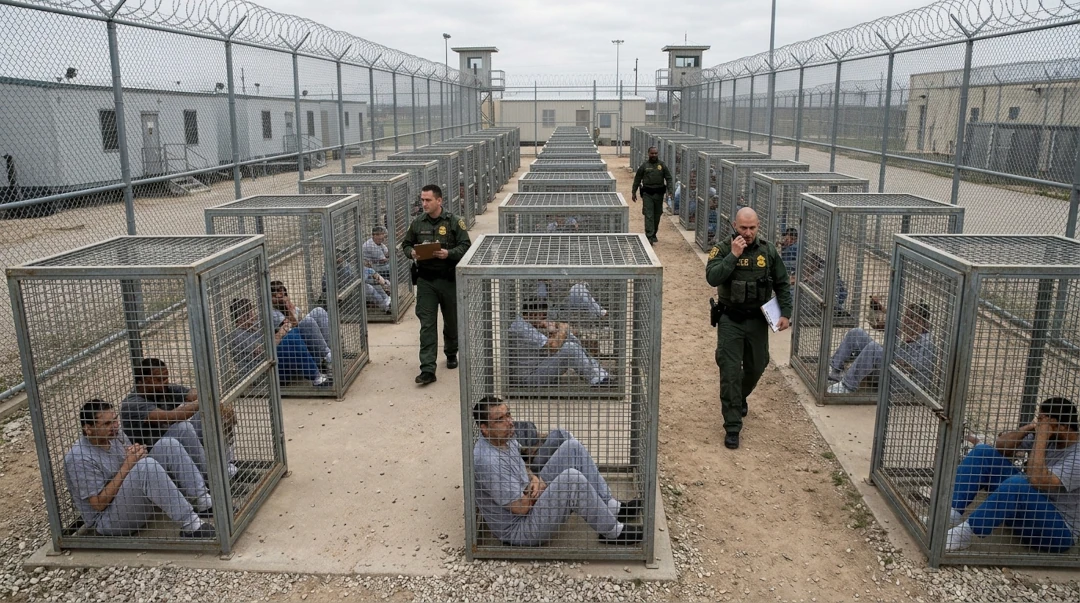
A federal watchdog has now confirmed what detainees, lawyers, and Amnesty International reported for more than a year: immigrants at Florida’s shuttered Everglades detention camp were locked in outdoor metal cages the size of phone booths. The practice was unprecedented. The cost was staggering. The oversight was blocked. And the President treated the entire thing as a punchline.
On September 11, 2026 — a date already heavy with meaning for a country still grieving loss and still arguing about liberty — the Department of Homeland Security’s independent Office of Inspector General quietly released a report that should shake the conscience of every American. Inside a soft-sided tent camp in the middle of the Florida Everglades — a facility the state’s own attorney general branded “Alligator Alcatraz” as a marketing exercise — federal inspectors documented a practice they had “never” observed at any Immigration and Customs Enforcement facility they had ever inspected. Human beings were being locked inside metal cages the size of telephone booths and told, in the sanitized bureaucratic language of the officials who cage them, to “reflect on their behavior choices.”
The cages were called “calming areas.” That is the phrase the government used. Detainees were reportedly placed inside them, according to the inspector general, to “manage their emotions, reduce stress and practice self-directed behavior.” The enclosures measured roughly four feet by four feet. Two of them stood outdoors, in the Florida sun and heat, without room for a person to lie down. Some detainees, the OIG found, were held inside them for nearly two hours. Between the facility’s opening in July 2025 and the inspection in January 2026, seventy-nine people were confined this way. Staff insisted the men were not locked in. The inspectors observed locking mechanisms on the cages.
The story of Alligator Alcatraz is not simply a story about one closed detention camp in the middle of a swamp. It is a story about what the second Trump administration has been willing to do — to human beings, to the Treasury, to congressional oversight, to the Constitution — in the name of a mass deportation program that even ICE veterans reportedly did not want. It is the story of a president who joked about detainees being eaten by alligators, of a governor who used no-bid contracts to raise a camp in eight days, and of a Republican Party in Congress that has refused, at every turn, to conduct the oversight the Constitution empowers it to conduct. This editorial is our attempt to lay out, in plain terms, what the record now shows.
I. The Box: What the Inspector General Found
The DHS Office of Inspector General is not a progressive advocacy group. Its current head, Joseph Cuffari, is one of the few cabinet-level inspectors general the Trump administration did not fire in its 2025 purge of independent watchdogs. His office’s inspectors visited the Florida Soft-Sided Facility unannounced on January 21, 2026. The formal report — OIG-26-22 — was delayed for months by what the office described as a lapse in appropriations from February through April. It was quietly released this month.
What the OIG documented is not ambiguous. In the report’s own language, the practice of confining detainees in these metal enclosures was, according to “unprecedented among detention facilities OIG has inspected” and presented “significant risks to detainee health and safety.” Inspectors reported that facility staff “could not clearly identify which detention standards they used” at all, and quoted one anonymous official saying it was “so gray as to whose place this is.” That gray zone — a state-operated facility holding federal detainees under a Section 287(g) delegation, funded by hundreds of millions in FEMA money — was not an accident. It was the entire point of the design.
Detainees who spoke to Amnesty International in September 2025 already had a name for the outdoor cages: the box. In the WLRN journalism that first surfaced these accounts, a Nicaraguan man with no criminal record described being shackled and forced to stand in a metal enclosure under the summer sun with no water — as punishment, he said, for talking back. Florida officials denied it. DHS denied it. For fourteen months, the government’s line was that the accusations were fabricated. This week the government’s own inspector general confirmed the men were telling the truth.
“Use of these small metal enclosures for any reason is unprecedented among detention facilities OIG has inspected and presents significant risks to detainee health and safety.”
— DHS Office of Inspector General, Report OIG-26-22, September 11, 2026
II. The Money Pit and the No-Bid Bonanza
Alligator Alcatraz was not merely inhumane. It was, at the same time, one of the most expensive detention experiments in modern American history. A financial analysis by CBS News Miami found the cost per detainee at Alligator Alcatraz was $3,571 per day. According to the same reporting, the Office of Homeland Security Statistics estimated the average ICE cost per detainee in 2024 at about $165 a day. In other words, taxpayers were paying more than twenty times the going rate to house men in a swamp — inside chain-link cages, under lights that never turned off, next to overflowing chemical toilets.
The facility was built in eight days using no-bid contracts issued through Florida’s Division of Emergency Management. According to a NewsNation review of state contract data, at least $245 million was signed in vendor contracts in the first weeks — a figure the Associated Press later confirmed ballooned to $405 million by late summer. CBS News Miami reported that one single vendor — a portable-toilet firm called Doodie Calls — was awarded a contract worth more than $200 million to handle sanitation, laundry, and showers. The Associated Press estimated $50 million alone was allocated for the bathrooms — the same bathrooms Amnesty International later documented as overflowing with sewage.
When Florida state Representative Anna Eskamani tried to inspect these contracts, she found that a dozen of them, worth more than $200 million, had been quietly scrubbed from the state’s public contract-tracking database. State officials claimed the contracts contained “proprietary information.” Eskamani was not persuaded. “There are no trade secrets,” she told Reason magazine. “Only government grift to no-bid contracts.”
None of this even accounts for the aftermath. Court filings reviewed by the Associated Press indicate that shutting the facility down cost the state an additional $15–20 million immediately, with another $15–20 million on top if Florida is later allowed to reopen it. Florida taxpayers may end up on the hook for most of the $218 million the state has already spent, since FEMA has declined to write the blanket check the DeSantis administration expected. When the state pleaded that it could not afford the $180,000 needed to install court-ordered phone lines so detainees could reach their lawyers, a federal judge was unmoved.
III. What Amnesty International Called Torture
Long before the DHS inspector general put its imprimatur on any of this, one of the world’s most respected human rights organizations had already done the reporting. In December 2025, Amnesty International released a sixty-one-page investigation, “Torture and Enforced Disappearances in the Sunshine State,” based on a September 2025 research mission to southern Florida. Its findings on Alligator Alcatraz and the nearby Krome North Service Processing Center are not the kind of language international organizations use lightly. Amnesty concluded that the use of “the box” at Alligator Alcatraz met the definition of torture under the United Nations Convention Against Torture.
Amnesty’s researchers were denied access to Alligator Alcatraz itself and to the Glades County Detention Center. They instead interviewed four former Alligator Alcatraz detainees who had been transferred to Krome. Those men, whose identities were withheld, described a detention regime that included, in the words of Amnesty’s UK summary of the report: overflowing toilets with fecal matter seeping into sleeping areas, limited access to showers, exposure to insects without protective measures, lights left on twenty-four hours a day, poor-quality food and water, being shackled every time they were removed from their cells including to eat, and verbal racial abuse from guards.
Ana Piquer, Amnesty International’s regional director for the Americas, put the point plainly. The pattern documented at Alligator Alcatraz and Krome, she said in Amnesty’s statement, is not the product of accident or oversight. It is a deliberate system built to punish, dehumanize, and hide the suffering of people in detention. The DeSantis administration’s response, delivered by spokesperson Molly Best to Axios, was to call the report “a politically motivated attack” and its findings “fabrications.” Nine months later, the federal government’s own inspector general validated most of what Amnesty had documented.
Get Involved Today
Contribute to our mission and turn your concerns into action.
IV. When Congress Tried to Look
Every step of the way, elected officials with a legal right to inspect Alligator Alcatraz were kept out. On July 3, 2025 — the day the first detainees arrived — five Democratic Florida state lawmakers arrived at the gate, badges in hand, invoking a state statute that plainly gives legislators the right to inspect any state-operated facility at their pleasure. They were turned away. State Senator Shevrin Jones (D-Miami Gardens) posted a two-word summary online: access denied.
Florida Democratic Party Chair Nikki Fried asked the obvious question in a statement that afternoon: “What are Ron DeSantis and his administration trying to hide? If it’s unsafe for lawmakers to visit, how is it safe for anyone inside?” The lawmakers sued. A spokesperson for Governor DeSantis called the lawsuit “dumb.” A Florida judge later rejected the legislators’ claim on the theory that Alligator Alcatraz was not, in law, a “correctional facility” — a bureaucratic technicality that would astonish any of the men held inside its metal cages.
On the federal side, Representative Debbie Wasserman Schultz, senior Democrat in the Florida delegation, and seven congressional colleagues introduced the No Cages in the Everglades Act, which would defund the facility and mandate greater oversight of all similar sites. As Wasserman Schultz put it in a statement: “Trump and Ron DeSantis have exploited legal ambiguity around this Everglades internment camp to avoid any scrutiny of abuses there.” Under a Republican-controlled Congress, the legislation has no realistic path to a vote. Senators Jon Ossoff (D-Ga.) and Dick Durbin (D-Ill.) sent a formal letter in March demanding information on the metal cages specifically; DHS did not meaningfully respond until the OIG report forced its hand.
The Constitution vests oversight authority in Congress under Article I. The Republican majority has simply declined to use it. That is a political choice, not a constitutional constraint — and it is why the burden has fallen to a handful of Democratic legislators, civil rights groups, and one appointed inspector general to establish the basic facts of what our government has been doing.
“This place is a stunt, and they’re abusing human beings here.”
— Rep. Debbie Wasserman Schultz (D-Fla.), After Touring Alligator Alcatraz, July 12, 2025
V. The Courts Have Tried. The Executive Has Resisted.
Federal courts have engaged with Alligator Alcatraz across multiple lawsuits, and their track record is mixed but revealing. U.S. District Judge Kathleen Williams ultimately ordered the site closed on environmental grounds, ruling that the DeSantis administration and its federal partners had failed to conduct required environmental reviews and had created, in her words, “irreparable harm in the form of habitat loss” to endangered species. U.S. District Judge Sheri Polster Chappell, hearing the ACLU’s legal-access suit, issued a preliminary injunction requiring officials to allow confidential attorney meetings and unannounced legal visits — rights guaranteed by both ICE’s own standards and the First Amendment. Even a Trump-appointed judge, Rodolfo Ruiz II, warned in his own ruling that his court’s role was to remedy constitutional violations, not to serve as “the warden of ‘Alligator Alcatraz.'”
The administration’s pattern in response has been to concede the minimum, delay the rest, and shift blame to the state. When the OIG delivered its report, DHS wrote back that it did not have a contract to manage the detention space, insisting Florida maintained authority over day-to-day operations. Florida, in turn, pointed at the federal government, which had obligated $608 million in federal money to the project. The OIG made ten formal recommendations for reform. All ten were administratively closed when the facility itself shuttered in June. Nobody, in other words, will ever be required to fix what was found.
VI. The President Laughed
All of this — the cages, the cost, the sewage, the blocked lawmakers, the Amnesty report, the courts — has occurred against the backdrop of a president who has treated the entire enterprise as spectacle. On July 1, 2025, before touring the facility, Donald Trump was asked by a Fox News reporter whether the point of Alligator Alcatraz was to have escaping detainees eaten by alligators or snakes. “I guess that’s the concept,” the president replied, smiling. “This is not a nice business.”
He went on to advise detainees, hypothetically, on how to run from an alligator. Not in a straight line, he said, tracing a zigzag pattern with his hands. “Your chances go up about one percent.” At the tour itself, standing alongside DHS Secretary Kristi Noem and Governor DeSantis, the president described the alligators as “cops” who “don’t have to be paid so much” and declared the facility “a little controversial, but I couldn’t care less.” He praised the model as one that other states should replicate.
This is the President of the United States. The men he was joking about were not, in most cases, “the most vicious people on the planet” his rhetoric described. They were, according to the independent enforcement data compiled by watchdog groups, largely people with no serious criminal record — asylum seekers, workers, and, in a growing number of documented cases, U.S. citizens themselves. In September 2025, PBS NewsHour aired the account of Andrea Velez, a U.S. citizen who says she was wrongfully arrested during an ICE raid in downtown Los Angeles and held for two nights. She is one of many.
Historians of American racial rhetoric were quick to notice something else about the president’s alligator jokes. As MSNBC noted at the time, “alligator bait” was Jim Crow-era propaganda used to dehumanize Black Americans. The imagery did not appear to be an accident. The cruelty, to borrow the observation many made across the political spectrum during his first term, was the point.
VII. What This Means for You
It is tempting, especially for citizens who have never worried about their status, to treat Alligator Alcatraz as someone else’s problem. The story is far away, the victims are undocumented, the facility is now closed. This is a mistake. The infrastructure being built — the no-bid contracts, the state-federal jurisdictional shell game, the metal cages, the routine denial of counsel, the mockery from the top — is not being built to hold seventy-nine detainees in a swamp. It is being built to hold whoever this or any future administration decides to hold.
The American Immigration Council reported in January that arrests of people with no criminal record surged by 2,450 percent in the administration’s first year, driven by “at-large” arrests, roving patrols, worksite raids, and re-arrests of people who showed up at their own immigration court hearings. The Government Accountability Office found that ICE’s average daily detained population grew from 39,314 in January 2025 to 67,204 by April 2026 — a seventy-one percent increase in fourteen months. More deaths occurred in ICE custody in 2025 than in the previous four years combined.
If, one day, you are the wrong person at the wrong worksite, or your name matches someone else’s on a warrant, or a masked federal officer decides your citizenship claim needs to be verified through the intake process — the machinery documented at Alligator Alcatraz is what awaits. That is not hypothetical. It happened to Andrea Velez. It happened to a U.S. citizen born in Colorado who was pressured to sign voluntary departure papers and deported to Mexico before his family could produce his birth certificate. It is a system in which the presumption of freedom, the right to counsel, and the guarantee of humane treatment have all been made contingent on the goodwill of the officer standing in front of you.
The Twenty-Fifth Amendment and a President Who Called It Funny
Section 4 of the Twenty-Fifth Amendment was not written for scandal. It was written for incapacity. Ratified in 1967 in the shadow of the Kennedy assassination, it permits the Vice President and a majority of the Cabinet to transmit a written declaration to Congress that the President “is unable to discharge the powers and duties of his office” — at which point the Vice President immediately assumes those powers. It is not impeachment. It is not conviction. It is a constitutional mechanism designed to protect the country from a leader who cannot, for any reason, faithfully execute the office.
The question of Donald Trump’s fitness has now been raised, on the record, by an unusual cross-section of American officials and medical professionals. On April 10, 2026, Representative Jamie Raskin, ranking Democrat on the House Judiciary Committee, wrote to the White House physician demanding a comprehensive cognitive evaluation and full disclosure of results. Representative Raja Krishnamoorthi (D-Ill.) publicly called on Vice President JD Vance and the Cabinet to invoke Section 4. On April 30, Senators Sheldon Whitehouse (D-R.I.) and Jack Reed (D-R.I.) entered into the Congressional Record a statement by thirty-six physicians — including neurologists and psychiatrists from Harvard, Tufts, Columbia, and George Washington University — warning of what they called a “rapidly worsening, reality-untethered, increasingly dangerous decline.” They, too, called for the Twenty-Fifth Amendment.
Alligator Alcatraz is not, in isolation, sufficient grounds for invoking Section 4. But it is a data point in a pattern, and the pattern is what constitutional accountability is supposed to detect. A President who laughs about detainees being eaten by wildlife, who praises a facility his own inspector general has found to violate humane detention standards, who directs federal money toward no-bid contracts under conditions his administration then works to conceal — that is a President whose exercise of executive authority no longer meets the “faithful execution” standard the Constitution assumes. When combined with the broader medical and behavioral record now on the Congressional Record, the case for constitutional review grows.
The Practical Barrier
We do not pretend the Twenty-Fifth Amendment will be invoked. Section 4 requires the cooperation of the Vice President and a majority of the Cabinet — officials who owe their positions to the President himself and who have signaled no willingness to act. As the International Bar Association observed this year, unlike during Trump’s first term, “no one in Trump’s close orbit will now speak truth to power.” The mechanism is real. The political will is absent.
Why It Still Matters
The absence of political will does not negate the constitutional case. The Amendment exists precisely so the country has a legal answer when the honorable one becomes unavailable. When elected physicians in Congress and thirty-six named specialists formally state on the Congressional Record that the President is medically unfit to hold nuclear codes — and when the same President is signing off on a detention regime his own inspector general calls “unprecedented” and inhumane — the failure to even debate Section 4 is itself a failure of constitutional stewardship. Silence is a choice. History will notice who made it.
Every generation of Americans is eventually handed a moment when the abstract commitments of the Constitution collide with a set of concrete facts. This is one of those moments. The facts are now public, sourced, and confirmed by a federal watchdog. The moral question is no longer whether to believe the reports. It is what we will do about them.
Editorial Conclusion
The United States held human beings in outdoor metal cages the size of phone booths, in the Florida sun, and told them to reflect on their behavior. The federal government spent more per detainee, per day, than most Americans earn in a week. The state blocked its own elected legislators from seeing the inside. Amnesty International called it torture. The DHS inspector general called it unprecedented. The President called it funny.
A country that permits this — and permits its executive branch to shield those responsible from oversight, from courts, and from Congress — is not fully a constitutional republic. It is a country in the process of forgetting what one is for. The remedy is not despair. It is oversight, prosecution, defunding, litigation, and, where the Twenty-Fifth Amendment applies, the constitutional courage to name what we see. What is at stake is not immigration policy. What is at stake is whether the promises written into the Bill of Rights apply to every person on this soil, or only to those whom power finds convenient.
Sources & References
- NBC News — “DHS watchdog finds immigrants held at ‘Alligator Alcatraz’ in outdoor cages the size of phone booths” (Sept. 14, 2026).
- Washington Post — “Alligator Alcatraz detainees were put in small cages, DHS watchdog report finds” (Sept. 14, 2026).
- CBS News — “Alligator Alcatraz held detainees in ‘cramped conditions,’ sometimes ‘small metal enclosures,’ DHS watchdog finds” (Sept. 14, 2026).
- WLRN Miami — “Federal watchdog confirms WLRN report that Alligator Alcatraz used ‘risky’ punishment” (Sept. 14, 2026).
- Corrections1 / Miami Herald — “DHS watchdog: ‘Alligator Alcatraz’ failed to meet federal, state detention standards” (Sept. 14, 2026).
- Tampa Free Press — “OIG Report Details Violations, Unprecedented Confinement at Florida ‘Alligator Alcatraz'” (Sept. 14, 2026).
- Amnesty International — “Torture and Enforced Disappearances in the Sunshine State” (Dec. 4, 2025).
- Amnesty International UK — “New findings reveal human rights violations at Florida’s ‘Alligator Alcatraz’ and Krome detention centres” (Jan. 30, 2026).
- CBS News Miami — “CBS News Miami investigates the cost of Alligator Alcatraz after its shutdown” (June 28, 2026).
- NewsNation — “How much will ‘Alligator Alcatraz’ cost? Florida signs $245M in contracts” (July 24, 2025).
- Reason / Yahoo News — “‘Alligator Alcatraz’ Contracts Disappeared From a Florida State Database”.
- Associated Press / CBS News Miami — “Florida taxpayers could be on the hook for $218 million”.
- CBS News Miami — “Democratic lawmakers denied entry to Alligator Alcatraz immigration detention site”.
- NBC News — “Allowed inside, lawmakers split over conditions for detainees in ‘Alligator Alcatraz'” (July 13, 2025).
- Yahoo News / Sun Sentinel — “Congressional Democrats seek to defund Alligator Alcatraz”.
- Truthout — “Judge’s Order for ‘Alligator Alcatraz’ May Shape Legal Access at Other ICE Jails”.
- NPR — “Trump tours ‘Alligator Alcatraz,’ a day before its first arrivals are expected” (July 1, 2025).
- House Judiciary Democrats — “Ranking Member Raskin Demands White House Physician Immediately Evaluate Donald Trump’s Cognitive Fitness” (April 10, 2026).
- The Hill — “Concerns Grow Over Trump’s Mental Fitness for Presidency” (June 10, 2026).
- American Immigration Council — “Immigration Detention Is Harsher and Less Accountable Than Ever” (Jan. 26, 2026).
Related News