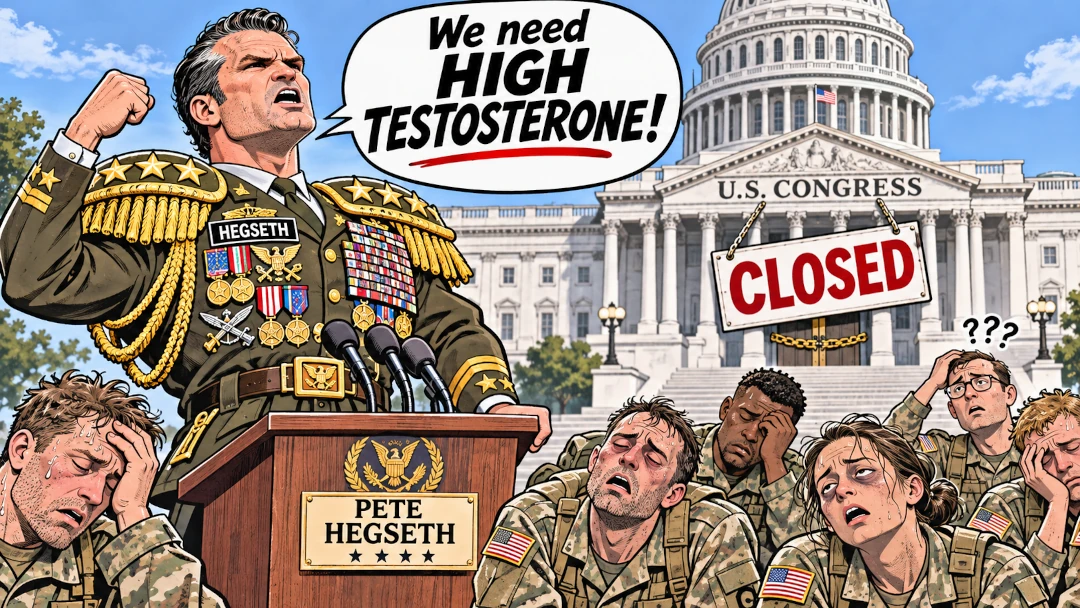
A 19-year-old airman broke after 255 days at sea and was punished for it. The Defense Secretary whose Pentagon called his crisis “suspect” has spent two years purging generals, gutting drone warfare, defying the courts and waging a war Congress never authorized. And when a Republican finally forced an impeachment vote, the Speaker of the House simply sent everyone home.
Nicholas McKelvey joined the Navy as a teenager hoping to give his young family a future. He ended up an aviation mechanic in a helicopter squadron aboard the USS Abraham Lincoln, working 12-hour shifts on the flight deck through a deployment that dragged past 250 days. He missed his daughter’s birth. His in-laws were fighting cancer. Food aboard the carrier ran short. In early August, in the Arabian Sea, he ran across the deck and dropped 67 feet into the water. A helicopter crew pulled him out roughly 50 minutes later, according to Navy records reviewed by The New York Times. On October 29, the Navy discharged him for “malingering” — faking a mental health crisis — under terms that strip him of his G.I. Bill education benefits.
That is the story of one sailor. But it is also the clearest window yet into how the Department of Defense operates under Secretary Pete Hegseth: a culture in which exhaustion is weakness, dissent is disloyalty, expertise is a threat, and the man at the top answers to no one but the President who keeps telling the country he is doing a great job.
I. A Breaking Point Treated as a Crime
The documents tell their own story. After McKelvey was pulled from the sea, he was put on suicide watch, ordered to clean floors the next day, and then formally charged. An investigating officer wrote that while his motives were undetermined, the “conditions in which he jumped appear suspect,” pointing to calm seas, daylight, the slow speed of the ship and the float coat he was wearing — standard flight-deck gear. A commanding officer then found him guilty at a hearing, ruling that his jump endangered the vessel. McKelvey disputes the Navy’s account that he waved for help; he says he was trying to swim away from the ship.
What the Navy’s paperwork leaves out is the ship itself. By August, military families were describing food shortages, broken plumbing and mental health crises aboard the Lincoln during its record-setting deployment, and Sen. Richard Blumenthal of Connecticut demanded answers about water contamination, deck safety and deteriorating mental health among its roughly 5,000 sailors and Marines. The Lincoln’s resupply problems worsened after an Iranian missile and drone attack destroyed the Navy’s base in Bahrain, its main logistics hub. Acting Navy Secretary Hung Cao ultimately told Congress that eight sailors attempted suicide during the deployment, which ran 321 days.
“I didn’t want to be there anymore.”
— Navy Airman Nicholas McKelvey, 19, to The New York Times
And what did the Secretary of Defense say while this was happening? Less than two weeks after McKelvey went into the water, Hegseth dismissed the accounts of the ship’s conditions as misrepresented by the media. He went further, calling the reports of food and water shortages, disrupted mail and fears about self-harm dishonest attempts to portray service members as “victims.” When he finally boarded the Lincoln in October, he praised the crew’s combat record and pinned a Presidential Unit Citation on the ship. The message to every sailor aboard was unmistakable: the institution would celebrate your sacrifice and deny your suffering in the same breath.
To be precise about responsibility: the discharge was carried out by McKelvey’s chain of command, and a Pentagon spokesman told the Times the fleet has specialized teams providing tailored care. But commanders take their cues from the top. When the Secretary publicly brands distress as a media fabrication and a sign of weakness, no one should be surprised when officers below him treat a 19-year-old’s collapse as a disciplinary problem rather than a medical emergency.
II. A Pattern, Not an Exception
McKelvey is not the first person in uniform — or formerly in uniform — to find Hegseth’s machinery turned against him. The most notorious case is Sen. Mark Kelly of Arizona, a retired Navy captain and astronaut, who joined other lawmakers in a video reminding troops that they may refuse illegal orders. Hegseth issued a formal letter of censure and moved to cut Kelly’s retirement rank and pay. In February, U.S. District Judge Richard Leon blocked the punishment, writing that the Pentagon had “trampled on Senator Kelly’s First Amendment freedoms” and threatened the liberties of millions of military retirees.
The Lincoln Sailor
A 19-year-old airman, charged and discharged after an apparent suicide attempt, loses the education benefits his family was counting on. Quartz / NYT
A Senator Censured
Hegseth sought to demote retired Capt. Mark Kelly over protected political speech; a federal judge enjoined it as unconstitutional retaliation. NPR
Generals Purged
Around two dozen generals and admirals removed, most without public explanation — including the Army Chief of Staff in the middle of a war. Stars and Stripes
Drone Unit Disbanded
The Army’s Unmanned Assault Battalion, built to absorb lessons from Ukraine, is being returned to standard infantry after its champions were pushed out. CBS News
Testosterone Screening
Annual testosterone testing for troops 30 and older, with hormone therapy offered, despite physicians’ warnings about the science. PBS NewsHour / AP
Strikes on Survivors
A September 2025 “double-tap” strike killed two survivors of an attack on an alleged drug boat; lawmakers of both parties raised war-crime concerns. CBS News
III. Decapitating the Army in Wartime
On April 2, with the United States weeks into its war with Iran, Hegseth fired Army Chief of Staff Gen. Randy George, along with Gen. David Hodne, who led the Army’s Transformation and Training Command, and Maj. Gen. William Green, the chief of chaplains. The Pentagon gave no reason. George’s replacement, on an acting basis, was Gen. Christopher LaNeve — Hegseth’s former military aide. One U.S. official told Axios that firing the Army’s top officer during a war was “insane.”
The purge did not stop. Gen. Christopher Donahue, who commanded U.S. Army Europe and Africa, stepped down in July. Army Secretary Dan Driscoll resigned at the end of August, and a source told CNN that his resignation raised concerns about Army readiness and Hegseth blocking modernization by firing the generals responsible for it. Just this week, Hegseth removed Lt. Gen. Brett Sylvia, the Joint Staff’s head of strategy, plans and policy — the military’s top planner — as the administration weighs renewed strikes on Iran. Hegseth’s own description of his approach, as quoted by Stars and Stripes: “The media calls that a purge. I call it accountability.”
Even Republicans who confirmed him have broken ranks. Sen. Thom Tillis of North Carolina, whose vote helped seat Hegseth, publicly called on President Trump to fire him after Driscoll’s exit.
“I have never witnessed more inept management of the brave men and women…”
— Sen. Thom Tillis (R-N.C.), calling for Hegseth’s firing, via Al Jazeera
IV. Grounding the Future: Drones and Readiness
If there is a single lesson from the wars in Ukraine and the Persian Gulf, it is that cheap, numerous drones have changed combat. The Army understood that. Under Gen. George, it stood up the Unmanned Assault Battalion inside the 173rd Airborne Brigade to study drone warfare and build tactics from Ukraine’s battlefield experience. Driscoll was so closely associated with that work that the President himself called him the “drone guy.”
Now the champions are gone and so is the unit. CBS News reported that the battalion is being phased out amid tension between the officers who championed it — George and Donahue, both fired or forced out — and LaNeve, who favors a “back to basics” approach. A bipartisan group of senators wrote to the Army warning that eliminating the unit would limit the military’s ability to learn from Ukraine and slow drone modernization. The Pentagon has since issued memos urging faster counter-drone deployment, but a memo cannot replace the expertise that was shown the door.
Meanwhile, the Secretary’s energy has gone elsewhere. In July, Hegseth announced that troops 30 and older would be screened annually for testosterone deficiency and offered hormone replacement therapy, insisting the effort was “not about artificial enhancement.” Physicians and former military medical leaders have questioned the science, service members already had access to testing through Tricare, and the Pentagon has not said whether troops who decline treatment will face consequences. It is a program that fits a culture-war brand of masculinity far better than any documented readiness gap.
V. The Timeline of a Failing Tenure
Get Involved Today
Contribute to our mission and turn your concerns into action.
VI. The Speaker Who Ran
On September 15, Rep. Thomas Massie, a Kentucky Republican, did something no member of his party had dared. He took the House floor and read a 34-page resolution containing eight articles of impeachment against Hegseth, a reading that took more than an hour. The articles charge Hegseth with conducting hostilities against Iran beyond the limits of the War Powers Resolution, ignoring laws meant to minimize civilian casualties, ordering extrajudicial killings in the boat-strike campaign, and retaliating against Sen. Kelly. Massie told ABC News he kept his plan secret because he feared Speaker Mike Johnson would shorten the session if he found out. Asked why now, he told Responsible Statecraft that Congress had “exhausted every other legislative remedy.”
Massie’s fear proved prophetic. Because the resolution was privileged, the House had to act on it within two legislative days. The next day, Johnson announced he was sending members home early for a seven-week campaign recess, canceling the final scheduled day of session. “It’s time for our members to go home to their districts,” he told reporters, insisting the decision had nothing to do with Hegseth. Few in Washington believed him. The House will not return until after the midterm elections.
Consider what that means. Rather than allow the people’s representatives to cast a recorded vote on whether a Cabinet officer had violated the law, the Speaker shut down the House. That is not party management. It is the deliberate suspension of a constitutional check to protect a political appointee — and the vulnerable members who would have had to defend him on the record.
Where the Law Stands Against the Secretary
Article I, § 8 and the War Powers Resolution (1973)
- Congress alone may declare war. The War Powers Resolution requires forces to be withdrawn from unauthorized hostilities within 60 days, plus a 30-day withdrawal window. Massie’s articles allege Hegseth kept prosecuting the Iran war well past that limit without authorization.
The First Amendment
- A federal court has already found that Hegseth’s attempt to punish Sen. Kelly for telling troops they may refuse illegal orders was unconstitutional retaliation against protected speech. Refusing manifestly unlawful orders is a principle taught at every service academy.
The Law of Armed Conflict
- Attacking shipwrecked or incapacitated survivors is prohibited under the laws of war the Pentagon itself teaches. Multiple legal experts and lawmakers of both parties said the September 2025 follow-up strike may have constituted a war crime. Hegseth denies wrongdoing and says the commander on scene made the call.
Article II, § 4 — Impeachment
- “Civil Officers of the United States,” including Cabinet secretaries, may be impeached for high crimes and misdemeanors. The House impeaches by simple majority; removal requires two-thirds of the Senate.
Service Member Mental Health
- The testosterone program is not itself unlawful, but how the military treats sailors in psychiatric crisis is a legitimate subject for oversight. A general discharge forfeits Post-9/11 G.I. Bill eligibility, which is why Congress should examine how “malingering” charges were applied aboard the Lincoln.
VII. The Outlook After Recess
The reprieve Johnson bought is about to expire. Massie has said he will force the impeachment vote shortly after the House returns on November 9, the week after the elections, and Republican leaders will again face a choice between a recorded vote and a motion to table. House Minority Leader Hakeem Jeffries has vowed that a Democratic majority would “run Pete Hegseth out of town.” According to CNN, Democrats plan to press impeachment in the lame-duck session and, if they win the House, again in the new Congress, with oversight hearings regardless of the outcome.
The odds deserve honesty. A Democratic House could impeach with a simple majority, but conviction in the Senate requires a two-thirds vote that remains far out of reach. Democrats are also divided over whether to prioritize impeachment or wide-ranging hearings, and some believe Trump may eventually fire Hegseth himself, as he did with Pam Bondi and Kristi Noem. But impeachment is not only about removal. It is about creating a permanent constitutional record of what was done, and who allowed it.
VIII. What This Says About Trump
Through all of it, the President has not wavered. As Democrats and a growing number of Republicans called for Hegseth’s ouster, Trump said this week that he has done a “great job” remaking the military and called the impeachment push “terrible.” In August, as sailors’ families described moldy showers and rationed food, Trump joined Hegseth in downplaying the reports from the Lincoln.
Presidents reveal their priorities by whom they protect. Trump has protected a Secretary who fired the Army’s top general in wartime, drove out the civilian leader trying to modernize the force, dismantled the unit studying the defining weapon of modern war, attempted to punish a decorated veteran for reciting the law, and presided over a Pentagon that answered a teenager’s suicide attempt with charges. What Trump values in Hegseth is not competence or care for the troops. It is loyalty — the same quality Hegseth now demands from every officer below him. A commander-in-chief who prizes obedience over readiness is not making America strong. He is making its military brittle.
IX. What You Can Do
Most of the decisive moments ahead happen in Congress, which means public pressure on specific lawmakers matters more than usual. The calendar is short: the election is Tuesday, and the impeachment resolution comes back on November 9.
- Vote on November 3 — and down the ballotControl of the House decides whether there will be hearings, subpoenas and an impeachment inquiry in January. Check your registration and polling place with your state election office.
- Call your Representative before November 9Ask one specific question: will they vote against tabling Rep. Massie’s impeachment resolution? A motion to table is how leadership avoids a vote on the merits. The Capitol switchboard is (202) 224-3121.
- Press the Armed Services CommitteesAsk your Senators and Representative to demand hearings on mental health care aboard the USS Abraham Lincoln and on how “malingering” charges were brought against sailors in crisis.
- Support a fair discharge reviewService members can ask a discharge review board to upgrade a characterization of service. Veterans’ legal clinics and advocacy groups help sailors through that process; supporting them helps McKelvey and others like him.
- Refuse to let the drone story disappearShare the reporting on the Unmanned Assault Battalion and ask your delegation what the Army is doing to replace that expertise. Readiness is a bipartisan concern, and it is where Republican lawmakers are most persuadable.
Editorial Conclusion
A nineteen-year-old who gave the Navy everything until he had nothing left was branded a malingerer and sent home without the benefits he earned. The man who set that tone fired the generals who disagreed with him, shut down the unit preparing for the wars of the future, tried to punish a senator for reciting the law, and was shielded from a vote of the people’s House by a Speaker who chose recess over responsibility.
This is not a dispute about style. The Constitution gives Congress the power to declare war, the power to oversee the military and the power to impeach the officers who abuse their authority. When the House returns on November 9, every member must cast a recorded vote. Anything less is a surrender of the constitutional duty they swore to uphold — and of the troops who are paying the price.
Sources & References
- Quartz — Navy moves to discharge 19-year-old airman who jumped from U.S.S. Lincoln
- The Daily Beast via Yahoo News — Pete Hegseth’s Punishment of Sailor Who Jumped Off Ship Exposed
- WTKR / Scripps — Democratic senators demand answers about conditions aboard USS Abraham Lincoln
- The National News Desk / WJLA — Hegseth visits USS Lincoln as it returns after 321 days
- The Week (India) — ‘Low morale, rationed food’: Crew exposes poor conditions on USS Abraham Lincoln
- NPR — Judge temporarily blocks Pentagon action against Mark Kelly over illegal orders video
- CNBC — Army chief of staff fired by Hegseth, sources say
- Axios — Hegseth’s wartime firing of top generals stuns officials
- Stars and Stripes — Top general removed from Pentagon’s Joint Staff
- CNN via KEYT — Army Secretary Dan Driscoll submits resignation after tension with Hegseth
- Al Jazeera — Republican senator calls on Trump to fire Secretary of Defence Hegseth
- CBS News — U.S. Army moves to end drone battalion set up to absorb lessons from Ukraine war
- Military Times — The Army shut down a specialized drone unit. Legislators want to know why.
- PBS NewsHour / AP — Hegseth announces new policy to test troops for low testosterone
- CBS News — Survivors in boat strike were trying to climb back onto vessel before follow-up attack
- ABC News / Good Morning America — Rep. Thomas Massie forcing vote on Pete Hegseth’s impeachment
- Responsible Statecraft — Massie tells RS why he went after Hegseth and not Trump
- CNN — House to adjourn early, stave off Hegseth impeachment vote
- The Jerusalem Post / Wall Street Journal — House Democrats push to impeach Hegseth after midterms
- Newsweek — Could Pete Hegseth be impeached? What a Democratic midterm win could mean
- CNN via KEYT — The push to impeach Hegseth will gain momentum if Democrats win the House
Related News