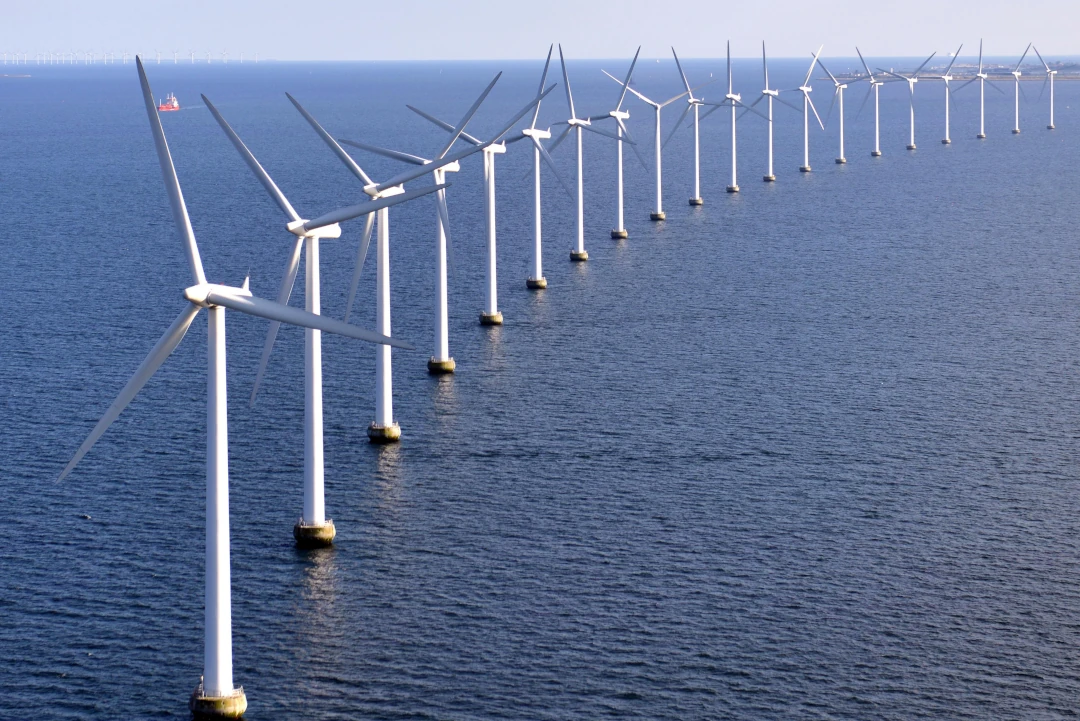
The Pay-Not-to-Play Presidency: How Trump Is Spending $2.5 Billion to Kill American Wind Power
The Interior Department just cut Invenergy a $765 million check to walk away from four offshore wind projects off New York, California, and Maine. It is the third such deal in three months. Taxpayers are footing the bill — and paying twice: first at the Treasury, then at the meter.
On June 18, Interior Secretary Doug Burgum announced that his department had reached a settlement with the energy developer Invenergy: the federal government would refund the company the entire $765 million it paid at auction for four offshore wind leases in the New York Bight, the Gulf of Maine, and off California’s Central Coast. In exchange, Invenergy would redirect the money into natural gas plants across the Midwest and geothermal projects in the West. The payment, as with the two deals that came before it, will come out of the federal Judgment Fund — a taxpayer reserve normally used to satisfy court verdicts against the United States. In this case, there is no court verdict. There is barely even a lawsuit. There is only a president who has said, plainly and repeatedly, that he does not want wind turbines built.
The Invenergy deal is not an isolated event. It is the third payment in a systematic, three-month campaign by the Trump administration to buy the shutdown of America’s offshore wind industry. In March, the government sent French energy company TotalEnergies $928 million to kill two wind farms off New York and North Carolina that would have powered 1.7 million homes. In April, Ocean Winds — a joint venture between Europe’s ENGIE and EDP Renewables — accepted $885 million to abandon two more projects off New York and California. All three companies pledged to redirect the money into fossil fuels. All three signed the settlements out of what industry sources describe less as legal disputes than as political capitulations.
Add it up and the arithmetic is stark: roughly $2.5 billion in taxpayer money has been committed to make sure electricity that was already leased, permitted, and in some cases under construction never reaches the American grid — at precisely the moment American electricity demand is hitting record highs and household electric bills are climbing at a pace that has outstripped inflation.
I. What Just Happened
The mechanics of the Invenergy settlement mirror those of the earlier two deals. Interior and the Department of Justice tell an energy company that a threatened or hypothetical lawsuit will be resolved out of the Judgment Fund. The company gets its lease-purchase money back. In return, it agrees to two conditions: cancel the wind projects, and reinvest the money in fossil-fuel or fossil-adjacent generation. Under the Invenergy deal, the $765 million will go toward natural gas plants in Indiana, Wisconsin, Iowa, Kansas, and Missouri, plus geothermal projects in the West.
Burgum’s public rationale is that offshore wind was “costly” and “unreliable” and posed unspecified “national security concerns.” His department’s official statement claims the deal will lower utility bills. The president’s own explanation, delivered at a January White House event, was simpler and blunter.
“My goal is to not let any windmill be built. They’re losers.”
— President Donald Trump, White House event, January 2026
That is the actual policy. Everything else is architecture around it. The Invenergy leases, originally auctioned by the Biden administration in 2022, included an 84,000-acre tract in the New York Bight that alone sold for hundreds of millions of dollars — money the Treasury has already spent. That money is now being paid back out of a different Treasury account, with no offshore wind to show for it.
II. The Pattern — Three Deals, Three Months, $2.5 Billion
These are not one-off transactions. They form a recognizable strategy — one the Trump administration turned to only after federal courts blocked its earlier attempts to freeze offshore wind outright. In December 2025, Interior issued stop-work orders on five active offshore wind projects, citing a classified Pentagon report. Courts issued preliminary injunctions against the pauses. Interior lost. The administration quietly abandoned its own appeal of the ruling vacating Trump’s Day One executive order on wind. Every legal challenge to the campaign against offshore wind has, so far, failed.
So the administration changed tactics. Instead of blocking wind projects at the permitting stage, it began paying developers to abandon them voluntarily. The result is the timeline below.
Industry observers say the administration is already in discussions with additional developers about further buyouts. RWE’s floating Canopy Offshore Wind, Equinor’s Atlas Wind, and Invenergy’s own Even Keel Wind — all planned for California waters — are viewed as candidates for the next tranche of settlements.
III. What Americans Lose
The Interior Department’s press releases speak the language of ratepayer relief. The evidence pulls the other way. Offshore wind, once online, is one of the most powerful tools for reducing wholesale electricity costs — because wind turbines have essentially zero marginal fuel cost, they undercut gas plants in the wholesale bidding market and drag the clearing price down for everyone on the grid. That mechanism, known as price suppression, is why states from Massachusetts to Virginia locked in long-term offshore wind contracts in the first place.
A Synapse Energy Economics study for the Sierra Club found that 9 GW of offshore wind online by 2030 would save New England electricity customers approximately $630 million per year on their bills. Source →
Aurora Energy Research found that if Empire, Sunrise, and South Fork Wind had all been operating in the winter of 2022, New York electricity customers would have saved $77 million in a single winter month. Source →
The TotalEnergies projects alone would have supplied electricity to more than 1.2–1.7 million homes across New York, New Jersey, and North Carolina, according to the Senate Environment and Public Works Committee. Source →
Vineyard Wind’s activated power purchase agreements are projected to save Massachusetts ratepayers about $1.4 billion in electricity costs over the next two decades — a preview of what canceled projects will not deliver. Source →
Meeting projected data-center-driven demand growth with fossil fuels rather than clean energy would add roughly $30 billion per year to customer electricity costs by 2030, according to Energy Innovation’s grid modeling. Source →
Average U.S. residential electricity prices have risen approximately 42% over the past five years — with increases of 58% in New York and 73% in Maine over the same period. Source →
The short-term impact is measurable in months. The Invenergy leases were among the most advanced in the pipeline. Their cancellation, on top of the earlier two deals, immediately removes multiple gigawatts of near-term generation planning at the exact moment PJM Interconnection and the New York ISO are warning of tightening reserve margins. Nationally, U.S. electricity demand is projected to reach record levels in 2025 and 2026, driven by AI data centers, industrial electrification, and rising cooling demand. Utilities have already sought a record $31 billion in rate increases from state regulators in 2025. When supply is choked off in a rising-demand market, prices rise. That is not ideology; that is arithmetic.
The medium-term impact falls on the industrial base the administration claims to champion. Offshore wind, once mature, is a manufacturing and skilled-trades sector: electricians, welders, pipefitters, machinists, and port workers. States betting on that future put real money on the table — New York’s $300 million port grant program, New Jersey’s $600 million Wind Port, California’s $225 million commitment to port and transmission infrastructure. Every one of those investments is now at risk of being stranded, not because the projects failed technically, but because the federal government paid the developers to walk away. Senate Minority Leader Chuck Schumer put the loss in plain terms.
“These projects represented thousands of good union jobs, millions of homes’ worth of electricity, and billions in economic development.”
— Sen. Chuck Schumer (D-NY), Senate Minority Leader
The long-term impact is felt on the atmosphere and on America’s ability to compete. The Department of Energy has documented that offshore wind costs fell by more than 50% globally between 2013 and 2024, and by roughly 62% between 2010 and 2024, driven by exactly the kind of scaled deployment the U.S. was on the cusp of achieving. Canceling projects interrupts that learning curve, hands the industry’s future to Europe and China, and locks American consumers into a fossil-fuel price structure that is by definition tied to global geopolitical shocks. Resources for the Future modeled the offshore wind pipeline the administration is now dismantling and found a benefit-to-cost ratio of roughly 14 to 1, including an estimated 520 avoided premature deaths per year from reduced particulate pollution downwind of Atlantic and Gulf coast cities. That is what is being paid off.
And this all lands in the middle of a warming climate the administration refuses to name. The cancellations do not merely fail to reduce emissions; they actively add to them. The redirected Invenergy money will build gas plants across five Midwestern states. The TotalEnergies money will build an LNG export terminal on the Gulf Coast. Each of those is a multi-decade carbon commitment being paid for, in part, with money that was raised — and, until March, held — for the express purpose of financing the transition away from fossil fuels.
Get Involved Today
Contribute to our mission and turn your concerns into action.
IV. The Judgment Fund Sleight-of-Hand
The legal architecture is the clearest tell that something is wrong. The Judgment Fund is a permanent, indefinite appropriation the Treasury uses to pay out court judgments and settlements the government cannot otherwise fund. It was not designed to be a slush account for reversing lease sales. Yet that is precisely how it is being used.
Senator Sheldon Whitehouse (D-RI), ranking member of the Environment and Public Works Committee, opened a formal investigation into the TotalEnergies deal in April, warning of possible violations of the Antideficiency Act. As Whitehouse noted, no Interior bureau holds sufficient funds to pay the nearly $1 billion promised, and TotalEnergies’s original lease payment was deposited into the general Treasury, not held in escrow for the company. Routing the refund through the Judgment Fund, he argued, “would unlawfully augment appropriation.”
Reps. Jamie Raskin (D-MD) and Jared Huffman (D-CA), the ranking Democrats on the Judiciary and Natural Resources Committees, followed with their own investigation, demanding TotalEnergies preserve all records and place the received funds in escrow. Their letter argues that under the Outer Continental Shelf Lands Act, a lessee whose lease is canceled is entitled only to the lesser of the current fair value of the lease or the excess of expenditures over revenues — not a full refund of the original purchase price. TotalEnergies got a full refund anyway. On the Invenergy deal, Huffman was more direct.
“Donald Trump is using your tax dollars to make America more dependent on dirty, volatile fossil fuels… It is hard to imagine a more backwards use of taxpayer money.”
— Rep. Jared Huffman (D-CA), Ranking Member, House Natural Resources Committee
The seven-state lawsuit filed by New York Attorney General Letitia James makes essentially the same argument. There is no genuine legal dispute here — no court case, no adjudicated grievance, no fair-value hearing under the Outer Continental Shelf Lands Act. There is only an executive who wanted certain projects killed and a Justice Department willing to invent a settlement mechanism to accomplish it. Every court that has looked at Trump’s offshore wind moves — the Day One executive order, the December stop-work orders — has ruled against the administration. Rather than obey those rulings, the White House pivoted to a mechanism designed to be difficult to challenge in court. That is not the behavior of an administration that believes it is acting lawfully. It is the behavior of an administration that has calculated it can spend faster than the courts can move.
An Executive Actively Working Against the American Interest — and What the Framers Left Open on Purpose
The 25th Amendment, ratified in 1967 in the aftermath of the Kennedy assassination and against the memory of Woodrow Wilson’s incapacitating 1919 stroke, was written to answer a question the original Constitution left unresolved: what happens when a president is unable to do the job. Its language is deliberately spare.
“Whenever the Vice President and a majority of either the principal officers of the executive departments or of such other body as Congress may by law provide, transmit to the President pro tempore of the Senate and the Speaker of the House of Representatives their written declaration that the President is unable to discharge the powers and duties of his office…”
The Amendment never defines “unable” or “inability.” Constitutional scholars agree the drafters did that on purpose. They did not want to lock future Congresses into 1967’s medical vocabulary. They anticipated that the meaning of “unable” would have to be worked out in real time, by human beings looking at facts — because they understood, correctly, that presidential incapacity is not always a coma. It can be a pattern.
The Argument Being Made by Named Lawmakers
Rep. Jamie Raskin, a constitutional law professor and ranking Democrat on the House Judiciary Committee, introduced the Oversight Commission on Presidential Capacity Act on April 14, 2026, to activate the “such other body as Congress may by law provide” clause that has sat dormant for nearly six decades. The bill, backed by more than 50 Democratic co-sponsors, would create a 17-member independent commission of physicians, psychiatrists, and former senior executive-branch officials empowered — in concert with the Vice President — to determine whether a sitting president is “mentally or physically unable to discharge the powers and duties of the office.”
Raskin’s framing has focused most publicly on the president’s Iran rhetoric, but the constitutional principle he is invoking is broader. In introducing the bill, Raskin said: “We are at a dangerous precipice, and it is now a matter of national security for Congress to fulfill its responsibilities under the 25th Amendment to protect the American people from an increasingly volatile and unstable situation.” More than 85 House and Senate Democrats have publicly floated impeachment or the 25th Amendment in recent months.
How the Wind Payouts Fit the Constitutional Question
A single erratic decision is not incapacity. A pattern of decisions that consistently move federal resources against the country’s own stated interests — in the middle of a documented energy emergency, at a documented cost to the taxpayer, in defiance of documented court rulings, funded through a mechanism the executive’s own General Counsel almost certainly knows is legally exposed — is a different kind of evidence. In three months, the administration has paid $2.5 billion to reduce American electricity supply while household electricity bills climb, while data-center demand strains the grid, while every serious energy analyst says the country needs more electrons, not fewer. The president’s own explanation for the policy is that windmills are “losers.” That is not an energy strategy. It is a personal grievance being funded with public money.
The Practical Barriers — Named Honestly
The barriers are real. Section 4 requires the concurrence of the Vice President plus either a majority of the Cabinet or a majority of a Congressionally-established body. Vice President Vance is a political ally, and the Cabinet was appointed for loyalty. Raskin’s commission bill will not pass a Republican-controlled Congress in this session, and Trump could veto it if it did. The 25th Amendment has never been invoked to remove a sitting president involuntarily. As Raskin himself has acknowledged, no mechanism is foolproof, and “the framers had no concept” of how a modern president might weaponize their office.
Why the Barriers Do Not Negate the Constitutional Case
None of that changes what the record documents. The Amendment does not require its own invocation to be easy; it requires the argument to be honest. When lawmakers of both parties, along with career civil servants, career military officers, and career diplomats, publicly and repeatedly say that the sitting president is making decisions that damage the national interest — and when the paper trail of $2.5 billion in Judgment Fund payouts, seven state-attorney-general lawsuits, and two ranking-member Congressional investigations backs that claim up — the constitutional question is on the table whether the political system is willing to answer it or not. The 25th Amendment is not a magic wand. It is a mirror. What is being reflected back at the country right now is a president who has stopped being able to distinguish policy from grievance, and a system that has, so far, chosen to look away.
V. What This Says About the Presidency
Every administration makes choices that its critics dislike. That is politics. What makes the wind payouts different is that they are, on every dimension, self-defeating for the country they are supposed to serve. They raise the federal deficit. They raise consumer electricity prices in the medium term. They forfeit American leadership in a manufacturing sector where the country was, briefly, competitive. They accelerate the climate crisis the president has said he wants no part of managing. They ignore the courts. They enrich foreign energy companies. They convert public money that was raised for one purpose into political favors dispensed for another. And they do all of that in the middle of an electricity-demand surge that every serious analyst — the EIA, the Belfer Center, Energy Innovation, Lawrence Berkeley National Laboratory — has been warning about for two years.
A president governing in the country’s interest could disagree with offshore wind on the merits and still choose not to spend $2.5 billion, unappropriated, to kill it. That is not the choice this president made. He made a choice that only makes sense if the goal is not policy but retribution — against Democratic states, against European companies, against a technology he personally dislikes. That is the leadership question the record now poses.
Editorial Conclusion
Two-and-a-half billion dollars is a policy statement. It has been spent to make American electricity more expensive, American manufacturing weaker, American consumers more exposed to fossil-fuel price shocks, and the American climate less survivable. It has been spent in defiance of the courts, outside the authority of any appropriation Congress has passed, at a moment when the country is running out of power.
The 25th Amendment does not require unanimity, and it does not require ease. It requires an honest reading of the record. That record, at this point, is documented — in Federal Register notices, in court filings, in Senate letters, in Interior Department press releases the administration itself wrote. What is required now is not more evidence. It is the political will to look at the evidence already in front of us and act.
Democracies do not fail because their constitutions are silent. They fail because the people entrusted with reading those constitutions decide, for reasons of comfort or convenience, not to.
Sources & References
- Bloomberg — Trump Erases Another $765 Million in Offshore Wind Leases
- The Hill — Trump admin pays Invenergy $765 million to abandon offshore wind projects
- Heatmap News — Trump Pays $765 Million to Kill 4 More Offshore Wind Leases
- ESG Today — $765 Million Deal with Invenergy to Swap Wind for Gas & Geothermal
- WorkBoat — Trump administration pays $765 million to kill four more wind leases
- ABC News — 7 states sue Trump administration over $1B deal to halt offshore wind
- CNN — Trump admin paid a French company $1 billion to not build offshore wind farms
- Christian Science Monitor — Why the US will pay TotalEnergies nearly $1 billion to give up wind plans
- Al Jazeera — Trump admin’s cancellation of wind energy projects causes business turmoil
- Fortune — Trump offers $2 billion to kill offshore wind projects
- E&E News / POLITICO — Trump is paying companies to quit offshore wind. These projects could be next.
- NRDC — Billion-Dollar Deals to Quit Offshore Wind Ignite Investigations and Alarm
- U.S. Senate Committee on Environment & Public Works — Whitehouse Launches Investigation Into TotalEnergies Payoff
- House Natural Resources Democrats — Raskin & Huffman Letter to TotalEnergies (PDF)
- Rep. Jamie Raskin — Legislation Establishing Independent Commission on Presidential Capacity
- TIME — Jamie Raskin on Trump, the 25th Amendment, and Congress’s Options
- Belfer Center, Harvard Kennedy School — AI, Data Centers, and the U.S. Electric Grid: A Watershed Moment
- Energy Innovation / Forbes — What Will It Cost America To Meet Data Center Electricity Demand?
- PolitiFact — How much have data centers increased electricity prices?
- Regional Plan Association — What’s in an Electric Bill? Offshore Wind & Consumer Costs
- New Bedford Light — Vineyard Wind’s power contracts switch on, stabilizing electricity prices
Related News