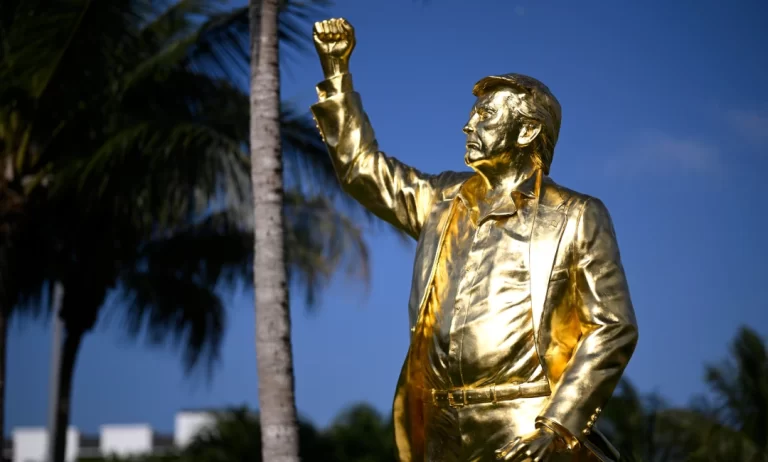
While millions of Americans struggle to afford groceries and healthcare, Donald Trump presided over the dedication of a 22-foot gold effigy of himself at his Florida resort — bankrolled by crypto speculators, blessed by an evangelical pastor, and celebrated as a monument to America’s leadership. This is not leadership. This is narcissism wearing a crown.
In the palm-shaded grounds of Trump National Doral Miami, on the morning of May 7, 2026, a white-and-blue cloth was pulled from a colossal bronze figure coated in gold leaf. What stood revealed was a 15-foot statue of Donald Trump — fist raised to the sky in the pose of a man who had survived an assassination attempt — mounted on a 7-foot marble pedestal, its total height reaching 22 feet into the Florida sky. A pastor spoke. Prayers were offered. And the sitting President of the United States posted about it on social media, calling those responsible “great American patriots.”
In the same week, the average American family continued absorbing what the Yale Budget Lab calculates as $1,700 in annual tariff-driven losses. Ground beef is up 17 percent. Coffee, nearly 20 percent. Manufacturers shed 108,000 jobs in 2025 — the worst year for job growth outside a recession since 2002. And nearly one million Americans are at risk of sliding into poverty under the weight of Trump’s economic policies, according to analysis by CNN and The Budget Lab.
These are the two Americas that Donald Trump has presided over: one of gleaming golden monuments, gilded golf resorts, and crypto-funded statuary — and one of empty grocery carts, deferred medical care, and families deciding whether to have children based on whether they can afford to. The Don Colossus, as the statue’s backers named it, is not merely a monument to a man. It is a monument to the staggering distance between this president and the people he was elected to serve.
1. The Statue, the Pastor, and the Crypto Grift
The Don Colossus was not commissioned by admirers of statecraft. It was commissioned by a group of cryptocurrency investors as a promotional device for their memecoin, $PATRIOT — a speculative digital token that briefly reached a market capitalization of $77.7 million before losing more than 90 percent of its value, cratered in part by the launch of Trump’s own competing memecoin, $TRUMP. Reporting by Futurism and the Daily Beast documented the chaotic, financially contentious saga behind the statue’s creation: infighting among investors, a sculptor who held the artwork hostage in an Ohio foundry over unpaid fees, and a dispute over copyright infringement that had to be resolved before the statue could be released.
Ohio-based sculptor Alan Cottrill — who has molded the likenesses of sixteen American presidents — originally agreed to create the bronze figure for $300,000. He later proposed coating it in gold leaf. His description of pitching that idea to Trump’s circle has become one of the more revealing details of this entire episode: it was, he said, like offering ice water to a man dying of thirst. The gold finish was enthusiastically embraced. The total cost ballooned to approximately $450,000, according to reporting by The Times.
“The Real Deal — GOLD — At Doral in Miami. Put there by great American Patriots!!!”
— Donald Trump, Truth Social post, May 7, 2026
The dedication ceremony on Wednesday was led by Pastor Mark Burns — a televangelist, member of the Pastors for Trump organization, and longtime informal spiritual adviser to the president. According to AFP, Burns moved quickly to preempt what he knew was coming: the obvious and immediate comparison to one of the most condemned acts in the Hebrew Bible. “Let me be clear: this is not a golden calf,” Burns told the assembled crowd. He repeated the denial days later in writing on social media, writing that “honor is not worship. Respect is not idolatry.”
The fact that Burns felt compelled to say these words at all speaks volumes. You do not hold a religious dedication ceremony for a gilded effigy of a living political leader, invite a pastor to lead the proceedings, and then express astonishment that people draw a connection to the most famous golden idol in Western religious history.
2. What the Bible Actually Says
The Second Commandment, as given in Exodus 20:4–5, is unambiguous: “You shall not make for yourself a carved image, or any likeness of anything that is in heaven above, or that is in the earth beneath, or that is in the water under the earth. You shall not bow down to them or serve them.” The golden calf episode in Exodus 32 — in which the Israelites, in Moses’ absence, melt down their gold jewelry and fashion a calf to worship — is treated throughout Jewish, Christian, and Islamic tradition as the paradigmatic act of idolatrous betrayal.
The parallels to the Doral ceremony are not subtle. A community of followers pools their resources — in this case, cryptocurrency rather than jewelry — to commission a golden image of their leader. A religious official presides over a dedication ceremony for the object. The resulting image is placed in a position of public veneration at the leader’s own property. The leader himself celebrates the monument on social media. The sole voice of conscience — a sculptor who noted, pointedly, that he was not invited to the dedication he had made possible — stands outside the proceedings entirely.
This pattern of quasi-religious self-deification has not emerged in a vacuum. As Latin Times reported, Trump has in recent months promoted a “God Bless the USA Bible,” compared political criticism of himself to persecution, and shared AI-generated images depicting himself as the Pope — and, in a now-deleted post in April 2026, as Jesus Christ himself. When called to account for the latter, Trump told reporters he believed the image depicted him “as a doctor” and referred to the Red Cross. There was no Red Cross symbol in the image. When conservative commentator Riley Gaines — a Fox News host and Trump ally — wrote that “faith is not a prop” and that “God shall not be mocked,” the breadth of the backlash became clear. Even Trump’s own base recognized the blasphemy.
A 15-foot bronze figure coated in gold leaf, mounted on a 7-foot marble pedestal, stands at Trump National Doral Miami. Total cost: approximately $450,000, funded by the $PATRIOT memecoin collective.
Televangelist Pastor Mark Burns led a dedicated blessing ceremony, telling attendees the statue was “a symbol of resilience, freedom, patriotism, strength.” The White House claimed no involvement, yet Burns confirmed Trump called him directly.
The $PATRIOT memecoin lost over 90% of its value. The statue was held hostage for months over unpaid sculptor fees. An anonymous donor ultimately paid the balance. The grift failed; the golden monument remains.
Within the past year: Trump promoted a commercial “God Bless the USA Bible,” posted AI images depicting himself as the Pope and as Jesus Christ, and allowed a religious leader to perform a consecration ceremony for a golden likeness of himself. Backlash erupted across the Christian spectrum.
As the statue was unveiled, the average American household faced $1,700 in annual tariff costs, ground beef up 17%, coffee up 20%, and a poverty rate on the rise.
John Feehery, a Republican strategist, told the Irish Times: “It works fine when the economy is great, when people feel optimistic. It works poorly when people feel down and out and uncertain about the future.”
3. A Presidency of Gold-Leafed Priorities
Donald Trump’s presidency has been defined by a fundamental aesthetic: gold. His residences, his aircraft, his tableware, his curtains — all gold. His communications strategy is premised on the language of bigness, richness, and the overwhelming. The Don Colossus is not an aberration. It is the logical conclusion of a presidency that has always been about the performance of power rather than its responsible exercise.
But performance has consequences, and the consequences of this presidency have been borne almost entirely by people who will never visit Trump National Doral. As the Center for American Progress documented in its comprehensive year-one review, 2025 was marked by chaotic tariff announcements, rising costs for everyday essentials, and historic cuts to healthcare and food assistance. The Affordable Care Act’s enhanced premium tax credits expired, producing a 114 percent increase in net premium costs for marketplace insurance purchasers. For a 55-year-old couple earning $90,000 a year, the same silver-plan insurance that cost $638 a month in 2025 now costs $2,179 in 2026. The Big Beautiful Bill — Trump’s signature tax legislation — delivered its largest benefits to the wealthiest Americans while those cuts to SNAP, Medicaid, and child care threatened the basic security of tens of millions of families.
“Tariffs are a tax on American families. Because they are a tax on goods and services instead of income, they hit harder on people who spend a higher percentage of income than they save.”
— John Ricco, Associate Director of Policy Analysis, The Budget Lab at Yale
PBS NewsHour reported that employers added just 181,000 jobs in all of 2025 — roughly 15,000 per month — the worst year for job growth outside a recession since 2002. Despite Trump’s explicit promises to revive American manufacturing, factories lost 108,000 jobs in 2025. Auto and auto parts plants have cut nearly 74,000 jobs over the past two years. The president who stood before steel workers in Pennsylvania and promised them a future watched his tariff policies drive up the cost of the raw materials those same factories need to operate.
Meanwhile, as CNN’s analysis noted, Trump has been “talking right past struggling Americans” — preferring to discuss the revenue flowing into the Treasury and the investment commitments of large corporations rather than the cost of ground beef. His messaging framework — “actually, we’re rich” — does not translate to the 65 percent of Americans who, according to polling cited by CNN, have delayed having children because of economic anxiety. It does not speak to the more than 43 million Americans carrying federal student loan debt. And it says nothing to the 3.3 million families with children who face losing SNAP benefits under the administration’s new paperwork requirements.
Get Involved Today
Contribute to our mission and turn your concerns into action.
4. A Timeline of Self-Aggrandizement
The $PATRIOT memecoin collective commissions sculptor Alan Cottrill to create a 15-foot bronze statue of Trump for $300,000, intending it as a marketing device for their speculative cryptocurrency.
Cottrill proposes a gold leaf finish. Trump’s allies embrace it immediately. The final cost rises to $360,000 plus additional intellectual property fees, totaling approximately $450,000.
$PATRIOT peaks at a $77.7 million market cap, then craters — losing over 90% of its value after Trump launches his own competing $TRUMP memecoin. Infighting erupts among the statue’s backers.
Trump shares an AI-generated image of himself as the Pope on Truth Social, days before the election of the first American-born pope, Leo XIV.
Cottrill holds the statue hostage in an Ohio foundry over unpaid fees. Eric Trump publicly distances the family from the $PATRIOT project. An anonymous donor eventually steps in to resolve the dispute.
Trump posts an AI-generated image of himself as Jesus Christ on Truth Social. After fierce backlash from conservative Christians, he deletes it — claiming he believed it depicted him as “a doctor” for the Red Cross, despite no such imagery in the picture.
Rep. Jamie Raskin (D-MD) introduces legislation to establish a 17-member Commission on Presidential Capacity under Section 4 of the 25th Amendment, with 50 Democratic co-sponsors, following more than 85 Democratic calls for impeachment or removal.
Pastor Mark Burns leads a formal dedication ceremony for the Don Colossus at Trump National Doral. Trump celebrates on Truth Social. Critics across the political spectrum — including Christian conservatives — note the Biblical resonances with the golden calf in Exodus 32.
5. What a Healthy Presidency Looks Like
It is worth pausing to ask a simple question: how does a president in full command of their responsibilities and genuinely committed to public service spend their attention? They work to reduce the cost of groceries. They fight for pharmaceutical pricing legislation that actually passes. They convene economists and labor secretaries to address job losses in manufacturing communities. They do not, in the ordinary course of democratic leadership, accept a 22-foot gold effigy of themselves on the grounds of their private resort — erected by cryptocurrency speculators whose token lost 90 percent of its value — and treat the occasion as a cause for celebration.
The statue tells us something about the interior landscape of this presidency that no policy document can capture. It tells us that the president’s self-image has become entirely untethered from the lived reality of the people who elected him. A working-class voter in Butler, Pennsylvania — the same city where Trump survived an assassination attempt, and whose gesture is now immortalized in gold — who earns $55,000 a year and is now paying 43 percent of a tariff surcharge on imported goods, cannot look at that statue and recognize a leader who is fighting for them. What they see — what most of us see — is a man who found in the gold finish a mirror that flatters him beyond all recognition.
The Question the Statue Forces Us to Ask
The 25th Amendment to the United States Constitution, ratified in 1967 in the aftermath of President Kennedy’s assassination, provides in Section 4 that the Vice President and a majority of the Cabinet may transmit to Congress a written declaration that the President “is unable to discharge the powers and duties of his office.” If the President contests the declaration, Congress has 21 days to resolve the question by a two-thirds vote in both chambers.
Section 4 has never been invoked against a sitting president. But the question of its applicability to Donald Trump has moved, over the past several months, from the fringes of legal commentary to the floor of the United States House of Representatives. On April 14, 2026, Rep. Jamie Raskin (D-MD), Ranking Member of the House Judiciary Committee, introduced legislation to establish the very commission that Section 4 authorizes Congress to create — a 17-member body empowered to carry out a medical examination of the President and determine whether he is mentally or physically unable to discharge the duties of his office. The bill was introduced with 50 Democratic co-sponsors and followed calls from more than 85 House and Senate Democrats for either impeachment or 25th Amendment removal.
In his statement introducing the bill, Raskin was explicit: “Public trust in Donald Trump’s ability to meet the duties of his office has dropped to unprecedented lows as he threatens to destroy entire civilizations, unleashes chaos in the Middle East while violating Congressional war powers, aggressively insults the Pope of the Catholic Church, and sends out artistic renderings online likening himself to Jesus Christ.” Notably, even Tucker Carlson — a longtime Trump supporter — called an April Truth Social post “vile on every level” and urged administration officials to “figure out the codes on the nuclear football.” Alex Jones, hardly a voice of institutional restraint, asked on his broadcast, “How do we 25th Amendment his ass?”
The gold statue is not, in isolation, a 25th Amendment issue. No one is removed from the presidency for vanity. But it is a data point in a pattern of behavior — a presidency increasingly oriented around the self-deification of its occupant, the blurring of political and religious veneration, the solicitation of personal enrichment through crypto vehicles and gold-plated memorabilia, and a disconnection from the practical duties of governance so profound that a majority of Americans now doubt the president’s mental fitness, according to polling cited by the House Judiciary Committee.
The practical barriers to invoking Section 4 are formidable. Republicans control both chambers of Congress. Vice President Vance has shown no inclination to act. The Cabinet is composed of appointees whose tenure depends on the president’s goodwill. Raskin’s bill, as even its supporters acknowledge, is a long shot. But the barriers do not negate the constitutional argument being made, nor the moral case being articulated by lawmakers, legal scholars, and — most strikingly — by members of Trump’s own political and religious coalition who have watched a man who once claimed to champion ordinary Americans consecrate a monument to himself while those Americans cut back on groceries and defer their plans to start families.
Narcissism is not a clinical diagnosis that can be issued from an editorial board, and we issue none here. What we can say, with certainty, is that a president who celebrates a gold statue of himself at his private resort while his tariff policies push nearly a million Americans toward the federal poverty line is not a president whose attention is oriented toward the public good. What we can say is that a religious ceremony blessing a gilded effigy of a living political leader, conducted by that leader’s self-described spiritual adviser, is not consistent with the Protestant Christianity that Trump has claimed as his faith tradition since his first campaign. And what we can say is that every hour this administration spends on self-commemorating spectacle is an hour not spent on the price of beef, the cost of insulin, or the future of the American factory worker.
Editorial Conclusion
A president who commissions gold monuments to himself while his countrymen can no longer afford food to eat, has not merely lost touch with the people he governs — he has revealed that he never understood the job. The Don Colossus is not a symbol of resilience or patriotism. It is a monument to a presidency that has confused self-aggrandizement with governance, and gilded spectacle with democratic leadership. The Constitution offers tools to address a president who can no longer discharge the duties of his office. The American people, in the meantime, deserve a president who spends his attention on their struggles rather than his own reflection. What is required now is not another ceremony. It is accountability — and the democratic courage to demand it.
Sources & References
- Yahoo News — “Donald Trump Celebrates 22ft Gold Statue at Golf Club”
- Yahoo News / The Times — “Pastor Leads Wild Dedication Ceremony for Trump’s Giant Gold Statue”
- AFP via Yahoo News — “Golden Trump Statue Is No Idol for Worship, Pastor Insists”
- MSN — “Pastor Dedicates Giant Gold Statue of Trump at His Own Golf Course”
- The Daily Beast — “Trump’s Golden Statue Honored in Bizarre Dedication”
- Latin Times — “Watch: Pastors Pray Over Massive Gold Statue of Donald Trump in Florida”
- Latin Post — MAGA Evangelical Leaders Bless Gold Trump Statue at Doral
- Premier Christian News — “‘Not a Golden Calf’: Trump Erects Gold Statue of Himself”
- Futurism — “Crypto Guys Who Bought a Huge Gold Trump Statue Now Have a Problem”
- The Daily Beast — “Giant Gold Trump Statue Held Hostage in Fight Over Cash”
- ARTnews — “Gold Statue of Trump Arrives at Doral After Artist Withheld It Over Money Dispute”
- MEXC News — “MAGA’s ‘Golden Calf’: Trump Statue at the Heart of a Dramatic Crypto Gamble”
- PBS NewsHour — “Trump’s Portrayal of ‘Golden Age’ Is Out of Sync With How Americans See Economy”
- Center for American Progress — “A Year in Review: How Trump’s Economic Policies Made Life Less Affordable”
- CNN Business — “Trump’s Tariffs Could Push Nearly 1 Million Americans Into Poverty”
- The Century Foundation — “Trump’s Tariffs and Economy of Uncertainty Are Already Causing Pain”
- CNN Politics — “Affordability Crisis: Trump Is Losing His Golden Economic Touch”
- Irish Times — “‘Gold Cards’ and a Gilded Toilet: Donald Trump’s Affordability Message Problem”
- House Judiciary Committee Democrats — Rep. Raskin Demands Cognitive Evaluation, Cites Bipartisan Calls for 25th Amendment
- Axios — “House Democrats File Long-Shot 25th Amendment Bill Targeting Trump”
- International Bar Association — “Comment and Analysis: President Trump and the 25th Amendment”
- CNBC — “Trump Deletes Truth Social Image Depicting Him as Jesus: ‘It Was Me as a Doctor'”
- Al Jazeera — “Trump Deletes Image of Himself as Jesus-like Saviour After Backlash”
- Variety — “Trump Posts AI Image of Himself as Jesus, Then Deletes It After Backlash”
Related News