The Trump administration paid a French oil company nearly $1 billion in taxpayer money to abandon clean energy off the New York coast — and seven attorneys general say the deal is illegal. The deeper question is whether a president who governs by personal grievance is fit to hold the office at all.
On Tuesday, June 2, New York Attorney General Letitia James and Governor Kathy Hochul walked into a federal courthouse in Washington with a question that ought to alarm every taxpayer in the country: how does a sitting administration legally hand a foreign oil company nearly a billion dollars of public money — not to build something, not to deliver a service, but to walk away from a project that was already going to power 700,000 American homes? The answer their lawsuit advances is blunt. It cannot. It is a “sham deal,” James said in announcing the coalition action, and the law she invokes — the Outer Continental Shelf Lands Act — sharply restricts the Interior Department’s authority to do what Secretary Doug Burgum has just done.
The facts are not in dispute, only the legality. In March 2026, after losing repeatedly in federal court when it tried to halt offshore wind construction by executive order, the Trump administration cut a different kind of deal: it would refund French energy giant TotalEnergies $928 million for two leases the company had won at auction in 2022 — provided TotalEnergies agree to abandon offshore wind entirely in the United States and instead spend the same money on liquefied natural gas and other fossil fuel projects. The vast majority of the payout, $795 million, was tied to the Attentive Energy lease located roughly 47 miles off the New York coast. Photographs from the signing in Houston in March show TotalEnergies CEO Patrick Pouyanné shaking hands with Burgum at the CERAWeek energy conference, a moment of mutual congratulation captured by news cameras and now Exhibit A in a federal lawsuit.
New York, Connecticut, Maine, Massachusetts, New Jersey, Rhode Island, and Vermont are asking the court to vacate the lease cancellation and unwind the settlement entirely. The Department of the Interior, for its part, claims the deal was a voluntary commercial arrangement reviewed by the Department of Justice. The states reply that no review changes the underlying problem: federal money was used to extinguish a project that would have served the public, in exchange for redirecting private investment into the very fossil fuel sources the country was supposed to be diversifying away from.
1. What Was Actually Killed
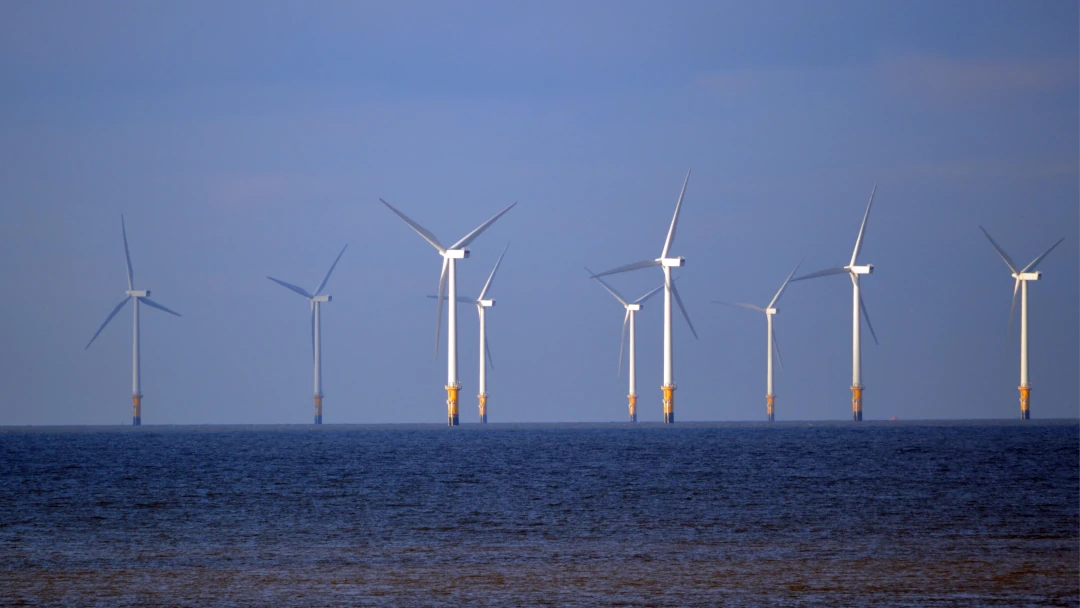
The Attentive Energy One project — a joint venture between TotalEnergies, Rise Light & Power, and Corio Generation — was not a speculative dream. New York selected it in 2023 from a competitive solicitation administered by the state’s energy authority, NYSERDA. Its plan was the kind of clean-energy buildout that should command bipartisan applause: a 1,400-megawatt offshore wind installation feeding electricity directly into New York City, paired with the retirement and renewable repowering of the 60-year-old Ravenswood Generating Station in Long Island City — the largest fossil-fuel plant in the city. According to the company’s project filings, that meant a “just transition” for unionized fossil-fuel workers, not their replacement by outsiders.
The numbers documented in the coalition’s complaint are not modeled fantasies. They are the figures Hochul’s administration accepted in awarding the contract: $25.6 billion in projected economic benefits to New York State, more than 1,700 direct jobs, and roughly $10 billion in ratepayer savings over the project’s first 25 years — including $500 million earmarked specifically for low-income households. Reduce that to plain language: enough electricity for 700,000 homes, lower utility bills for working families, and a manufacturing investment at the Port of Coeymans north of Albany. All of it dissolved by a single signature in Houston.
“After repeatedly losing in court, this administration cooked up a sham deal to pay a foreign energy company hundreds of millions of taxpayer dollars to abandon offshore wind and invest in oil and gas instead.”
— Letitia James, New York Attorney General
2. What This Costs the Ordinary American
Strip away the abstraction of “policy” and what remains is a bill paid by households. Electricity demand in the Northeast is rising. New York City’s grid, in particular, is straining under the dual pressure of building electrification and the surge in data-center load tied to artificial intelligence. The state’s plan to meet that demand — a plan signed off by its energy regulators, its utilities, and the developer itself — was Attentive Energy. Removing 1,400 megawatts of planned capacity from that grid does not make electricity cheaper. It makes it more expensive, more dependent on aging fossil-fuel generators, and more vulnerable to the kind of price shocks that follow every disruption in global oil and gas markets.
The coalition’s complaint argues that the cancellation will raise electricity costs across New England and the mid-Atlantic. House Democrats led by Rep. Jared Huffman and Rep. Jamie Raskin had already warned the Interior Department, in an April 6 letter demanding the legal basis for the payment, that the deal “directly undercuts American energy security by ending offshore wind leases that would have provided reliable, affordable energy for American families.” Rep. Alexandria Ocasio-Cortez sent her own letter to Burgum demanding to know what statutory authority permits the Department of the Interior to compensate a foreign company for relinquishing valid leases, and to identify the appropriation Congress passed for that purpose. The administration has yet to provide one.
The ordinary New Yorker — the union electrician who would have been on the Coeymans manufacturing line, the Bronx grandmother running a window air conditioner through next month’s heat wave, the small-business owner in Queens whose utility bill has climbed for three years running — has been quietly conscripted into financing this arrangement. Their tax dollars went to a company headquartered in Paris so that the company could promise not to provide them with cheaper electricity. There is no precedent in modern federal practice for a transaction of that character. The Anti-Deficiency Act, which prohibits federal officials from spending money Congress has not appropriated, hovers over the entire arrangement.
3. The Global Race the U.S. Just Conceded
Look beyond the New York coast and the picture darkens further. The Global Wind Energy Council projects that between 2026 and 2030, China will account for roughly 56 percent of new offshore wind capacity added worldwide. The European Union will add another 29 percent. The United States, the country that invented the modern energy economy, is projected to contribute about 5 percent. According to an Atlas Public Policy report released in May, 2025 was the first year that announced U.S. clean-energy manufacturing investments actually shrank — with more project cancellations in the United States than in the rest of the world combined. Chinese firms have captured 55 percent of nearly $1.1 trillion in announced global clean-energy manufacturing since 2019.
The Council on Foreign Relations, hardly a left-wing organ, observed in a March 2026 analysis that China’s new Five-Year Plan doubles down on lead positions in solar, electric vehicles, batteries, and wind turbines while extending its ambitions into hydrogen and fusion. The United States, meanwhile, is paying foreign companies to stop building the same technologies. Rystad Energy’s analysts described the trajectory plainly last fall: U.S. renewable energy investments dropped 36 percent year-on-year in 2025, with European capital fleeing the American market and consolidating in markets that still welcome it. The Trump administration calls this energy independence. In practice, it is unilateral disarmament in the only industrial competition that will matter over the next quarter-century.
This is not what global leadership looks like. It is what global retreat looks like. And it is being executed by an administration that has chosen, with apparent deliberation, to put a personal aesthetic preference — Donald Trump’s decades-long enmity toward wind turbines — ahead of the strategic and economic interests of the country he was elected to serve.
Get Involved Today
Contribute to our mission and turn your concerns into action.
4. A Grievance Older Than the Presidency
The decision to bribe a foreign company to abandon a $25 billion American project does not come from nowhere. Donald Trump’s antipathy toward wind power is documented across two decades and well predates his political career. According to the BBC, his loathing of wind turbines crystallized around a 2006 fight over an offshore wind project visible from his Aberdeenshire golf course in Scotland. He sued to block it. He lost. He was ordered in 2019 to pay the Scottish government’s legal fees. In 2024, at a Mar-a-Lago fundraising dinner with oil-industry executives, he reportedly declared “I hate wind” and pledged to halt the industry “on day one” of a second term.
There is a name for the kind of governing in which a personal twenty-year grudge from a Scottish golf course dispute becomes the reason a Bronx family pays more for electricity. The polite term is “policy capture.” The honest term is something else. Lena Moffitt, executive director of Evergreen Action, called the arrangement a “billion-dollar bribe” to kill clean energy. Ted Kelly, the clean energy director at the Environmental Defense Fund, made the analytic case: the administration, having failed to defeat offshore wind in court, simply purchased the outcome it could not litigate.
“This pay-not-to-play scheme pressuring a foreign company to forego planned offshore wind projects in America in favor of gas and oil drilling is an outrageous abuse of taxpayer dollars.”
— Kathy Hochul, Governor of New York
“Unable to discharge” — and the word the framers refused to define
Section 4 of the Twenty-Fifth Amendment, ratified in 1967, allows the Vice President and a majority of the Cabinet — or a body Congress establishes for the purpose — to declare that the President is “unable to discharge the powers and duties of his office.” The amendment does not define unable. It does not define inability. The drafters, working in the aftermath of the Kennedy assassination and with the example of Woodrow Wilson’s concealed incapacitation in mind, made that omission deliberately. They wanted a standard flexible enough to capture every kind of failure the office could suffer — physical, cognitive, and judgmental — without freezing the meaning to the medical vocabulary of any particular era.
Pay-not-to-play is the kind of transaction that, in a normally functioning executive branch, does not happen. A foreign company is handed nearly $1 billion in taxpayer money, drawn from an account meant for litigation judgments, on the condition that the company will not deliver electricity to American households. There is no national security review on the record. There is no congressional appropriation. There is no statutory basis the administration has been willing or able to identify in writing to House investigators. There is only a presidential grievance — documented since 2006 in Aberdeen — and the executive machinery bent to satisfy it.
If governing decisions can be reverse-engineered from the President’s personal feuds rather than the public interest, the constitutional question is no longer rhetorical. It is operational.
House Judiciary ranking member Rep. Jamie Raskin has been the most consistent congressional voice on the question. In April, after Trump’s Easter Sunday social media threats against Iranian power plants, Raskin demanded a comprehensive cognitive evaluation of the President and introduced legislation establishing the independent Commission on Presidential Capacity expressly contemplated by Section 4. Senators Bernie Sanders, Chris Murphy, and Ed Markey have called publicly for the amendment’s invocation. Representatives Sydney Kamlager-Dove and Yassamin Ansari have done the same. More than seventy lawmakers have, at one point or another, joined the call.
The honest assessment of the political path is that it will not happen quickly. Section 4 requires the Vice President and a majority of the sitting Cabinet, both of which are populated by appointees personally selected by the President. The congressional commission alternative requires majorities Raskin does not currently command in either chamber. The Republican leadership will not act on the standard their own caucus once endorsed in private.
None of that empties the constitutional argument. The framers wrote Section 4 for a reason. They left “inability” undefined because they knew the country would eventually face a presidency in which the failure to discharge the duties of office would not announce itself with a stroke or a hospital admission, but would arrive instead as a pattern — a series of decisions in which the public interest is repeatedly subordinated to private grievance, foreign capitals are paid not to invest in America, and federal money is spent without statutory authority to satisfy an idiosyncrasy older than the President’s first political campaign. That is the pattern the lawsuit filed Tuesday has now placed on the public record.
5. What the Courts Cannot Do Alone
The Tuesday filing in the District of Columbia is a serious legal action. It is led by an attorney general — Letitia James — who has won meaningful federal litigation against this administration before, and it is joined by six other states whose grids and economies are directly harmed by the cancellation. The legal arguments are strong: the Outer Continental Shelf Lands Act sharply restricts the Interior Department’s discretion to cancel offshore wind leases, and the use of the federal Judgment Fund to finance a settlement with no underlying lawsuit raises substantial questions under federal fiscal law.
But courts move slowly, and an injunction will not by itself restore the Attentive Energy project to the construction schedule it had a year ago. The supply chain has been disrupted. European developers are already redirecting capital out of the American market. Even a state coalition victory at the district-court level will be followed by appeals that consume years the country does not have if it intends to remain in the global energy competition. The judicial branch can name the illegality. It cannot, by itself, replace the leadership that produced it.
That is the unavoidable point. The lawsuit that James and Hochul announced this week is necessary. It is also insufficient. The constitutional remedy for a president whose decisions repeatedly serve no discernible public interest exists in the document the framers wrote. Whether the country has the political will to invoke it is a separate question — but the moral and legal case for asking is now considerably stronger than it was on Monday.
Editorial Conclusion
A foreign oil company was paid nearly a billion dollars of American taxpayer money to walk away from American clean energy. The grid is weaker for it. Families will pay more. Union workers will not be hired. China and Europe will build what the United States refused to build. And the reason — once the press releases and “national security” language are stripped away — is that the President of the United States carries a personal grudge against wind turbines that he has nursed publicly since 2006.
This is not a difference of policy preference between left and right. It is the use of federal authority and federal money to satisfy a private resentment at the expense of the public interest. The framers of the Twenty-Fifth Amendment left the word “unable” undefined because they understood that this is exactly the kind of failure a constitution must be prepared to name. The lawsuit filed this week names the illegality. The country must now find the courage to name the rest.
Sources & References
- NY Attorney General’s Office — James and Hochul Announce Lawsuit Challenging Unlawful Trump Wind Deal (June 2, 2026)
- NY Governor’s Office — Governor Hochul on the TotalEnergies Lawsuit (June 2, 2026)
- CNN — Trump Admin Paid French Company $1 Billion Not to Build Offshore Wind; Blue States Sue
- PBS NewsHour — New York and Six Other States Sue Over Offshore Wind Deal
- ABC News — Seven States Sue Trump Administration Over $1B Offshore Wind Deal
- Fortune — “This Administration Cooked Up a Sham Deal”: New York Sues Over $1B Refund
- CT Mirror — Connecticut Joins New York Suit Over TotalEnergies Deal
- Power Technology — New York Leads Coalition Challenging $1B Wind Lease Settlement
- House Natural Resources Democrats — Huffman-Raskin Letter to DOI on Offshore Wind Contract Cancellation (April 6, 2026)
- Rep. Ocasio-Cortez — Letter to Secretary Burgum on TotalEnergies Payoff (March 31, 2026)
- House Judiciary Democrats — Ranking Member Raskin Demands Cognitive Evaluation, Calls to Invoke 25th Amendment
- Deseret News — Democrats Introduce 25th Amendment Commission Bill
- Rystad Energy — U.S. Forfeits Offshore Wind as China Dominates Market into 2030
- Inside Climate News — China Widens Its Clean Energy Lead Over the United States
- Council on Foreign Relations — China Is Planning Decades Ahead on Clean Energy
- The Washington Post — Trump Says He “Hates” Wind Power at Oil Executive Fundraiser
- BBC News — How Trump’s Loathing for Wind Turbines Started with a Scottish Court Battle
- Attentive Energy / NYSERDA — Attentive Energy One Project Overview & Economic Benefits
Related News