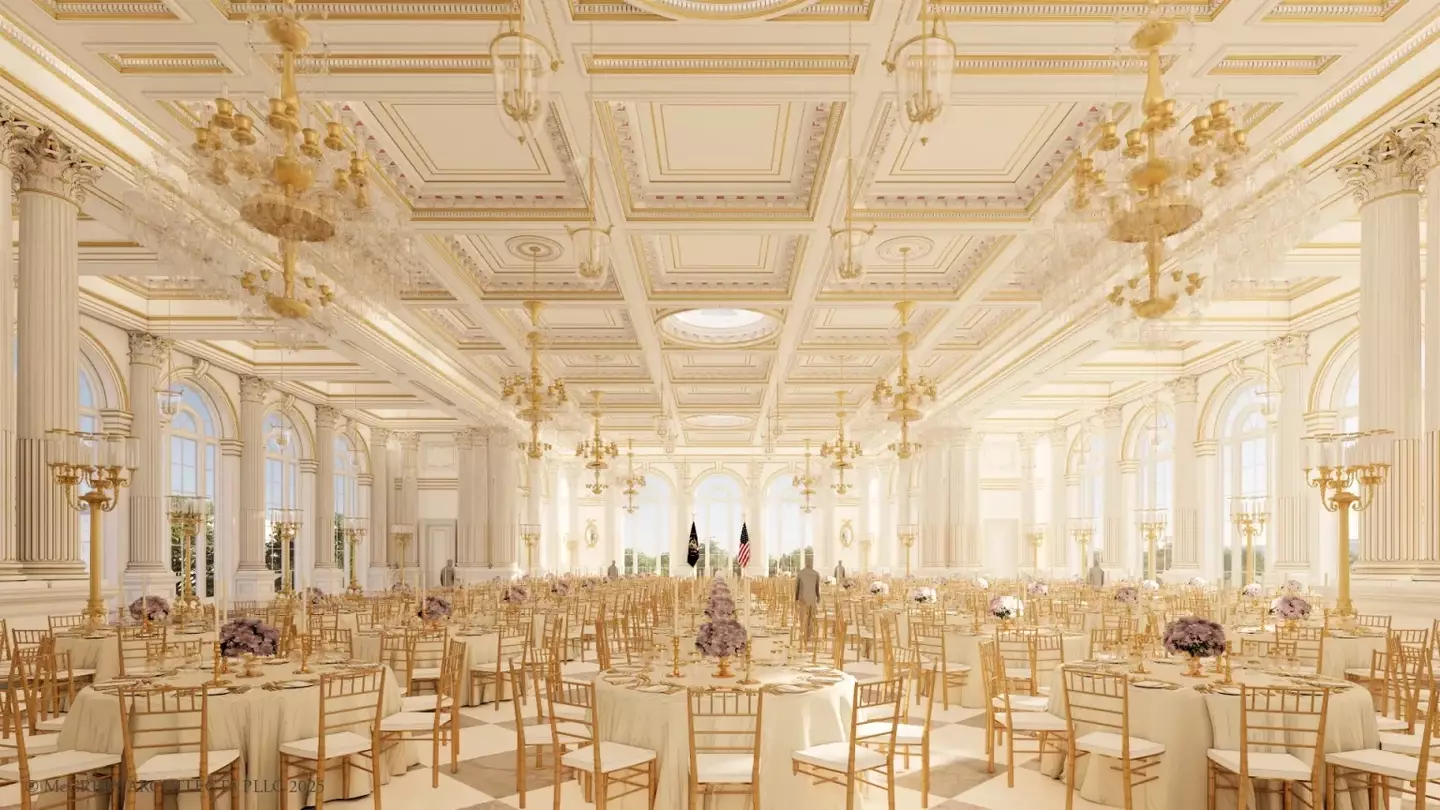
While millions of Americans struggle with the real costs of inflation, tariff-driven price hikes, and evaporating health coverage, the president of the United States is spending upward of $400 million — and counting — on a palace wing attached to the people’s house. The ballroom is not merely a construction project. It is a self-portrait: impulsive, grandiose, structurally flawed, and profoundly disconnected from the country it purports to serve.
On a Tuesday in late March, as food stamp deposits failed to appear on the EBT cards of 42 million low-income Americans due to a congressional standoff the administration helped engineer, the architects and editors of The New York Times published a meticulous analysis of President Trump’s grand ballroom design. Their findings were damning: a proposed grand staircase on the South portico leads nowhere. Columns obscure the interior view. Fake windows line the north facade. The sheer bulk of the 90,000-square-foot structure — nearly twice the footprint of the White House itself — threatens to reduce the historic mansion to what critics described as a mere shed. That image, a $400 million monument to bad taste looming over a building that once stood as the symbol of democratic governance, has become the defining metaphor of this presidency’s second term.
The president’s fixation on building is not new. At least as far back as 2010, when Trump was still a real estate promoter and reality television fixture, he called White House senior advisor David Axelrod to lobby for a ballroom addition to the executive mansion. Sixteen years later, wielding the powers of the presidency, he has finally gotten his way — though at a cost, in both financial and constitutional terms, that no preliminary sketch could have captured.
1. A Price Tag That Refuses to Stop Climbing
When the White House announced the ballroom project in July 2025, the administration pegged its cost at $200 million, to be covered entirely by private donations from what it called “patriot donors” and “great American companies.” Within three months, that estimate had doubled to $400 million. By December 2025, another hundred million in costs had materialized — and the undisclosed price of a classified underground military complex being built beneath the structure, funded entirely by public money, remains a separate line item no one is permitted to audit. The administration’s own fiscal year 2026 budget, released this spring, revealed $377 million in White House renovation spending for the current year, with an additional $174 million penciled in for fiscal year 2027 — an 866 percent increase over the $39 million spent during fiscal year 2025.
The donor list is its own story. Corporations that gave lavishly to the ballroom project — Alphabet among the most prominent — were the same companies whose executives had been invited to White House events hosted by the very president soliciting their contributions. The Associated Press noted the administration did not publish a full donor list until October 22, 2025, the day after it promised to do so, and only after sustained public pressure.
Announced July 2025. Promised as fully privately funded by “patriot donors.”
Doubled within months; $377M in this year’s federal budget alone, with $174M more in 2027.
Of 32,000 public comments submitted to the National Capital Planning Commission opposed the project, per a New York Times review.
The Commission of Fine Arts — stacked with Trump appointees — spent just 12 minutes deliberating before granting final approval to a 90,000 sq ft permanent structure.
2. The Nation It Leaves Behind
The ballroom’s escalating costs and the president’s singular obsession with its completion land against an economic backdrop that ought to command far more of his attention. According to a February 2026 report from the Center for American Progress, the Trump administration’s first year marked the weakest job growth outside of a recession since 2003, with only 181,000 jobs added over the entire year — roughly one-eighth the monthly pace of the prior administration. The manufacturing sector, which the president’s tariffs were ostensibly designed to revitalize, lost 77,000 jobs between April and December 2025.
The pain is not abstract. For the 25 million Americans who purchased health insurance through Affordable Care Act exchanges, net premiums more than doubled in 2026 after enhanced tax credits were allowed to expire. A 55-year-old couple earning $90,000 per year went from paying $638 per month for a silver plan to $2,179 per month — a 241 percent increase in a single year. Inflation has remained sticky at 3 percent, driven in significant part by the administration’s own tariff agenda: 60 percent of Americans disapprove of the tariff increases, according to a Pew Research survey of more than 8,500 adults conducted in January 2026, with 39 percent saying they strongly disapprove.
“Americans cannot afford Trump’s America. In contrast, Democrats are focused on lowering costs and reining in political corruption.”
— Ken Martin, Chair, Democratic National Committee, April 2026
Elizabeth Pancotti, managing director at the Groundwork Collaborative, put it plainly in an interview with The New Republic: small businesses have seen hiring freeze entirely, layoffs are accelerating, and the populations getting crushed hardest are low- and middle-income Americans — precisely the people the president claims to champion. “It seems like a really bad time for Trump’s ballroom to be dominating the news,” the interviewer observed. It is not merely bad timing. It is a window into priorities.
Representative Don Bacon of Nebraska, a Republican, told CNBC that the administration’s self-inflicted wounds on economic messaging were “so unnecessary.” Brittany Martinez, executive director at Principles First and a former aide to House Speaker Kevin McCarthy, was more blunt: “The president, who is supposed to be this ardent businessman, is prioritizing things elsewhere. I think that’s going to be a problem for Republicans during midterms for sure.”
3. A Demolition Before a Blueprint
The ballroom’s procedural history is, if anything, more alarming than its mounting costs. The East Wing — a structure dating to 1902 and the traditional home of the First Lady and her staff — was demolished beginning in October 2025, before the administration had completed a final design, secured the required approvals from the National Capital Planning Commission, or complied with federal historic preservation review guidelines. Demolition crews swinging backhoes through the East Wing became an impromptu tourist attraction, in the words of Fortune magazine.
In the rubble, two historic magnolia trees were destroyed. One had been planted in 1922 by Florence Harding in honor of her husband, President Warren G. Harding. A second commemorated President Franklin Delano Roosevelt, whose leadership guided the country through Depression and war. The National Trust for Historic Preservation sued the administration in December 2025, arguing it had failed to observe federal guidelines. The Justice Department, in a court filing dated February 2, 2026, signaled it would appeal any ruling halting construction on grounds of “national security implications.” A federal district judge declined to stop construction on February 26 but left the litigation open.
4. Architecture as Psychology
The New York Times analysis, published March 29, 2026, was not merely aesthetic criticism. It was a clinical study in what happens when impulsivity is given institutional authority. The architects who examined the ballroom’s design noted that the proposed South portico’s grand staircase leads to nothing — visually striking, architecturally nonfunctional. Columns placed for decorative effect block the view from within the ballroom itself. The scale of the new wing, at 90,000 square feet, would dwarf the existing White House and disrupt the property’s historic symmetry — making what has stood for 230 years as the seat of democratic power look, in the words of observers, like an afterthought beside a developer’s vanity.
The Times noted that the Commission of Fine Arts, whose current membership was appointed entirely by the president, deliberated for just 12 minutes before granting final clearance for the largest permanent addition to the White House in a century. For context, the Obama Presidential Center in Chicago — a privately funded structure of similar ambition — underwent years of design review, community input, and environmental study before breaking ground. As the Times wrote, the ballroom “will be worse off for it.”
The president himself made changes to the design — increasing the seating capacity from 650 to 900 to 999 people — well into the construction phase, the kind of scope-expansion decision that would ordinarily occur at the conceptual stage of any professional project. A former member of the National Capital Planning Commission told the Times that a project of this scale would normally require 18 months to two years of design development before construction documents are prepared. The ballroom’s construction documents were reportedly being written at the same time the design was still under review. That is not confidence. That is compulsion.
“Trump rushed to demolish the whole East Wing before the plans were finalized. His speedy approach has all the hallmarks of a real estate developer who prioritizes speed and bravado over patience.”
— MSNBC Opinion, April 2, 2026
5. Influence, Access, and the Gilded Donor List
The ballroom was announced as a gift from patriotic private donors to the American people. The reality is considerably more transactional. The corporate names on the donor list — assembled only after sustained pressure from journalists and watchdogs — read as a catalog of companies with significant regulatory and legislative interests before the federal government. Alphabet contributed. So did other firms whose executives had attended White House events in the months immediately preceding the donation solicitation. The connection between ballroom access and presidential access, while not explicitly stated, is impossible to ignore.
Get Involved Today
Contribute to our mission and turn your concerns into action.
Meanwhile, the classified underground structure being built beneath the ballroom — which Trump confirmed to reporters while describing the ballroom as “essentially a shed for what’s being built under” — is funded entirely by public appropriations whose scope remains undisclosed. Americans are paying for something their government refuses to describe, beneath a building their president designed while expanding its size, ripping down historic trees, and brushing aside 98 percent of the citizens who bothered to comment.
The Society of Architectural Historians and the American Institute of Architects both expressed alarm about the project’s lack of transparency and the compressed design review process. The Asbestos Disease Awareness Organization filed a federal FOIA lawsuit in January 2026 seeking public records about asbestos inspection and disposal tied to the East Wing demolition — safety records the administration has declined to provide voluntarily. This is a building that houses the presidency of the United States. The public is entitled to know whether its demolition was conducted safely. The president’s administration believes otherwise.
What the Constitution Provides — And Why Congress Is Asking the Question
The Twenty-Fifth Amendment to the United States Constitution, ratified in 1967, provides in Section 4 that whenever the Vice President and a majority of the Cabinet — or “such other body as Congress may by law provide” — transmit a written declaration that the president is “unable to discharge the powers and duties of his office,” the Vice President shall assume those powers as Acting President. The amendment was drafted in the aftermath of President Kennedy’s assassination, when the nation confronted for the first time the terrifying possibility of an incapacitated president with no clear legal mechanism for transfer of authority.
On April 14, 2026, Representative Jamie Raskin of Maryland, the top Democrat on the House Judiciary Committee, introduced legislation that would establish a Commission on Presidential Capacity to Discharge the Powers and Duties of Office. The bill drew 50 Democratic co-sponsors. Its purpose, as Raskin explained, was to create the “other body” envisioned by the amendment’s drafters — an independent commission of 17 members empowered to conduct a medical and cognitive examination of the president within 72 hours of adoption. Raskin cited what he described as “incoherent, volatile, profane, deranged, and threatening” public statements by the president, including a Truth Social post threatening to destroy Iran’s “whole civilization.” He wrote in a letter to the White House physician that the country had “indisputably entered the realm of profound medical difficulty and concern.”
Senator Chris Murphy of Connecticut said that if he were a Cabinet member, he would spend his Easter weekend consulting constitutional lawyers about the 25th Amendment, calling the president’s conduct “completely, utterly unhinged.” Illinois Governor JB Pritzker publicly called for the Cabinet to invoke the amendment. Representative Alexandria Ocasio-Cortez joined over 70 Democratic lawmakers in calling for the president’s removal. More than 70 lawmakers across the House and Senate have signed onto some form of call for a fitness review.
The legal and practical barriers are real. The Republican-controlled Congress is unlikely to advance Raskin’s bill. Vice President JD Vance and the Cabinet have shown no public appetite for action. Even if they acted, a two-thirds vote of both chambers would be required to make removal permanent once the president contested it — a threshold not currently achievable. Republicans, with narrow exceptions, have rallied around the president.
But the barriers do not negate the constitutional argument — or the moral case. The amendment exists precisely because the framers understood that a democracy must have mechanisms proportionate to every foreseeable threat to its functioning, including a president who cannot or will not govern in the public interest. The ballroom alone is not grounds for invoking the amendment. But the ballroom, taken together with erratic wartime rhetoric, disdain for congressional oversight, compulsive redecorating of democratic institutions, and a demonstrated inability to sustain focus on the material conditions of working Americans, forms a portrait of leadership that the amendment’s authors might have recognized as its intended subject.
6. The People’s House Is Not a Palace
The White House press secretary, Karoline Leavitt, called the ballroom “a gift to the American people” — a phrase that demands scrutiny. The American people were not consulted. When the National Capital Planning Commission opened a formal public comment period, 98 percent of the 32,000 comments received opposed the project. The commission’s chair — Will Scharf, a Trump appointee who simultaneously serves as the president’s White House staff secretary — approved the project anyway. The Commission of Fine Arts, staffed entirely by Trump’s own picks, spent 12 minutes on the decision.
“The White House is not a palace. It is not a tsar’s residence,” one architectural expert told The Daily Beast. The phrase carries uncomfortable resonance at a moment when the president is simultaneously spending hundreds of millions on personal construction projects, appointing loyalists to rubber-stamp regulatory bodies, and dismissing the economic anxiety of tens of millions of Americans as a “Democratic hoax.” The Hill described the timing of the renovations as poor, coming amid poor jobs reports and the rippling costs of tariff policy.
What is the legacy of a president who tears down magnolia trees planted to honor Franklin Roosevelt and Warren Harding — men who presided over genuine national catastrophe with some measure of institutional gravity — in order to erect a gilded event space with staircases that go nowhere? The answer is inscribed in the project itself: this is a presidency that has always been more interested in the appearance of grandeur than in the obligations of governance.
Editorial Conclusion
The White House ballroom is not a gift to the American people. It is a monument to a presidency that has confused self-aggrandizement with service. While food stamp recipients waited for benefits that never arrived, while working families watched health premiums double and grocery prices climb, the president’s singular focus remained fixed on a 90,000-square-foot vanity project — one with stairs that lead nowhere, a design approved in 12 minutes by his own appointees, and costs that have more than doubled in less than a year. Representative Raskin is right to demand a cognitive accounting. Governor Pritzker is right to name what he sees. The 70-plus lawmakers calling for a fitness review are right to use every constitutional tool available to them. A democracy cannot be governed from a palace mindset. The Twenty-Fifth Amendment exists for moments when the presidency is consumed by itself rather than by the nation it exists to serve. We are in such a moment. The Cabinet and the Congress must decide whether they will acknowledge it.
Sources & References
- Wikipedia — White House State Ballroom: Full Project Overview
- The White House — White House Announces Ballroom Construction, July 2025
- Fortune — $400M Ballroom Was Just the Beginning — Trump Plans $174M More, April 2026
- PBS NewsHour — 9 Things to Know About Trump’s White House Ballroom
- Society of Architectural Historians — Statement on the Proposed Ballroom Addition at the White House
- The Daily Beast — Trump Ballroom Trashed Over Its Humiliating Design Flaws, March 2026
- The Daily Beast — Leavitt Melts Down as NYT Exposes Ballroom Design Flaws, March 2026
- Mediaite — Its Stairs Lead Nowhere: Ballroom Design Trashed by NYT Architects
- MSNBC Opinion — Trump’s Ballroom Blitz Has Become a Quagmire, April 2, 2026
- CNBC — Trump’s Lack of Focus on Economy Is Spooking Republicans, April 2026
- Center for American Progress — A Year in Review: How Trump’s Economic Policies Made Life Less Affordable
- Pew Research Center — Americans Largely Disapprove of Trump’s Tariff Increases, February 2026
- The New Republic — Trump Ballroom Fiasco Worsens as Economic Data Gets Brutal, October 2025
- Council on Foreign Relations — A Year After Liberation Day: Experts Review the Costs of Trump’s Tariffs, April 2026
- Axios — Raskin Demands Trump Cognitive Test in 25th Amendment Push, April 2026
- Deseret News — Democrats Introduce 25th Amendment Commission Bill, April 2026
- News Directory 3 — Trump’s Mental Fitness and Calls for the 25th Amendment, April 2026
- The Fulcrum — Is Pritzker Right? Is It Time to Invoke the 25th Amendment Against Trump?
Related News