The Armada and the Ballot: Trump Is Staging a Post-Midterm War
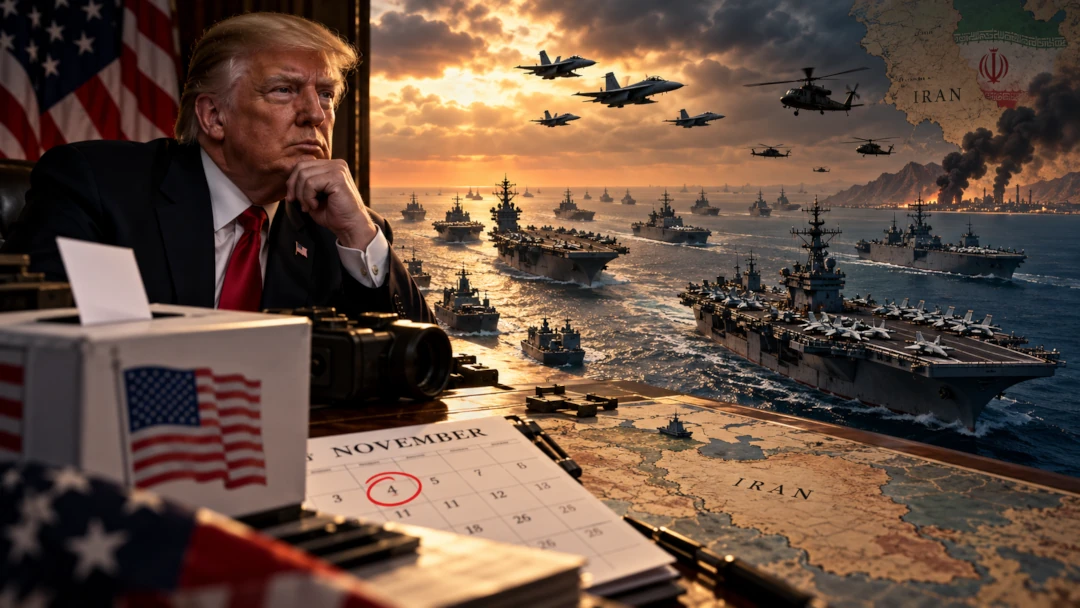
Three carriers, two amphibious groups and more than 20,000 sailors and Marines could be off Iran’s coast within weeks of Election Day. It is not yet an invasion force. It is something a responsible government would never build on a political calendar: the means to widen a war the moment voters can no longer weigh in.
The ships left San Diego quietly. On Sunday, September 27, the aircraft carrier USS Theodore Roosevelt slipped out of port with no sailors manning the rails, and a day later the USS Makin Island followed with the 13th Marine Expeditionary Unit aboard, according to aviation outlet Migflug. The Associated Press reports the combined force carries over 7,000 sailors and 2,000 Marines, and that President Trump continues to describe a post-midterm escalation as a live option, despite having first sold Americans a campaign that would last weeks.
That war began on February 28. It is now in its eighth month. And the most important fact about the next phase may be its timing: the reinforcements are scheduled to arrive just as the votes are counted.
I. What Is Actually Sailing
A U.S. official told Bloomberg the deployment adds a carrier and roughly 10,000 sailors and Marines, explicitly giving commanders more options if the president chooses to escalate. The Wall Street Journal, as summarized by Migflug, put the increase at 9,000 to 10,000 troops on top of the more than 50,000 already in the region. If the carriers already on station stay, EA WorldView calculates the U.S. naval presence would exceed 20,000 sailors and Marines and hundreds of aircraft, alongside the USS George H.W. Bush, the USS George Washington and the USS Boxer amphibious group.
Airpower at scale
A third carrier air wing would let the Pentagon sustain strikes on missile, naval, nuclear and government targets around the clock. CNBC reports the full buildup should be complete by November.
Blockade and the strait
Trump turned down Iran’s offer to reopen Hormuz in exchange for lifting the U.S. blockade of Iranian ports, The Week notes. More hulls mean a blockade that can be held longer and enforced harder.
Marines for raids, not occupation
The Makin Island group carries the 13th MEU, about 2,000 Marines suited to raids, seizures of islands or coastal facilities, and evacuations, per Stars and Stripes.
No asset leaves, deal or not
Al Jazeera’s Washington correspondent, citing Pentagon and White House sources as relayed here, reported the Pentagon does not plan to pull any asset even if a deal is reached.
Defense Secretary Pete Hegseth has said these forces are “ready to go” if the president orders new strikes. Earlier in the war, he told 60 Minutes the administration was reserving the right to put boots on the ground, refusing to name any limit. Before the bombing even began, Sen. Tim Kaine of Virginia had flagged the president’s own remark that he doesn’t “have the yips about boots on the ground.”
II. A War Timed to the Election
- Feb 28, 2026
U.S. and Israeli strikes begin against Iran. Gas sat just under $3 a gallon the day before, NBC News reports. - April 2026
Three carriers in theater for the first time since 2003, shortly before an April ceasefire, per EA WorldView. - May 19, 2026
Senate advances a war powers resolution 50–47 after four Republicans break ranks, the first success in eight tries, CBS News reports. - August 2026
USS George Washington rushed in to relieve the exhausted Abraham Lincoln amid alarm over crew mental health, per Stars and Stripes. - Sept 22, 2026
Trump at the U.N. muses about whether to annihilate Iran and claims Tehran is waiting on the midterms, per Rolling Stone. The same day, the acting Navy secretary confirms eight suicide attempts in the Lincoln strike group. - Sept 26, 2026
Ceasefire offer rejected. The Journal reports Trump told aides he expects bombing to resume after the midterms, CNBC says. - Sept 27–28, 2026
Roosevelt and Makin Island deploy from San Diego. - Oct 1, 2026
Trump tells TIME intensified bombing after November 3 is “possible,” as reported by CNBC. - Nov 3, 2026
Midterm elections. The buildup is due to be complete that month.
Get Involved Today
Contribute to our mission and turn your concerns into action.
Iran was watching how he does in the midterms, Rolling Stone documented. Georgetown University in Qatar’s Paul Musgrave told Al Jazeera that if Republicans lose Congress, Trump may reach for unilateral action, possibly including renewed warfare. Put simply, the window for escalation opens precisely when voters’ leverage closes.
“Do I annihilate the Islamic Republic, and do it quickly?”
— President Donald Trump, U.N. General Assembly, Sept. 22, 2026 · via Rolling Stone
III. Why This Is Not Yet an Invasion
Honesty requires a qualifier, and it strengthens rather than weakens the case for alarm. The 9,000 additional personnel are overwhelmingly sailors and Marines assigned to ships. Carrier groups exist to project airpower and control the sea. A single Marine expeditionary unit cannot conquer, occupy or stabilize a country of roughly 90 million people. And the Roosevelt may simply be relieving the George Washington; Axios reported that whether it adds to the fleet or replaces a carrier has not been decided. Even a temporary three-carrier overlap, though, is enough to underwrite a high-intensity bombing campaign.
A genuine invasion would leave fingerprints that the reporting to date does not show:
| Indicator | Current reporting | What it would suggest |
|---|---|---|
| Carriers and amphibious groups | Yes | Major strike, maritime, and limited expeditionary capability |
| 9,000–10,000 mostly shipborne personnel | Yes | Reinforcement and endurance, not occupation |
| Large Army or Marine ground formations moving in | Not established | Preparation for sustained land combat |
| Heavy sealift of armor, artillery, fuel and ammunition | Not established | A campaign to seize and hold territory |
| Reserve mobilization or very large force increases | Not established | A protracted, larger war plan |
| Stated invasion objectives and allied basing plans | Not established | Political commitment to ground war |
IV. What This Says About Leadership
Strategy is missing. One Trump ally, speaking to reporters cited by the Times of Israel, conceded there was no real strategy for how long the war should last or what endpoint it should reach. The same report described the president clashing with Hegseth, accusing him of misleading the White House about munitions stockpiles.
The facts are bent in public. At the U.N., Trump boasted of more munitions than the country could ever use. The Pentagon’s own inspector general had just reported the war produced strategic inventory shortfalls, CBS News noted. A commander in chief who cannot level with the public about the arsenal cannot be trusted to level with it about the risks.
Threats replace diplomacy. Foreign Policy observed that experts have argued threats of this kind could be considered war crimes. Talk of driving a nation “into hell” forecloses compromise and invites the other side to assume the worst.
The troops absorb the cost. Acting Navy Secretary Hung Cao confirmed to Sen. Kirsten Gillibrand of New York that eight sailors in the Lincoln strike group attempted suicide during its deployment, The Hill reports. The first ship of that group came home after 301 days at sea, per Military Times, following the Gerald R. Ford‘s record 327-day deployment. Now Roosevelt families have been told to plan for eight months.
Families pay at the pump. Gas is near $4.50 a gallon and diesel has hit records around $6.52, according to NBC News. As early as April, Pew Research Center found 64% of Americans lacked confidence in Trump’s decisions on Iran, with majorities worried about ground troops being sent.
“This war is accomplishing really, nothing, except imposing massive costs on the United States.”
— Sen. Tim Kaine (D-Va.) · via WVVA
Taken together, the pattern reveals the president’s priorities. Political timing comes before strategy. Personal toughness comes before candor. And the burden of an open-ended war falls on the sailors who crew the ships and the families who fill the tanks, while the decision itself is held until it can no longer cost him at the ballot box.
Congress, not the calendar, decides whether America goes to war
Article I, Section 8 gives Congress, not the president, the power to declare war. The 1973 War Powers Resolution requires the president to withdraw forces from unauthorized hostilities after 60 days unless Congress acts. This war has run for more than 200 days without a declaration or an authorization.
Congress has not been silent. Kaine says he has forced a war powers vote every week the Senate has been in session, and that the president “ignored” a resolution Congress passed in June. The House passed its third such resolution in September, and a new Senate version was filed by Sen. Andy Kim of New Jersey, WVVA reports. Senate Minority Leader Chuck Schumer, after the May breakthrough, said Democrats were breaking through Republicans’ silence vote by vote, per CBS News.
The constitutional remedies for a president waging unauthorized war are the ones the framers placed with Congress: the power of the purse, binding war powers legislation that can survive a veto, and, if a president defies the law, impeachment. A war deliberately paused until after an election, then resumed without a vote, would be a direct test of whether those powers still mean anything.
V. What to Watch Before November
Four signals will tell the public whether this is coercion or the opening of a wider war: whether the Bush and Washington stay once the Roosevelt arrives; whether Army or Marine ground-combat formations begin moving in large numbers; whether sealift starts carrying heavy armor and artillery rather than ship crews; and whether the administration begins naming objectives, such as regime change or seizing territory, that airpower alone cannot achieve. Any one of those would mark a qualitative change, and Congress should demand to be told before it happens.
VI. What You Can Do
An honest assessment first. A war powers resolution can pass both chambers and still be vetoed, and two-thirds majorities to override are not in sight. But public pressure has already moved Republican senators once this year, and the power of the purse and formal oversight do not require a supermajority to start. Here is where ordinary citizens have real leverage.
Call both senators and your representative
Use the Capitol switchboard at 202-224-3121. Ask one specific question: will they vote for the pending war powers resolution and oppose any further escalation that Congress has not authorized? Calls that name a specific bill get logged and counted.
Demand a vote before the bombs, not after
Ask your members to insist publicly that any resumption of major strikes after November 3 comes to Congress first. A clear on-the-record position before the election is the strongest guard against an escalation timed to follow it.
Back the oversight already underway
Two Democratic lawmakers have called for a hearing on conditions aboard the Lincoln, the Deseret News reports. Urge your representative to support it and to demand testimony on munitions shortfalls and deployment lengths. Oversight produces facts that make the next escalation harder to sell.
Make the war a question on November 3
Ask every candidate in your district where they stand on authorizing this war. Then vote, and help others do the same. Musgrave’s warning about unilateral action is a reason to elect a Congress willing to use its powers, not a reason to give up on one.
Stand with military families
Support organizations serving Navy and Marine families during long deployments, and amplify their reporting on conditions aboard ship. The people carrying this war are the best witnesses against running it without limits.
Editorial Conclusion
A president who parks a fleet off Iran’s coast, rejects a ceasefire, and tells aides the bombing will resume after the votes are counted is not waiting for a deal. He is waiting for permission he believes the calendar will grant him.
The Constitution grants no such permission. The decision to widen this war belongs to Congress, before November and after it. Every member who stays silent now is choosing to let an election date stand in for a declaration of war. Americans should accept nothing less than a vote, in the open, on the record, before another sailor or Marine is sent deeper into a war no one has authorized.
Sources & References
- Associated Press via U.S. News — Third aircraft carrier and thousands of troops head to Mideast
- Bloomberg — US adds carrier and 10,000 troops to Mideast
- Stars and Stripes — Navy ships deploy as Trump weighs renewed strikes on Iran
- Migflug — Third carrier for Iran? USS Theodore Roosevelt deploys
- EA WorldView — US War on Iran, Day 219: third aircraft carrier
- CNBC — U.S. to send third carrier group as Trump warns of new strikes
- CNBC — Trump rejects Iran’s conditional ceasefire proposal, WSJ reports
- Al Jazeera — Trump rejects Iran’s seven-day ceasefire proposal. What’s next?
- The Week — Are the midterms dictating Trump’s Iran strategy?
- Srpske.rs (Al Jazeera reporting) — Third US carrier heads to Iran as Marines follow
- Countercurrents (Axios, WSJ reporting) — Carrier and up to 10,000 troops sent toward Iran
- Yahoo News / Mediaite — Hegseth tells 60 Minutes the administration reserves right to boots on the ground
- Times of Israel — Trump bashed Hegseth over munition shortages
- CBS News — In U.N. speech, Trump threatens to “annihilate” Iran
- Rolling Stone — Trump makes wild threats in chaotic U.N. speech
- Foreign Policy — Trump threatens to “annihilate” Iran in U.N. speech
- The Hill — Acting Navy secretary says 8 Lincoln sailors attempted suicide
- Military Times — First elements of Lincoln strike group return home
- Deseret News — Lincoln suicide attempts prompt calls for congressional action
- WVVA — Kaine expects new vote on Iran war powers resolution
- CBS News — Senate advances Iran war powers resolution after 4 Republicans defect
- Office of Sen. Tim Kaine — Kaine sponsors resolution to curb actions in Iran
- Pew Research Center — Gas prices are Americans’ top concern in Iran war
- NBC News — The U.S. economy before and after the Iran war
Related News