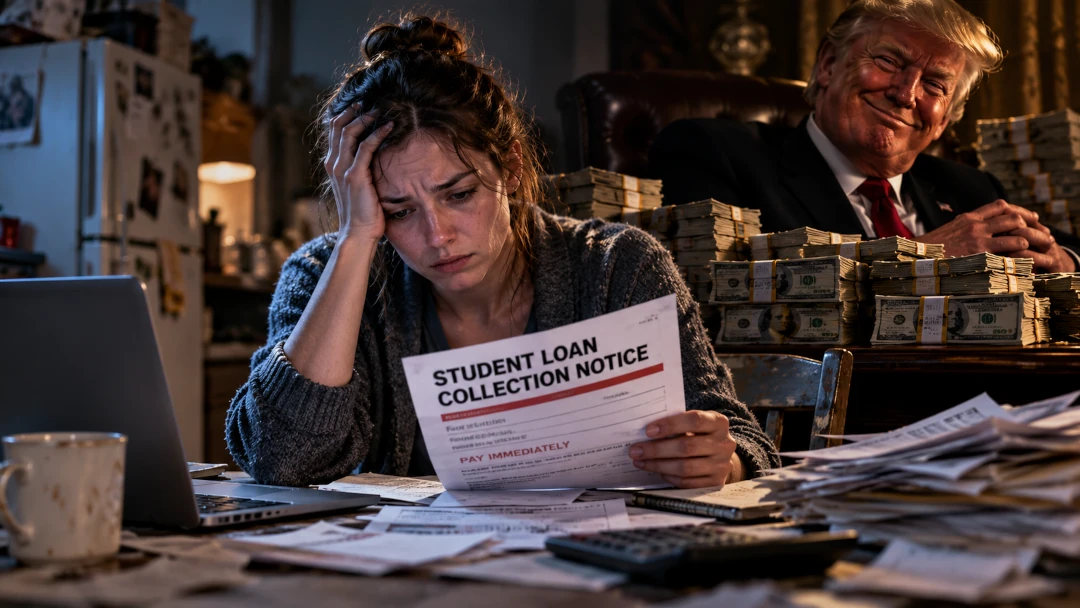
Collect After the Count: Trump’s Post-Election Squeeze on 10 Million Student Borrowers
The administration is reportedly preparing to turn private debt collectors, wage garnishment and benefit seizures loose on Americans in default on their federal student loans — but not until the ballots are counted. In a year of war-driven gas prices and tariff-driven costs, the timing tells you exactly whom this White House is working for.
Twelve days before the midterm elections, the clearest statement of this administration’s economic priorities is not a speech or a rally line. It is a calendar. According to reporting first published by the Washington Sun on October 19 and relayed by Benzinga, the Treasury Department is moving to hire private debt collectors to pursue Americans who have defaulted on their federal student loans — possibly as soon as November — while the paper’s sources say the plan is unlikely to be announced before Election Day.
Read that sequence again. The penalties are ready. The contractors are being lined up. And the public will be told only after it can no longer register an opinion at the ballot box. That is not fiscal responsibility. It is political risk management, paid for by the paychecks of working people.
I. The Plan: Collect After the Ballots Are Counted
Five sources familiar with the discussions told the Sun that officials are preparing financial penalties for borrowers in default, with more than 9.3 million people in default on a federal portfolio of roughly $1.7 trillion, Benzinga reported. Some officials reportedly want to garnish against the current tax year, though the timeline could slip again while Treasury confirms that its new Defaulted Loans Support Center is actually functioning.
The political logic was not hidden. Common Dreams, summarizing the Sun report, noted that Treasury had earlier blocked a push by the Education Department and the Office of Management and Budget to garnish wages and seize benefits — and that staffers urged officials to weigh what renewed upheaval would do to Trump’s own voters. One source reportedly described launching the effort before the midterms as politically suicidal, suggesting 2027 as the more sensible start.
The tools on the table are among the most coercive the federal government possesses. Once a loan is in default, Washington can seize tax refunds and Social Security benefits and order an employer to withhold up to 15 percent of a borrower’s pay, NPR has reported — no lawsuit, no judge, no jury.
“…how little interest Trump has in helping working families stay afloat.”
— Mike Pierce, executive director, Protect Borrowers, via Common Dreams
II. The Scale: One in Five Borrowers in the Crosshairs
This is not a niche enforcement action. It is a collections campaign aimed at a population larger than all but a handful of American states. An Associated Press analysis published by PBS NewsHour in July counted roughly 9.5 million people in default — one in five federal student loan borrowers — each more than nine months behind. The number of defaulted borrowers had swollen from about 5.3 million, according to the AP’s reading of Federal Student Aid data.
Borrowers in Default
About one in five federal student loan borrowers, per an AP analysis of federal data.
Paycheck Exposure
Share of wages the government can order an employer to withhold from a defaulted borrower, per NPR.
Seniors at Risk
People aged 62 and older in default — the age at which Social Security can begin — according to CFPB figures cited by CBS News.
Hardest-Hit State
Mississippi’s default rate, the nation’s highest, followed by Louisiana and Alabama, per the AP.
Seriously Delinquent
Share of student loan balances 90+ days past due in Q2 2026, up from 10.3% in Q1, per New York Fed data cited by The Hill.
Credit Damage
Average credit-score drop for borrowers who recently defaulted, per New York Fed research compiled by Walnut.
A credit score that falls by nearly a hundred points does not stay inside the student loan system. It follows a family to the car dealership, the apartment application and the mortgage office. Default is not just a debt problem; it is a door that closes on the ordinary ladder of middle-class life.
III. A Break From How Washington Has Handled Default
Honesty requires acknowledging what is not new. Wage garnishment and Treasury offsets have been part of federal student lending for decades, and before the pandemic the Education Department routinely handed defaulted accounts to private collection agencies roughly 60 days after default, as the Department’s own Inspector General documented.
What changed is the direction of travel. In 2021, the Education Department terminated those private collection contracts, and its Fresh Start initiative wiped the effects of delinquency and default for borrowers whose loans had been paused, allowing them to re-enter repayment in good standing, the Inspector General report explains. The priority was getting people back into repayment rather than extracting money from them.
This administration has inverted that priority — and moved the machinery itself. Collections on defaulted loans have been shifted to the Treasury Department under a joint “Federal Student Assistance Partnership,” which on September 30 launched an online Defaulted Loans Support Center. In the Treasury announcement, Secretary Scott Bessent framed the effort as “restoring fiscal responsibility” to the portfolio. Meanwhile, the Education Department cut 653 Federal Student Aid employees — more than 40 percent of the office that manages loans and polices servicers — according to a congressional letter reported by The College Investor.
In other words: gut the staff that helps borrowers navigate their options, hand the portfolio to the government’s revenue agency, sign up private collectors, and time the rollout to the electoral calendar. That combination has no real precedent.
Get Involved Today
Contribute to our mission and turn your concerns into action.
IV. Who Gets Hit Hardest
The stereotype of the student borrower — a coastal graduate with an expensive degree — collapses on contact with the data. The AP analysis found the highest default rates in Mississippi, Louisiana, Alabama, West Virginia, Oklahoma, Georgia, South Carolina and Texas. The advocacy group Protect Borrowers found that roughly two-thirds of defaulted borrowers live in states Trump carried in 2024, as Common Dreams reported.
“These are folks who live in states that President Trump won in the previous election.”
— Aissa Canchola Bañez, policy director, Protect Borrowers, via PBS NewsHour / AP
Within that map, the pain concentrates further. Borrowers who attended for-profit colleges were far more likely to be seriously behind — 33 percent were at least 90 days delinquent, more than double the rate for public-school borrowers, according to the AP. These are often people who were sold a credential that did not deliver, and who now face the collector alone.
Then there are the seniors. Some 452,000 Americans over 62 are in default, and roughly a third of Social Security recipients depend on their monthly check for at least three-quarters of their income, CBS News reported. Many of them borrowed for their children’s education, not their own. A 15 percent offset against a fixed income is not an inconvenience; it is groceries and prescriptions.
And the timing compounds the injury. Betsy Mayotte of The Institute of Student Loan Advisors warned that restarting garnishment would collide with rising Affordable Care Act premiums, putting heavy strain on low- and middle-income borrowers, NPR reported.
V. How the Debt Got This Big — and This Expensive
Total U.S. student debt has roughly tripled in two decades, from about $0.52 trillion in 2006 to $1.86 trillion in 2026, according to Federal Reserve figures compiled by Walnut. Interest accrual is a big part of that story: even in years when new borrowing slowed, compounding kept balances climbing.
The deeper driver is a generation-long policy choice to finance higher education through individual debt rather than public investment. College prices rose faster than inflation for decades; higher-education economist Robert Kelchen notes that tuition has actually held at or below inflation over the last ten years — but he warns that new financial pressure from Washington could push colleges back toward bigger increases, as he wrote on his blog. The recent pause in price growth did nothing to erase the debt accumulated during the decades before it.
Borrowing is also getting more expensive. Federal undergraduate loans hit a record-low 2.75 percent rate in 2020–21; for 2026–27 the rate is 6.52 percent for undergraduates, 8.07 percent for graduate students and 9.07 percent for PLUS loans, according to The College Investor. A parent borrowing today pays nearly triple the rate a student paid five years ago.
Republicans’ One Big Beautiful Bill Act, which passed over unanimous Democratic opposition, then narrowed the exits. As of July 1, 2026, Grad PLUS loans ended for new borrowers, professional students face caps of $50,000 a year and $200,000 total, and new borrowers may choose from only two repayment plans, the American Bar Association explains. The new Repayment Assistance Plan requires a minimum payment of at least $10 a month no matter how little a borrower earns, the National Consumer Law Center notes in its 2026 borrower brief. The administration also eliminated the SAVE plan, the most generous income-driven option, per the AP. Students who need more than the new caps will be steered toward private lenders — with credit checks, variable rates and none of the federal safety net.
VI. Public Service Forgiveness: Targeted, Not Abolished
Let us be precise, because misinformation here hurts the very people the program serves: Public Service Loan Forgiveness has not been eliminated. Teachers, nurses, first responders, military members and nonprofit workers who make 120 qualifying payments while working for a qualifying employer can still earn forgiveness.
What the administration tried to do was something more insidious. A rule finalized on October 31, 2025, would have let the Education Secretary strip PSLF eligibility from employers deemed to have a “substantial illegal purpose” — a standard critics warned could be wielded against organizations the administration dislikes. Federal judge Myong J. Joun found the rule exceeded the Department’s statutory authority, was arbitrary and capricious and violated the First Amendment, noting that more than 100 amici opposed it and none supported it, The College Investor reported. The court found the rule had already chilled protected activity at groups serving immigrants, teaching diversity content and providing gender-affirming care.
A second federal court in Washington also vacated the rule on June 30, 2026, and the existing PSLF employer standards remain in force — but the administration filed appeals in both cases on August 27, signaling it intends to keep fighting rather than rewrite the policy, according to The College Investor. The lesson is plain: forgiveness for public service survives today because states, cities and nonprofits went to court, not because this administration values it.
VII. A War of Choice, Tariffs of Choice — and Now a Collections Notice
Every one of these borrowers lives in the same economy as the rest of us, and that economy has been made more expensive by decisions taken in the Oval Office. Since the President launched war on Iran on February 28, 2026, the national average price of gasoline has risen 42 percent, from $2.90 to $4.13 a gallon, according to 50+1. Tariffs now cost the typical household more than $1,000 a year, according to an August estimate from the nonpartisan Yale Budget Lab reported by ABC News.
Stack those costs together. A borrower in rural Mississippi is paying more to fill the tank, more for imported goods, and potentially more for health insurance — and the administration’s answer is to prepare to take up to 15 percent of that worker’s paycheck. These are not separate crises. They are one squeeze, applied from three directions, by one set of policy choices.
And if you have no student loans at all, you are still paying. Marc Goldwein of the nonpartisan Committee for a Responsible Federal Budget estimates that Treasury’s start-and-stop postponements have already cost taxpayers about $5 billion, according to the Washington Sun‘s reporting. Every dollar garnished from a working family in Alabama or Ohio is a dollar not spent at a local grocery, a hardware store or a pharmacy — and every grandparent whose Social Security check is docked is a family member someone else will have to help cover.
VIII. What Congress and Democrats Are Doing
Congressional Democrats, locked in the minority, have relied on the tools available to them: oversight, public pressure and allied litigation. In June, Senators Elizabeth Warren and Jeff Merkley and Representatives Ayanna Pressley and André Carson led 62 lawmakers in a letter warning of “the largest student loan default and delinquency crisis on record,” urging the Department to cancel debt for borrowers who already qualify under existing programs and to rehire fired Federal Student Aid staff, The College Investor reported.
In September, Senators Cory Booker, Jeff Merkley, Chris Van Hollen and Elizabeth Warren demanded that Secretary Linda McMahon explain how her Department used a $1 billion student-loan administration fund created by the Republican budget law — of which only about $215.5 million had been spent as of the start of the fiscal year, The Hill reported. Democratic-led states, meanwhile, pushed in court to stop the PSLF employer rule — and won.
An honest assessment: letters are not laws. Without a majority in at least one chamber, Democrats cannot subpoena the contracts, cannot write binding limits into appropriations, and cannot force the administration to restore the repayment options it eliminated. That is precisely why the timing of this announcement matters — and why the administration would prefer voters not know about it until November 4.
IX. The Administration’s Case — and Why It Falls Short
The administration’s argument deserves a fair hearing. Loans are legal obligations, and unpaid federal debt is ultimately borne by taxpayers. When collections restarted in 2025, Education Secretary McMahon said “American taxpayers will no longer be forced to serve as collateral” for loose loan policy, NPR reported. Budget hawks make a sharper version of the point: Goldwein argued that by repeatedly delaying collections, the administration has “done the same thing they criticized Biden for,” per the Sun. And the new online support center, which lets defaulted borrowers apply for rehabilitation or consolidation without mail and fax paperwork, is a genuine improvement, as Treasury describes it.
But the argument collapses under its own logic. If this were about fiscal principle, the administration would announce its plan now and defend it before voters. If it were about getting borrowers back into repayment, it would not have fired more than 40 percent of the student aid office, eliminated the most affordable repayment plan, and left most of a $1 billion administration fund unspent. A government serious about responsibility does not hide its policies until after the election. A government serious about borrowers does not dismantle the help desk before sending in the collectors.
Power Without a Courtroom — and the Limits the Courts Have Drawn
Administrative garnishment.
Federal student loans carry an extraordinary feature: the government can garnish up to 15 percent of wages and offset tax refunds and Social Security benefits without first obtaining a court order, as both NPR and the National Consumer Law Center explain. That power exists by statute, which means its fair use depends entirely on accurate records and meaningful notice. Advocates including Mike Pierce have pressed that any debt must be valid before it is collected, and have questioned whether Treasury has the data to properly certify these accounts, per Common Dreams. Due process is not a courtesy; it is the price of wielding collection powers no private creditor enjoys.
Congress sets eligibility, not the Secretary.
In striking the PSLF employer rule, Judge Joun held that the Department exceeded the authority Congress gave it and violated the First Amendment by tying eligibility to the administration’s priorities, according to The College Investor. When an executive branch rewrites a statutory benefit to punish disfavored speech, it is not enforcing the law — it is replacing it.
Accountability to the public.
No statute requires an administration to announce enforcement plans before an election. But democratic accountability depends on voters knowing what their government intends to do. Deliberately withholding a policy affecting nearly ten million Americans until after they vote is legal maneuvering in service of avoiding the consent of the governed.
What this episode reveals about leadership is not complicated. This is a President who chose a war that drove up gas prices, chose tariffs that drove up the cost of goods, signed a law that narrowed repayment options and raised minimum payments for the poorest borrowers — and is now choosing to collect from those same households only once they can no longer hold him accountable at the polls. The priority is not the borrower, and it is not the taxpayer. It is the election.
X. What You Can Do
If you are behind on federal student loans, or if someone you love is, there is still time to act before collections restart — and acting early preserves options that disappear once garnishment begins. Here are the main paths, in plain language.
- Find out exactly where you stand. Log in at StudentAid.gov to confirm whether your loans are in default and who holds them. Treasury’s new Defaulted Loans Support Center at studentaid.gov/default-support lets defaulted borrowers compare options, apply online and make payments. Ignore anyone who calls or texts promising “forgiveness” for a fee — official help is free.
- Rehabilitate your loan. Rehabilitation requires nine on-time, reasonable and affordable monthly payments, and it removes the record of default from your credit report, according to the National Consumer Law Center. If the payment offered is unaffordable, ask for one based on your income and expenses.
- Consolidate out of default. Consolidation pays off the defaulted loan with a new federal loan and is usually faster than rehabilitation, though the default notation stays on your credit history, the NCLC brief explains. Get advice first: post-July 2026 consolidation can affect which repayment plans you qualify for.
- If you’re behind but not yet in default, get on an income-driven plan now. Default begins after more than 270 days without payment, per NPR. Enrolling in an income-driven plan — even at the new $10 minimum under RAP — can keep you out of default entirely.
- Check for discharge and forgiveness. Loans in default remain eligible for most cancellation and discharge programs, including disability, closed-school and borrower-defense discharges, according to the NCLC. Public service workers: PSLF remains intact — certify your employment regularly. Free counseling is available through legal aid offices and state attorneys general.
An honest word: none of these paths is painless. Rehabilitation payments, even “affordable” ones, are hard on a stretched budget, and the system has fewer staff to help you than it did two years ago. But every one of these options is better than waiting for a garnishment notice — and every one gets harder to use once collections begin.
Beyond your own account, there is the civic path. Call your senators and representative and ask a simple question: will they demand that the administration disclose its collections plans before November 3? Share what you have learned with family members — especially older relatives who co-signed or borrowed for a child. And vote. The administration is betting that you will not find out what is coming until it is too late to matter. Prove it wrong.
Editorial Conclusion
A government that waits until after an election to tell nearly ten million citizens it intends to garnish their wages has already told us what it thinks of them. This administration made life more expensive through a war it chose and tariffs it chose, stripped away the repayment options that kept working people afloat, gutted the office meant to help them — and now plans to send collectors to the very households it squeezed, on a schedule designed to dodge the voters’ judgment.
Debts may be owed. But power is owed something too: honesty with the people it governs. Hiding a policy from the electorate until it can no longer be answered at the ballot box is not stewardship — it is contempt for democratic consent. Americans deserve to know the plan before they vote. They deserve a student loan system built to get people back on their feet, not one built to empty their paychecks. And they deserve leaders who face the public with their choices, not after it. On November 3, the public gets its say. Use it.
Sources & References
- From Millions of Defaulted Student Loan Borrowers: Report
- Common Dreams — Student Loans on Ballot as Trump Officials Gear Up to Garnish Wages After Midterms
- The Washington Sun (via DNyuz) — Report on Treasury’s student loan collection plans and postponement costs
- PBS NewsHour / Associated Press — A wave of student loan borrowers have entered default since pandemic-era protections lapsed
- U.S. Department of the Treasury — Treasury and Education Launch New Defaulted Loans Support Center
- NPR — Trump administration to resume collections on student loan borrowers in default
- NPR (via KAXE) — Student loan borrowers in default may soon see their wages garnished
- CBS News — Trump administration pauses garnishment of Social Security checks for defaulted student loans
- U.S. Dept. of Education, Office of Inspector General — The Department’s Decision to Terminate Private Collection Agency Contracts
- American Bar Association — The Future of Law School Loans Under the One Big Beautiful Bill Act
- National Consumer Law Center — What Housing Counselors Need to Know About Student Loans in 2026
- The College Investor — Historical Federal Student Loan Interest Rates
- The College Investor — Federal Judge Strikes Down Education Dept.’s New PSLF Employer Rule
- The College Investor — Education Department Appeals Court Rulings That Struck Down PSLF Employer Rule
- The College Investor — 62 Lawmakers Demand Education Department Act on Student Loan Default Crisis
- The Hill — Democratic senators ask McMahon for details on student loan administration spending
- 50+1 — Trump is losing the public over Iran
- ABC News / Good Morning America — Tariffs will cost US households over $1,000 a year, Yale Budget Lab says
- Walnut — Student Loan Debt Statistics (2026)
- Robert Kelchen — College Prices Have Not Risen Dramatically in the Last Decade—But Will That Change?
Related News