The Week Everything Broke — and a President Who Says “Things Like That Happen”
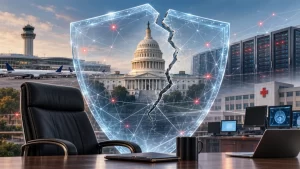
In six days, Americans watched the skies close, office email go dark, bank apps stall, hackers slip card-skimming code onto the websites of 178 organizations, and the NSA lose its own classified network. Most of these failures were not attacks. That should worry us more, not less: they show how brittle the country’s digital backbone has become while the administration has stripped away the people paid to defend it.
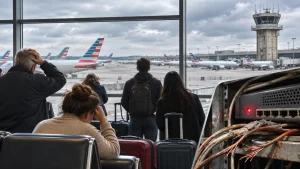
Start with the plain facts, because this administration is counting on Americans not to read them. Between Thursday, November 12, and Tuesday, November 17, the United States suffered what Sen. Josh Hawley (R-Mo.), hardly a progressive firebrand, called something that would be “the greatest coincidence in the history of the world” if it were in fact a coincidence. The Federal Aviation Administration grounded every departing flight in the nation. Microsoft’s workplace cloud failed across dozens of countries. Customers at five major banks reported problems. United Airlines went down. Apple services stuttered. And on Tuesday, the National Security Agency, the country’s premier cyber agency, lost the classified network its own employees use to talk to one another.
Asked about all of it, President Trump offered a shrug. According to Al Jazeera, he told reporters on Tuesday that “things like that happen,” adding, “It’s fine.”
It is not fine. To be clear about what we know and don’t know: federal officials and the companies involved say they have found no evidence that the FAA, Microsoft or NSA outages were cyberattacks. We take them at their word until evidence says otherwise, and we urge readers to do the same before sharing viral claims. But one incident this week was a deliberate attack on American consumers. And taken together, the week has exposed something the administration cannot explain away: a country whose critical systems fail at national scale, defended by a government that has spent two years dismantling its own defenses.
I. Six Days, Six Failures
The sequence matters, because it shows how quickly one failure followed another, and how little the public was told while it happened.
Microsoft 365 collapses. Outlook, Teams and Copilot were disrupted for close to a day in more than 70 countries. Microsoft’s preliminary account, reported by Patch, blamed a software defect, heavier traffic and reduced server capacity. Its safeguards meant to contain the failure also failed. System failure
The FAA grounds the nation. A telecommunications failure hit air route traffic control centers, and the FAA halted all departures. Aviation officials called it only the third nationwide ground stop in U.S. history, after 9/11 and a 2023 FAA outage. The FAA said instability hit 17 of its 22 en route centers, and the controllers’ union said some controllers lost communication with some planes. System failure
Hackers poison a trusted web platform. The earliest malicious script injected into Optimizely’s Web Experimentation platform dates to this moment, according to researcher Scott Helme and Report URI. The code reached visitors to websites of at least 178 organizations. Confirmed attack
Banks and United stumble. Customers at five major banks reported trouble with online banking or Zelle. Chase blamed a software bug and said funds were intact. That afternoon, United Airlines reported a systemwide outage that kept pilots from getting final aircraft weights and delayed hundreds of departures. System failure
The NSA goes dark internally. NSA Net, the classified network the agency uses for internal communications, went down. CNN, citing six sources, reported no evidence of a cyberattack. The NSA blamed “scheduled routine maintenance” and staggered staff arrivals at Fort Meade. The same day, Apple Music, the App Store and iCloud sign-ins were disrupted. System failure
II. The One That Was an Attack
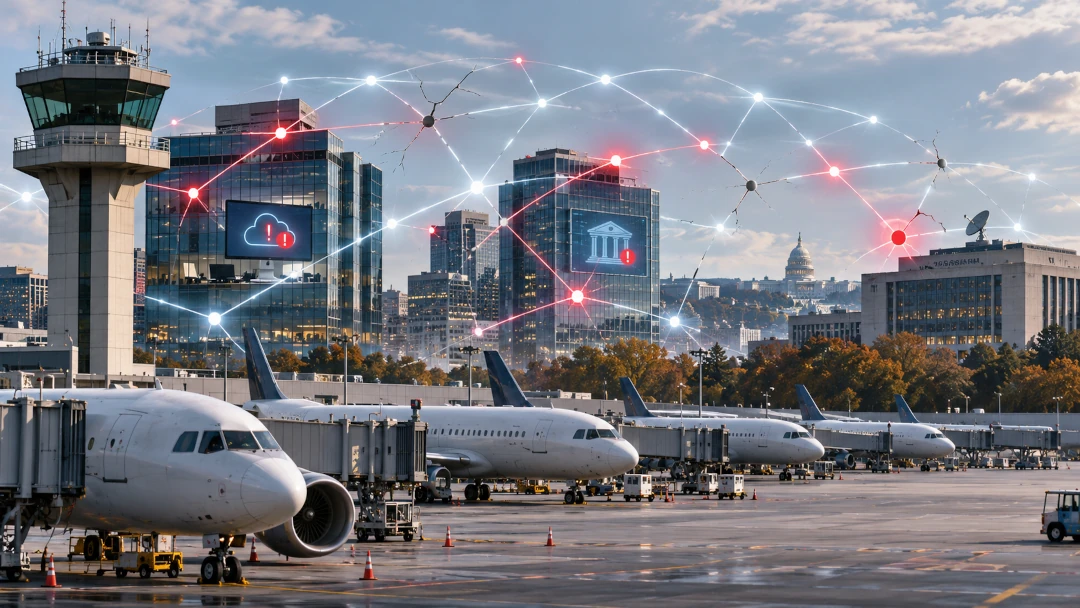
Lost in the airport chaos was the one incident this week that was unambiguously criminal. Attackers exploited a flaw in Optimizely, a tool businesses use to test and customize their websites, and planted malicious JavaScript in customer projects. Because the code was served from Optimizely’s own trusted infrastructure, visitors could receive it without the target companies’ own systems ever being breached. The list of affected brands reads like a map of daily American life: Zoom, CNN, Equifax, HSBC, Salesforce, IKEA and Peacock.
The code was built to swap cryptocurrency wallet addresses for attacker-controlled ones, capture payment card details typed into forms, collect cookies and screenshots, and deliver exploit kits aimed at iPhones and iPads. Cybernews reports that Salesforce disabled the altered scripts and that Equifax, a credit bureau that holds the financial lives of most American adults, stopped using Optimizely and says it found no compromise of its systems.
Accuracy matters here. The attack targeted card data on 178 organizations’ websites; it is not yet known how many people actually had card numbers stolen. Researchers have confirmed that some cryptocurrency reached attacker wallets, but Reuters could not determine the full extent of the damage. Optimizely says it has fixed the flaw and removed the code. Researchers say they still do not know how the attacker got write access to so many unrelated customer projects.
Notice who found it: a private researcher, not the federal government. That is the pattern of the past two years.
“Things like that happen… It’s fine.”
— President Donald Trump, asked about the outages, Nov. 17, 2026
III. The Price Tag
No one has yet tallied the full cost of this week, and we will not invent a number. But the documented figures are already staggering, and they land on travelers, workers and small businesses, not on the officials responsible.
Flights canceled Friday
Total U.S. cancellations on the day of the ground stop, including 9,082 by major airlines, per FAA figures reported in Yahoo News’ live coverage, with roughly 6,400–6,700 more on Saturday.
Microsoft outage, lost productivity
Michigan consultancy Anderson Economic Group estimated lost productivity could reach $7 billion. Microsoft has not offered a figure, BetaNews notes. Treat this as an early, rough estimate.
Average U.S. data breach
IBM’s 2026 Cost of a Data Breach report puts the U.S. average at $11.5 million per incident, more than double the global average, eSecurity Planet reports.
The AI premium
The same IBM study found AI-driven attacks rose 56% year over year and added roughly $1 million to the average breach, pushing AI-driven incidents above $6 million on average.
What Duffy now wants
Transportation Secretary Sean Duffy is seeking $50 billion on top of the $12.5 billion Congress already approved, after Trump asked for $30 billion. FAA chief Bryan Bedford says finishing the modernization costs about $10.1 billion more.
Cut from America’s cyber agency
The White House’s FY2026 budget sought to cut $495 million and roughly 1,083 positions from the Cybersecurity and Infrastructure Security Agency, the largest downsizing since its creation in 2018.
Set the last two cards side by side. The administration that now says it needs $50 billion, urgently, for one failing system is the same one that proposed cutting half a billion dollars from the agency charged with protecting all of them.
IV. A Cyber Defense, Deliberately Hollowed Out
The Cybersecurity and Infrastructure Security Agency, better known as CISA, is the civilian agency within the Department of Homeland Security responsible for helping hospitals, utilities, banks, airports and state governments defend against digital threats. Under this administration, it has been gutted.
By February, TechCrunch reported that bipartisan lawmakers and industry leaders feared CISA could no longer perform its core mission and was unprepared for a crisis. The agency had lost about a third of its staff, along with its counter-ransomware initiative, its work promoting secure software, and members of its election security team. Hundreds more staffers were reassigned to other DHS agencies to support the administration’s immigration crackdown.
Read that again: in a year when, by Google’s own threat researchers’ account, criminals began handing whole stages of their attacks to AI agents, Washington moved cybersecurity specialists into deportation work. CISA’s then-acting director, Madhu Gottumukkala, told Congress that 70 staff had been reassigned to other DHS offices, including Immigration and Customs Enforcement, a move Nextgov notes became a flashpoint for lawmakers worried about threats from China.
The ideological motive was never hidden. Defending election-security cuts, then-DHS Secretary Kristi Noem accused CISA of playing “the role of the ministry of truth” under the prior administration. This was an agency punished for telling the truth about the 2020 election, and the country’s defenses paid the price.
The same hollowing hit aviation. Using federal workforce data, One Mile at a Time found the FAA has lost about 1,767 employees during Trump’s second term, after gaining 1,284 under Biden. The union representing FAA employees says projects like the one behind Friday’s shutdown would normally have had a risk assessment and FAA oversight, and that this no longer happens.
Get Involved Today
Contribute to our mission and turn your concerns into action.
V. Who Is Responsible
Accountability starts with names. Here are the people who own this week.
Transportation Secretary Sean Duffy blamed contractor L3Harris, whose newly installed router at a remote site in El Dorado, Arkansas, flooded the FAA network; a second router in Amarillo, Texas, did the same. Duffy questioned whether the work showed “incompetence.” He also declined to apologize, saying he “can’t apologize for what was passed off to us.” Yet the router maker, HPE, says the devices “did not fail,” and officials still have not determined whether the equipment was defective or configured wrong. Transportation reporters also asked why a switchover like this happened on a busy Friday afternoon rather than in the middle of the night.
FAA Administrator Bryan Bedford said there was “zero evidence of anything nefarious.” Good. But reassurance is not an explanation, and his agency’s network was flagged as obsolete by a 2023 FAA-commissioned review, three years before this administration let it fail on a Friday afternoon.
DHS Secretary Markwayne Mullin and other officials said the events stemmed from infrastructure overload, not a cyberattack or foreign interference. That may be true. But it is DHS, through CISA, that is supposed to coordinate defense of critical infrastructure, and the department has spent two years shrinking that mission.
And then there is President Trump, who answered the worst air-travel disruption in a quarter-century by posting that “The Biden Administration was an FAA disaster” and that “Our FAA is doing a great job, and is ready to go.” He has been in office for nearly two years. The routers were installed on his watch.
“Identifying the device that failed does not establish why it failed.”
— Senate Commerce Committee Democrats, letter to Sec. Duffy & Administrator Bedford
VI. The AI Accelerant
Nothing so far ties this week’s outages to artificial intelligence, and the FAA specifically ruled out AI involvement. But the threat environment our weakened defenses now face is unmistakable.
Google Threat Intelligence Group’s Q3 2026 tracker documents attackers using AI agents to automate vulnerability scanning, credential harvesting and troubleshooting, including a financially motivated group that deployed an autonomous multi-agent framework inside a victim’s cloud. IBM found AI-driven attacks up 56% year over year. Honest experts note that fully autonomous attacks remain rare and that humans still steer most operations. But every trend line points the same way: attacks are getting cheaper, faster and more automated, and the Optimizely compromise shows how a single weak link can reach millions of people at once.
The right response to that future is more trained defenders, stronger information sharing and serious investment in civilian cyber capacity. This administration has delivered the opposite.
A Law on Life Support, and a Congress That Has Not Done Its Job
The Cybersecurity Information Sharing Act of 2015.
This law gives companies legal protection when they share cyber-threat data with the government and with each other: shields against liability, antitrust exposure and Freedom of Information Act disclosure. It has broad bipartisan support. It expired in the fall of 2025, was revived, lapsed again in January 2026, and has since survived on short-term patches. The latest continuing resolution extends it only through December 11, 2026. That deadline is three and a half weeks away.
The CISA Act of 2018.
Congress created CISA by statute, signed by President Trump in his first term, and gave it a standing mission to coordinate the protection of federal networks and critical infrastructure. An executive branch that drains that agency of a third of its people and moves the rest into immigration enforcement is defeating Congress’s purpose through budgets and transfers.
Article I and Article II.
Congress holds the power of the purse and the duty of oversight; it must not hand over $50 billion on demand without the root-cause answers its own members have requested. And Article II, Section 3 requires the President to “take Care that the Laws be faithfully executed,” which includes keeping the agencies Congress created able to function. A president who calls national-scale failures “fine” has not met that obligation.
VII. Congress: Some Alarm, Too Little Action
Give credit where it is due. Sen. Maria Cantwell (D-Wash.) led all 13 Democrats on the Senate Commerce Committee in a letter demanding “clear, fact-based answers” about the ground stop, and asked how any new money would fix the vulnerabilities exposed on November 13. The Democrats also called for pausing router installations until the root cause is identified. Sen. Chris Van Hollen (D-Md.) said it was “really rich” for Duffy to blame Congress when Congress had given the administration what it asked for.
House Democratic Leader Hakeem Jeffries has called for a briefing of both chambers on the Microsoft outage, the ground stop and the NSA failure, Newsweek reports. He noted it was still unclear whether the failures were “all infrastructure-related or whether there’s some malignant activity.”
Some Republicans are worried too. Besides Hawley, Rep. Mike Lawler (R-N.Y.) asked the administration to brief Congress “so that we can have an all of government response,” and Sen. Ron Johnson (R-Wis.) admitted he has “as much uncertainty as an average American.” Sen. Thom Tillis (R-N.C.) questioned the jump from $30 billion to $50 billion, and Majority Leader John Thune said the administration must justify the money. But Speaker Mike Johnson backed attaching the $50 billion to year-end legislation, saying, “We don’t really need any investigation to understand we need further investment,” according to Patch. That is the problem in one sentence: money without answers.
Democrats are right to demand answers, but letters are not a strategy. We have seen no Democratic plan yet to restore CISA’s workforce, reverse the reassignments, or pass a long-term renewal of the information-sharing law. Industry groups are already pressing negotiators to keep a 2035 extension in the defense bill. Democrats should make that, and a rebuilt CISA, a condition of any infrastructure money.
VIII. What This Means for You
For ordinary Americans, this week was not abstract. It was a missed funeral, a lost shift, a payroll run that didn’t go out on time, a Zelle payment stuck in limbo, a family sleeping on an airport floor. As analyst Patrick Moorhead put it, “When one piece fails, it fails at a national scale.” Our flights, paychecks, medical records and savings run on a few shared systems, and when they fail, there is often no backup.
There is a second danger: confusion. A monitoring firm, PeakMetrics, found that about one in six sampled social posts during the ground stop contained an unverified claim. The FBI warns that criminals use AI-generated video and cloned voices to impersonate officials. A crisis with no clear public explanation is exactly when scammers strike.
IX. What You Can Do
- Update your devices today. The Optimizely code carried exploit kits aimed at older iPhones and iPads. Go to Settings → General → Software Update and install everything available. Do the same for your computer and browser.
- Watch your money, and freeze your credit. Check card and bank statements for charges you don’t recognize and report them immediately. A credit freeze at Equifax, Experian and TransUnion is free and blocks anyone from opening new accounts in your name. Note: simply visiting an affected site does not mean you were compromised.
- Turn on multifactor authentication for email, banking and shopping accounts, and never enter payment details on a site you reached through an unexpected text, email or link.
- Refuse to be a vector for panic. Before sharing an alarming clip, find the original, check its date, and look for confirmation from the agency or company involved. Be wary of anything urging you to act immediately. If your flight was canceled or delayed three or more hours, you are entitled to a full refund if you choose not to fly.
- Call your senators and representative this week. Ask for three things by name: a long-term reauthorization of the Cybersecurity Information Sharing Act before it expires December 11; restoration of CISA’s workforce and an end to reassigning cyber staff to immigration enforcement; and no new FAA money until DOT delivers the root-cause report Senate Democrats demanded.
X. What This Says About Leadership
Every administration inherits aging systems. What separates leaders is what they do next. This president inherited a functioning, if imperfect, civilian cyber agency and chose to shrink it, purge its election experts, and send its people to process deportations. He inherited an FAA workforce that had been growing and chose to shrink it. Then, when the predictable happened, he blamed his predecessor, praised himself, and told the country it was “fine.”
That is a statement of priorities. Spectacle and retribution come first; the dull, essential work of keeping planes in the air and hackers out of our bank accounts comes last. The NSA’s own network failed this week and the response from the top was a shrug. A government that cannot say why its systems are failing, and will not rebuild the people who defend them, is not putting America first. It is leaving America exposed.
Editorial Conclusion
This was the week America learned how thin the line is between normal life and national paralysis. Most of the failures were not attacks. That is no comfort: it means the next real attack will hit systems already shown to be brittle, defended by an agency this administration has cut by a third.
The fix is not a $50 billion blank check. It is a full public accounting of what failed and why, a rebuilt CISA, a permanent information-sharing law, and a Congress willing to use its power of the purse and its oversight duty. Self-government depends on a state that can keep its own lights on. Right now, ours cannot promise that, and the people in charge say it is fine.
Sources & References
- Al Jazeera — FAA ground stop lifted: Why were US flights grounded, and what’s next?
- Yahoo News — FAA ground stop latest: Duffy blames L3Harris, seeks $50B; no sign of cyberattack
- ABC7 Los Angeles — United Airlines outage and FAA live updates
- CNN (YouTube) — Sources: Highly classified NSA comms network down; what we know
- Al Jazeera — NSA attributes US network outage to routine ‘maintenance’ activities
- Click2Houston / CNN Wire — Hackers target iPhones, payment information through websites used by millions
- Cybernews — Optimizely script attack hit 178 major websites
- Patch — Major cyber outages pile up, putting Americans on edge
- BetaNews — Microsoft 365 outage and the $7 billion productivity estimate
- eSecurity Planet — IBM 2026 Cost of a Data Breach Report: Key findings
- eSecurity Planet — Trump’s 2026 budget guts CISA: nearly 30% of jobs and $500M
- TechCrunch — US cybersecurity agency CISA reportedly in dire shape amid Trump cuts and layoffs
- Nextgov/FCW — CISA’s acting chief says 70 staff were reassigned to other DHS offices
- Federal News Network — CR extends cyber info sharing law through December
- Help Net Security — Threat actors are giving AI agents a bigger role in cyberattacks (Google GTIG Q3 2026)
- One Mile at a Time — Trump blames Biden for “FAA disaster,” praises himself for “great job”
- U.S. Senate Commerce Committee — Commerce Democrats demand clear, fact-based answers on Nov. 13 ground stop
- WSB-TV / AP — Democrats call for pause in router work linked to air travel stoppage
- Yahoo News — Lawmakers want answers from the Trump administration on recent tech outages
- Newsweek — NSA network, Apple services reported offline as mass outages continue
Related News