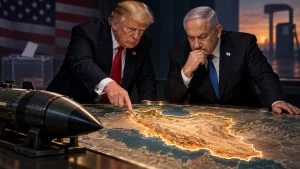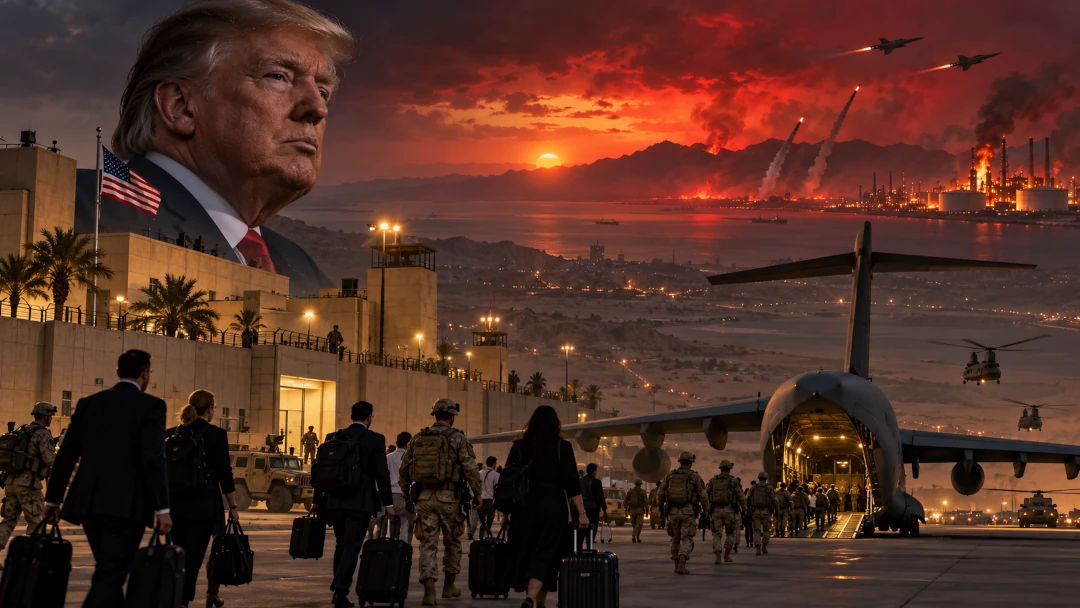
American troops and diplomats are slipping out of Gulf posts. Moscow’s nuclear engineers are reportedly boarding cargo jets home. Oil is back above $115. Every signal points to an attack after Election Day — launched by a president who rejected a ceasefire roadmap, denies the talks his own mediators confirm, and is running down the very arsenals and oil reserves that would cushion Americans from the fallout.
Governments do not empty embassies and thin out air bases on a whim. They do it when they expect missiles. This week, NBC News reported that the U.S. military has been quietly reducing its troop presence at bases across the Middle East, while the State Department orders further staff cuts at several diplomatic posts — all as President Trump weighs new military action against Iran. Eight months into a war that was supposed to last a month, the administration is once again clearing the decks. The question for the American people is not whether the signs are real. It is whether anyone in Washington will stop what they portend.
I. The Quiet Exodus
The drawdown is broad. According to reporting summarized by Al Bawaba and Antiwar.com, forces in Jordan, Qatar and Kuwait are among those being moved — the same kind of target-reduction the Pentagon carried out before the war began in February. U.S. Central Command offered only boilerplate, with spokesperson Timothy Hawkins saying the military regularly moves personnel and assets “to optimize mission readiness.”
On the diplomatic side, State Department spokesperson Tommy Pigott confirmed an ordered departure — mandatory evacuation of non-emergency staff and families — for the U.S. Embassy in Saudi Arabia, while insisting it applied to that country only. CBS News nonetheless learned that several other regional embassies have shifted to “restricted operations” staffing. Pigott blamed escalating Houthi attacks on the kingdom; Iran denies any role.
Moscow appears to be reading the same tea leaves. Siasat Daily, citing flight-tracking data reported by The Hormuz Report, says several Russian military cargo aircraft, including an Il-76 out of Novosibirsk, landed at Bushehr Air Base beginning the night of October 19 as Russia prepared to withdraw personnel from the nearby Bushehr Nuclear Power Plant. Rosatom has not publicly confirmed a new evacuation, and Iranian sources suggested some flights may also have carried weapons. But the pattern is familiar: Rosatom pulled staff on the war’s first day and in waves through the spring, and by April its chief, Alexei Likhachev, said only about 20 volunteers remained at the site, according to the AP. Some personnel returned in August as tensions eased. If they are leaving again, Russia expects the bombs to fall near an operating nuclear reactor — one that has already been struck at least four times in this war.
II. The Countdown: What Trump Is Signaling
The president has made little effort to hide his intentions. Asked on October 21 whether talks with Tehran were continuing, Trump first said “a little bit,” then reversed himself, as JNS reported, adding that most people expect action after the election.
“We are not negotiating with [Iran]. We are gonna have something one way or the other, it’ll happen fairly soon.”
— President Donald Trump, Joint Base Andrews, October 21, 2026 · via JNS
The same day, The New York Times reported that U.S. and Israeli militaries have drawn up specific plans for a short but intensive campaign after the November 3 midterms, with rehearsal flights over Iraq and Defense Secretary Pete Hegseth meeting Prime Minister Benjamin Netanyahu in Israel to discuss renewed strikes, TIME summarized. The Times reported the full complement of U.S. forces is expected in place by early November, per Investing.com. Two Israeli sources told ABC News that the strikes would almost certainly come after Election Day because Trump does not want to rattle oil markets during the campaign — and that for the Israeli government, regime change, not a deal, is the real objective.
Then the president’s own envoy jumped the gun. Tom Barrack, ambassador to Turkey and Syria envoy, was asked on a podcast whether there could be a strike this weekend and replied “Absolutely,” the Times of Israel reported. Trump sarcastically waved it off — “if that’s the case, I don’t know anything about it,” he told reporters, per TASS. The White House has formally repeated that no attack will come before the midterms. Note the logic: the stated constraint on war is not law, diplomacy or human cost. It is the election calendar.
That calendar has governed this crisis for weeks. On October 7, The Atlantic reported the White House had asked Central Command for strike options executable before the vote to show “progress,” the Jerusalem Post noted. A day later, as oil spiked, Trump posted that the U.S. “will not be attacking Iran at any time prior to the midterm elections,” and some analysts read the move as an effort to talk prices back down, Al Jazeera reported. And the Financial Times reported that Trump stopped a Netanyahu-ordered strike in early October because he didn’t want fighting to resume before the midterms — a report Netanyahu denies, Haaretz reported. War timed not to the threat, but to the ballot box.
III. The Markets Are Already Bracing
Wall Street does not wait for a press release. Brent crude climbed to roughly $117 a barrel on Friday and was on track for another weekly gain on escalation fears, MarketScreener reported, while West Texas Intermediate held above $100. TheStreet reported stocks falling Friday on a tech sell-off compounded by Middle East tension and surging crude — the highest oil prices since spring. Energy majors like Chevron hit new highs as traders bet on renewed strikes within weeks, Benzinga noted. Analysts at European Business Magazine warned that strikes on Iranian energy facilities could push oil toward $130 and force central banks to keep tightening.
There is one honest nuance worth stating: total Gulf oil flows have actually recovered above prewar levels as producers route around Hormuz, according to Kpler data cited by Fortune. That is precisely why markets fear a new round. The current fragile equilibrium depends on both sides avoiding strikes on each other’s oil terminals. A “short but intensive” campaign aimed at Iran’s energy infrastructure is designed to break that equilibrium.
IV. What the Next War Would Look Like
On the American side, the target list reported by the Times includes Iran’s energy infrastructure, nuclear facilities and missile and drone arsenals, with some officials suggesting refineries might be spared to avoid a gasoline spike, Haaretz reported. Trump has also floated hitting the deeply buried “Pickaxe Mountain” nuclear site.
On the Iranian side, Tehran has spent the week publishing its answer. Mehdi Mohammadi, an adviser to Iran’s lead negotiator, called a third war in two years an existential threat and declared a strategy of “zero red lines” — a conflict longer and wider than Washington expects, Unusual Whales reported. An international lawyer close to Iran’s foreign ministry warned that a third wave would fully close the Strait of Hormuz and tip the world economy into recession, as Business Insurance noted, citing The Guardian. Here is what Iran has said it would hit:
Undersea Internet Cables
IRGC spokesman Hossein Mohebbi pointedly noted that seven major internet cables run beneath the Strait of Hormuz and promised “new targets” and “new weapons,” National Security Journal reported.
Data Centers & AI Hubs
Security chief Mohsen Rezaei listed data centers and AI facilities in up to seven Gulf countries. Iranian drones already struck Amazon data centers in the UAE and Bahrain in March.
Gulf Oil Infrastructure
Rezaei said there can be no arrangement where Iran’s economic lifelines burn while the region’s stay untouched. Reuters has counted at least 135 strikes on 84 Gulf installations since February.
U.S. Bases & Warships
Iran has threatened American bases and warships alongside airports and pipelines in neighboring states, MarketScreener reported.
Shipping in Hormuz
The IRGC claimed seven tankers were hit or struck mines near Hormuz this week — a preview of a full closure, per Democracy Now!.
Political Targets
Iran’s Fars agency reported that military units have been told to hit political as well as military sites in a renewed war, NewsBytes reported.
Get Involved Today
Contribute to our mission and turn your concerns into action.
The war is already spilling over. Yemen’s Houthis, aligned with Tehran, have waged a campaign against Saudi airports and oil facilities all month. A strike on Riyadh’s airport killed at least 12 people on October 10, Al Jazeera reported, and an attack on Dammam’s King Fahd International Airport this week killed two and wounded eight, after which Saudi Aramco reportedly evacuated its Dhahran headquarters, Al Jazeera reported. The Houthis also claimed strikes on the Saudi Defense Ministry and an Aramco facility in Yanbu. Meanwhile, the U.S. is backing Saudi Arabia’s bombing campaign in Yemen with intelligence and refueling, according to Antiwar.com — widening the circle of war, not shrinking it.
And Russia is rearming Iran. Western officials told Bloomberg that Iran’s missile and drone factories survived eight months of bombing, that Tehran remains “well-stocked,” and that Russia is supplying it with missiles, the Times of Israel reported. That directly contradicts Hegseth’s September claim that the U.S. had destroyed Iran’s “military industrial capacity.” FDD’s Long War Journal has documented Russian explosives and drone components moving to Iran across the Caspian on a sanctioned Russian shipping line. A new round of bombing would not end this war. It would invite a better-supplied Iran to fight a longer one.
V. Diplomacy, Abandoned
Here is what makes this moment so damning: a diplomatic off-ramp exists, and the president keeps refusing to take it.
In September, Iran used the UN General Assembly to unveil a seven-day roadmap, transmitted through Qatar, to cease hostilities across the region — Lebanon included — and reopen Hormuz, with final-deal negotiations beginning on day seven. Trump’s response, standing outside the White House: “I reject their proposal,” Reuters reported via the Express Tribune. Al Jazeera’s Washington correspondent noted at the time that Trump offered no alternative.
Iran’s Foreign Minister Abbas Araghchi insists that indirect negotiations through Pakistan and Qatar continue without interruption and that Washington had accepted Iran’s conditions while seeking to add clauses, Arab News reported. “The negotiating table remains in place,” he said this week, per CBS News — which also reported Trump accusing Iran of fabricating attacks on ships to drive up oil prices. Tehran’s posture has hardened too: President Masoud Pezeshkian told Pakistan’s army chief that the U.S. must lift threats and sanctions before talks resume, The National reported, and said bluntly that “our nation today does not trust the United States,” iHeart reported. Iran’s leaders are not peacemakers, and their human-rights record is monstrous. But when one side publicly offers a timetable and the other publicly denies talks exist while drawing up target lists, the burden of escalation is not evenly shared.
VI. The World Pleads for Restraint
America’s partners are not cheering. Qatar’s foreign ministry spokesman Majed al-Ansari warned this week that unchecked escalation means the region is “spiraling towards a regional war” that will not stay inside its borders, Newscord compiled. Pakistan’s army chief, Asim Munir, flew to Tehran to revive stalled diplomacy. Saudi Crown Prince Mohammed bin Salman has previously urged Trump to delay military action and return to negotiations, Defense News reported, after Iran warned Gulf capitals it would hit their oil, power and water plants. The kingdom now hosts an embassy in evacuation and an oil company fleeing its own headquarters.
The United Nations has repeated the same message all year. When fighting resumed in late August, Secretary-General António Guterres’s spokesman called it “very regrettable, to say the very least” and urged maximum restraint and a return to talks, Xinhua reported. In March, Guterres warned that this war was “out of control.” Even Israel’s own military chief, Eyal Zamir, reportedly said he sees no operational need to strike Iran before Israel’s election, the Times of Israel reported. When the generals, the Gulf monarchies and the UN are all urging patience, a president racing toward round three is not responding to necessity. He is choosing war.
VII. Congress: Votes Cast, Votes Ignored
Congress has not been silent — it has been ignored. The House has now passed Iran war powers resolutions three times. The most recent, sponsored by Rep. Seth Moulton, passed 220–204 in September with seven Republicans joining every voting Democrat, The Hill reported (Roll Call 307). In the Senate, a resolution failed by a single vote, 49–50, on September 24; Republicans Susan Collins, Lisa Murkowski, Rand Paul and Thom Tillis voted yes, while Democrat John Fetterman voted no, the Carolina Political Review recorded.
Rep. Gregory Meeks, the top Democrat on Foreign Affairs, put it plainly on the House floor: “this Congress has not authorized a war with Iran” — noting that, as of September, 19 service members had died and more than 750 had been wounded. House Minority Leader Hakeem Jeffries has hammered the cost, declaring that “the Republican war of choice in Iran is making life more expensive,” Fox Business reported. Democratic Senate candidates in Michigan, Ohio, Iowa, Georgia and Maine are running directly on Republican votes against ending the war, PolitiFact found.
But fairness demands criticism of our own side, too. Democratic leaders have been cagey about using their real leverage — government funding — in the lame-duck session before January 3, The Intercept reported. Campaigning against the war is not the same as stopping it. With a post-election strike now openly planned, the window for Democrats to act is the weeks immediately after the vote — exactly when the bombs are scheduled to fall.
Who decides when America goes to war? Not one man with a midterm calendar.
Article I, Section 8 of the Constitution gives Congress — not the president — the power to declare war. The War Powers Resolution of 1973 (50 U.S.C. §§ 1541–1548) requires the president to withdraw forces from unauthorized hostilities within 60 days (plus a 30-day withdrawal period) absent congressional approval. Congress has authorized none of this war.
The administration’s defenses do not survive scrutiny:
- The “duty to protect” theory. The White House argues the war needed no authorization because the president must protect Americans, Al Jazeera reported. A pre-planned, rehearsed, post-election offensive against energy infrastructure is the opposite of an emergency response to imminent attack.
- The resetting clock. Trump has argued that because the war has “started and stopped” several times, each restart gives him a fresh 60-day window. Under that reading, the statute’s limits evaporate for any president willing to pause and resume a war at will.
- Ignoring the vote. After both chambers passed a war powers resolution in June, the administration ignored it and called the law unconstitutional, The Intercept reported.
The remedy that remains is the purse. Article I, Section 9 says no money shall be drawn from the Treasury except by appropriation. Overriding a veto requires two-thirds of both chambers — and no war powers resolution has ever survived a veto, PolitiFact notes. But a funding bill with a rider barring money for offensive operations against Iran turns the question around: the president would have to veto the funding of his own government. That is Congress’s constitutional trump card, and it should be played.
VIII. What It Means at the Kitchen Table
“The war in Iran is a kitchen table issue,” Jonathan Guyer of the Institute for Global Affairs told Al Jazeera. The numbers prove it.
At the Pump
National average for regular gas on Oct. 23, versus $3.07 a year ago, per AAA via Transport Topics. This is the first October ever above $4.
Per Household
Moody’s Mark Zandi estimates the war’s cost to the average household, growing about $50 a week at current fuel prices, Fortune reported.
Diesel
Up 68% from prewar, raising the cost of moving every grocery and package in America, per the same Fortune analysis.
Human Cost
Iranian civilians killed, including at least 254 children, in the war’s first 40 days alone, per HRANA data compiled by NIAC. Gulf residents and Saudi travelers are now dying too.
For military families, it means extended deployments and loved ones in harm’s way. For anyone who relies on the global internet — which is everyone — Iran’s threat to Gulf data centers and cables is a reminder that this war can reach the cloud services and payment systems we never think about. And for every American, a second energy shock means higher interest rates for longer, as central banks fight war-driven inflation.
IX. Empty Arsenals, Empty Reserves, Empty Leadership
A responsible commander-in-chief facing depleted stocks would de-escalate. Trump is doing the reverse.
The oil cushion is nearly gone. The Strategic Petroleum Reserve has fallen to about 283 million barrels, its lowest level since October 1982, InvestingLive reported from Energy Department data — down from roughly 415 million before the war, per CNBC. Analysts told Al Jazeera that if full-scale fighting resumes and both Hormuz and Bab al-Mandeb are choked, the world’s usable emergency stocks could last only weeks. On Friday the Energy Department authorized yet another emergency exchange from the reserve to cover a Louisiana refinery disruption, Reuters reported via FMT. The president understood the danger months ago:
“We run out of reserves in about four weeks.”
— President Donald Trump, June 17, 2026 · via The Hill
He is now planning to restart the war anyway.
The interceptors are running out. The Center for Strategic and International Studies estimates the U.S. has fired more than 60% of its key Patriot and THAAD interceptors, leaving fewer than 827 Patriots and 278 THAADs; sources told CNN those estimates track internal figures, and Joint Chiefs Chairman Gen. Dan Caine has raised the shortage directly with the president. Close to half of all Tomahawks have been used, CNN separately reported. Trump’s answer was a Truth Social post insisting the U.S. has “massive amounts” of munitions, Al Jazeera noted. Every interceptor fired over the Gulf is one unavailable to protect our troops, our allies or a deterrent against China.
And Russia is profiting. Even as Moscow ships missiles to Tehran, Washington has temporarily lifted sanctions on Russian fuel to ease the shortages its own war created, Haaretz reported. The president’s de-escalation toolkit, such as it is, consists of rejecting ceasefire plans, denying talks, calling the war “a little conflict” and joking at a South Carolina rally about sending boxer Evander Holyfield to fight it, as Antiwar.com recounted.
The only restraint this president has shown is to the electoral calendar — not to Congress, not to the Constitution, not to the families paying for his war. What this says about Trump’s priorities is not subtle. The timing of war is set by polling. The constitutional role of Congress is treated as an obstacle. The Gulf allies who host our troops are ignored when they beg for talks. The reserves meant to shield American families from exactly this kind of shock are drained, and the plan is to spark a bigger shock anyway. This is not strength. It is recklessness wearing a uniform.
X. What You Can Do
No single action stops a determined president. A war powers resolution will likely be vetoed, and courts have historically avoided war powers fights. The realistic levers are political pressure on swing Republicans, a funding fight in the lame-duck session, and a new Congress in January with the power of the purse. All of them depend on public pressure starting now — before the strike, not after.
Call Congress This Week
Use the Capitol switchboard at (202) 224-3121. Ask your representative and both senators one specific question: will they support a rider in any year-end funding bill barring money for offensive military operations against Iran without congressional authorization? Ask for a yes or no.
Target the Persuadable Republicans
Four GOP senators and seven GOP House members have already voted to end this war. A one-vote margin decided the Senate. If you live in a state or district represented by a Republican who hasn’t broken ranks, your call matters most.
Demand Public Hearings Before Any Strike
Ask your members to demand open testimony from Secretary Hegseth and Gen. Caine on the strike plans, munitions shortfalls and SPR levels — before November 3, not after the bombs fall.
Vote — and Vote Early
Early voting is underway in many states. Candidates’ war powers votes are public record. Check yours, and make a plan to vote by November 3.
Show Up and Organize Locally
Attend town halls and candidate forums and ask about Iran on the record. Join or organize peaceful local demonstrations, and support humanitarian groups aiding civilians caught in the war across Iran, Lebanon, Yemen and the Gulf.
Editorial Conclusion
When embassies empty and nuclear engineers flee, a nation is being prepared for war — but its people have not been asked. This president rejected a ceasefire roadmap, denies negotiations his own mediators confirm, and has scheduled the next round of bombing for the morning after Americans vote, using munitions and oil reserves already near exhaustion.
The Constitution does not give one man the power to launch a war of choice and time it to his political convenience. Congress must use every tool it holds — starting with the power of the purse — to forbid a new offensive without its consent. Anything less surrenders the most solemn power a democracy possesses. America has had enough of wars it never declared.
Sources & References
- NBC News — U.S. troops and diplomats evacuating Middle East posts, sources say
- CBS News — U.S. ordering some government staff to depart Saudi Arabia
- Al Bawaba — US pulling troops and diplomats out of Middle East
- Siasat Daily — Russia evacuates staff from Iran nuclear plant amid war fears
- Times of Israel / AP — Russia evacuates nearly all personnel from Bushehr
- JNS — Trump on Iran: Something will happen ‘fairly soon’
- TIME — U.S. reportedly considering major strikes on Iran after midterms
- ABC News — US and Israel drawing up plans to resume attacks on Iran post-election
- Times of Israel — US envoy: We could strike Iran this weekend; Trump: I don’t know anything about that
- Al Jazeera — Trump says US will not strike Iran before midterm elections
- Haaretz — Report: Trump opposed Netanyahu’s proposed early October strikes
- MarketScreener — The Week in Oil: Fears of U.S.-Iran escalation push Brent to $117
- TheStreet — Stock Market Today (Oct. 23, 2026)
- Fortune — Energy markets are adapting to the Iran war as a ‘forever conflict’
- National Security Journal — Iran threatens data centers, undersea cables and energy installations
- Business Insurance — Iran threatens infrastructure strikes across Gulf countries
- Al Jazeera — Attack on Saudi Arabia’s King Fahd airport kills two
- Times of Israel — Iran said still able to produce missiles and drones, is being armed by Russia
- FDD’s Long War Journal — Russia helps Iran sharpen its sword
- Express Tribune / Reuters — Trump rejects Iran’s proposal on Hormuz
- Arab News — Iran says US talks continue through Pakistan, Qatar despite impasse
- CBS News — Live updates: Iran says ceasefire proposal still in play
- The National — US peace talks off without sanctions removal, Iran tells Pakistan
- Defense News — Iran issues warning to Gulf states
- The Hill — House passes Iran war powers resolution, 220–204
- Carolina Political Review — Senate votes down resolution to end Iran war
- The Intercept — Dems have an opportunity to force an end to the Iran war
- PolitiFact — How accurate are Democrats’ attacks on GOP opponents over the Iran war?
- Al Jazeera — ‘Foreign policy is the economy’: How Iran war is shaping US midterm vote
- Fortune — The Iran war has cost the average U.S. household almost $2,000
- InvestingLive — US strategic oil reserve falls to lowest since 1982
- Al Jazeera — Are global oil reserves sufficient to withstand renewed US-Iran war?
- CNN — US weapons stockpiles continue to dwindle
- NIAC — Civilian casualties and housing damage in Iran
Related News