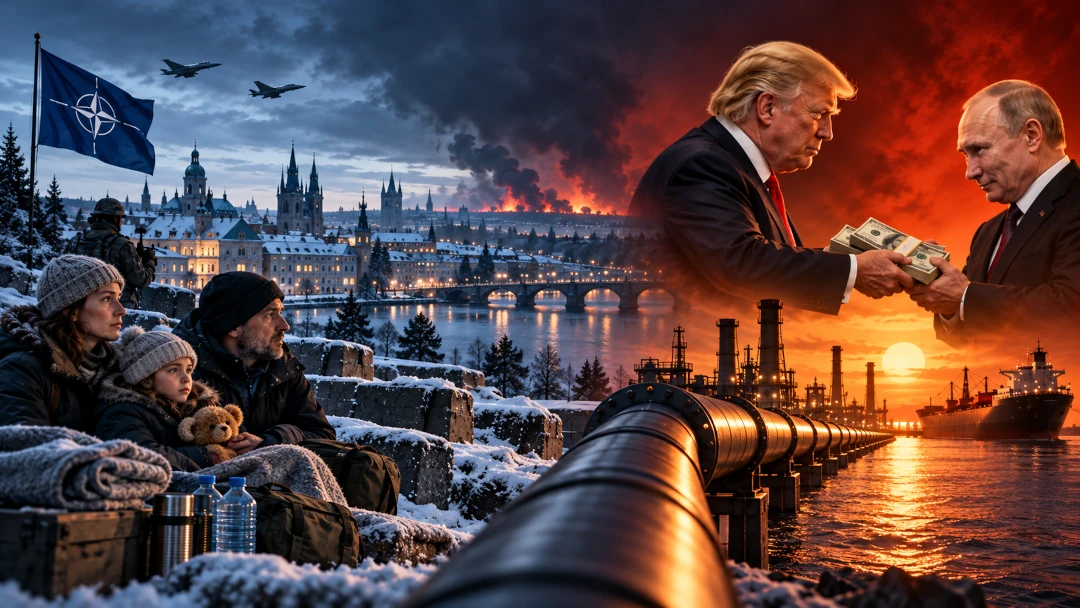
Europe Braces for a Winter War While Trump Pays Putin’s Bills
As intelligence chiefs from Warsaw to Prague warn that a Russian strike on NATO soil could come within months, the White House is waiving sanctions, buying Kremlin diesel, and now pressing Ukraine to reopen the very pipelines that once financed Moscow’s war machine. Europe is stockpiling water and readying hospitals. Washington is negotiating Russia’s paycheck.
On Saturday, The New York Times reported what many in Europe had feared and few were willing to say aloud: President Trump’s peace envoys, Steve Witkoff and Jared Kushner, have been urging Ukraine and its European backers to restart Russian natural gas flowing through Ukrainian pipelines as part of a settlement. According to the Kyiv Post’s account of the Times report, the Americans argued that restored pipeline flows would give the Kremlin a commercial reason to stop fighting, would generate transit fees for Ukraine, and would eventually be demanded by European voters tired of high energy bills. Backchannel conversations reportedly even touched on the sabotaged Nord Stream 2 line under the Baltic — something the White House formally denies discussing.
Put plainly: while Russia’s army grinds through its fifth year of war against a democracy, the President of the United States is proposing that Europe go back to wiring billions of dollars to Moscow. And he is doing it at the precise moment that European governments are telling their citizens to fill their pantries, find their nearest shelter, and prepare, in the words of Finland’s president, for the possibility that something will happen.
This is not a peace plan. It is a revenue plan — for Vladimir Putin.
I. The Ledger: What Trump Has Given the Kremlin
The gas proposal did not come out of nowhere. It is the latest entry in a rapidly lengthening ledger of concessions that, taken together, have done more to ease the pressure on Russia’s war economy than anything Moscow could have won on the battlefield. In just the past ten days alone:
Oct. 9 — The Diesel Deal
Trump announced a deal letting Russian diesel flow into U.S. and global markets, temporarily easing sanctions on Russian fuel. Critics warned it would put money in Russia’s pocket while undercutting Western pressure, Al Jazeera reported.
Oct. 16 — Graham Act Gutted
Trump signed an order waiving key provisions of the sanctions law named for the late Sen. Lindsey Graham — two days before they took effect. Putin’s economic envoy Kirill Dmitriev hailed it on X as a “truly historic moment.”
Oct. 17 — Reopen the Pipelines
The NYT reports U.S. envoys want Europe buying Russian gas again and Ukraine reconsidering pipeline transit — reversing years of EU policy designed to end dependence on Moscow.
Earlier Inducements in Miami
Witkoff and Kushner previously floated unfreezing up to $100 billion in immobilized Russian state assets, a Middle Eastern buyout of Lukoil’s foreign operations, and easing sanctions on Belarusian potash, per the Kyiv Post.
A G20 Seat for Putin
Washington invited Putin to December’s G20 summit in Miami, a move widely read as a step toward ending Moscow’s diplomatic isolation since 2022, according to Al Jazeera.
Pressure Aimed at Kyiv, Not Moscow
Days before the waiver, Trump called on Ukraine to replace President Zelensky — a pattern TIME says reflects increasingly uneven U.S. support between the victim and the aggressor.
Zelensky, for his part, has said publicly that he expects still more waivers to follow, and that undoing the bipartisan sanctions consensus seems wrong to him, CNBC reported. Germany has pushed back hardest on the gas idea. At consultations in Florida, Chancellor Friedrich Merz’s security adviser Günter Sautter rejected it outright, and former Economy Minister Robert Habeck warned against repeating Berlin’s most catastrophic strategic mistake of the last generation.
“Europe, and especially Germany, must never again become dependent on Russian gas.”
— Robert Habeck, former German Economy Minister, via the Kyiv Post
Note the domestic politics the Trump plan feeds. In Germany, the far-right AfD — polling near 30 percent — has campaigned heavily on restoring cheap Russian gas. An American administration openly predicting that European voters will eventually demand Russian energy is not neutral analysis. It is a thumb on the scale for Europe’s most Kremlin-friendly parties.
II. Europe Reads the Signs of a Winter Attack
The European alarm is not abstract. Within a single week in September, the measured caution that had long characterized NATO capitals evaporated. Polish Prime Minister Donald Tusk told the Sejm that intelligence assessments show Russia’s plans include hybrid strikes with drones and missiles against countries supporting Ukraine, warning of a real risk that Moscow would hit NATO’s eastern flank and then call it an accident, Israel Hayom reported. Finnish President Alexander Stubb urged his citizens to “prepare mentally for something to happen.” French President Emmanuel Macron convened party leaders in the Élysée crisis room and said the Russian hybrid threat had intensified.
Then came the Czech warning. Michal Koudelka, director of the Czech BIS security service, told the Guardian that a surge in drone activity could be the prelude to a limited incursion, false-flag provocations, or a massive influence campaign — on a timeline of “months, not years,” as 19FortyFive summarized. The underlying assessment, shared by more than one service: Moscow believes NATO cannot agree on how to answer a direct attack, and that a limited provocation would expose Article 5 as more theoretical than real.
What are the specific warning lights European officials point to as winter approaches?
The Associated Press, as cited by Israel Hayom, has counted roughly 200 incidents of sabotage and malicious activity in Europe since 2022 that Western officials have linked to Russia — arson at arms factories, cut undersea cables, GPS jamming, and the November 2025 rail bombing between Warsaw and Lublin that Tusk called unprecedented.
Honesty requires noting the dissent. The Institute for the Study of War says it sees none of the massing of troops and supplies that preceded the 2022 invasion, though it cautions a limited operation would not require them. Latvia’s state security director, Normunds Mežviets, said his service sees no signs of an imminent attack — while conceding there are indications Moscow is planning some kind of provocation. And NATO’s commander, Gen. Alexus Grynkewich, has said war is neither imminent nor inevitable. That is precisely the point: deterrence is what keeps it that way.
III. How Europe Is Preparing Its People
Across the continent, governments are dismantling the post–Cold War assumption that war was a relic. According to reporting compiled by Yahoo News, Norway now recommends that households be able to manage for a full week without normal infrastructure or government help, while Sweden tells residents to locate their nearest civil-defense shelter and keep water, food, medicine, warm clothing, cash, flashlights and power banks on hand. Germany is expanding medical task forces for mass-casualty events and has warned that civilian hospitals may need to treat large numbers of wounded soldiers in a NATO emergency.
The United Kingdom has told citizens to begin preparing for the possibility of war and to stockpile canned food and drinking water, and its chief of defence has called this the most dangerous period in decades, Brett McGurk wrote for CNN. Macron has ordered new protections for France’s critical infrastructure. Merz has spoken of decisive moments in defending Europe’s freedom.
And militarily, NATO has a plan. At the Warsaw Security Forum on October 12, Grynkewich described NATO’s theory of victory, built on three phases — block an attack at the border, blunt it with strikes from air, sea and land, then break the attacking force by severing its supply lines and command networks. His message to Europe’s one billion citizens: the alliance knows what it would need to do. But McGurk’s analysis names the uncomfortable truth behind all of it: deterrence depends on what Putin believes, and the American response to a wider war has become uncertain.
IV. Siding With the Aggressor: How Washington Is Hollowing Out Europe’s Defense
The uncertainty is not a misunderstanding. It is policy. After Europe declined to send warships to the Strait of Hormuz during the U.S.–Israeli war on Iran — a war several European capitals said was not theirs to fight — Trump turned on the alliance. TIME reported that he called NATO members “cowards,” ordered 5,000 U.S. troops out of Germany, threatened deeper cuts in Spain and Italy, and floated suspending Spain from NATO altogether. Even several Republicans on the Armed Services Committee publicly voiced serious concern.
The damage reaches well beyond troop counts:
Weapons withheld and delayed. In April, U.S. officials told European governments — including some bordering Russia — that weapons they had already purchased would be delayed as the Iran war drained American stockpiles, according to Military Times, citing Reuters. Among the scarce items are PAC-3 Patriot interceptors — the same missiles Ukraine depends on to protect its power grid from ballistic missiles going into winter.
Ukraine’s lifeline used as leverage. The Financial Times reported that Trump threatened to halt shipments under PURL — the NATO program through which European governments pay for American weapons for Ukraine — to force allies into the Hormuz operation. The White House warned, per the Kyiv Post, that “the United States will remember” Europe’s refusal.
An open signal to Moscow. Former Russian Deputy Foreign Minister Andrei Fedorov told the BBC that many military experts advising the Kremlin are convinced NATO would not respond forcefully to a Russian strike on Britain. His explanation, as Al Jazeera reported it, was blunt: “Trump will not allow NATO to answer.”
Whether or not Fedorov is right, the belief itself is the danger. Every intelligence warning cited above rests on the same assessment: that Moscow thinks the alliance is divided and America is checked out. Each waiver, each diesel deal, each insult hurled at an ally from the Oval Office makes that belief more rational in the Kremlin.
The White House argues the war is driving up energy prices across Europe and inflicting economic hardship on both Russia and Ukraine, and that economic incentives for both sides can help secure a durable armistice. A spokesperson told TIME that enforcing the Graham Act sanctions would impede U.S. efforts to negotiate peace. U.S. officials also note that Europe's own defense spending is rising and that the U.S. still keeps the top NATO command.
The problem is the evidence. Every incentive flows to the aggressor; every penalty — leadership demands, delayed interceptors, threatened arms cutoffs — lands on the victim and its defenders. That is not even-handed mediation. It is a negotiation in which one side has already been paid.
Get Involved Today
Contribute to our mission and turn your concerns into action.
V. What Congress Is — and Isn’t — Doing
Congress has not been silent. On October 13, a bipartisan group of twelve senators — Democrats Richard Blumenthal, Chris Coons, Dick Durbin, Jack Reed, Jeanne Shaheen and Sheldon Whitehouse, joined by six Republicans — wrote to Trump demanding he rescind the diesel deal, warning that it “will not achieve just ends, nor will it benefit Americans,” NPR reported.
Democratic leaders have been sharper still. Senate Democratic Leader Chuck Schumer, Ranking Foreign Relations member Jeanne Shaheen, and Ranking Banking member Elizabeth Warren issued a joint statement accusing the President of resorting to desperate deals with a murderous dictator to clean up the mess of his own war with Iran.
“A total betrayal of Ukraine, our European allies, and American national security.”
— Sen. Chuck Schumer, Sen. Jeanne Shaheen & Sen. Elizabeth Warren, joint statement
Structurally, Congress has built real guardrails. The Senate Armed Services Committee’s fiscal 2027 defense bill would require 120 days’ notice and an independent risk assessment before any troop reduction in a NATO country, would bar the U.S. from giving up the Supreme Allied Commander post, and would extend Ukraine security assistance through 2029 at $750 million a year, up from $400 million, NOTUS reported. Those protections build on the 76,000-troop floor Congress wrote into last year’s law.
But letters are not laws, and the hard truth is that the Republican majority has not moved to override the waiver or block the diesel deal. If Congress will not enforce the laws it wrote, the decision falls to voters on November 3.
Is Trump Breaking the Laws Congress Wrote?
- The Graham Act waiver. The Lindsey O. Graham Sanctioning Russia and Iran Act passed the House on September 16 and was signed September 18. It contains a national-interest waiver requiring the President to certify to Congress and explain his reasoning; Trump’s order says he did so, per CNBC. The waiver may be technically lawful — but invoking an emergency valve to nullify an entire statute within a month of signing it defeats the plain will of a Congress that passed it overwhelmingly.
- The 2022 Russian energy import ban. Sen. Shaheen has argued the President cannot simply ignore the 2022 law banning Russian energy imports to buy Putin’s diesel, and lawmakers note that law mandates consultation with Congress and a formal review, the Kyiv Independent reported.
- Troop floors. Under the FY2026 NDAA, the Pentagon may not keep U.S. forces in Europe below 76,000 for more than 45 days without certifying to Congress that doing so serves U.S. security and that allies were consulted. The Senate’s FY2027 bill would add a 120-day notice requirement and an independent risk assessment, per NOTUS.
- Leaving NATO. A 2023 provision authored by Sens. Tim Kaine and Marco Rubio bars any president from withdrawing from NATO without Senate consent or an act of Congress. Trump cannot legally quit the alliance by fiat — which is why the more dangerous path is the one he is taking: staying in name while signaling that Article 5 is negotiable.
- Article I. The Constitution gives Congress the power over foreign commerce and the purse. When sanctions laws are waived wholesale and appropriated assistance is used as leverage against an ally, the question is no longer policy — it is whether Congress will defend its own constitutional authority.
VI. What It Means for the Average American
Trump sells these concessions as relief at the pump. The numbers say Americans are paying for his choices either way. Brown University’s Watson School estimates the Iran war had cost U.S. consumers about $100 billion in extra gasoline and diesel costs by early September — more than $760 per household — with diesel hitting all-time records, Axios reported. Diesel moves the trucks that stock grocery shelves; its price shows up in everything Americans buy.
The diesel deal does not fix a problem Putin caused; it rewards Putin for a problem Trump created. And the costs do not stop at the pump. The interceptors America has drained in the Middle East are the same ones that protect American troops and allies. The roughly 30,000 American troops who remain in Germany, and the tens of thousands more across the continent, are the ones who would be first in harm’s way if Moscow concludes it can test NATO without consequence. NATO’s Article 5 has been invoked exactly once in history — for the United States, after September 11. An America that teaches the world its guarantees are for sale will one day find itself asking for help that does not come.
VII. Asia Is Watching: Japan, South Korea, Taiwan
America’s allies in the Pacific have drawn the obvious lesson. The Council on Foreign Relations warns that the abrupt rollback of joint exercises with South Korea is the latest in a series of moves draining Asian confidence in U.S. commitments, and that Trump has treated Taiwan as a bargaining chip with Beijing — even describing the island as “indefensible.”
Trump postponed a planned $14 billion arms package for Taiwan after his May summit with Xi Jinping and has described arms sales as a negotiating tool, CNBC reported, citing the Associated Press; analysts say Japan and the Philippines fear Washington could soften its support for Taiwan in exchange for Chinese trade concessions or help ending the Iran war.
Beijing is watching too. Every concession to Moscow is a data point about what Washington will trade away under pressure — and Taiwan’s leaders know it.
VIII. What the Experts Expect in the Year Ahead
The expert consensus has darkened. In the Atlantic Council’s Global Foresight survey, 45 percent of more than 350 strategists said Russia and NATO will likely fight a direct military conflict within the decade, up from 29 percent the year before; 47 percent predicted the Ukraine war will end on terms largely favorable to Russia. Among those expecting another world war, more than two-thirds anticipated a direct Russia–NATO clash.
For the next twelve months, the most credible scenario is not a tank invasion of Germany. It is what European services describe: a calibrated, deniable strike — drones over Poland or the Baltics, an attack on a weapons plant or port, a false-flag incident, or a small “little green men” grab near the Suwałki Gap — designed to make NATO argue about whether Article 5 has been triggered. Whether that gamble looks attractive to Moscow depends almost entirely on how united the West appears. Right now, the American President is the alliance’s most visible crack.
For Ukraine, the outlook is a harsh winter under bombardment with fewer interceptors and more pressure from Washington to accept Moscow’s terms. For Europe, it is a costly, accelerated rearmament that will not reach full strength until late in the decade. For America’s Pacific allies, it is a hedging spiral. And for the United States, it is a slow forfeiture of the trust that has made American power cheaper and safer for 75 years.
IX. What You Can Do
An honest assessment: no individual American can change Kremlin calculations directly, and the current congressional majority has shown little appetite to confront the President. But the guardrails that do exist — troop floors, aid authorizations, sanctions law — exist because constituents demanded them. Pressure works slowly, and it works.- Call your senators this weekAsk them to support the bipartisan demand to rescind the Russian diesel deal, to hold hearings on the Graham Act waiver, and to keep the 120-day troop-notice and $750 million Ukraine assistance provisions in the final defense bill. The Capitol switchboard is (202) 224-3121.
- Press your House member on the defense billAsk whether they will vote to keep the 76,000-troop floor in Europe and protections for U.S. forces in Korea. Ask them to say so publicly.
- Vote on November 3 — and make it about thisEvery House seat and a third of the Senate are on the ballot. Ask candidates directly: will you defend NATO, Ukraine, and the sanctions Congress already passed?
- Support Ukraine’s civilians through winterReputable humanitarian organizations are funding generators, heating and medical supplies for communities whose power grids are under attack.
- Refuse the disinformationThe Kremlin’s stated strategy is to convince Western publics that defending Ukraine is pointless and Europe’s fears are invented. Share credible reporting; challenge the claim that rewarding aggression is “peace.”
Editorial Conclusion
A president who lifts sanctions on an aggressor, buys its fuel, invites it back to the world’s table, and urges its victim’s friends to resume paying for its gas is not brokering peace. He is underwriting the next war.
Europe is doing what responsible democracies do when danger rises: arming, warning, preparing its people. The United States must decide whether it still stands with them. Congress has the constitutional power to restore the sanctions it passed, protect the troops it authorized, and keep the promises America made in 1949. It must use that power now — and if it will not, voters must elect a Congress that will. The credibility of American guarantees, from the Baltic to the Taiwan Strait, is not a bargaining chip. It is the foundation of the peace we have known.
Sources & References
- The New York Times — Trump envoys propose Europe resume Russian gas purchases (Oct. 17, 2026)
- Kyiv Post — Trump Envoys Push Russian Gas Transit in Ukraine Peace Talks
- CNBC — Trump waives broad new Russia sanctions, Zelenskyy condemns it as “wrong”
- TIME — What Trump’s Waiver of New Russia Sanctions Means for Ukraine
- Al Jazeera — “Block, blunt, break”: What’s in NATO’s new Russia war plan?
- Israel Hayom — Europe braces for war as Russia tests NATO’s red lines
- 19FortyFive — European Intelligence Officials Forecast Russian Attack in “Months, Not Years”
- CNN — Beyond Ukraine: Why Europe is preparing for a wider conflict (Brett McGurk)
- Yahoo News — CIA Warns Europe of Russian Attack; Nations Prepare Civil Defense
- TIME — The U.S. Military Drawdown in Europe Has Only Just Begun
- Military Times / Reuters — US to delay weapons deliveries to some European countries due to Iran war
- Kyiv Post — Trump Threatened to Halt Ukraine Arms to Pressure Europe Over Hormuz
- NPR — Bipartisan group of senators call on Trump to rescind Russian diesel deal
- Senate Democrats — Schumer, Shaheen, Warren slam Trump’s diesel “deal” with Putin
- NOTUS — Senate Armed Services NDAA pushes back on Europe troop cuts
- Axios — Iran war drives $100 billion in extra energy costs for U.S. consumers
- Council on Foreign Relations — Trump’s South Korea Move Fuels Growing Fears of U.S. Retreat From Asia
- CNBC — America’s Asian allies want a Trump-Xi truce — but not at their expense
- Kyiv Independent — “Will only lead to more slaughter”: Bipartisan backlash over Trump-Russia diesel deal
- Atlantic Council — Welcome to 2035: Global Foresight survey of 350+ experts
Related News