Elon Musk Is Trying to Buy a Congress
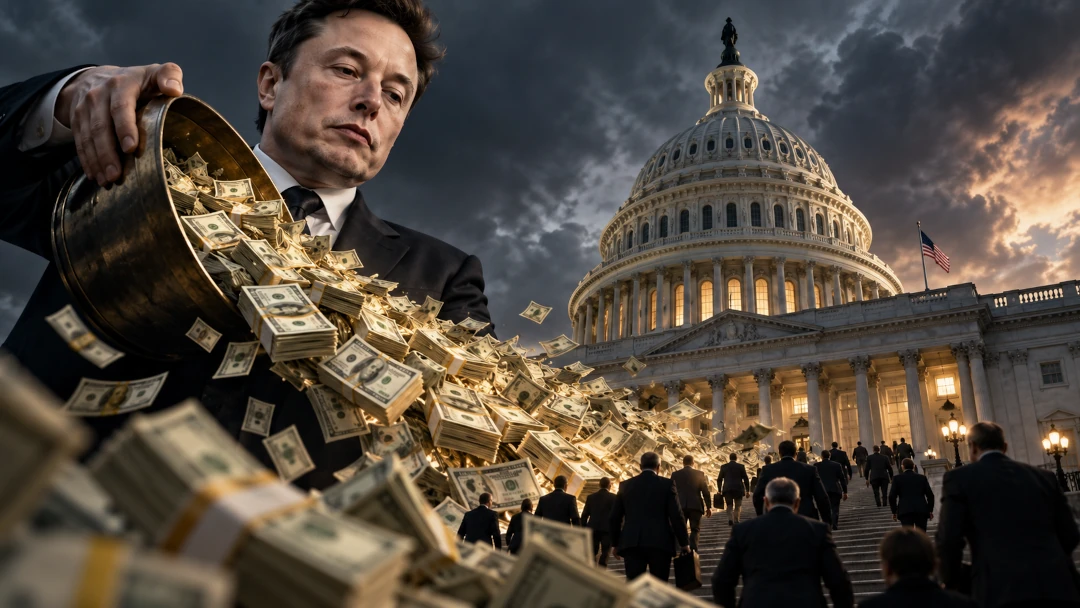
The world’s richest man has poured at least $366 million into this year’s midterms, more than he spent electing Donald Trump in 2024, to keep a Republican Congress standing guard around an unpopular president. He is not alone. A small circle of billionaires, a Supreme Court that keeps removing the guardrails, and a campaign-finance cop with no quorum have turned the 2026 election into the most expensive auction in American history.
In May of last year, Elon Musk told an audience in Qatar that he had done enough in politics and would spend far less going forward. Seventeen months later, a spokesman for his own super PAC confirmed to Reuters that Musk has spent roughly $366 million in the 2026 cycle, $276 million of it since July alone. That is not a donor hedging his bets. It is a single man underwriting a governing party at the exact moment voters appear ready to put a check on it.
The timing tells the story. Republicans enter the final stretch weighed down by Trump’s sagging approval, rising prices, and an unpopular war with Iran. CNBC summed up the money race bluntly: Democrats have the candidate cash, while Republicans have Elon Musk. A Democratic House or Senate would mean subpoenas, oversight hearings, and a Congress that no longer rubber-stamps the White House. Musk is spending to prevent that, and to keep Donald Trump from becoming the lame duck the voters seem inclined to make him.
I. Following the $366 Million
According to figures confirmed by America PAC spokesman Andrew Romeo and reported by CNBC, the bulk of Musk’s third-quarter money did not go to his own operation. It went straight into the Republican Party’s establishment machinery: the Senate super PAC aligned with Majority Leader John Thune, the House super PAC aligned with Speaker Mike Johnson, and the national associations of Republican governors and attorneys general.
Senate Leadership Fund
The single largest check of the cycle, to the Thune-aligned super PAC. Musk supplied nearly 60 percent of what SLF raised for its Texas operation, per Salon.
America PAC (his own)
His spokesman confirmed $76 million in new money; FEC filings reviewed by CNBC show $89 million into America PAC in the quarter.
House, Governors, AGs
$20 million to the Congressional Leadership Fund, $10 million to the Republican Governors Association and $2 million to Republican attorneys general, according to CNBC.
Kentucky Senate Primary
In January Musk gave $10 million to Fight for Kentucky, backing Nate Morris for Mitch McConnell’s seat. Axios called it his largest single gift ever in a Senate race.
Texas is where the money becomes most visible. Salon traced how the Senate Leadership Fund passed money into Texas PAC, a new super PAC propping up Attorney General Ken Paxton against Democrat James Talarico. Two weeks after his first check, Musk sent SLF another $83 million, and SLF moved $83 million into Texas PAC the next day. On paper, Musk’s name never touches the Paxton ads. In practice, the money moved in lockstep. America PAC separately pumped $18.8 million into the Texas Senate race in mailers, texts and ads, and about $800,000 into the five most competitive Texas House races.
America PAC’s own program is a ground war. FactCheck.org reported that Musk authorized $100 million to $120 million this summer for a field operation in at least eight states, starting with Senate races in Alaska, Iowa, Maine, Michigan and Ohio, run by longtime Musk political adviser Chris Young and built around door-knocking, digital ads and direct mail aimed at Republicans who usually skip midterms.
Musk's disclosed political spending, by cycle
Bars share one scale. The 2024 figure is the FEC-based total reported by CBS News; the Brennan Center puts it near $290 million. Either way, the 2026 total already breaks Musk's own record and the previous midterm record of $179 million, set by George Soros in 2022. Excludes undisclosed nonprofit giving.
II. What He Spent Last Time, and What He Promised
In 2024, Musk spent at least $277 million to elect Trump and other Republicans, according to CBS News. About $239 million went to America PAC. Another $20.5 million paid for the so-called RBG PAC, whose ads tried to persuade voters that Trump and the late Justice Ruth Bader Ginsburg shared views on abortion. America PAC’s largest single expense was a $40.5 million payment to a company registered at an address associated with Musk.
Then came 2025. Musk and groups he supports spent more than $20 million in Wisconsin’s April Supreme Court race, where he handed $1 million checks to two voters on stage after the state’s high court declined Attorney General Josh Kaul’s last-minute request to stop him, the Associated Press reported. Musk openly framed that judicial race around congressional maps. Wisconsin voters rejected his candidate anyway.
“In terms of political spending, I’m going to do a lot less in the future.”
— Elon Musk, May 2025, as quoted by CNBC
- July 2024
Musk makes his first $5 million gift to America PAC, months after saying he would not donate to either presidential candidate.
- October – November 2024
America PAC launches $1 million daily giveaways to registered swing-state voters who sign its petition. A Philadelphia judge declines to stop them on Nov. 4.
- December 2024
FEC filings show at least $277 million in Musk political spending, the most by any donor that cycle.
- March 2025
$20 million-plus and two $1 million checks in Wisconsin’s Supreme Court race.
- May 2025
Musk says he will spend “a lot less” on politics. A public feud with Trump follows weeks later.
- January 2026
$10 million to Fight for Kentucky, after a reconciliation and a November dinner with Vice President JD Vance and White House aides, per Axios.
- July – September 2026
$276 million in a single quarter, including $158 million to the Senate Leadership Fund.
- October 2026
Colorado and Washington election officials warn voters about misleading America PAC texts and its VoteSafe.org site.
III. The Money We Cannot See
The $366 million is only what Musk’s team chose to confirm and what the FEC requires super PACs to disclose. Reuters, citing The New York Times, reported that Musk has also given through groups that do not disclose their donors. How much, and to whom, voters may never learn.
His track record with such groups is well documented. Reuters reported in 2024 that Musk had been quietly funding Building America’s Future, a nonprofit that shares personnel with America PAC, since at least 2022. Tax records obtained by Sludge show that group took in a single anonymous $75 million gift during the 2024 cycle and pushed money into pro-Trump super PACs, a fake pro-Harris digital campaign, and a “whistleblower” fund hunting for election fraud. The donor’s identity is shielded by federal law.
The broader picture is worse. The Brennan Center’s Ian Vandewalker notes that more than $1 billion in dark money has already entered the 2026 elections, and that growing sums are going to paid social-media influencers whose sponsors are easy to hide and who disclose nothing. Musk also owns X, where America PAC runs its feed and where his own posts reach an audience no ad budget can buy. None of that shows up on an FEC report.
IV. The Billionaire Class Is All In
Progressive lawmakers have a name for this crowd. Rep. Ro Khanna of California has popularized the phrase “the Epstein class,” and Sen. Jon Ossoff of Georgia has used it on the stump to describe the wealthy circle around the Trump administration, as Jewish Insider reported. Critics argue the label confers guilt by association, and that is a fair warning: appearing in Epstein’s contacts or files is not evidence of any crime. What the term captures is a class of people whose wealth lets them operate under different rules than everyone else.
That class spends across party lines but leans hard right. The Americans for Tax Fairness Action Fund found that billionaire families had spent more than $1.7 billion on the 2026 elections through late August, already past the $1 billion midterm record set in 2022. Just 15 families account for $962 million of it. Fewer than one dollar in five went to committees that face contribution limits; the rest went to super PACs. A separate ATF analysis reported by Truthout found that 40 billionaires and families with documented ties to Epstein, ranging from address-book entries to close friendships, have spent $1.57 billion on federal elections since 2010, including $282 million to Trump’s campaigns and super PACs.
| Donor | Leans | 2026 cycle | Notes |
|---|---|---|---|
| Elon Musk | GOP | $366M | Largest known donor; SLF, America PAC, CLF |
| Marc Andreessen & Ben Horowitz | GOP | $115M | Venture capital; AI, crypto, defense interests |
| George Soros & family | Dem | $103M | Mostly through Democracy PAC |
| Jeff Yass; Richard & Elizabeth Uihlein; Miriam Adelson | GOP | "Trailing closely" | Finance, shipping supplies, casinos |
| Dustin Moskovitz & Cari Tuna | Dem | ~$16M | Summer giving |
| Reid Hoffman | Dem | $11.5M | To the super PAC backing Talarico in Texas |
The trend line matters more than any single name. Billionaire political spending has grown 53-fold since Citizens United, according to ATF. Independent expenditures from super PACs and other groups hit a record $2 billion through September, up 51 percent from the last midterm after inflation, the Brennan Center found. Among the 20 biggest-spending outside groups, Republican spending is more than double Democratic spending. In 2014 those groups were roughly tied. Democrats have their own megadonors, and we should be clear-eyed about that. But the gap has widened every cycle, and this year it is the widest since Citizens United.
V. Trump’s War Chest, and Whose Money It Really Is
While Musk wrote checks, the president sat on his. MAGA Inc., the super PAC built to serve Trump, entered 2026 with nearly $300 million and ended August with $415.8 million after months in which Republican candidates begged for help and received almost none. On Sept. 4, with GOP anxiety mounting, Trump announced from the Oval Office that he would deploy $400 million to $500 million, and claimed the fund held close to $1 billion. FEC records reviewed by CNBC showed about $403.5 million as of July 31. He also said he might hold some of it for 2028.
“This is my money that I control.”
— President Donald Trump on MAGA Inc., Oval Office, Sept. 4, 2026, via CNBC
It is not his money, and it is not supposed to be his to control. MAGA Inc.’s funds came from donors such as Adelson, Yass and Andreessen; CNBC noted plainly that none of it is Trump’s personal fortune. His first major outlay came a day after the Oval Office pledge: $10 million for Ken Paxton in Texas, split between ads attacking Talarico and ads praising Paxton, according to CBS News. Since then MAGA Inc. and a second Trump-linked group, No Going Back Inc., have spent more than $150 million to help congressional Republicans, the Brennan Center reports.
And his own money? In August Trump told reporters he would spend MAGA Inc.’s funds “and my own money” on good Republican candidates. We found no public filing or press report showing a personal contribution from Trump to any 2026 candidate, party committee or super PAC. Meanwhile, Trump-focused television ads that his administration had been running at taxpayer expense are now being shifted onto MAGA Inc.’s books only after public scrutiny, CBS News reported.
The priorities on display are hard to miss. A president who held hundreds of millions in donor money while his party’s candidates went unfunded, who describes that money as his personal instrument, who has spoken of saving it for the next presidential cycle, and who has not visibly put his own fortune on the line is treating the midterms as a test of loyalty to him rather than a contest he owes his party. Leadership means spending your capital for the people who stood with you. This is accumulation.
Get Involved Today
Contribute to our mission and turn your concerns into action.
VI. Rewriting the Rules Before the Count
Money is only one of the levers. U.S. News catalogued how the administration has used executive orders and federal agencies to reshape the midterms: an order requiring the Postal Service to deliver mail ballots only to voters on federally screened lists; an order directing the Justice Department to build a voter-roll purge tool from an immigration database; a 2025 proof-of-citizenship order that courts halted; and the stationing of federal agents near polling places. Trump also pressed Republican-led states into unusual mid-decade redistricting. The Supreme Court initially let the mail-ballot order proceed in August, and Justice Brett Kavanaugh, a Trump appointee, later called the rule arbitrary and capricious and said states lacked time to implement it before the midterms.
Musk’s operation is pushing on the same pressure points from the outside. Election officials in Colorado and Washington have warned voters about America PAC, CNN reported. Colorado voters received texts saying their ballot request had been received, in a state that mails every active voter a ballot automatically. Secretary of State Jena Griswold called the messages misleading, and Weld County’s Republican clerk, Carly Koppes, fielded calls from residents who feared someone had requested ballots in their names. Washington’s Secretary of State Steve Hobbs urged voters to avoid VoteSafe.org, the PAC’s lookup site, which collects phone numbers and emails and enrolls users in the PAC’s messaging.
VII. How the Courts Built This, and What the Law Still Forbids
None of this happened by accident. Each step was a legal choice, usually made by a narrow majority, that treated unlimited spending as a form of speech and treated the appearance of corruption as something voters would simply have to tolerate.
Four rulings opened the floodgates. Four statutes still stand.
Citizens United v. FEC (2010)
- The Supreme Court held that corporations and unions may spend unlimited sums on independent political expenditures. ATF ties the 53-fold rise in billionaire spending to this ruling.
SpeechNow.org v. FEC (D.C. Cir., 2010)
- Applying Citizens United, the appeals court struck down limits on contributions to groups that only make independent expenditures. That decision created the modern super PAC, the vehicle for nearly all of Musk’s money.
McCutcheon v. FEC (2014)
- Struck down aggregate limits on how much one person can give across all candidates and parties in a cycle, freeing the biggest donors to spread money everywhere at once.
NRSC v. FEC (June 2026)
- The Court struck down limits on how much parties may spend in coordination with their candidates. The Brennan Center reports the Senate GOP spent $48 million in coordination with candidates by the end of August, most of the $63 million spent by all four congressional committees, and that parties now get the low ad rates candidates receive.
Where the law may have been broken
Officeholder control of soft money, 52 U.S.C. § 30125(e)
- Federal officeholders may not solicit, receive, direct or spend unlimited “soft money.” The Campaign Legal Center’s FEC complaint argues that Trump’s own statement that he controls MAGA Inc. is an admission of exactly that. The complaint asks for civil penalties and an injunction; MAGA Inc. calls the complaint frivolous.
Paying people to register or vote, 52 U.S.C. § 10307(c)
- In 2024 the Justice Department warned America PAC that its $1 million giveaway could violate this provision. Philadelphia District Attorney Larry Krasner sued under state lottery law; Judge Angelo Foglietta allowed the giveaways to continue after Musk’s advisers testified the winners were not chosen at random, despite Musk’s public description of random awards, PhillyVoice reported. No federal case was brought.
Coordination and conduits, 52 U.S.C. § 30116
- Super PAC money may not be coordinated with campaigns. Super-PAC-to-super-PAC transfers like SLF’s $158 million to Texas PAC are legal, but they delay public disclosure of who is paying. Talarico’s campaign has filed an FEC complaint alleging illegal dark-money spending for Paxton; the groups say they follow the law.
Federal contractors, 52 U.S.C. § 30119
- Companies holding federal contracts may not make federal political contributions. The ban covers the contracting firm, not its owner’s personal checks, which is why Musk can give hundreds of millions while SpaceX holds billions in government business. The law is followed to the letter while its purpose is defeated.
Who enforces any of this?
Nobody, for now
- The FEC has had only two of six commissioners since Trump removed Chair Ellen Weintraub and Republican members departed. It has not resolved a single enforcement case since May 2025, and its backlog doubled from 154 to 307 cases, CBS News found. Trump’s two nominees have waited eight months for a Senate hearing. Every complaint above sits in a drawer.
Former FEC lawyer Adav Noti, now executive director of the Campaign Legal Center, told CBS that the paralysis has created “blanket impunity for lawbreaking.” Public Citizen’s Craig Holman put it in simpler terms: with no referee, everyone knows they can do whatever they want this time around. A campaign-finance system with no enforcer is not a system. It is a suggestion.
VIII. What It Means for the Rest of Us
A family that maxes out to a House candidate gives $3,500. Kentucky’s Senate race shows the arithmetic: it would take more than 2,800 such donors to match one Musk check to Fight for Kentucky. When a single donor can outspend whole states, candidates learn whose calls to return. The policy stakes are concrete. Musk’s companies hold federal contracts and face federal regulators; House Democrats have called for investigations into those contracts and into his tenure running the Department of Government Efficiency, Reuters reported. A Republican Congress means those investigations do not happen.
There is reason for hope in the numbers too. CNBC found that the Republican spending blitz since Labor Day, more than $740 million including Musk’s money, has barely moved polling in the Senate battlegrounds. Money buys airtime and door-knockers. It does not buy the votes of people who show up informed. Brennan’s polling shows nine in ten voters regard government that serves billionaires as corrupt. That anger is a resource, if it gets to the ballot box.
IX. What You Can Do
The plain truth is that no single voter can outspend a billionaire, and no ruling will change before Nov. 3. What you can do is make sure your own vote counts, protect your neighbors from confusion, and build pressure for the reforms that would end this. Here are five concrete steps, with an honest read on each.Verify your registration at the official source
Check your status and your polling place on your state or county election office website, or through vote.gov, which links to every state. Do not use third-party lookup sites run by PACs; they may be inaccurate, and many enroll you in political messaging.
Honest assessment: this is the single highest-value step, and it takes five minutes.
Treat campaign texts as advertising, not instructions
If a text says your ballot was requested, received or rejected, confirm it with your county clerk. Track mail ballots through your state’s official tracker. Report misleading election messages to your secretary of state and to the nonpartisan Election Protection hotline at 866-OUR-VOTE.
Honest assessment: you cannot stop the texts, but you can stop them from working.
Vote early or return your ballot early
With postal rules in flux and the Justice Department pressing states over voter rolls, an early ballot leaves time to fix problems. If you vote by mail, follow your state’s signature and envelope instructions exactly.
Honest assessment: early voting is the best insurance against last-minute disruptions you cannot predict.
Give your time where money cannot follow
Sign up as a poll worker, drive neighbors to the polls, or talk to people you know. Paid canvassers knock on strangers’ doors. You can talk to people who already trust you.
Honest assessment: personal contact remains the most effective turnout tool in campaign research, and no billionaire can buy your relationships.
Vote on the money itself, and make candidates commit
Voters in Michigan, Montana and California have campaign-finance measures on the ballot this fall, and Alaskans voted in August to restore contribution limits. Everywhere else, ask candidates directly: Will you support a constitutional amendment to overturn Citizens United, full disclosure of dark-money donors, and confirming a working FEC quorum?
Honest assessment: real reform needs a new Congress and likely a constitutional amendment. That is a long fight, and it starts with who wins in November.
Editorial Conclusion
Elon Musk has every legal right to his opinions and, under the rules the Supreme Court has written, nearly every legal right to spend his fortune promoting them. That is precisely the problem. A democracy in which one man can outspend most of the country, in which a president calls a donor-funded war chest his personal money, and in which the only agency empowered to enforce the law cannot even meet, is a democracy running on the honor system for people who have shown they have none.
The answer is not despair, and it is not cynicism. It is a ballot cast early, checked against official sources, and multiplied by every neighbor you bring with you. Then it is a Congress that restores the referee, forces dark money into the light, and begins the work of undoing Citizens United. Self-government belongs to citizens who show up, and on November 3 the people still have something Elon Musk cannot buy: the final word.
Sources & References
- Reuters — Musk has spent $366 million to help Republicans retain control of Congress
- CNBC — Elon Musk gives $276 million to Republican groups, becomes biggest known 2026 midterm donor
- CNBC — 5 midterm money takeaways: Democrats have candidate cash, Republicans have Elon Musk
- Salon — Elon Musk is the donor behind Senate Republicans’ rescue mission for Ken Paxton
- FactCheck.org — America PAC profile
- Brennan Center — Big Money Breaks Records, Boosts GOP: 5 Things to Know About the Midterms
- CBS News — Elon Musk spends $277 million to back Trump and Republican candidates
- Axios — Musk shocks with $10 million donation in Kentucky Senate race
- Sludge — Musk-linked “dark money” group got a $75 million anonymous donation
- Associated Press — Musk hands out $1 million payments after Wisconsin Supreme Court declines to stop him
- Americans for Tax Fairness Action Fund — Billionaires Buying Elections: Midterm Edition
- Truthout — 40 Epstein-tied billionaires have injected $1.6B into US elections, report finds
- Jewish Insider — Anger at the “Epstein class” and its uses
- CNBC — Trump says he will spend up to $500 million of “my money” to help Republicans
- CBS News — Trump delivers $10 million to Ken Paxton in first major contribution of midterms
- Campaign Legal Center — FEC complaint: MAGA Inc. soft money (PDF)
- CBS News — Weeks before Election Day, the campaign finance regulator can’t enforce the law
- CNN — Elon Musk’s PAC is spreading inaccurate voting information, election officials say
- U.S. News — Mail ballots, voter rolls and ICE: how Trump has tried to change the 2026 election
- PhillyVoice — Judge dismisses Krasner’s lawsuit challenging Musk’s $1 million giveaways
All figures reflect public disclosures and reporting available as of October 17, 2026. Spending by nonprofits that do not disclose donors is not included in any total above. Complaints described in this article are allegations that have not been adjudicated.
Related News