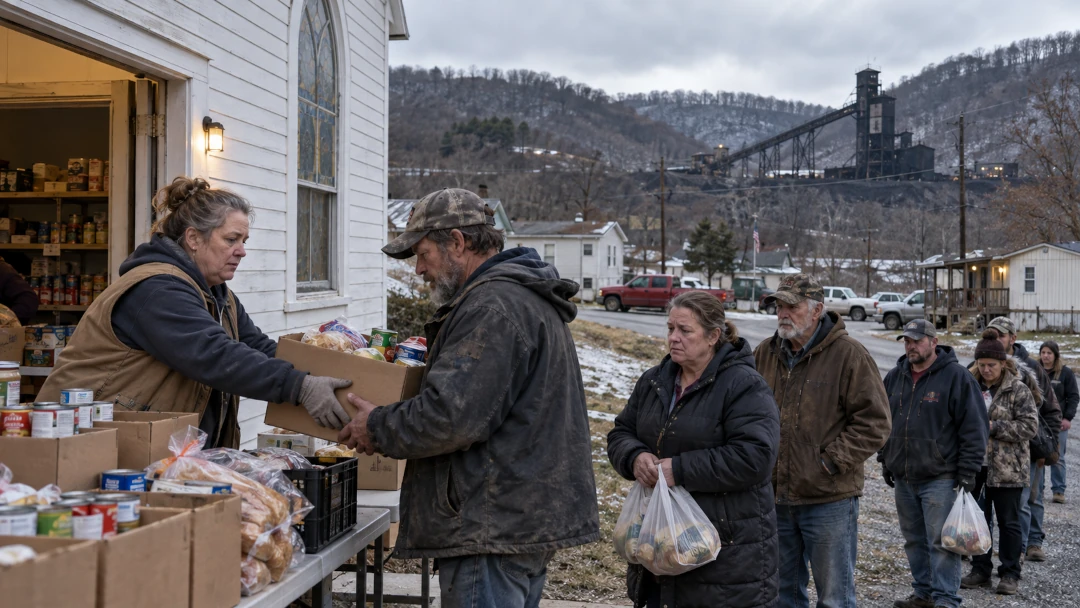
Hunger in the Land of Plenty
In West Virginia’s coal country, neighbors are struggling to feed neighbors. Across America, food assistance is shrinking, medical coverage is under attack and household bills keep arriving. Washington calls it fiscal discipline. The people living with the consequences know a different name for it.
In a coal-country community in West Virginia, hunger is no longer a distant abstraction or a statistic in a government spreadsheet. It is the food pantry trying to stretch limited supplies, the volunteer watching the line grow, and the working family calculating whether there is enough money left after gasoline and rent to buy groceries. An NBC News report describes front-line food providers confronting enormous pressures as federal policy, household expenses and an energy shock converge.
What makes this story politically devastating is that it is no longer exceptional. Hunger has become an increasingly ordinary feature of communities that are told the economy is thriving. The White House did not invent food insecurity, housing shortages or the fragility of rural health care. But Donald Trump and the Republican Congress have chosen policies that make a difficult situation harder for those with the least cushion.
I. The Emergency Is Spreading
The warning signs predate this week’s headlines. In March 2025, Reuters reported that federal food purchasing cuts and freezes were putting food banks under severe pressure, with West Virginia providers anticipating sharply reduced shipments. That means fewer boxes of groceries at the same moment higher food and transportation bills push more people through the doors.
Federal nutrition benefits and local charities are not interchangeable. SNAP supports regular food purchases; food banks respond to emergencies and fill gaps. When Washington weakens SNAP and disrupts food deliveries to charitable providers, it constricts both routes to the dinner table. The effect is especially harsh in rural areas where a trip to a pantry may require a car, gasoline and time away from work.
“When you take SNAP away, the implications are cataclysmic.”
— Claire Babineaux-Fontenot, Feeding America CEO, Associated Press
II. What Washington Actually Cut
The centerpiece is the Republican reconciliation law enacted in 2025, Public Law 119-21, marketed as the “One Big Beautiful Bill.” The Congressional Budget Office’s 2026 outlook estimates the law will reduce projected federal SNAP spending by about $211 billion through 2035, through tighter eligibility and work rules, benefit calculation changes and greater pressure on state budgets. The law expands work requirements, restricts some waivers and narrows eligibility for certain noncitizens.
Its health-care impact is even larger. CBO estimates Medicaid spending will be about $1.2 trillion lower over 2026–2035 than previously projected, with a projected 7.5 million additional uninsured people in 2034 attributable to the law. The human consequence is not merely paperwork: fewer covered patients mean postponed treatment, uncompensated hospital care, strained rural clinics and medical debt. Associated Press reporting in October 2026 documents that certain lawfully present immigrants have already lost Medicaid eligibility under provisions effective October 1.
The pressure is compounded by administrative decisions. In 2025 the administration reduced or canceled federal food-purchasing arrangements that helped stock pantries and supported farmers, as Reuters documented. The DOGE-era drive to shrink agency staffing, grants and federal operations forms part of this larger governing philosophy. Not every reduction was authored by DOGE, nor is every canceled contract a documented direct cause of hunger; the demonstrable issue is the cumulative loss of capacity in systems communities rely on.
$4 billion
Approximate LIHEAP funding the administration proposes eliminating in its FY2027 budget, not an enacted elimination. White House budget
$4.2 trillion
CBO’s estimated increase in cumulative deficits during 2025–2034 due to the 2025 law, including economic and interest effects. CBO
III. The Tariff Tax and the Monthly Bills
Families do not pay their bills according to Washington’s preferred categories. They pay for the whole basket: groceries, prescriptions, rent, gasoline, heating and the drive to work. Trump’s tariff regime added another burden to the price of imported goods and production inputs. Tariffs are collected from importers, not directly from foreign governments; their cost is ultimately paid by the consumer. The average U.S. household paid $1,745 in tariff costs between February 2025 and January 2026, totaling $231 billion for all consumers. For the full year of 2026, estimates project the average household burden will range from $820 to $2,500, depending on whether temporary Section 122 tariffs expire or are extended after a Supreme Court ruling struck down the bulk of the initial IEEPA tariffs.
- Pass-Through Rate: Approximately 90% of the tariff burden falls on U.S. firms and consumers, with import prices rising nearly one-for-one with tariff increases.
- Price Impact: By February 2026, tariffs contributed 2.9 percentage points to consumer goods price inflation, raising the overall goods price level by nearly 3%.
- Distributional Burden: The cost is regressive; the bottom income 10% pays roughly 0.7–0.8% of its after-tax income in tariffs, compared to 0.3–0.5% for the top 10%.
The energy crisis adds insult to injury. Oil and gasoline costs have been buffeted by conflict involving Iran, with knock-on effects for freight, food deliveries and heating. The administration cannot fairly be assigned sole responsibility for world energy prices, but it is responsible for the choices it makes in response. The FY2027 White House budget proposes eliminating the Low Income Home Energy Assistance Program, or LIHEAP, which helps eligible households with heating and cooling bills. That is a proposal requiring congressional action, not an already completed abolition. Even the proposal reveals an astonishing disconnect between policymakers and households facing a winter utility bill.
Housing completes the vise. Rent and mortgage expenses are not discretionary: people cannot decide to stop needing shelter. In October, Reuters reported pressure on mortgage markets as interest rates and energy-driven inflation fears rose. Those wider economic forces do not all originate in the Oval Office. Yet less health coverage, weaker nutrition support and threatened heating assistance leave families with fewer ways to withstand them.
Get Involved Today
Contribute to our mission and turn your concerns into action.
IV. The Poverty Number That Misses the Rent
On September 15, 2026, the Census Bureau released data showing an official 2025 poverty rate of 10.2 percent, down half a percentage point from the year before. That improvement is real within the official measure and should not be erased to suit an argument. But the measure counts pretax cash income against a threshold; it does not directly subtract the distinctive medical, work and housing costs that often consume a household’s resources.
The Census Bureau’s Supplemental Poverty Measure, which does account for taxes, benefits and important expenses, stood at 13.1 percent for 2025, with no statistically significant change from 2024. It does not prove that nationwide poverty rose in 2025. It does demonstrate why a victory lap based solely on the official number misses the lived squeeze: households can show more cash income on paper and still confront punishing costs. Nor do 2025 figures capture the full future impact of policy changes scheduled for later years.
“It’s just really bad, this economy. It’s horrible.”
— Girvin, West Virginia resident, NBC News
V. Tax Relief at the Top, Debt for Everyone
The president calls his tax law a great achievement, and it is true that many middle-income households receive tax relief. But the full fiscal bargain matters. The CBO distributional analysis of the enacted law finds that resources will generally fall for people toward the bottom of the income scale, while increasing for people in the middle and at the top. Its estimates show that lower-income households are losing valuable health and food benefits at the same time the tax code delivers large benefits to higher-income groups.
The Tax Policy Center likewise describes the legislation’s tax benefits as tilted toward high incomes. It would be inaccurate to claim that every dollar goes to billionaires, or that every middle-class household gets nothing. The deeper indictment is the distribution of benefits and sacrifices: a family receiving a modest tax cut can be worse off once lost Medicaid or SNAP is counted, while wealthier taxpayers collect much larger tax gains.
And Washington has not purchased fiscal prudence with those sacrifices. CBO projects that the 2025 legislation increases the cumulative deficit by approximately $4.2 trillion during 2025–2034. The national debt is already at historically unprecedented nominal levels. Calling the law “the largest tax cut in history” without specifying how the comparison is measured would be imprecise; its large scale, unequal benefits and debt effects are sufficiently damning without a contest over slogans.
VI. What Congress Is — and Is Not — Doing
Republican majorities enacted the central 2025 package. They had alternatives: preserve food and health funding, scale back tax preferences benefiting affluent households, or choose a different combination of taxes and spending. They made a political choice and must answer for it.
Democrats have denounced the reductions. House Democratic Leader Hakeem Jeffries has described the Medicaid cuts as historic and said Democrats will fight to restore health care and nutrition support, according to his June 2026 statement. Senator Elissa Slotkin and Jeffries are among party figures wrestling with how to convert public anger over affordability into a governing program; The Washington Post reported October 11 that the party has not settled on a complete shared agenda. Senator Jon Ossoff has made health care and food-and-fuel prices central to his criticisms of Trump-aligned Republicans, while Republican Senate Majority Leader John Thune continues to lead a chamber that has not reversed the law’s key provisions.
The distinction between protest and protection matters. Speeches are not restored meals. Oversight requests are not reopened clinics. Democrats can advance repeal proposals, demand hearings, negotiate must-pass spending legislation, defend assistance in state governments and describe exactly how they would pay for restoration. But without majorities and, ultimately, the ability to overcome presidential resistance, promises alone cannot change statutes. The question for voters is not simply who sounds angrier. It is who offers a workable plan that moves food, medical care and energy relief from a campaign pledge into law.
VII. The Human Cost Is Not Hypothetical
Reduced health coverage can cause people to delay diagnosis, ration medication and avoid preventive care. Lost nutrition support can intensify diet-related disease and child hardship. A heating shutoff can endanger elderly people and those living with serious illness. Researchers can estimate population risks, but it would be wrong to attribute an unverified number of deaths to a particular cut before the evidence exists. Preventable suffering is already a serious consequence; the plausible risk of preventable death deserves urgent attention, not invented statistics.
Those who live in rural America see the multiplier effect. When a hospital struggles, jobs vanish as well as medical services. When a pantry loses supply, it cannot magically replace a national nutrition program. And when federal policy transfers costs onto states, counties and charities, someone locally must pay — or someone vulnerable goes without. The suffering in West Virginia is a local expression of a national decision.
VIII. A Timeline of the Squeeze
IX. What You Can Do
- Protect benefits before an interruption. If you receive SNAP, Medicaid or ACA coverage, immediately read renewal notices, maintain copies of eligibility documents, report required changes and appeal an adverse decision within the deadlines stated in the notice. Start with your state benefits office or USA.gov’s food-assistance guide.
- Get immediate local help. Contact 211 for local programs, or use Feeding America’s food-bank finder. Ask about both food distributions and enrollment support. Receiving help is not a moral failing.
- Organize practical neighborhood support. Arrange recurring donations to a pantry, deliver groceries for someone without reliable transportation, support community fridges, and ask providers what supplies they actually need. Consistent funding is often more useful than occasional food drives.
- Defend health and energy access. Check eligibility for Marketplace coverage, Medicaid and utility assistance. If a shutoff is threatened, contact the utility and state LIHEAP office before the deadline; disconnection protections vary by jurisdiction and season.
- Demand measurable action. Ask members of Congress whether they will restore SNAP and Medicaid support, protect LIHEAP funding, examine tariffs’ household costs and publish fiscal estimates. Contact the House and Senate and vote in state and federal elections. Ask for specific legislation, not another slogan.
Constitutional Accountability: The Power of the Purse and the Limits of Presidential Authority
The Constitution does not give a president unlimited authority to dismantle federal programs, withhold congressionally authorized spending, or rewrite the nation’s social contract through executive orders. Under Article I, Sections 8 and 9, Congress holds the power to levy taxes, provide for the general welfare, and control federal appropriations. Under Article II, Section 3, the president has a constitutional obligation to faithfully execute the laws—not selectively disregard them because their purposes conflict with his political agenda. These divisions of authority are fundamental safeguards against the concentration of government power in a single individual.
The distinction between legislation and executive action matters enormously. Congress has the constitutional authority to reduce SNAP benefits, change Medicaid eligibility, or repeal assistance programs through properly enacted laws, however destructive those decisions may be. But when an administration independently freezes appropriated money, terminates congressionally established activities, or imposes requirements beyond its statutory authority, different legal questions arise. The Impoundment Control Act of 1974 restricts presidential withholding of congressionally appropriated funds, while the Administrative Procedure Act provides mechanisms for challenging agency actions that are arbitrary, capricious, procedurally defective, or contrary to law. Executive orders cannot override either statute.
That distinction also exposes the limits of executive accountability. The Republican Congress bears direct responsibility for cuts it enacted into law. The Trump administration bears responsibility for how it implements those laws and for any independent executive actions that exceed its authority. Courts can invalidate unlawful agency actions, the Government Accountability Office can investigate improper withholding of funds, and Congress can conduct oversight, demand records, restore appropriations, and repeal damaging legislation. But these safeguards function only when institutions exercise their authority and elected officials are willing to challenge abuses, including those committed by their own party.
There is no constitutional prohibition against economic policies that favor the wealthy or impose disproportionate burdens on the poor. That is precisely why democratic accountability matters. A policy can be legally enacted and still represent a profound failure of government responsibility. The Constitution establishes who has the authority to make these decisions and how that authority must be exercised. It remains the responsibility of Congress, the courts, and ultimately the American people to ensure those powers are not abused—and that government serves the general welfare rather than the privileged few.
X. A President’s Priorities Are Revealed by Who Pays
President Trump continues to defend tariffs, push an energy and spending agenda oriented around his preferred priorities, and support a tax-and-budget structure that asks lower-income Americans to absorb especially punishing losses in public benefits. His administration argues that tougher eligibility rules deter misuse, tariffs strengthen domestic industry and tax relief promotes growth. Those aims deserve scrutiny against measurable outcomes — and against the costs borne by people who cannot negotiate down rent or postpone hunger.
Leadership is not merely announcing a better economic statistic or a bigger border-enforcement budget. It is making defensible choices when scarce resources have competing claims. A president can choose to protect the purchasing power of those already struggling; he can choose to keep the rural clinic solvent; he can choose to view a food pantry’s growing line as evidence that his policy needs correction. When the pattern instead consists of retrenchment at the bottom and rewards concentrated higher up, voters are entitled to draw conclusions about whose comfort counts.
Editorial Conclusion
Hunger in West Virginia is not a failure of neighborliness. It is a failure of public priorities. America has the resources to keep children fed, vulnerable patients treated and low-income households warm. What it lacks is a federal government consistently willing to put those obligations ahead of preferential tax policy and political theater. Food, health and human dignity must come before the rewards of wealth — and Congress must be made to act accordingly.
Sources & References
- NBC News — West Virginia hunger, food stamps and energy costs.
- Reuters — Trump cuts hit struggling food banks.
- Congressional Budget Office — Budget and Economic Outlook, 2026–2036.
- CBO — Distributional Effects of Public Law 119-21.
- Tax Policy Center — Effects of the major tax package.
- U.S. Census Bureau — Poverty in the United States: 2025.
- U.S. Census Bureau — 2025 income, poverty and insurance release.
- White House — FY2027 budget proposal, LIHEAP.
- Yale Budget Lab — One year of tariff analysis.
- Axios — New York Fed findings on tariff-related prices.
- Associated Press — Medicaid eligibility losses for legal immigrants.
- Rep. Hakeem Jeffries — Democratic response to Medicaid reductions.
- Washington Post — Democrats and an affordability agenda.
- Reuters — Treasury yields and mortgage-market pressure.
- Congressional Constitution Annotated — 25th Amendment.
- Feeding America — Find your local food bank.
Related News