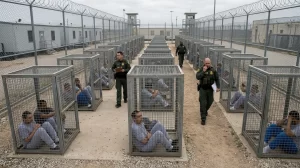
“I’m a U.S. Citizen, Please Help Me”: Inside the Crackdown That Is Swallowing Americans
A new ProPublica investigation has counted more than 500 American citizens held by immigration agents: handcuffed, held at gunpoint, tackled, jailed without a phone call, and in a dozen cases deported. The cameras have mostly moved on. The arrests have not. This is what a lawless agency looks like when nobody is watching.
In a video recorded in Key Largo, Florida, a woman being detained by immigration agents for the third time says the sentence that now defines this era of American policing: “I’m a U.S. citizen, please help me.” She was driving a car registered to her partner, an immigrant. That was enough. Her plea opens ProPublica’s landmark accounting, published October 6, of every case its reporters could document of an immigration agent holding an American citizen during President Trump’s second term. The total is 506, and ProPublica says plainly that it is an undercount.
The government does not keep this number. It has never wanted to. The Department of Homeland Security insists it is not arresting citizens by mistake, that its stops are never indiscriminate, and that accusations of racial profiling are false. ProPublica’s reporters checked each case against at least two sources, gave DHS a chance to respond to every incident, and found the opposite of what the department claims, at a scale far larger than anyone had previously shown.
I. 506 Americans, and Counting
The ProPublica dataset runs from January 2025 through September 2026 and spans 33 states and the District of Columbia. It counts anyone held against their will, by the same standard courts use: if you are not free to leave, you are detained. Former immigration officials who reviewed the footage were stunned. Eric Balliet, a two-decade veteran of Homeland Security Investigations and Border Patrol who served in Trump’s first administration, called it terrible. Darius Reeves, who ran ICE’s Baltimore field office until last year, said he had never seen so many citizen encounters in his career and called it an embarrassment to the agency.
Held over their citizenship
Americans detained after agents questioned whether they were citizens. Nearly all were people of color. ProPublica
Children and teens
American minors detained, about 20 of them handcuffed or zip-tied, despite DHS claims that ICE never restrains children. ProPublica
Cut off for a day or more
Citizens held at least 24 hours without being able to reach a lawyer or their family. ProPublica
Deported Americans
U.S. citizens removed from their own country, most of them children sent out with their parents. ProPublica
The second-largest category is just as revealing. ProPublica tracked roughly 300 Americans detained for allegedly assaulting or obstructing agents. Fewer than half were ever charged in federal court. Of the 137 who were charged, nearly half saw their cases dropped or dismissed. At least 63 citizens were detained while doing nothing more than recording agents in public. The pattern is not law enforcement. It is intimidation, followed by an accusation that rarely survives contact with a judge.
II. Profiled by Heritage: The “Kavanaugh Stop”
How did it become routine for federal agents to grab Americans off the street because of how they look? The answer runs through the Supreme Court. In September 2025, in Noem v. Vasquez Perdomo, the Court lifted a lower-court order that had barred agents in Los Angeles from stopping people based on four factors: apparent race or ethnicity, speaking Spanish or accented English, being at a place like a car wash or bus stop, and doing a certain kind of work. Justice Brett Kavanaugh, the only justice to explain the majority’s vote, wrote that ethnicity by itself cannot justify a stop but may be weighed alongside other factors.
In practice, the other factors describe millions of Latino Americans doing ordinary things. As Washington Monthly’s analysis of the case noted, Justice Sonia Sotomayor’s dissent, joined by Justices Kagan and Jackson, warned that the Fourth Amendment does not permit stops on criteria so broad they sweep in citizens and lawful residents wholesale. ProPublica reports that DHS now cites Kavanaugh’s concurrence to defend its agents, and that the administration describes even handcuffed, hours-long detentions as mere questioning.
Consider Willy Wender Aceituno, a naturalized citizen in Charlotte who voted for Trump twice. In November 2025, Border Patrol agents broke his truck window, pulled him out, and pinned him to the pavement, even as he and bystanders protested that he had already proved his citizenship to other agents. He told ProPublica that agents are looking for Latinos, not criminals, and that his U.S.-born daughter now carries her passport to college while her white friends do not.
III. Through the Front Door Without a Judge
The Fourth Amendment’s oldest promise is that the home is protected from government entry without a judicial warrant. In January 2026, the Associated Press obtained an internal ICE memo, surfaced by whistleblowers, asserting that officers could force their way into homes using only an administrative warrant, the I-205, signed by an immigration official rather than a judge. The AP described it as a sharp reversal of longstanding guidance, and whistleblowers said new hires were being trained on it even though it contradicted written DHS materials. DHS spokeswoman Tricia McLaughlin responded that anyone served with such a warrant had already received due process.
Jeyli Salguero, a 20-year-old citizen in Oakdale, Minnesota, would disagree. ProPublica reports that armed agents broke through her family’s front door before dawn looking for a brother who does not live there. When she said she was a citizen with the right to record, they took her phone. Agents left her and her mother in a wrecked house with the winter air pouring through the broken door. Salguero is now a plaintiff in a lawsuit challenging the policy; DHS has moved to dismiss it arguing that it has since paused the policy.
Get Involved Today
Contribute to our mission and turn your concerns into action.
IV. Bloodied, Pepper-Balled, Killed
The violence is not incidental. On September 20, in Evanston, Illinois, ICE agents pursuing a fugitive seized a Black man who merely resembled their target. According to the Associated Press, a resident who tried to help heard him scream that he was a citizen and wanted to be left alone as an agent pinned him down. Police found him injured by the roadside; he reported injuries to his head, neck and teeth and was taken away by ambulance. DHS said only that he refused assistance and was released once he identified himself.
“They’re gonna make mistakes sometimes. ICE is gonna be too rough with somebody.”
— President Donald Trump, after agents killed two citizens in Minneapolis · via Rolling Stone
That shrug came after the worst of it. In January, federal agents in Minneapolis shot and killed two U.S. citizens within weeks of each other: Renee Good, a 37-year-old mother of three, and Alex Pretti, a 37-year-old ICU nurse at the Minneapolis VA. Administration officials branded Good a terrorist and said she tried to run agents over; video and witnesses have fueled sharply different accounts, and Rolling Stone reported footage of about half a dozen agents wrestling Pretti to the ground and striking him before he was shot. The president’s response was to remark that he felt worse about Good because her parents were his supporters.
- January 2025 · Philadelphia
A 21-year-old citizen is held at gunpoint and handcuffed during a raid on the car wash where he works. - July 23, 2025 · Brownsville, Texas
Three siblings, including a 14-year-old, are detained after stopping to film an immigration arrest; agents grab their phones, calling them evidence. - October 7, 2025 · Forest Park, Illinois
Agents cut open a cemetery gate, fire pepper balls and tackle workers who refused entry and began filming. Darren Eichler begs for an ambulance for an hour. No one is charged. - November 2025 · McMinnville, Oregon
A 17-year-old on his lunch break says “I’m a U.S. citizen” as agents break his car window. On video, an agent answers that he doesn’t care. - January 2026 · Minneapolis
Federal agents kill Renee Good, then Alex Pretti, both U.S. citizens, during Operation Metro Surge. - January 14, 2026 · Oakdale, Minnesota
Agents break into the Salguero home without a judicial warrant and seize a citizen’s phone. - April 2026 · Fredericksburg, Texas
Brian Morales García, born in Denver, is deported to Mexico four days after a traffic stop, having never been allowed to call a lawyer. - September 20, 2026 · Evanston, Illinois
A citizen mistaken for a fugitive is left bloodied on the roadside and taken to the hospital.
V. No Lawyer, No Phone Call, No Country
The right to counsel and the right to contest the government’s claims are what separate a detention from a disappearance. Brian Morales García’s case shows how quickly both can vanish. The Texas Tribune reported that the 25-year-old Austin construction worker, whose birth certificate shows he was born in Denver, was a passenger in his employer’s truck when troopers stopped it for window tint. He was moved through five facilities before signing deportation papers. His lawsuit says he was coerced into admitting a foreign birth he never had. He told officers he was a citizen; he was in Mexico within four days and spent nearly five months there before a federal lawsuit forced the government to let him come home.
His attorney, Kate Lincoln-Goldfinch, has made the point that should alarm every American: no citizen has any legal obligation to carry proof of citizenship. Yet ProPublica found 36 Americans held at least a day with no access to a lawyer or their family, and roughly a dozen citizens deported. When the government can expel its own people on the strength of a pressured signature, citizenship itself becomes conditional.
Five Guarantees the Crackdown Is Breaking
Fourth Amendment · Seizures and force
Fourth Amendment · The home
First Amendment · Recording and protest
Fifth Amendment · Due process
Equal protection
The statutory line: ICE’s civil arrest powers under 8 U.S.C. § 1357 reach people suspected of being removable noncitizens. As House Judiciary Democrats reminded DHS, ICE’s own policy prohibits detaining U.S. citizens in immigration enforcement. Citizens cannot be deported under any statute. Every citizen held in an immigration sweep is held outside the agency’s lawful authority.
VI. Quieter, Not Calmer
If the crackdown feels like it has faded from the evening news, that is by design rather than by accident. NBC News reported that ICE set new monthly arrest records three months running, reaching 50,925 in August, even as operations dropped the militarized spectacle of the winter surges. Field offices are under a mandate to arrest 2,000 people a day, and agents have shifted to airports, courthouses and routine check-ins, where arrests happen out of public view.
Fewer viral confrontations means fewer headlines, and the national press has largely followed the spectacle rather than the arithmetic. But the people inside these numbers are no less detained because no helicopter filmed them. ProPublica’s database shows citizen detentions continuing through the summer in Kansas, Utah, Oklahoma, Virginia, Texas and Idaho, while two citizens enrolled in the Leech Lake Band of Ojibwe were detained in a June worksite raid in Bemidji, Minnesota. The story did not end. It went quiet.
VII. What Congress Is Doing, and Not Doing
Democrats have used the one lever they hold: the power of the purse. After the Minneapolis killings, they refused to fund DHS without enforceable guardrails. Their demands, as reported by The Hill, include a ban on agents’ face masks, judicial warrant requirements before arrests, mandatory body cameras, and a prohibition on raids at schools, hospitals and polling places.
“The American people know ICE is out of control.”
— House Minority Leader Hakeem Jeffries (D-N.Y.) · via The Hill
Senate Minority Leader Chuck Schumer told reporters that the DHS bill would not have the votes until ICE was reined in through legislation, and a six-bill package failed 45–55 in the Senate. DHS funding lapsed on February 14. In the House, Republicans pushed their version forward on a 211–209 party-line vote that raised ICE detention capacity to 50,000 beds without the reforms; Homeland Security Committee ranking member Bennie Thompson said he could not in good conscience send more money to agencies terrorizing communities and sullying the Constitution. Appropriations ranking member Rosa DeLauro offered an alternative that funded every part of DHS except ICE, CBP and the secretary’s office.
The result is a partial win with a large asterisk. The rest of DHS was funded on April 30, but according to the Congressional Research Service, that law left out annual appropriations for ICE and Border Patrol entirely. The catch is that ICE barely needs them: last year’s reconciliation law handed the agency about $74.85 billion in multiyear money, available through 2029. Withholding the annual budget slows ICE at the margins. It does not stop the raids.
Individual Democrats have pushed further. Rep. Pramila Jayapal of Washington filed an amendment to bar ICE from detaining or deporting citizens, stressing that the agency has no legal power to arrest, hold or remove Americans; at her Minnesota field hearing, a woman testified she had been held in a cell set aside for citizens. Rep. Delia Ramirez of Illinois introduced a bill to defund DHS detention and surveillance, while acknowledging it cannot advance unless Democrats win the House. Republicans, who control both chambers, have blocked every one of these measures.
VIII. The Scapegoat Strategy
Why would an administration tolerate, and defend, the detention of its own citizens? Because fear is the product. Facing historically low marks on the economy, the president used his December address to the nation to blame migrants for soaring housing costs, a claim NPR noted cannot be pinned on immigration alone. At a Pennsylvania rally billed as a speech on affordability, the Associated Press reported that he turned to grievances about immigrants from what he called “hellholes” and complained the country did not take more people from Scandinavia.
The pattern is old and effective: when prices rise because of tariffs and policy choices, point at the outsider. A visible crackdown gives the president a villain to wave at crowds and a monthly arrest record to announce, while the costs fall on Latino citizens, protesters, children, and anyone who looks like they might belong to the group being blamed. It also reveals what this White House values. ICE received tens of billions with few strings, while FEMA, TSA and the Coast Guard went months without regular funding during the shutdown fight.
The public has noticed. An NPR/PBS News/Marist poll in February found 65 percent of Americans believe ICE has gone too far, up 11 points since the previous summer, and six in ten disapprove of the job it is doing. Among Latinos, 70 percent say ICE has gone too far. Republicans still largely back the agency, which tells you whom this policy is designed to please.
IX. What You Can Do
No single action will stop a federal agency with a $75 billion war chest. But the cases that have ended in accountability, from Morales García’s return to the lawsuit that pushed DHS to pause warrantless home entries, share a common thread: documentation, legal pressure and public attention. Here are five honest options.
Know your rights, and say them out loud
You have the right to remain silent, to refuse a search, and to keep your door closed unless agents show a warrant signed by a judge. Citizens are not legally required to carry proof of citizenship. The ACLU’s Know Your Rights cards are available in several languages.
NOTE: asserting your rights will not always stop an agent in the moment, but it creates a record that matters later in court.
Document from a safe distance
Filming officers in public is protected by the First Amendment, and video has been central to nearly every case that later collapsed. Stay back, do not physically interfere, and preserve the footage.
NOTE: at least 63 citizens were detained while recording. Know that risk before you film.
Lean on Congress where it still has leverage
ICE’s annual appropriations remain unenacted. Call your representative and senators and ask whether they support a judicial-warrant requirement, a ban on detaining citizens, body cameras and unmasked agents as conditions of any ICE funding.
NOTE: the reconciliation money blunts this lever, which is why lawmakers must also attach conditions to how that money is spent.
Report abuses and back the lawsuits
If you or someone you know is wrongly detained, contact your state ACLU affiliate or a local immigrant rights legal clinic, and share cases and footage with investigative outlets like ProPublica, which built its database because the government refuses to.
NOTE: litigation is slow, but it has already forced policy reversals and brought a deported citizen home.
Act locally, and vote on November 3
State and city laws like Illinois’s TRUST Act and Evanston’s Welcoming City Ordinance limit how far local police cooperate with ICE. Push your city and state for the same, and press candidates in the November 3 midterms on exactly where they stand.
NOTE: Democrats themselves concede that their strongest bills will not move without a House majority.
Editorial Conclusion
Five hundred and six Americans did not lose their rights because of a paperwork error. They lost them because this administration built an enforcement machine that treats a Latino face, a Spanish accent or a raised phone as probable cause, and then denied it was happening. Congress must condition every dollar ICE spends on judicial warrants, unmasked and recorded agents, and an absolute ban on detaining or deporting citizens, and it must investigate every case ProPublica found. A country where a citizen has to beg strangers for help while federal agents hold her is a country whose Constitution has stopped being enforced. Restoring it is not optional. It is the job.
Sources & References
- ProPublica — More Than 500 U.S. Citizens Have Been Detained in Trump’s Immigration Crackdown
- Associated Press (via KOLD) — ICE memo asserts power to enter homes without a judge’s warrant
- Associated Press (via MyNorthwest) — U.S. citizen injured in Evanston after ICE mistook him for a fugitive
- ABA Journal — Kavanaugh explains vote allowing Los Angeles immigration stops
- Washington Monthly — The Supreme Court blocks relief from racial profiling
- Texas Tribune — ICE deported man who says he’s a U.S. citizen after Texas traffic stop
- Rolling Stone — Trump on the deaths of Alex Pretti and Renee Good
- House Judiciary Democrats — Raskin, Jayapal renew demand for answers on wrongful detention of citizens
- Office of Rep. Pramila Jayapal — Amendment requiring ICE to end targeting of U.S. citizens
- The Hill (via AOL) — Jeffries digs in on DHS funding: no deal without ICE reforms
- NPR (via The Public’s Radio) — Senate fails to advance spending bills as Democrats push DHS reforms
- Legis1 — House clears DHS funding bill on 211–209 party-line vote
- Congressional Research Service — DHS Budget Request Analysis: FY2027 (R48979)
- NBC News (via NBC Washington) — ICE arrests reached record highs this summer as tactics shifted
- NBC News — Rep. Ramirez bill to cripple DHS detention capacity
- NPR (via OPB) — Poll: two-thirds of Americans say ICE has gone too far
- Associated Press (via WUSF) — Trump’s inflation speech turns to grievances about immigrants
- NPR (via Connecticut Public) — Trump blames immigrants in address on the economy
- ACLU of New Mexico — Know your rights when interacting with immigration agents
Related News