Arsenal of Influence: A $6.6 Billion Submarine Deal and the Family Business of Government
On Tuesday the president stood at Sparrows Point and committed up to $2.9 billion in Navy money to a defense company whose backers include the venture fund where his eldest son is a partner. It is the newest entry in a ledger that now runs to billions of dollars in contracts, loans, crypto windfalls and foreign gifts. No modern president has blurred the line between public office and private fortune this completely, and Congress has barely begun to ask why.
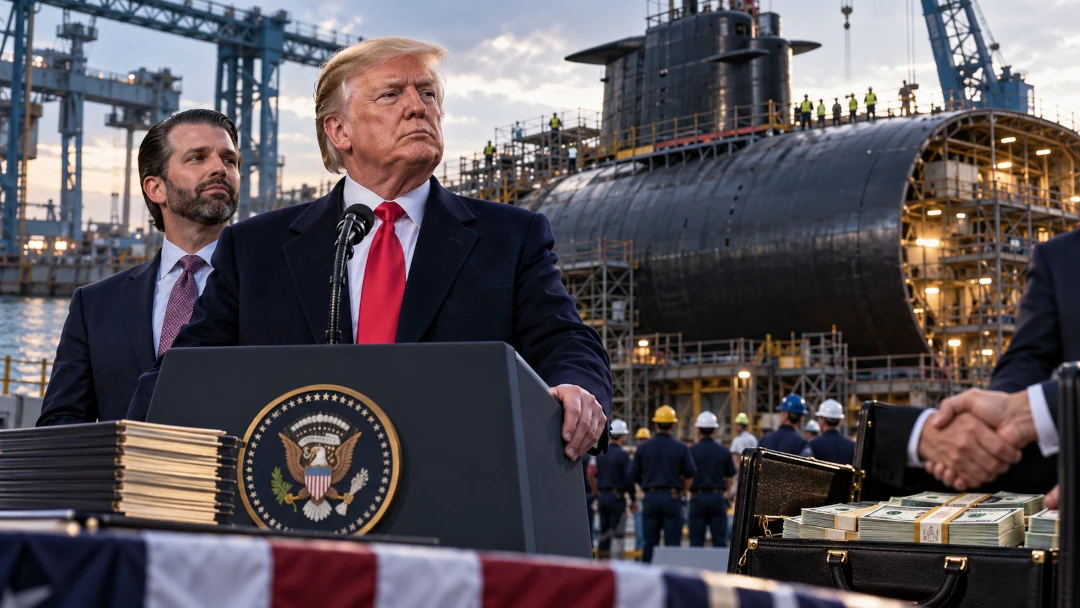
The ceremony had everything a presidential announcement is supposed to have: a storied industrial site, a defense secretary, a crowd of workers and a promise of thousands of jobs. At the former Bethlehem Steel grounds outside Baltimore, President Trump unveiled Arsenal-2, a shipyard to be built by Anduril Industries with $3.7 billion of the company’s own money and a Navy contract worth up to $2.9 billion. What the ceremony did not include was any acknowledgment that, as IBTimes and others reported, one of Anduril’s investors is 1789 Capital, the venture fund where Donald Trump Jr. is a partner.
That omission is the story. Americans can debate whether the Navy needs more submarine capacity (it does) and whether a newer defense firm should help build it (perhaps). What they should not have to debate is whether the president’s family stands to gain when the president signs the check. Under any previous administration, that question would have ended careers. Under this one, it has become routine.
I. What Was Actually Promised at Sparrows Point
The headline number is $6.6 billion, but the public commitment is the Navy’s share. According to WMAR, the yard will build components and large assemblies for Virginia-class nuclear attack submarines, with Navy payments tied to production. The Maryland Daily Record adds that the state and Baltimore County plan to match up to 13 percent of Anduril’s investment through incentive programs, which works out to roughly $480 million more in public support. Trump told the crowd that taxpayers would receive a 40 percent stake in the shipyard, a claim Spectrum News reported but whose terms have not been published.
The timing invites scrutiny on its own. The award landed in the same week that Defense Secretary Pete Hegseth named Anduril founder Palmer Luckey to co-lead a new Pentagon study on the future of warfare, Political.org reported. Maryland Governor Wes Moore, who says his administration spent a year courting the project, was barred from speaking at the event. And the public still has not seen how Anduril was chosen, whether other firms were invited to compete, or what the Navy’s written justification says.
Navy commitment
Up to $2.9B
Contract ceiling for Virginia-class components, paid against production. Operations are not expected before 2030, per WMAR.
State & county match
Up to 13%
Maryland and Baltimore County incentives on Anduril’s $3.7 billion stake, according to the Daily Record.
The family link
1789 Capital
The Don Jr. partnership that backs Anduril grew from about $150 million under management to roughly $3 billion, according to House Judiciary Democrats and Axios.
II. Not an Accident but a Pattern
If Arsenal-2 stood alone, it might be explained away as coincidence. It does not stand alone. A July analysis by The Washington Post, republished by the Anchorage Daily News, found that 15 defense, robotics and AI companies backed by Donald Trump Jr. and Eric Trump had collected at least $3.2 billion in direct government business since the brothers invested, plus another $3.1 billion in contract options. Neither son had meaningful defense-industry experience before they began investing in companies that sell to the Pentagon.
The individual cases are worse than the totals. ProPublica, in reporting discussed on NPR, found that White House adviser Peter Navarro, a friend of Don Jr., asked the Pentagon to approve a record $620 million loan to Vulcan Elements, a rare-earth magnet startup that 1789 Capital had invested in just three months earlier. Pentagon staff reportedly rushed the loan through in weeks. Don Jr. also holds shares in and advises drone maker Unusual Machines, which Quartz, citing The Wall Street Journal, reported was among companies in talks for Pentagon equity stakes.
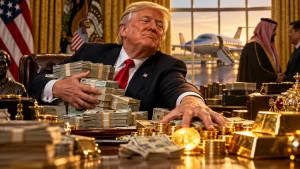
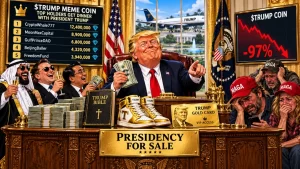
Then there is the money that flows straight to the president. According to the financial disclosure released by the Office of Government Ethics and reported by AFP, Trump recorded roughly $1.2 billion in crypto income in 2025, including nearly $550 million tied to World Liberty Financial, the venture his sons co-founded. Forbes estimates his fortune nearly tripled in two years, from $2.3 billion to $6.5 billion, while his administration deregulated the very industry paying him. And in 2025 the administration accepted a luxury Boeing 747-8 from Qatar’s royal family, valued around $400 million, to serve as Air Force One and later pass to the Trump presidential library foundation, as FactCheck.org documented. The Trump Organization had announced a Qatari golf resort deal the month before, Jewish Insider noted.
“Nothing says ‘America First’ like Air Force One, brought to you by Qatar.”
— Senate Democratic Leader Chuck Schumer, via GlobalSecurity.org
- November 2024Donald Trump Jr. joins 1789 Capital as a partner days after his father wins the election, instead of taking a government post.
- May 2025Qatar offers a $400 million jet; Attorney General Pam Bondi’s office concludes it does not violate the Emoluments Clause.
- November 2025Pentagon announces a $620 million loan to Vulcan Elements, three months after 1789 Capital buys in.
- May 8, 2026Rep. Robert Garcia asks the Pentagon Inspector General to investigate whether companies are using the Trump family as a conduit to contracts.
- June 30, 2026Federal disclosure shows about $1.2 billion in presidential crypto income for 2025.
- July 13, 2026Washington Post analysis tallies $3.2 billion in awards to firms backed by the Trump sons.
- August 5, 2026Warren, Garcia, Blumenthal and Duckworth formally ask the Pentagon IG to review those awards.
- August 27, 2026Rep. Jamie Raskin opens a Judiciary Committee inquiry into 1789 Capital.
- October 6, 2026Trump announces Arsenal-2 and up to $2.9 billion in Navy money for 1789-backed Anduril.
Get Involved Today
Contribute to our mission and turn your concerns into action.
III. Why This Is Without Modern Precedent
Presidential families have always had business lives. The Post’s reporting recalls that the Bush sons worked in oil while their father was in office. What is new is the structure: a sitting president’s children raising money from investors who know exactly whose name is on the letterhead, then placing that money into companies whose fortunes rise and fall with decisions their father’s administration makes. One ethics specialist told Business Insider that 1789 represents a new level, calling it “a flashing red light of a conflict.”
Don Jr. once made Hunter Biden’s business dealings a centerpiece of the 2020 campaign, arguing that trading on a father’s name was disqualifying. The comparison now cuts the other way, and at a vastly larger scale. Hunter Biden held no stake in companies receiving billions in Pentagon awards from his father’s government. Compounding all of it, the president’s own assets sit in a trust managed by the same son, so the supposed wall between the family’s money and the president’s money is managed by the family.
The administration’s answer
Fairness requires stating the defense. White House spokeswoman Anna Kelly has said repeatedly that neither the president nor his family has any conflicts of interest. 1789 Capital’s lawyers told Raskin that its investment thesis predated the 2024 election and that, in their words, “political association is not a substitute for evidence.” The Post found that ten of the fifteen companies it tracked had government business before the sons invested, and eight held contracts under President Biden. Anduril itself won major Pentagon work long before 1789 came aboard.
The Navy’s need is real, too: U.S. yards deliver only about 1.1 to 1.2 Virginia-class boats a year against a goal of two, and the Arsenal-2 contract pays only when parts are delivered. None of that answers the core problem. Even a deal that would have happened anyway cannot be trusted when the people approving it share a household with people who profit from it. That is why conflict-of-interest law exists, and why no investigator has yet been allowed to see the records.
IV. The Price of Skipping the Bidding War
Competition is the taxpayer’s only reliable price check. When several qualified firms bid against each other, the government learns what a thing should cost. When a contract goes to a favored firm without that test, decades of audits show the same result: higher prices, thinner documentation and cost growth. The Government Accountability Office’s review of federal contracting, GAO-10-833, found noncompetitive awards with ambiguous justifications, little evidence that proposed prices were reasonable, and contracts whose costs grew significantly after award. The Pentagon’s own Inspector General documented a Defense Logistics Agency office paying more for parts under a single-source arrangement when competition would have saved money.
The secrecy compounds the cost. The Center for Public Integrity, reporting on a later GAO audit, noted that the Pentagon failed to publish required sole-source justifications in about a third of cases. We do not yet know whether Arsenal-2 was competed. That is precisely the problem. A contract of this size, steered toward a family-linked firm, should come with its full justification on the public record the day it is announced. When it does not, Americans are entitled to assume the worst until they are shown otherwise, and to remember that favoritism costs twice: once in inflated prices and again in the better product a hungrier competitor might have delivered.
“The potential for corruption is obvious.”
— Sen. Elizabeth Warren, Rep. Robert Garcia, Sen. Richard Blumenthal & Sen. Tammy Duckworth, letter to the Pentagon IG, via House Oversight Democrats
What the Constitution Says, and Who Must Enforce It
The Framers feared exactly this: an executive whose loyalties could be bought, by foreign powers or by private gain. They wrote safeguards into the text, and they assigned Congress, not the courts, as the primary enforcer.
- Foreign Emoluments Clause · Art. I, §9, cl. 8
- No federal officeholder may accept any present from a foreign state without Congress’s consent. The Qatari jet, routed through the Air Force to a presidential library foundation, was blessed by the Justice Department, not by Congress. Congress has never voted to consent.
- Domestic Emoluments Clause · Art. II, §1, cl. 7
- The president receives a fixed salary and no other compensation from the United States. Federal dollars reaching family-backed firms do not fall neatly within its text, which is why the protections that matter most here are statutory and political, not judicial.
- Power of the Purse & Oversight · Art. I
- Every dollar for Arsenal-2 is appropriated by Congress. The Supreme Court recognized in McGrain v. Daugherty (1927), a case born of the Teapot Dome scandal, that Congress’s power to investigate is inherent in its power to legislate. Oversight here is an obligation, not a courtesy.
- Impeachment · Art. II, §4
- “High crimes and misdemeanors” was understood by the Framers to reach abuse of public trust for private advantage. It is the Constitution’s ultimate remedy for corruption, and it requires a House willing to investigate first.
V. What Congress Is Doing, and What It Is Not
Democrats, in the minority in both chambers, have used the tools available to the minority. In January, Senators Elizabeth Warren, Andy Kim and Richard Blumenthal pressed Secretary Hegseth on loans and contracts to Trump Jr.-linked firms. In May, House Oversight ranking member Robert Garcia asked the Pentagon Inspector General to examine whether companies are recruiting Trump family members as a path to contracts. In August, Warren, Garcia, Blumenthal and Duckworth asked the IG to identify every award involving Trump-tied firms and to test whether ethics rules were followed.
Rep. Jamie Raskin, the top Democrat on House Judiciary, opened an inquiry into 1789 Capital on August 27, demanding its portfolio list, its communications with federal officials and the preservation of encrypted messages. Raskin wrote that the firm’s bets had been timed with “almost clairvoyant accuracy.” The firm refused to cooperate, and Republicans who control the committees have so far resisted Democratic efforts to subpoena Don Jr.
That is the honest state of play: letters, requests and a minority inquiry with no subpoena power, set against a majority that has chosen not to look. Republican chairs who spent years investigating the Biden family’s business dealings have shown no comparable interest in contracts worth many times more.
VI. The Tools Congress Already Has
Congress does not need new powers to act. It needs the will to use the ones it has. Committees can issue subpoenas for the Navy’s source-selection records and the written justification for Arsenal-2. Members can direct the GAO, Congress’s own auditor, to review every award to Trump-family-linked firms since January 2025. Appropriators can attach conditions to defense spending, requiring that no contract above a set value go to a company in which a relative of the president or a senior official holds a financial interest without full competition and public disclosure. And Congress can legislate: extending conflict-of-interest rules, which currently exempt the president, to the president and immediate family, and requiring that any foreign gift receive an actual congressional vote.
Every one of those tools turns on who holds the gavel. That is why the November 3 midterm elections, less than four weeks away, matter so much to this story. A Democratic House would inherit Raskin’s and Garcia’s unfinished inquiries along with the subpoena power to complete them.
VII.What You Can Do
Citizens cannot cancel a Navy contract, but they can make the people who can do so feel the pressure. Here is a plain-language assessment of the options, from most to least direct.
-
Demand the Arsenal-2 justification
Call your House member and both senators. Ask one specific question: will they publicly request the Navy’s source-selection decision and any sole-source justification for the Anduril contract? Specific asks get tracked; vague outrage does not.
Effort: low · Impact: moderate -
Back the Inspector General review
Ask your representatives whether they have signed or will endorse the August request to the Pentagon IG. Inspectors general respond to visible congressional interest, and broad bipartisan signatures protect the review from being quietly shelved.
Effort: low · Impact: moderate -
Vote on November 3, and vote the oversight question
Subpoena power belongs to the majority. Ask every House and Senate candidate whether they will support investigating family-linked federal contracts and extending conflict-of-interest law to the president. Make the answer part of your vote.
Effort: moderate · Impact: highest -
Press for structural reform
Support legislation that bars no-bid awards to firms tied to the president’s family, requires an actual vote of Congress on foreign gifts, and publishes sole-source justifications on time. Reform outlasts any single administration and protects against the next one.
Effort: moderate · Impact: long-term -
Support the reporters doing the digging
Nearly everything in this article exists because of ProPublica, The Washington Post and local newsrooms that read contract databases and filings. Subscribe, share their work and attend town halls with their findings in hand.
Effort: low · Impact: sustained
VIII. The Swamp He Promised to Drain
“Drain the swamp” was a promise that Washington would stop serving the connected at the expense of everyone else. Measured against that promise, the record is stark. The president did not divest. He handed his assets to a trust run by his son. His sons did not step back from business. They moved into the one industry most dependent on federal dollars. His administration did not tighten ethics rules. It accepted a palace in the sky from a foreign monarchy and approved hundreds of millions in crypto-friendly policy while the president banked the proceeds.
Leadership is a statement of priorities, and priorities are revealed by what a leader protects. The Navy needs submarines. Workers in Baltimore deserve good jobs. Both goals could have been met with an open competition and a published justification. Choosing instead to hand the contract over without that transparency, to a company carrying the president’s son’s fund on its cap table, tells the country whose interests come first.
Editorial Conclusion
A republic cannot survive a government that functions as a family enterprise. When public contracts, public loans and foreign gifts flow toward the president’s household, the question is no longer whether a single deal was clean. It is whether citizens can trust that any decision was made for them.
Congress holds the purse, the subpoena and the duty to use both. It must demand every record behind Arsenal-2, empower the inspectors general, and write into law that no president’s family may profit from the president’s power. If this Congress will not do it, the voters must elect one that will. The Constitution entrusted this check to the people’s representatives, and on November 3 it returns to the people themselves.
Sources & References
- Spectrum News · Trump announces launch of new military shipyard in Baltimore
- WMAR-2 News · Trump visits Baltimore County to announce new $3.7B shipyard plans
- Maryland Daily Record · Trump announces new Sparrows Point facility to manufacture submarines
- IBTimes UK · Trump awards $2.9B Navy contract to Anduril, a firm backed by Don Jr.-linked fund
- Political.org · Anduril wins Navy contract days after Luckey joins Pentagon panel
- Anchorage Daily News / Washington Post · Trump’s sons invest heavily in defense tech as father’s administration pours money in
- NPR · White House asked Pentagon to loan money to a company linked to Trump’s oldest son
- Quartz · Pentagon in talks for stakes in drone firms, including one advised by Trump Jr.
- Business Insider · ‘A flashing red light’: how Donald Trump Jr. is cashing in on his dad’s presidency
- Khaleej Times / AFP · Trump earned over $1 billion from crypto ventures in 2025
- FactCheck.org · Unwrapping Qatar’s $400 million winged gift to Trump
- Jewish Insider · Report: Trump gifted luxury jet from Qatari royal family
- GlobalSecurity.org · Trump set to accept luxury ‘flying palace’ as gift from Qatar
- House Oversight Democrats · Garcia demands DoD watchdog investigate Trump family defense contracts (May 8, 2026)
- Office of Sen. Elizabeth Warren · Warren, Garcia, Blumenthal, Duckworth urge DoD watchdog to investigate $3.2 billion in awards
- House Judiciary Democrats · Raskin demands answers from Donald Trump Jr.’s 1789 Capital
- Axios · 1789 Capital fires back at congressional inquiry
- Raw Story · Don Jr. gets warning shot over ‘almost clairvoyant’ investment streak
- U.S. GAO · GAO-10-833: Opportunities exist to increase competition in federal contracting
- DoD Office of Inspector General · Report 07-119: noncompetitive spare parts and the benefits of competition
- Center for Public Integrity · Competition in Pentagon contracting declines
Related News