A third meme-coin “dinner with the president” contest is the latest storefront in a presidency run like a casino. Nearly a million buyers of $TRUMP are underwater, while the president banked $636 million. Behind the merchandise sit far larger flows — foreign stablecoin deals, Venezuelan oil money, a self-settled lawsuit against his own government — that Congress and taxpayers can barely see.
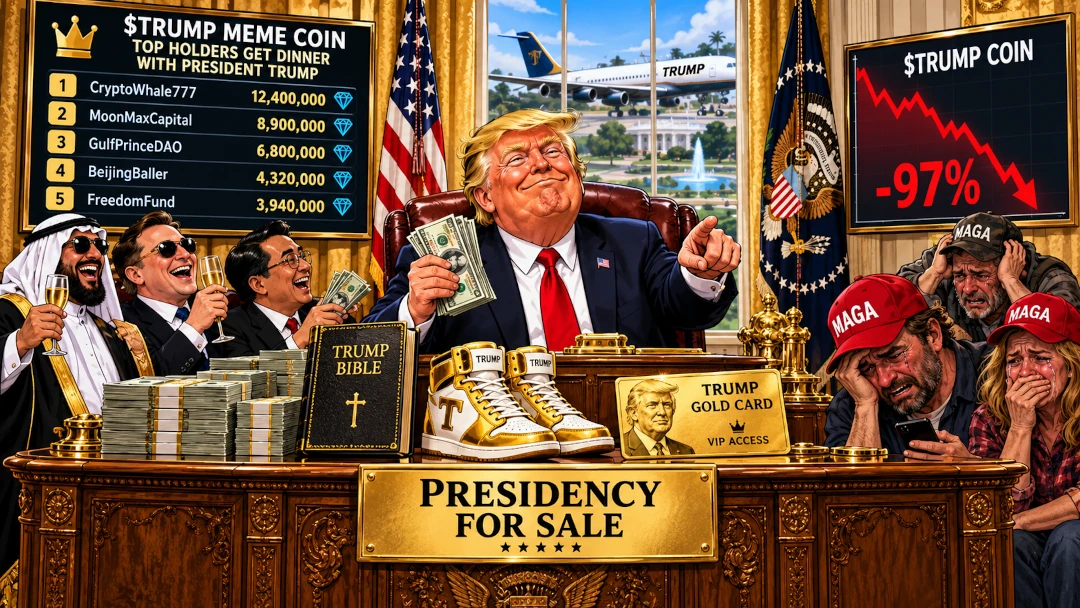
The invitation promises “the most exclusive dinner in the world,” and the price of admission is simple: buy more of the president’s meme coin than almost anyone else. This week the firm behind $TRUMP opened yet another contest in which the coin’s top 185 holders win a November 22 evening with President Trump and three unnamed “legends,” the top 29 earn a VIP reception, and the top four take home an 18-karat Trump-branded gold watch. The leaderboard closes November 12, nine days after the midterm elections.
It is the third such event. As Forbes reported, a May 2025 black-tie dinner at Trump’s Virginia golf club was followed in April 2026 by a Mar-a-Lago gala for 297 top holders, with prizes along the way including Super Bowl and Singapore Grand Prix tickets. Each time, the pitch is the same: proximity to the most powerful man on Earth, for sale to whoever holds the most of a token that makes him rich.
I. The Dinner Bell Rings Again
The White House insists this is not selling access. An administration official told MS NOW it is hard to call the event “buying access” because the organizers have said no attendee gets a private meet-and-greet with the president. That fine print is the entire defense — and it collapses on contact. The contest’s own website ranks entrants on a live scoreboard of time-weighted holdings. The more you buy and the longer you hold, the closer you sit to the president. That is the product.
Ohio Democrat Greg Landsman summarized the offer more bluntly, and ethics experts quoted by Common Dreams called the arrangement corruption embodied. Good-government groups have warned for over a year that nothing stops a foreign government, a sanctioned oligarch or a company with business before federal regulators from quietly accumulating the coin through anonymous wallets and buying a seat at the table.
“The most corrupt president in American history.”
— Rep. Greg Landsman (D-Ohio), on the new $TRUMP dinner contest, via Common Dreams
II. The Meme Coin Math: $3.8 Billion Lost, $636 Million Banked
Launched three days before the 2025 inauguration, $TRUMP peaked at $75.35. This week it trades near two dollars. Blockchain analytics firm Nansen, in an analysis first reported by the New York Times and summarized by TechCrunch, found that 988,905 wallets — roughly two of every three buyers — had lost money through June, for combined losses of $3.81 billion. The winners, Nansen concluded in findings reported by Fortune, were a small group of early buyers who captured enormous gains while the retail majority absorbed the losses.
Retail losses
Lost by 988,905 $TRUMP buyers through June 2026, per Nansen data reported by TechCrunch.
The president’s take
From a license deal letting the coin’s issuer use his name and image, per his 2025 disclosure reported by ABC News.
Collapse from peak
From $75.35 to about $2.04 as the new contest launched, according to crypto.news.
One investor’s story
A 26-year-old buyer described his stake’s collapse to The Washington Sun.
The structure is the scandal. Because Trump earns licensing revenue rather than simply holding the coin, he profits whether the price rises or falls. Senators Elizabeth Warren and Richard Blumenthal made exactly that point in an August 3 letter urging the SEC to examine the coin. And the dinners work as price pumps: when the first contest was announced in April 2025, the token, already down 88% from its peak, surged sharply in a single day. Presidential access is the marketing budget; ordinary buyers are the exit liquidity.
III. A Storefront Presidency: Bibles, Sneakers, Phones and Gold Cards
The meme coin is not an aberration. It is the most lucrative item in a catalog that has followed the same formula since the 2024 campaign: attach the Trump name, collect the fee up front, and leave the risk with the buyer.
The Gold Card deserves special scrutiny because it was sold not as merchandise but as fiscal policy. Trump once claimed such cards could raise trillions. Yet a Department of Homeland Security court filing showed only 338 people had applied and just 165 had paid the $15,000 processing fee, and IMI Daily notes that more than a year after the program was announced, neither the account receiving the money nor the mechanism for spending it has been publicly specified. A program created by executive order, not statute, collecting money for an undefined account: that is the template for everything that follows.
IV. The Stablecoin Pipeline: Abu Dhabi, Binance and a Pardon
If the meme coin is the retail counter, World Liberty Financial is the private banking floor. The Trump family’s crypto company sends a Trump entity 75% of net token-sale proceeds after certain expenses — guaranteeing a profit even as its WLFI token has fallen roughly 82% since September 2025.
The largest money did not come from small investors. According to the Wall Street Journal reporting summarized by the Center for American Progress, Sheikh Tahnoon bin Zayed — the UAE’s national security adviser — secretly bought a 49% stake in World Liberty four days before the 2025 inauguration, with $187 million wired up front to Trump family entities and $31 million to the family of Steve Witkoff, soon to be Trump’s Middle East envoy. A firm Tahnoon chairs, MGX, then used $2 billion of World Liberty’s brand-new USD1 stablecoin to invest in Binance — the exchange that pleaded guilty to U.S. money-laundering violations. The watchdog Democracy Defenders Fund estimates the arrangement could yield the family roughly $80 million a year in interest income, and notes that Trump pardoned Binance founder Changpeng Zhao in October 2025.
This is what “donations” to a president look like in the crypto era: not checks, but purchases of a family-controlled token or stablecoin that generate fees and interest for the president’s household. Tron founder Justin Sun bought at least $75 million in WLFI tokens and became an adviser; the SEC’s fraud case against him was paused and later settled for a $10 million fine, as Unchained reported — before Sun himself sued World Liberty this spring, alleging it froze his holdings. Senators Warren and Jeff Merkley have demanded World Liberty’s records on the MGX deal. None of this money passes through a campaign finance report. Much of it moves through anonymous wallets.
V. Off the Books: Venezuela’s Oil Money
The meme coin costs its buyers. The next set of schemes costs the public. After U.S. forces seized Nicolás Maduro in January, Trump declared that Venezuela’s oil would be under his personal control.
Venezuela’s oil “will be controlled by me.”
— President Donald Trump, January 2026, as quoted in The Hill
What followed has been a shell game. Secretary of State Marco Rubio told senators about $500 million had gone into a Qatari bank account owned by Venezuela but controlled by the United States; Energy Secretary Chris Wright later said the Qatar account was closed; by June, Rubio described a Treasury-blocked Citibank account with KPMG hired to audit spending. A Financial Times analysis cited by The New Republic put collections at about $13 billion, with no evidence the money was reaching ordinary Venezuelans. Rep. Joaquin Castro (D-Texas) said Congress had been “kept in the dark.”
The contracts raise their own alarms. Rep. Lloyd Doggett (D-Texas) highlighted Financial Times reporting that $250 million in oil proceeds went to trader Vitol, whose senior trader had given $6 million to Trump’s 2024 campaign. Castro has asked the Government Accountability Office for an audit in a formal letter flagging the lack of any defined oversight mechanism, and he and Rep. Sean Casten have introduced a Venezuela Oil Proceeds Transparency Act to force one. A recent executive order would hand Rubio authority over “custodial” accounts holding not just oil revenue but other Venezuelan assets. Billions in public money, managed by executive decree, without appropriation and without a public ledger: the Constitution gives Congress the power of the purse precisely to prevent this.
Get Involved Today
Contribute to our mission and turn your concerns into action.
VI. The Taxpayer Tab: Suing Himself, a Flying Palace and a Ballroom
The self-settled lawsuit. In January, Trump, his two eldest sons and the Trump Organization sued the IRS — an agency the president runs — for $10 billion over the leak of his tax returns, on top of roughly $230 million in damage claims against his own Justice Department. In May, a DOJ led by Trump’s former personal defense lawyer settled. As CBS News and ABC News reported, Trump dropped the claims in exchange for a $1.776 billion “Anti-Weaponization Fund,” run by commissioners the attorney general appoints, to compensate people who say they were targeted under the Biden administration — potentially including January 6 defendants. Trump himself is ineligible, but the arrangement converts a personal grievance into nearly $1.8 billion in public money steered to his political allies, and because the settlement was never docketed, no judge reviewed it.
The flying palace. The Qatari 747 was accepted as a “gift” to the Air Force, but the Air Force’s acting acquisition chief has affirmed a roughly $400 million retrofit bill, and experts told NBC News the full cost could exceed $1 billion. The plan has been for the plane to go to Trump’s presidential library foundation when he leaves office. Taxpayers upgrade it; the Trump legacy keeps it.
The ballroom. The $400 million White House ballroom, built after the demolition of the historic East Wing, is funded by private donors whose individual gift amounts remain undisclosed. A Public Citizen report found 14 of 27 known corporate donors received more than $50 billion in new or increased federal contracts in the six months after giving. Rep. Jim Himes, the top Democrat on the House Intelligence Committee, has warned intelligence contractors that their donations may face scrutiny over possible links to contracts or access.
VII. Following the Money: What Trump Has Disclosed
Federal disclosure forms report income in broad ranges, often list revenue rather than profit, and say nothing about money held by family members or anonymous token buyers. Even so, the two forms filed since Trump returned to office describe a fortune transformed by the presidency. His 2025 report ran 927 pages; Barack Obama’s final form was eight.
| Source | Amount |
|---|---|
| Calendar 2024 (filed June 2025) — total reported income: more than $600 million | |
| Golf resorts in Florida and Mar-a-Lago (Doral alone: $110.4M) | $217.7M+ |
| World Liberty Financial token sales | $57.4M |
| Foreign licensing and development fees (Dubai, India, Vietnam) | ~$31M |
| “Save America” book | $3.0M |
| Trump Watches | $2.8M |
| Trump Sneakers & Fragrances | $2.5M |
| Greenwood “God Bless the USA” Bible | $1.3M |
| Digital trading card (NFT) licensing | $1.16M |
| “45” Guitar | $1.06M |
| Calendar 2025 (filed June 30, 2026) — crypto income alone: more than $1.4 billion | |
| $TRUMP meme coin license (via CIC Digital LLC) | $635M+ |
| World Liberty Financial token sales | ~$515–526M |
| Stablecoin Holdco LLC (World Liberty parent) investments | $196.9M |
| Sale of World Liberty holding-company equity | $65M+ |
| Foreign licensing (largest share from the UAE) | ~$61M |
| Trump Watches | $4.7M |
| Greenwood Bible | $208K |
| Gifts received | $370K+ |
Figures compiled from disclosure coverage by Reuters, NBC News, ABC News, CNBC and Rolling Stone. Outlets differ slightly in how they total World Liberty income; ranges reflect that. Amounts are largely gross revenue, not profit.
Outside the forms, the numbers grow. Reuters has estimated the Trump family has made at least $2.3 billion from crypto ventures since Trump returned to the White House, and that World Liberty had directed more than $1.6 billion to the family by April. CNBC tallied the president’s 2025 income at at least $2 billion. In one year as president, crypto — an industry his administration regulates and which he has championed through legislation — became the largest source of his personal earnings.
VIII. The Family Business: Heads They Win
The president says his businesses sit in a trust managed by his children. But as CNN and Reuters noted, the income still ultimately accrues to him — and the sons’ own ventures follow the same pattern of insiders profiting while public investors absorb losses.
Eric Trump’s American Bitcoin, co-founded with Donald Trump Jr., debuted on Nasdaq in September 2025 and briefly made Eric a billionaire on paper despite reporting just two full-time employees. Forbes later documented how the company sold richly priced stock to the public to buy bitcoin; the shares have since fallen about 77%, and the company posted a $118 million first-quarter operating loss even as Eric urged investors to “just hold on.” Mother Jones reports Trump Media, the president’s Truth Social parent, has lost $1.1 billion since its founding, largely on bitcoin bets. Donald Trump Jr., meanwhile, is a partner at 1789 Capital, a venture firm whose portfolio companies have benefited from administration decisions, and sits on the advisory board of prediction market Polymarket after his firm invested in it.
The pattern holds across every venture we examined: the Trumps collect licensing fees, token-sale cuts, founder equity and interest income up front; the buyers, shareholders and taxpayers carry the downside.
IX. What This Says About Leadership
A president’s time and attention are finite public resources. This one has spent his second term building revenue streams that depend on his office: tokens marketed on the promise of access, a stablecoin funded by a foreign government with business before his administration, a lawsuit in which he sat on both sides, a foreign jet bound for his library and a ballroom funded by contractors seeking federal business. Meanwhile, the questions Congress is asking — where Venezuela’s billions are, who funded the ballroom and for how much, where Gold Card money goes — go unanswered.
The founders anticipated this danger. The Constitution’s foreign emoluments clause forbids federal officeholders from accepting gifts or payments from foreign states without congressional consent, and the domestic emoluments clause bars the president from receiving any compensation beyond his salary from the federal government or any state. When a foreign royal’s firm buys into the president’s family company and a foreign government gives him a plane, the clauses are not abstractions. They are the central question.
Can a President Be Unfit for Office Because He Cannot Stop Selling It?
Section 4 of the 25th Amendment lets the vice president and a majority of the Cabinet — or another body Congress creates — declare that a president is “unable to discharge the powers and duties of his office.” It is not a corruption statute; constitutional scholars quoted by PBS stress it addresses incapacity, not misconduct, and that impeachment is the designed remedy for abuse of office. But the line between the two blurs when a pattern of conduct reveals an inability to perform the job itself. We see four such indicators:
- An inability to separate public office from private enterprise. Selling proximity to the presidency, settling his own lawsuit against his own government, and taking foreign gifts bound for his library show a president who no longer distinguishes the office from his brand.
- Abandonment of fiduciary duty to the public purse. Billions in Venezuelan proceeds held under executive control without appropriation or a public ledger, and Gold Card money flowing to an unspecified account, reflect a failure to faithfully execute the laws Congress passed.
- Decision-making compromised by personal financial stakes. When the president’s family profits from a stablecoin used by a foreign state, and he pardons the founder of the exchange that received the deal, Americans cannot know whether national policy serves the country or the family.
- A broader pattern of erratic judgment. These financial entanglements come amid conduct that led more than 85 Democrats this spring to call for impeachment or removal, and prompted House Judiciary ranking member Jamie Raskin to introduce a bill creating a 17-member commission under Section 4 — a role the amendment expressly allows Congress to establish.
Rep. Raja Krishnamoorthi (D-Ill.) has urged Vice President Vance and the Cabinet to act, citing a dangerous pattern rather than any single incident. That is the right frame. Raskin’s commission would give Congress a standing, nonpartisan mechanism to examine whether a president’s conduct — financial and otherwise — has crossed from bad judgment into incapacity. Passing it would not remove anyone. It would restore a missing check.
X. What You Can Do
An honest assessment: With Republicans controlling both chambers and a loyal Cabinet, neither removal nor impeachment is imminent. But oversight works on pressure and time. Every letter, audit request and disclosure fight builds the record the next Congress will need — and the November 3 midterms will decide who holds the subpoena power.
- Demand an audit of Venezuelan oil money. Call your representative and senators (Capitol switchboard: 202-224-3121) and ask them to cosponsor the Casten–Castro Venezuela Oil Proceeds Transparency Act and to support the pending GAO audit request.
- Back Raskin’s 25th Amendment commission. Ask your member of Congress whether they support the bill establishing a Section 4 body — and to put that answer on the record.
- Report losses and deceptive sales. If you lost money on $TRUMP, WLFI or a Trump-branded product, file complaints with the SEC, the FTC and your state attorney general. Documented victims make investigations harder to ignore.
- Insist on ballroom and Gold Card transparency. Support watchdogs such as Public Citizen pressing for full donor amounts and for a public accounting of where Gold Card payments go; ask your senators to require it in appropriations.
- Vote — and protect your neighbors’ money. Vote on November 3 for candidates who commit to oversight. And tell friends and family the truth Nansen’s data shows: meme coins tied to politicians are not investments; they are a transfer from late buyers to insiders.
Editorial Conclusion
A million Americans have lost $3.8 billion on a coin whose chief selling point is the presidency itself. Taxpayers are retrofitting a foreign jet for a library, funding a $1.8 billion grievance account and waiting for any accounting of billions in oil money. The Trump family, meanwhile, has made billions.
This is not a side hustle. It is a theory of government in which public power exists to generate private revenue. The Constitution’s answer is oversight, the emoluments clauses and, when a president can no longer tell the office from the business, the tools Congress has been given to say so. Those tools must be used. The office belongs to the people — and it is not for sale.
Sources & References
- CNN — Another Trump meme coin contest promises an “exclusive” dinner with the president
- Forbes — Top Trump meme coin holders will win invite to “most exclusive dinner in the world”
- Common Dreams — “Brazenly corrupt”: Firm behind Trump meme coin plans “most exclusive dinner”
- MS NOW — $TRUMP meme coin assures top buyers “exclusive” dinner with president
- TechCrunch — Trump memecoin investors lost $3.8 billion, analysis finds
- Fortune — Close to a million Trump memecoin investors lost $3.8 billion
- U.S. Senate Banking Committee — Warren–Blumenthal letter to SEC on Trump memecoin
- ABC News — Trump earned over $1.4 billion from crypto ventures in 2025
- CNBC — Trump’s annual financial disclosure shows crypto-related income
- NBC News — Disclosures reveal income from guitars, Bibles and watches
- Center for American Progress — How Trump’s $500 million UAE crypto deal trades national security for family profit
- Democracy Defenders Fund — Trump’s crypto connections
- IMI Daily — $1.3 billion “sold,” one approved: Gold Card’s first four months
- Popular Information — We were promised a gold-plated Trump phone
- The New Republic — What did Trump do with the billions he collected from Venezuelan oil?
- Rep. Joaquin Castro — Letter to GAO requesting audit of Venezuela fund
- CBS News — Trump settles $10 billion lawsuit against IRS, sets up $1.7 billion fund
- Bloomberg — Air Force affirms $400 million cost estimate for jet from Qatar
- Public Citizen — Ballroom donors received $50 billion in government contracts
- Axios — Democrats file 25th Amendment commission bill targeting Trump
Related News