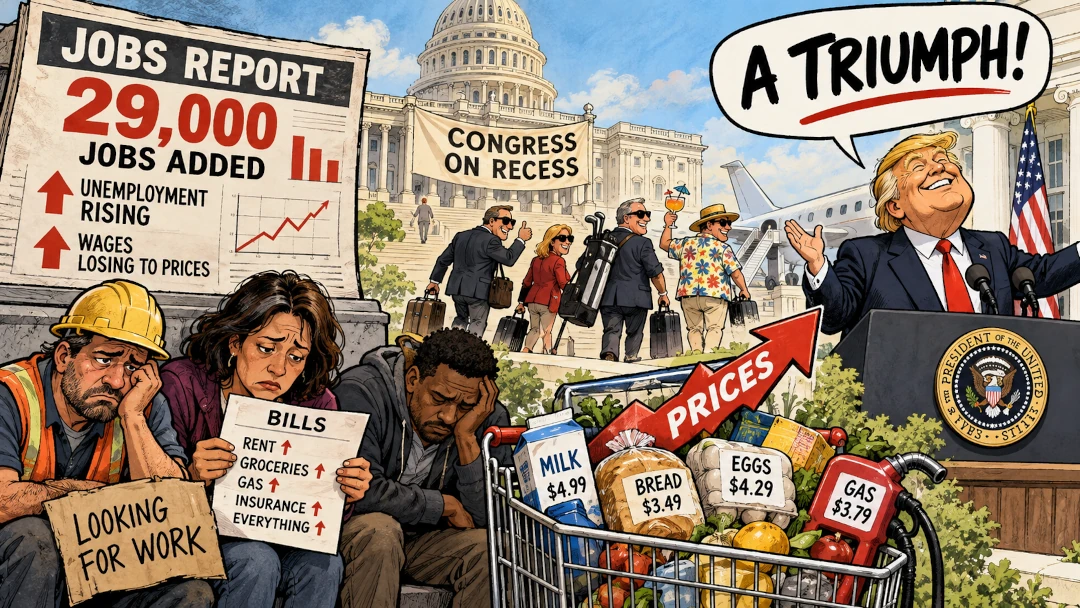
Just 29,000 jobs. Unemployment climbing. Paychecks losing ground to gas, groceries, power bills, and premiums. And the official response from Washington? Congress went home to campaign, and the White House declared victory.
The last word voters will hear from the Bureau of Labor Statistics before they cast midterm ballots arrived Friday morning, and it was grim. Employers added only 29,000 jobs in September while unemployment rose to 4.2%, CNN reported — well short of the roughly 90,000 economists had expected. Bloomberg noted the figure missed every single estimate in its survey of economists. As NBC News framed it, this was the labor market’s final verdict before the midterms — and the verdict was “slowing.”
It gets worse beneath the headline. Revisions erased a combined 60,000 jobs from July and August, and July — originally reported as a modest gain — is now officially a month in which the economy lost 10,000 jobs, according to Forbes. The “summer rebound” the administration touted was, in other words, a statistical mirage. Over the past year, job gains have averaged roughly 45,000 a month. That is not a boom. It is a treadmill.
I. What 29,000 Jobs Actually Signals
Economists describe the current moment as a “low-hire, low-fire” economy: companies are not laying off workers en masse, but they have largely stopped adding them. The sector detail is telling. Health care, long the most reliable engine of hiring, added just 17,000 jobs — roughly half its recent monthly pace — while nursing and residential care facilities shed positions and financial activities kept bleeding jobs, Forbes reported. Government shed 17,000 jobs, temporary help lost 11,000, and the information sector lost 10,000 amid anxieties over artificial intelligence, according to Rolling Out’s breakdown of the data.
The pain is not evenly shared. Black unemployment jumped a full point in a single month, to 7%, per an analysis by the progressive Groundwork Collaborative cited by Rolling Out, and more than 27% of jobless Americans have now been searching for six months or longer. Black workers have long served as the economy’s early-warning system: the last hired in a boom, the first let go in a slowdown.
In fairness, not every number was dire. The separate household survey showed several hundred thousand more people working and a growing labor force, and a broad measure of underemployment actually dipped. But honest analysis requires weighing those bright spots against the core reality: wages are no longer keeping up with prices. Average hourly earnings rose a mere 0.1% in September, bringing annual wage growth down to 3% — its lowest since May 2021 — while inflation runs near 3.4%. Heather Long, chief economist at Navy Federal Credit Union, observed that inflation is erasing what little wage growth workers are getting, just ahead of the holiday season.
Even Wall Street’s reaction was perverse. Stocks rallied on the bad news, because investors bet a weaker labor market would stop the Federal Reserve from raising rates again. eToro analyst Bret Kenwell cautioned that cheering for a deteriorating job market is a losing bet, since a genuine hiring collapse eventually drags down consumer spending — the backbone of the entire economy.
II. Inflation “Cooled” — Because the Ruler Changed
Two days before the jobs report, the Commerce Department released August’s Personal Consumption Expenditures index — the Fed’s preferred inflation gauge. Headline PCE inflation held at 3.4% and core inflation at 3.0%, both below forecasts, according to the Bureau of Economic Analysis. On the surface, a modest relief. Look closer, and the relief evaporates.
The August report was the first published under a revised methodology that changed how the BEA measures prices for computer software, portfolio-management fees, and legal services — and applied those changes retroactively. July’s headline inflation, originally reported at 3.7%, was quietly rewritten down to 3.4%. Bill Adams, chief U.S. economist at Fifth Third Commercial Bank, told Fox Business that inflation now looks closer to the Fed’s target mainly because of how it is measured, not because of where it is actually heading.
The changes did not escape scrutiny. Economists had projected for months that the new methods would knock between one and three tenths of a point off measured inflation, Marketplace reported, though some, like UC San Diego economist Munseob Lee, defended the update as more accurate. Others were blunter. UBS economist Alan Detmeister calculated that the new method would slash the measured annual price increase for software from roughly 21.6% to 9.0%, and UBS warned that only the categories that had been pushing inflation up were selected for revision — and that the new approach lacked transparency, as BigGo Finance summarized.
Whether or not the timing was engineered, the political effect is unmistakable: a lower inflation number arrived one month before the election, without a single price at the pump or the grocery store actually falling. And even the new, friendlier yardstick shows inflation running well above the Fed’s 2% goal. The Fed itself acted accordingly — on September 16 it raised interest rates for the first time since 2023, with Chair Kevin Warsh warning that “too many categories are still posting increases above 3%.” A central bank does not raise rates in the middle of a hiring slump because inflation is under control.
III. The Kitchen-Table Ledger
For the average American, PCE methodology debates are abstractions. What isn’t abstract is the receipt. Here is what households are paying as the economy stalls:
Gasoline
September’s average price per gallon — a new record for the month, a full 50 cents above the prior September high, per AAA. A year earlier, gas cost about $3.19. Analysts blame the Iran war and the near-closure of the Strait of Hormuz.
Health Insurance
The median premium increase ACA insurers have proposed for 2027, following a 20% jump in 2026. Typical premiums could rise by more than a third over two years, according to KFF.
Electricity
Year-over-year rise in the average residential electricity rate, now 18.34¢ per kWh. Rates are up 23% since 2022 — about $440 more per year for the typical household, per ElectricChoice.
Groceries
Annual increase in beef and veal prices, with coffee up 6.1% and farm-level wheat up 35%, according to the USDA’s Economic Research Service. Overall food prices are 2.7% higher than a year ago.
Get Involved Today
Contribute to our mission and turn your concerns into action.
Some of these numbers have eased at the margin — grocery inflation slowed in August — but industry analysts warn that rising fuel and transportation costs are still working their way through the food supply chain. And diesel, the fuel that moves nearly everything Americans buy, neared record highs this fall, CNN reported. Health costs are compounding the squeeze: KFF’s Larry Levitt told NBC News that “Healthcare costs are going up faster than they have in years,” and the administration has ended a temporary program that had helped keep some Medicare drug premiums in check.
Put the pieces together and the picture is a family whose income is rising about 3% while its gas, power, insurance, and food bills climb faster. That is a pay cut, delivered slowly. Sen. Elizabeth Warren made the point directly Friday, noting that job growth under Trump has averaged roughly 33,000 a month since January 2025 and that real wages have fallen since the Iran war began, as Rolling Out reported.
IV. Congress Left the Building
Faced with this, what did the people’s representatives do? They went home. Speaker Mike Johnson canceled the House’s final scheduled votes and sent members away for more than six weeks, declaring, “The House has done its work.” Not everyone in his own party agreed: South Carolina Republican Ralph Norman complained that the House had now canceled at least 63 scheduled voting days this Congress. The Senate followed on September 30, recessing until after the election, per iHeart.
The final days were consumed by messaging votes. Senate Democrats forced a vote to overturn a Trump administration ACA rule that Sen. Tammy Baldwin said would price 2 million Americans out of coverage; it failed 48–50, with only Sen. Susan Collins crossing over, according to The Washington Sun. Democrats, in turn, blocked the GOP’s Ratepayer Protection Act on data-center energy costs, arguing it merely asked state regulators to “consider” protections and had no enforcement teeth, CNN reported. Even Missouri Republican Josh Hawley conceded that “people would love some relief in the price of their gas” — and that his party could have made it a priority.
Democrats deserve credit for repeatedly forcing votes on health costs — including a long shutdown fight last year over the expiring ACA subsidies — and for naming the problem plainly. Senate Minority Leader Chuck Schumer said Friday that families are being squeezed from every direction. But naming the problem is not the same as solving it, and with Schumer telling reporters he would spend the next five weeks focused on fundraising, voters can be forgiven for wondering who in Washington is minding the store. The minority cannot pass legislation. It can, however, make the stakes of this election impossible to ignore — and that work must not stop just because the Capitol is empty.
“…it’s proving that Trumponomics is really working.”
— Kevin Hassett, White House National Economic Council Director, Oct. 2, 2026, via Common Dreams
V. The White House: Denial as Economic Policy
The same morning the jobs report landed, Hassett went on air to boast. That was not an isolated lapse; it was the strategy. The president, now on a 32-day campaign tour, insisted in a TIME interview this week that the economy is the strongest it has ever been, according to Rolling Out. On Friday, speaking from the Oval Office, he lashed out at financial markets, the Federal Reserve, and America’s trading partners — and claimed GDP could grow by 12 to 15 percent if only interest rates were lower, as Time News reported. No serious economist believes the U.S. economy can grow at that pace.
The pattern held at the Fed. Hours after the central bank raised rates to fight inflation, Trump posted that “Interest Rates in the United States should be 1%, or less” — demanding, in effect, that the Fed pour fuel on the very fire it is trying to contain.
What has the administration actually done? It has drawn down the Strategic Petroleum Reserve to its lowest level since the early 1980s, summoned refining executives, and eased fuel regulations — yet Vice President JD Vance declined to say when gas prices would return to pre-war levels, CNN reported. Meanwhile, the single biggest driver of the energy shock — the war itself — grinds on. Late last month Trump rejected an Iranian proposal to reopen the Strait of Hormuz within seven days, sending Brent crude toward $108 a barrel, according to Al Jazeera. Reasonable people can debate the diplomacy. What cannot be debated is that American families are paying for it at the pump, and the president keeps telling them they aren’t.
VI. A Month of Warning Signs
Labor Day weekend brings the highest holiday gas prices on record; within a week the national average jumps 13 cents as crude returns to the $100 range (AAA).
The Fed raises rates for the first time since 2023. Trump responds on Truth Social demanding rates of 1% or less.
Speaker Johnson cancels votes and sends the House home for more than six weeks.
Gas hits $4.48 a gallon — the highest ever recorded for that time of year.
Trump rejects Iran’s Hormuz reopening plan; Brent crude surges toward $108.
Republicans block Democrats’ ACA rule challenge; the Senate leaves town. The BEA publishes the first PCE report under its revised methodology, lowering measured inflation.
The final pre-election jobs report: 29,000 jobs, 4.2% unemployment, July revised to a loss. The White House’s top economic adviser calls it proof the president’s agenda is working.
When a President Cannot See the Economy in Front of Him
1. How the mechanism works
Section 4 of the 25th Amendment allows the Vice President, together with a majority of the Cabinet — or of another body Congress establishes by law — to declare in writing that the president is “unable to discharge the powers and duties of his office.” The Vice President then becomes acting president. If the president contests the declaration, Congress decides, and keeping him sidelined requires a two-thirds vote of both chambers. It has never been invoked.
2. Who has called for it
This is not a fringe idea. In April, after Trump’s threat that a “whole civilization” would die over Iran, more than 85 House and Senate Democrats called for his removal through impeachment or the 25th Amendment, and Rep. Jamie Raskin (D-Md.), ranking member of the House Judiciary Committee, introduced legislation creating a 17-member commission to serve as the “other body” contemplated by Section 4, as Axios reported. Fifty House Democrats co-sponsored the bill, per The Hill, while House Minority Leader Hakeem Jeffries has stopped short of endorsing removal. Even former Trump ally Marjorie Taylor Greene publicly invoked the amendment during the April Iran crisis, Fox News noted.
3. The constitutional argument
The case advocates make is not that the president holds bad economic views — bad policy is the province of elections, not the 25th Amendment. It is that “inability” can include a sustained incapacity to perceive and respond to reality. On the economy, the record is now a pattern: insisting the economy is the strongest ever on the eve of a 29,000-job report; claiming 12–15% growth is within reach; demanding near-zero rates while his own Fed chair warns inflation is too broad; and presiding over a war-driven energy shock while assuring families they are not feeling it. A president who cannot accurately process the conditions facing the country cannot faithfully execute the laws meant to address them.
4. The honest barriers
The obstacles are enormous. Section 4 requires Vice President JD Vance and a Cabinet majority — all Trump appointees — to act against him. Raskin’s commission bill would need to pass a Republican Congress and survive a presidential veto, which Axios rightly called a long shot. And a contested declaration demands a two-thirds supermajority that no party holds. The White House, through spokesperson Davis Ingle, has dismissed the effort as partisan and insisted the president is sharp and energetic, and critics across the spectrum warn that an amendment drafted chiefly with medical incapacity in mind should not become a tool for removal-by-disagreement.
5. Why the barriers don’t erase the case
None of that makes the question illegitimate. The Framers of the 25th Amendment deliberately left “unable” undefined, trusting the officials closest to the president to recognize when the office is no longer being competently discharged. The fact that those officials refuse to look does not mean there is nothing to see. When economic reality is denied, rewritten, and spun while millions of families fall behind, Congress has both the authority and the duty to establish the review body Section 4 contemplates — and voters have the power, five weeks from now, to elect a Congress that will.
“We are at a dangerous precipice.”
— Rep. Jamie Raskin (D-Md.), introducing his 25th Amendment commission bill, via The Hill
VII. What Leadership Would Look Like
Real leadership in this moment is not mysterious. It would begin with telling the truth about the numbers rather than celebrating them. It would mean treating the war’s energy shock as the economic emergency it is, rather than an inconvenience to be waved away. It would mean restoring the health-care subsidies whose expiration has pushed premiums up by double digits two years running, and protecting households from utility bills inflated by corporate data-center demand with standards that actually have enforcement teeth. And it would mean a Congress that stays in Washington when the economy is stalling — not one that cancels dozens of voting days to campaign.
Instead, Americans have a president who blames the Fed, the markets, and foreign governments for conditions his own policies helped create, an economic team that calls a 29,000-job month a triumph, and a statistical update that made inflation look better without making anything cheaper. That is not stewardship. It is spin — and the people paying for it are the ones filling their tanks, opening their insurance renewal notices, and watching their paychecks shrink in real terms.
Editorial Conclusion
The September jobs report is not merely a bad number. It is the final, official confirmation before Election Day that the American economy is stalling while its costs keep climbing — and that the man in charge either cannot see it or will not say it.
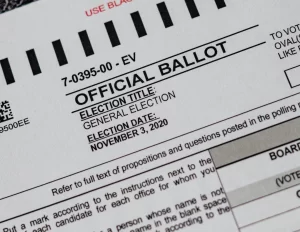
A democracy depends on leaders who govern from reality. When a president denies the data, when an administration celebrates failure, and when Congress abandons the Capitol in the middle of a crisis, the constitutional checks that exist for exactly this moment must be used — in the halls of Congress, through every lawful mechanism the Constitution provides, and at the ballot box on November 3. America has had enough.
Sources & References
- NBC News — Labor market slowed in September, final monthly jobs report before midterms shows
- CNN — The US economy added just 29,000 jobs last month and the unemployment rate ticked up to 4.2%
- Bloomberg — US Firms Add Just 29,000 Jobs, Unemployment Rate Ticks Up
- Forbes — Labor Market Loses Momentum in September — While July Turns Negative
- Rolling Out — September jobs report sends unemployment to 4.2% ahead of midterms
- Common Dreams — US Added Just 29,000 Jobs, Wage Growth Hit New 5-Year Low
- Time News — Trump Faces Economic Fallout as September Jobs Report Misses Expectations
- Bureau of Economic Analysis — Personal Consumption Expenditures Price Index
- Fox Business — Fed’s favored inflation gauge cooled in August but remained elevated
- Marketplace — The Fed’s preferred measure of inflation is changing
- BigGo Finance — US PCE Calculation Faces “Paper Cooling” Overhaul; Wall Street Warns on Credibility
- U.S. Bank — What Federal Reserve monetary policy means for investors
- Al Jazeera — US Fed raises interest rates for first time in three years
- AAA — National Average Dips Following Record-Setting September
- CNN — Labor Day gas has never been this expensive. Trump is scrambling for answers
- Al Jazeera — Oil prices surge after Trump rejects Iran’s plan to reopen Strait of Hormuz
- USDA Economic Research Service — Food Price Outlook: Summary Findings
- ElectricChoice — Electricity Rates by State (October 2026)
- KFF — How Much and Why ACA Marketplace Premiums Are Going Up in 2027
- NBC News — Your health insurance bills are about to go up
- CBS News — House cancels votes, cutting week short before adjourning until after midterms
- iHeart — Congress Leaves Washington For Midterms Break
- The Washington Sun — Senate Democrats Force an Uncomfortable Vote on Health Care Costs
- CNN — Republicans’ last-ditch effort to lower costs ahead of midterms fails in key Senate vote
- Axios — Dems file long-shot 25th Amendment bill targeting Trump
- Fox News — Dems want to boot Trump with 25th Amendment, but refused to do so under Biden
- The Hill — Raskin introduces long-shot bill to assess president’s fitness under 25th Amendment
Related News