Machines Without Masters: How Trump’s Washington and Putin’s Moscow Gutted the Killer-Robot Treaty
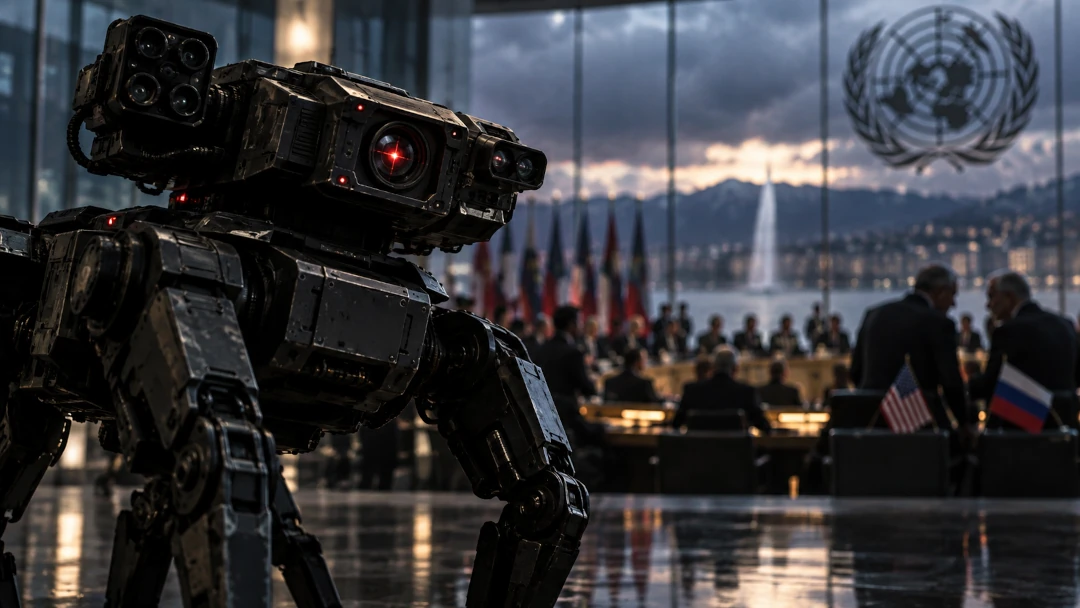
In fifteen closed-door hours in Geneva, American diplomats worked alongside Russia’s to delete the words that would have kept a human being between an algorithm and a kill decision. Most of the world wanted guardrails. The two largest nuclear powers wanted a free hand, and they got it.
For more than a decade, diplomats have tried to answer a question that once belonged to science fiction: should a machine ever be allowed to decide, on its own, that a human being should die? This month in Geneva, the world came closer than ever to a shared answer. According to reporting by The Washington Post, the United Nations talks produced the most advanced effort yet to govern lethal autonomous weapons. Then, in the final hours, the United States and Russia took it apart.
The Post, citing three people familiar with the closed-door negotiations and documents it reviewed, reported that American and Russian diplomats spent roughly fifteen hours on the last day hammering at the draft. When they were done, the text no longer required AI weapons to behave predictably or reliably, no longer required ethical considerations to be weighed, and no longer required a human to review targets an AI system had generated before a strike. The State Department, the Russian Foreign Ministry and the UN did not respond to the Post’s requests for comment.
There is no public evidence that Donald Trump and Vladimir Putin personally coordinated this outcome. There doesn’t need to be. Their governments sat in the same room, pursued the same objective, and produced the same result: a world with fewer rules on machines that kill. When the foreign policy of the United States becomes indistinguishable from the Kremlin’s on a question this fundamental, Americans are entitled to ask who, exactly, is being served.
I. Fifteen Hours in Geneva
The negotiations took place under the Convention on Certain Conventional Weapons, the UN framework that has previously restricted blinding lasers and incendiary weapons. A Group of Governmental Experts met in two sessions this year, in March and from August 31 to September 4, as IBTimes UK detailed, with a mandate to agree by consensus on the elements of a future instrument. That consensus rule is the lever. It lets a single state hold the room hostage, and two powerful states working together can rewrite it.
According to the Post, the rewriting happened after UN cameras were switched off and civil society observers were asked to leave. The American and Russian delegations each brought roughly ten lawyers, nearly double what many other countries fielded, and pushed edits through so quickly that smaller delegations struggled to keep pace. One participant described the process to the paper as “death by a thousand paper cuts.”
Deleted: Human Review
A provision requiring humans to review military targets developed by AI before a strike was removed, per The Washington Post.
Deleted: Predictability
Language requiring systems to operate predictably and reliably was struck, along with references to explainability and traceability, according to Human Rights Watch.
Deleted: Ethics
The clause mandating that ethical considerations be taken into account was cut, as were references to design and development, HRW reported.
Narrowed: Scope
The text was narrowed from all of international law to international humanitarian law alone, quietly dropping human rights law from the frame, per HRW.
Verity Coyle, who leads arms work in Human Rights Watch’s crisis and conflict division, told the Post what this means in plain terms. Weaker rules, she said, open the door to machines making life-and-death choices with no human in control, and to “more civilian harm, less accountability and a faster slide into riskier, automated warfare.” Coyle also named a familiar pattern: when Washington wants to protect a military or technological edge, it steers toward voluntary guidelines rather than binding law, as it has on cyber and space.
“It could mean machines can make life‑and‑death decisions without human control.”
— Verity Coyle, Human Rights Watch, to The Washington Post
II. The World Was Ready. Two Nations Were Not.
It is worth understanding how isolated Washington and Moscow actually are. When the UN General Assembly adopted its resolution on lethal autonomous weapons in December 2024, it passed 166 to 3, with Russia voting no alongside only Belarus and North Korea. That is the company the United States is now keeping on this issue.
Momentum for a treaty has only grown. By the close of the Geneva session, 76 states had said they support moving to negotiations on legally binding rules. Seventy of them are voting members of the Convention, a majority of its parties and the strongest political momentum the process has ever seen. In testimony to Congress, Human Rights Watch’s Deborah Brown noted that some 130 states have called for a legally binding instrument on autonomous weapons.
Just days before the final session, UN Secretary-General António Guterres and International Committee of the Red Cross President Mirjana Spoljaric issued a renewed joint appeal urging states to adopt binding prohibitions and restrictions. Their proposal would ban autonomous weapons whose effects cannot be predicted and those designed to target people, while restricting the rest. As UN News reported, the head of disarmament affairs at UN Geneva, Mélanie Régimbal, restated the Secretary-General’s long-held position that systems taking human lives without human control and judgment are “politically unacceptable, morally repugnant and should be prohibited under international law.”
“We are now dangerously close to crossing a moral red line: the autonomous targeting of humans by machines.”
— UN Secretary-General António Guterres & ICRC President Mirjana Spoljaric, joint appeal, August 25, 2026
Nicole van Rooijen, executive director of the Stop Killer Robots coalition, told the Post that neither Washington nor Moscow favors binding rules, and that under a consensus system both “have the power to block any significant progress that is made by the vast majority of states who do want to move forward on a binding treaty.” The ICRC’s disarmament adviser Richard Lennane made the counter-case: treaties on chemical weapons, landmines and cluster munitions changed behavior not by punishing, but by setting norms. That is precisely what is now at risk.
Human Rights Watch’s assessment is sober rather than despairing. The adopted text, though watered down, still affirms that human control and judgment are required for compliance with international law, and HRW judges it sufficient to launch negotiations. The decisive moment is the Convention’s Seventh Review Conference, November 16–20 in Geneva. If the U.S. and Russia block a negotiating mandate there, the world’s primary forum on this question may simply run out of road.
III. When the Machine Gets It Wrong
Opponents of regulation like to frame these concerns as hypothetical. They are not. The machines are already here, and so are the mistakes.
On February 28, the opening day of the Iran war, two Tomahawk missiles struck an elementary school in Minab, in southern Iran. According to IBTimes UK’s account of Bloomberg’s reporting on an unreleased Pentagon review, at least 123 children were among the more than 150 dead. The review reportedly found that personnel relied heavily on the AI inside Palantir’s Maven Smart System, expecting it to catch outdated or inconsistent intelligence. It didn’t. More than 1,000 targets were struck in the first 24 hours, a tempo that compressed the time for human confirmation. Staffing on civilian-harm mitigation teams had reportedly fallen by about 90 percent before the war began.
Palantir has said its software was not responsible for the underlying data, and some former officials argue human failures bore primary blame. That debate misses the point. The lesson of Minab is exactly the safeguard Washington just deleted in Geneva: when an algorithm accelerates targeting beyond the speed of human scrutiny, humans stop scrutinizing. A requirement for meaningful human review before a strike is not bureaucratic friction. It is the difference between a school and a target.
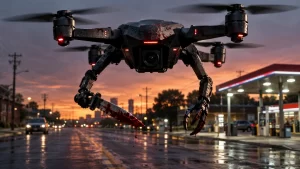
The next threshold has already been crossed. In August, Semafor relayed New York Times reporting that a Russian drone running an autonomous AI system killed three Ukrainians, deaths experts believe are the first Russian-inflicted killings with no human in the loop. The drone reportedly ran on an Nvidia minicomputer not sold in Russia but obtained through resale markets, a vivid demonstration that this technology will not stay in the hands of responsible actors. “This is a risk for the whole world,” a Ukrainian commander said.
The Road to Geneva
Beyond the battlefield errors lies a deeper social danger. In September testimony before Congress’s Tom Lantos Human Rights Commission, Deborah Brown laid out the human rights stakes. Autonomous weapons cannot weigh necessity and proportionality, cannot defuse a situation, and cannot ensure lethal force is used only as a last resort. They reduce people to data points and inherit whatever biases live in their design and training data. Deployed in policing, they could chill the constitutionally protected right to peaceful protest. And when they kill wrongly, there may be no one to hold accountable: an operator is hard to prosecute for the unpredictable act of a machine he could not understand, and manufacturers are shielded by legal hurdles.
This is the accountability gap at the heart of the matter. A soldier who kills unlawfully can be court-martialed. A commander who orders it can be tried. An algorithm cannot be put in the dock. Remove the human from the chain of command and you do not just risk more errors; you dissolve the moral architecture that has, however imperfectly, constrained the violence of states since Nuremberg.
Get Involved Today
Contribute to our mission and turn your concerns into action.
IV. The Price of a New Cold War
Every arms race begins with one side deciding that restraint is weakness. The nuclear age taught us, at a cost of trillions of dollars and several near-misses with annihilation, that the only thing more expensive than an arms control treaty is the absence of one. We are now choosing to relearn that lesson with weapons that are cheaper to build, easier to copy, and faster to fire.
The money is already moving. DefenseScoop reported that the Pentagon’s fiscal 2027 request would boost the Defense Autonomous Warfare Group from $225.9 million to as much as $54.6 billion, an increase of more than 24,000 percent inside a record defense request. Russia is fielding autonomous drones in Ukraine. China is watching both. Once the world’s two largest nuclear powers signal that no human review is required, every other military will draw the obvious conclusion: build faster, test less, and trust the machine. That is how a cold war starts, and cold wars are paid for in decades of diverted national wealth and the constant risk that one misread signal ends in catastrophe.
Your tax dollars are being redirected into a weapons category with no binding rules, money that is not going to health care, housing or schools. American service members may be deployed alongside systems that cannot reliably tell friend from foe, which is why Sen. Ruben Gallego (D-Ariz.) demanded to know how the Pentagon will protect U.S. troops, allies and civilians under any rushed rewrite of its rules. And technology normalized on foreign battlefields has a way of coming home: to borders, to police departments, to protests.
Autonomous weapons are cheap, copyable and hard to contain. The same chips that power consumer electronics can end up in a drone over Zaporizhzhia. Without binding global rules, the likeliest victims are civilians in conflict zones, the children of Minab and the families of Ukraine, and eventually anyone living where a warlord, a militia or a terrorist cell can buy a swarm. A world without norms is a world where the cheapest weapon sets the standard for everyone.
V. The President’s Program, and His Portfolio
The Geneva maneuver did not come out of nowhere. It is the international face of a domestic agenda. On June 5, Trump signed National Security Presidential Memorandum 11, directing the military and intelligence agencies to accelerate AI adoption, ordering a rewrite within 90 days of Pentagon Directive 3000.09 (the core policy requiring human judgment over autonomous weapons), and instructing agencies to terminate contracts with companies that repeatedly limit government use of their technology. The Council on Foreign Relations’ Michael Horowitz noted that the contract provision was widely read as a response to the Pentagon’s fight with Anthropic, which had refused to drop its own safeguards. The 90-day deadline passed in early September; as of late September, the Post reported, no revised directive had been made public.
The message to industry is unmistakable: companies that insist on a human in the loop will be punished, and companies that don’t will be rewarded. Speaking at the United Nations this week, the president declared that the United States “totally rejects any attempt to construct a globalist scheme” to control artificial intelligence, as the Post reported. On his own platform, he offered his philosophy of oversight in a single sentence: “The only control or ‘guardrails’ that AI needs is a STRONG AND SMART (High IQ!) PRESIDENT,” he wrote on Truth Social.
Read that again. The president of the United States has proposed that the only safeguard humanity needs against lethal artificial intelligence is himself. That is not a policy. It is a claim to personal, unaccountable power over life and death, the very thing constitutional government exists to prevent.
Follow the money, too. Citing a Washington Post analysis, IBTimes UK reported that the president’s investment accounts have disclosed nearly 30,000 securities transactions since he returned to office, including purchases of AI-hardware and energy-infrastructure companies such as Dell Technologies, Micron Technology and GE Vernova. Donald Trump Jr. and Eric Trump have invested in AI, data-center, defense and robotics ventures, largely through 1789 Capital and American Ventures. One company in that orbit, the rare-earth magnet maker Vulcan Elements, was offered a $620 million Pentagon loan about three months after 1789 Capital took a stake; ProPublica reported the request originated with White House adviser Peter Navarro. Eric Trump has invested in Space-Eyes, which uses AI to process satellite and sensor data.
White House spokesman Davis Ingle has said the investments are managed independently and that there are “no conflicts of interest”; Trump Jr.’s spokesperson and the Pentagon say he played no role in the Vulcan loan. We cannot see into the president’s motives. But we don’t have to prove intent to recognize the problem. When a president’s family profits from the defense and AI boom, and that same president dismantles every guardrail that might slow it down, the appearance of self-dealing is itself a failure of leadership. Public trust in decisions about war should never have to compete with a family portfolio.
VI. Congress Steps Into the Breach
While the administration races to remove limits, Democrats in Congress, joined by a handful of Republicans, have been trying to write them into law.
In June, Sen. Jack Reed (D-R.I.) and Sen. Chris Coons (D-Del.) introduced legislation requiring “appropriate levels of human judgment” and “ultimate human responsibility” over the use of force. According to Arms Control Today, the Senate Armed Services Committee folded much of their bill, along with substantial pieces of a measure from Sen. Mark Kelly (D-Ariz.) and Rep. Suhas Subramanyam (D-Va.), into its draft of the fiscal 2027 defense authorization. The framework would require human supervision, the ability to intervene in or terminate an engagement, manual-control fail-safes, records of targeting logic, an incident database for failures and near-misses, and a flat prohibition on AI deciding to launch a nuclear weapon. That last goal was first pushed in 2023 by Sen. Ed Markey (D-Mass.) and Reps. Ted Lieu (D-Calif.) and Don Beyer (D-Va.) together with Republican Ken Buck. Sens. Kirsten Gillibrand (D-N.Y.), Adam Schiff (D-Calif.) and Elissa Slotkin (D-Mich.) introduced further measures. The House version defers more to the Pentagon, and final passage remains uncertain.
Democrats have also pressed for accountability on Minab. More than 120 House Democrats, following a similar letter from 46 Senate Democrats, asked the Pentagon whether AI, including Maven, was used to identify the school as a target. Rep. Sara Jacobs (D-Calif.) said Americans should feel “deeply ashamed” of the civilian toll and called on the administration to take responsibility. And in September, the Tom Lantos Human Rights Commission, chaired by Rep. Jim McGovern (D-Mass.) and Rep. Chris Smith (R-N.J.), held a hearing where Human Rights Watch urged Congress to push the U.S. to join the 76 states ready to negotiate.
That is the concrete ask for every reader. Before November 16, call your senators and your representative. Tell them to demand that the U.S. delegation support, not block, a negotiating mandate at the Review Conference, and to keep the Senate’s human-control provisions intact in the final defense bill.
A President Who Says He Is the Only Guardrail
The mechanism
Section 4 of the 25th Amendment allows the vice president and a majority of the Cabinet to declare in writing that the president is unable to discharge the powers and duties of the office, immediately transferring those powers to the vice president. If the president contests the declaration, Congress decides, and keeping him sidelined requires a two-thirds vote of both chambers. As PBS NewsHour explains, Section 4 has never been invoked.
Who has called for it
Sen. Ed Markey (D-Mass.) called for invoking the amendment in January over the Greenland crisis, PBS reported. In April, after the president warned that “a whole civilization will die tonight,” Rep. John Larson (D-Conn.) filed articles of impeachment and urged the Cabinet to act. Rep. Raja Krishnamoorthi (D-Ill.) called on Vice President Vance and the Cabinet to invoke it, citing “a dangerous pattern of reckless escalation, erratic decision-making.” House Democrats led by Rep. Jamie Raskin (D-Md.) introduced legislation to create a commission assessing presidential capacity, as more than 85 Democrats called for removal by impeachment or the 25th Amendment.
The constitutional argument
The amendment’s drafters deliberately left “unable” undefined, and its proponents argue it reaches not only physical incapacity but a demonstrated inability to exercise the judgment the office requires. The autonomous-weapons record adds to that case. Consider the pattern: a president who dismisses catastrophic AI risk, who claims his own intellect is the only safeguard humanity needs, who orders the military to rewrite its human-judgment rules while a Pentagon review reportedly ties AI overreliance to the deaths of children, and whose diplomats align with Moscow to erase human review from a global text. That is not a single policy disagreement. The core duty of the commander in chief is to keep lethal force under lawful, accountable human control. Deliberately dismantling that control is evidence of an inability to discharge that duty.
The practical barriers
Honesty requires acknowledging that invocation is extraordinarily unlikely. It depends on Vice President Vance and a Cabinet majority, all appointed by and loyal to the president, and, if contested, on two-thirds of a Republican-controlled Congress. Many constitutional scholars also caution that the amendment was designed for incapacity rather than for policy choices, however dangerous, and critics argue that using it over policy would turn a safety valve into a partisan weapon. Raskin’s commission bill would face a near-certain veto.
Why the barriers don’t erase the case
The difficulty of a remedy does not diminish the reality of the harm. The 25th Amendment exists because its drafters in 1965 understood that the nation cannot always wait for an election when the person holding supreme military authority cannot be trusted to exercise it soundly. Every official who swore an oath to the Constitution, including the members of this Cabinet, has an obligation to ask the question honestly. Putting it on the record, as Raskin, Larson, Krishnamoorthi and Markey have done, preserves the principle that fitness for command is not a partisan preference but a constitutional requirement.
Editorial Conclusion
A human being must always decide when another human being dies. That principle is older than any treaty and more important than any arms race. In Geneva, the Trump administration stood with Vladimir Putin’s government to erase it, at the very moment AI-accelerated targeting was implicated in the deaths of children in Iran and autonomous drones were killing civilians in Ukraine. Congress must write human control into law. The U.S. delegation must stop blocking a treaty mandate in November. And the Cabinet must confront whether a president who calls himself the only guardrail can be trusted with the most dangerous weapons ever built. The question is not whether machines will learn to kill. It is whether a democracy will insist that someone still answers for it.
Sources & References
- The Washington Post — U.S., Russia stripped human oversight from global AI weapons pact
- Human Rights Watch — UN Talks on Killer Robots Ends with Calls for Negotiations Growing
- IBTimes UK — US and Russia Quietly Strip Ethics and Human Review Safeguards From UN Draft on AI Weapons
- Human Rights Watch — Statement to the Tom Lantos Human Rights Commission on AI in the Military Domain
- International Committee of the Red Cross — Renewed call from UN Secretary-General and ICRC President to adopt rules on autonomous weapon systems
- UN News — UN chief, Red Cross renew call for rules on lethal autonomous weapons
- IBTimes UK — Pentagon Blames AI System for Deadly US Strike on Iranian School
- Semafor — Fully autonomous Russian drone kills three Ukrainians
- The White House — National Security Presidential Memorandum/NSPM-11
- Council on Foreign Relations — What Trump’s National Security AI Memo Gets Right—and Leaves Unresolved
- Arms Control Today — U.S. Senate Panel Approves AI, Autonomous Weapons Rules
- Arms Control Today — Pentagon Labels AI Company Supply Chain Risk
- Sen. Ruben Gallego — Gallego Warns Pentagon Against Rushing Autonomous Weapons Policy
- IBTimes UK — Trump Pushes Back on AI Safeguards as Family Investments Grow Across Booming AI Industry
- DefenseScoop — DOD moves to make its largest-ever investment in drones and anti-drone weapons
- Axios — House Democrats file long-shot 25th Amendment bill targeting Trump
- Rep. John Larson — Larson Files Articles of Impeachment, Calls for 25th Amendment
- Rep. Raja Krishnamoorthi — Krishnamoorthi Calls for President Trump’s Removal Under 25th Amendment
- PBS NewsHour — Could the 25th Amendment be invoked against Trump? Here’s how it works
Related News