Speaker Johnson Sent the House Home. The Constitution Stayed Behind.
To shield Defense Secretary Pete Hegseth from a forced impeachment vote over the unauthorized Iran war, Mike Johnson canceled votes and dismissed Congress for seven weeks. It is the sharpest illustration yet that the Republican leadership will protect one man before it protects the country — and it demands a constitutional reckoning.
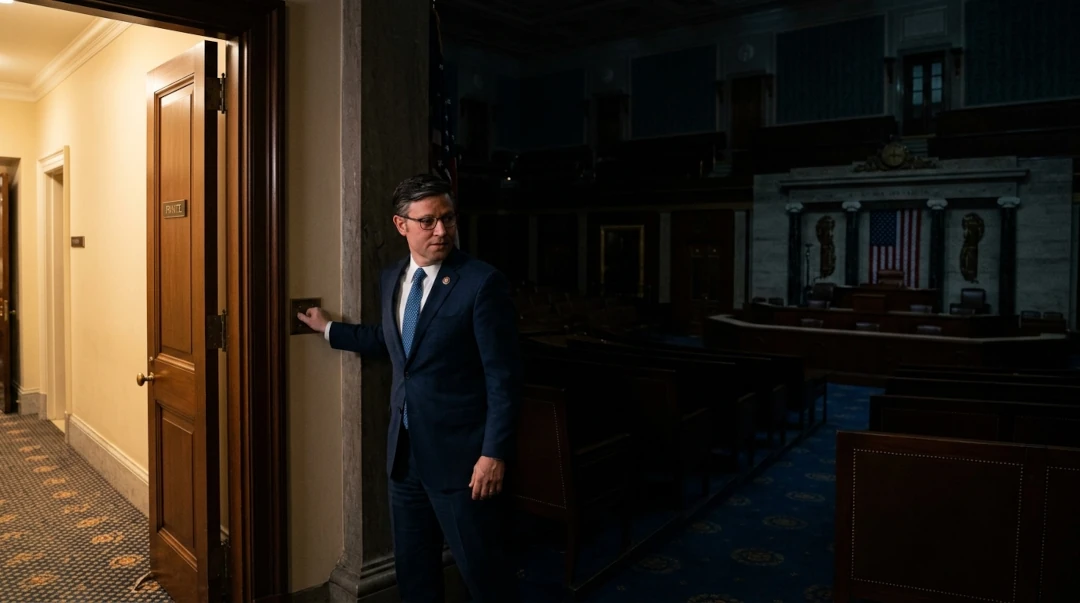
Speaker Mike Johnson did not need to explain why he cut off the People’s House a day early on Wednesday and sent members home for a seven-week campaign recess. The math already explained it. Twenty-four hours earlier, Republican Rep. Thomas Massie of Kentucky had walked to the well of the House and, without warning to his party’s leadership, read aloud eight articles of impeachment against Defense Secretary Pete Hegseth. Because Massie filed the resolution as privileged, House rules required a floor vote within two legislative days. Johnson found a simpler answer: cancel the legislative days.
The Speaker denied that Hegseth had anything to do with it. “It is a publicity stunt by someone who wants attention,” Johnson told reporters, insisting the House “should not be playing games with national security.” That is the sort of sentence that is meant to end the conversation. It should begin it. National security is precisely what is at stake — a seventh month of an undeclared war with Iran, a Defense Department renamed the Department of War, an inspector general’s finding that the Secretary himself relayed strike plans marked SECRET/NOFORN over the commercial app Signal, and a president openly telling Americans that surging gasoline costs are a “very inexpensive price to pay.” Johnson’s response to all of it was to lock the chamber door and drive to the airport.
The Speaker of the House is not a partisan whip. He is a constitutional officer. When he chose the schedule, he chose the shield.
I. The Case Against Hegseth
Massie’s 34-page resolution is not, as Johnson would have it, a stunt. It is the most detailed indictment yet assembled of a sitting Cabinet secretary, and its central charges — the ones the Speaker most needed to keep off the floor — are that Hegseth violated his oath to defend the Constitution and abused the powers of the Pentagon. The document lays out eight articles. Four center on the Iran war.
Unlawful war from inception
Charges Hegseth with waging war on Iran with no declaration, statutory authorization, attack on the United States, or imminent threat — the predicate violation of the 1973 War Powers Resolution.
Defying Congress
Alleges Hegseth continued military operations in Iran after both chambers directed the withdrawal of U.S. forces — a direct affront to the constitutional war power.
Blowing the 60-day clock
Accuses Hegseth of continuing hostilities long after the War Powers Resolution’s 60-day authorization window and any 30-day withdrawal period had expired.
Kidnapping a sovereign leader
Cites the January 2026 seizure of Nicolás Maduro and Cilia Flores in Caracas, an operation that reportedly killed some 75–80 people, as an unauthorized act of war under U.S. and international law.
Unlawful war in Yemen
Charges Hegseth with initiating Operation Rough Rider without authorization or imminent threat, and with strikes on civilians and protected persons — the same operation at the heart of “Signalgate.”
SECRET/NOFORN over an app
A Pentagon inspector-general review confirmed the strike details Hegseth pushed into a commercial Signal chat came from an email classified SECRET/NOFORN — a fact CNN’s national-security desk called “anything but” the exoneration Hegseth claimed.
These are not political grievances dressed up as legal ones. They track the plain text of federal law — the War Powers Resolution of 1973, which requires reporting within 48 hours, withdrawal after 60 days without authorization, and an additional 30-day window at most. The Iran war began in late February 2026. It has now run more than 200 days.
Massie put the point plainly to Newsweek this week. “This could turn into a nuclear war,” he said. “This is not a game. People are dying, civilians are dying. Members of the military are giving their lives for this. It’s not a declared war. There’s not any authorization. We are almost 180 days into this war, and it’s still unauthorized.”
“There’s really only one explanation for why they would cancel votes tomorrow and send us home early before the midterms, and that’s because they are afraid that the House of Representatives will vote to impeach Pete Hegseth. And the Speaker obviously, and obviously the President, does not want that.”
— Rep. Melanie Stansbury (D-N.M.), Sept. 16, 2026
II. The Bipartisan Resistance the Speaker Would Not Let You See
The most inconvenient fact for Johnson is that the Hegseth impeachment resolution is not a Democrats-versus-MAGA fight. It is not even one Republican. The night before Massie moved, the House delivered its third bipartisan rebuke of the Iran war in six months.
The vote was 220–204. All voting Democrats, plus seven Republicans, ordered the president to remove U.S. armed forces from hostilities with Iran. The number of Republican defectors has climbed each time — from four in June and July to seven in September, including Reps. Tom Barrett of Michigan, Warren Davidson of Ohio, Brian Fitzpatrick of Pennsylvania, Nancy Mace of South Carolina, Mariannette Miller-Meeks and Zach Nunn of Iowa, and Massie himself. As Colorado’s Rep. Jason Crow, who has led the effort, promised, Democrats will force “vote after vote after vote.”
Rep. Gregory Meeks of New York, the top Democrat on the Foreign Affairs Committee, put the constitutional question in one line on the floor: “This Congress has not authorized a war with Iran.” He is correct. The record shows he is correct. And now the Speaker of the House has made it structurally impossible for the chamber to vote on that record until after the November election.
That is not a scheduling decision. That is a governance decision. It says the Republican leadership would rather deny its own members the chance to be counted than let them go on record about a war two-thirds of Americans oppose.
III. Six Months of Warning, One Week of Cover
IV. What Trump Is Doing (and Not Doing) to Address the Country’s Concerns
The president’s response to congressional and public alarm has been consistent: contempt. Trump has argued he does not need congressional approval for the Iran war and, per CBS News reporting, called the War Powers Resolution itself unconstitutional. He has told Americans facing surging pump prices that this is a “very inexpensive price to pay” for his war. His Attorney General, Todd Blanche, defended Hegseth from the White House Rose Garden the same afternoon Massie filed his articles.
To Congress’s constitutional objections, the administration has offered no accommodation, no renegotiated authorization, no genuine hearing. To the public’s polling — an approval rating that has cratered to 32 percent, an Iran-war approval of 25 percent, and two-thirds of the country disapproving of his handling of the conflict — the White House has responded with insult. When Rep. Raskin asked the president’s own physician to conduct a neuropsychological assessment, spokesperson Davis Ingle called Raskin “a stupid person’s idea of a smart person.”
The Pentagon’s official statement — offered by press secretary Kingsley Wilson in response to Massie’s articles — was that “by every measurable metric, the Department of War is better under President Trump and Secretary Hegseth’s leadership than before.” It is a slogan, not an answer. Every measurable metric that matters to a democracy — congressional authorization, constitutional compliance, public support, transparency about strike operations, protection of classified information, and civilian casualties in unauthorized strike zones — moves in the opposite direction.
What the president has done, in effect, is delegate management of Congress to a Speaker willing to close the chamber, and management of the public to a Pentagon willing to call inspector-general findings a “political witch hunt.” This is not leadership of a constitutional republic. It is administration of a personal grievance.
Get Involved Today
Contribute to our mission and turn your concerns into action.
V. What This Says About Priorities
The lesson Wednesday’s adjournment teaches is not subtle. Faced with a choice between letting the People’s House vote its conscience on an unauthorized war and protecting a single Cabinet secretary from personal political exposure, Speaker Johnson chose the secretary. Faced with a choice between owning Republican defections on the record or manufacturing a seven-week silence, he chose the silence. Faced with a choice between the country’s judgment and the president’s convenience, he chose the president.
The Republican leadership has, once again, put the individual above the country. That is what Wednesday was — the outward, procedural sign of an inward, constitutional sickness: the belief that a party’s loyalty to its president is more sacred than a chamber’s loyalty to its oath. When a Speaker uses the calendar as a shield, the calendar becomes the story. When a Cabinet secretary can only survive because his own party will not let a vote happen, his survival is itself an argument for removal.
When the vote is denied, the amendment’s logic still holds.
The mechanism. Section 4 of the 25th Amendment, ratified in 1967, empowers the Vice President and a majority of the Cabinet — or “such other body as Congress may by law provide” — to declare that the president “is unable to discharge the powers and duties of his office.” If the president disputes the finding, a two-thirds vote in both chambers is required to sustain the transfer of power. It is a constitutional circuit breaker, not a political weapon.
Who has called for it. On April 8, 2026, more than 70 House Democrats — including Reps. Melanie Stansbury, Ayanna Pressley, Summer Lee, Bonnie Watson Coleman, and Andrea Salinas — publicly called for Trump’s removal after his threat that “a whole civilization will die.” Days later, House Judiciary ranking member Jamie Raskin and 50 co-sponsors introduced legislation to establish the Commission on Presidential Capacity to Discharge the Powers and Duties of Office — the very “other body” the amendment contemplates. Rep. Yassamin Ansari, in announcing her impeachment articles against Hegseth, was explicit: “The 25th Amendment exists for a reason; his Cabinet should use it.”
The constitutional case. The argument is not psychiatric; it is functional. The 25th Amendment addresses a president who is “unable to discharge the powers and duties” of the office. When a commander-in-chief conducts a foreign war for more than 200 days without the legal authorization the Constitution requires, ignores three bipartisan House votes ordering the war’s end, calls the War Powers Resolution itself unconstitutional, threatens genocide by post (“a whole civilization will die”), and tells inflation-battered families that spiking gas costs are a small price to pay for his war — the plain reading of “unable to discharge” is met not by illness but by refusal. A president who will not execute the office within its constitutional constraints is, functionally, not executing the office.
The practical barriers. They are serious. Section 4 requires Vice President JD Vance’s signature; nothing suggests he will provide it. It requires a majority of a Cabinet composed almost entirely of loyalists. Raskin’s Commission bill would have to pass a Republican House, a Republican Senate, and survive a Trump veto — a chain of near-impossibility. Impeaching Hegseth would still require Senate conviction. In cold procedural terms, none of these paths clears easily.
Why the barriers do not negate the case. The 25th Amendment does not lose its force because a Cabinet declines to invoke it. Its moral and constitutional case is independent of its political feasibility. What Wednesday’s adjournment demonstrated is not that removal is impossible — it is that the ordinary corrective mechanisms of the Republic have been jammed shut by the very officials sworn to keep them working. When the Speaker will not schedule the vote, when the Cabinet will not invoke the amendment, when the Senate will not consider the resolution, the argument for the amendment is not weakened. It is confirmed. The Constitution’s remedies were written for exactly the moment when its officers stop administering it. This is that moment.
VI. The Stakes
The Iran war has already cost the American people more than $38 billion, six or more service members dead, an Iranian civilian toll that includes strikes on schools and hospitals, and an open-ended conflict with no exit strategy and no congressional authorization. It has cost Americans at the pump and at the grocery store. It has cost the country the credibility of its constitutional order.
Every one of those costs is a policy question that Congress was elected to weigh. Every one of them was on the ballot in 2024 in theory and is on the ballot in November in fact. But between now and Nov. 3, the People’s House will not sit. The Speaker will not let it. That is the story. Not a scheduling change, not a procedural quirk — a democratic institution shuttered so that one Cabinet secretary would not have to face a vote.
“Secretary Hegseth is breaking the law and must be held accountable. He is abusing the power of his office to ignore congressional war powers resolutions, to kidnap foreign leaders, and to intimidate critics of the Trump administration by retaliating against them for exercising free speech.”
— Rep. Thomas Massie (R-Ky.), on introducing the articles
Editorial Conclusion
Speaker Johnson did not stave off a stunt. He staved off a verdict — one his own members were divided enough to reach honestly. He put one man’s political comfort above a chamber’s constitutional duty, and in doing so he became the second-most vivid argument, this week, for why the country needs the 25th Amendment’s machinery to work.
The first argument is the president himself. The second is a Speaker who will close the People’s House rather than let it be the People’s House. The remedy is not the calendar. It is the Constitution — and it is available to any Cabinet, any Congress, any citizenry with the nerve to use it.
The country was not built to be governed by men who will not stand a vote. It will not be saved by them either.
Sources & References
- CNN Politics — House to adjourn early, stave off Hegseth impeachment vote (Sept. 16, 2026)
- CBS News — GOP Rep. Massie introduces impeachment articles against Hegseth over Iran war
- The Hill — Thomas Massie seeks impeachment of Pete Hegseth over Iran war
- The Hill — House cancels final day of votes, avoiding Pete Hegseth impeachment vote
- CNBC — Hegseth avoids impeachment vote with early House election recess
- Washington Post — GOP defections widen as House passes measure intended to halt the Iran war
- Fox News — Massie introduces 8 articles of impeachment against Hegseth
- NPR — Rep. Massie moves to impeach Defense Secretary Hegseth over Iran war
- Newsweek — Pete Hegseth Impeachment Vote Led by Thomas Massie Delayed
- House Clerk — Roll Call 307 — H. Con. Res. 93 (Iran War Powers), Sept. 15, 2026
- Colorado Politics — Iran war powers resolution passes House with seven GOP defections
- Military.com — Republican lawmaker forces House vote to impeach Hegseth over Iran war
- CBS News — House Democrats file articles of impeachment against Hegseth
- Rep. Ansari — Rep. Ansari: Impeach Pete Hegseth (official statement)
- The Hill — Rep. Raskin introduces bill to assess president’s fitness under 25th Amendment
- The Hill — Democrats say Trump’s Iran threat cause for 25th Amendment removal or impeachment
- Mediaite — House Democrats file bill to form 25th Amendment Commission
- CNN Politics — Why the new ‘Signalgate’ IG report is so damning for Pete Hegseth
- The Hill — Hegseth’s Signal messages came from email labeled ‘SECRET’
- Just Security — Congress, the President, and Military Force in Venezuela
- UMass Amherst Poll — Aug. 2026 National Poll: Two-thirds disapprove of Trump’s Iran war handling
- Al Jazeera — US public support for Iran war falls as Trump approval at record low
- The Hill — Trump approval drops to -25% amid Iran war, inflation
Related News