The Time of America’s Testing Has Come
Judge J. Michael Luttig — the conservative jurist whose counsel helped stop the last coup — says the 2026 midterms are “the final battle for America’s democracy.” As Trump’s approval collapses to historic lows and his administration escalates its assault on the ballot, the crisis he warned about is arriving on schedule.
J. Michael Luttig does not speak lightly. For fifteen years he served on the U.S. Court of Appeals for the Fourth Circuit, nominated to that bench in 1991 by President George H. W. Bush and long considered one of the most influential conservative jurists in the country. He is a Republican’s Republican — the kind of judge whose name once regularly appeared on GOP shortlists for the Supreme Court. And on January 5, 2021, when Vice President Mike Pence’s legal team needed to know whether Pence could lawfully refuse to certify Joe Biden’s electoral votes, they turned to Luttig. His sober constitutional answer — no — helped save the Republic.
Five years later, Judge Luttig has issued the most alarming warning of his career. In a September 11 op-ed for The New Republic titled “The Final Battle for America’s Democracy,” and in a televised interview with MS NOW, the 72-year-old jurist declared that the country is “sleepwalking” toward a repeat of January 6 — one that, this time, no Mike Pence will stop. In his own words: America’s “time of testing” has arrived.
I. The Judge Who Won’t Look Away
To understand the weight of Luttig’s warning, one must first understand the man delivering it. He is not a partisan operative or a cable-news personality. He is a former federal appeals judge, once clerk to Chief Justice Warren Burger and Justice Antonin Scalia, and a longtime senior fellow at the nonpartisan Charles F. Kettering Foundation. When Luttig testified before the House Select Committee on the January 6 attack in June 2022, he said with characteristic understatement: “Donald Trump and his allies and supporters are a clear and present danger to American democracy.” That warning aged well. It is aging faster now.
Luttig’s September op-ed lays out, with the granular precision of a federal appeals opinion, exactly how the 2026 elections could be stolen — not in November, but on January 3, 2027, when the 120th Congress is scheduled to be sworn in. His prediction rests on a single procedural pressure point: the House Clerk’s roll. Speaker Mike Johnson, Luttig argues, could install a loyalist clerk before the new Congress convenes and instruct that clerk to simply refuse to list duly-elected Democratic representatives on the roll — thereby preventing them from being seated, voting for Speaker, or organizing the chamber. A Democratic majority-elect could be denied its majority by administrative fiat.
“This is the final battle for America’s democracy. If this is the time of America’s testing, if America doesn’t rise to this moment, this moment under this President Donald Trump, then there is no America in the future.”
— Judge J. Michael Luttig, MS NOW, September 2026
Luttig is not alone in sounding this alarm. In an unusually coordinated moment, historians Heather Cox Richardson and Timothy Snyder, former federal prosecutor Joyce Vance, and columnist David French have all issued parallel warnings in recent weeks. What was once a fringe worry — that a defeated Republican Party might simply refuse to accept the outcome — has become the conservative-legal establishment’s central concern. As if to confirm Luttig’s thesis, Speaker Johnson told attendees at a Trump event in Dallas last week, as quoted by Richardson: “We cannot and will not allow them to take the majority in the Congress. We’re not gonna do it.”
II. A Presidency in Freefall
Luttig’s warning cannot be read apart from the political reality that makes it plausible. Donald Trump does not believe he can win a fair midterm — because he cannot. Every credible polling aggregator now shows his approval ratings in historic-collapse territory. According to the Wikipedia aggregation of ten major trackers updated September 12, Trump sits at an average of 37.4 percent approval and 59.1 percent disapproval — a net of negative 21.7. CNN’s tracker puts him at 35–63. A recent Financial Times/Focaldata poll pegged him at 33 percent — the lowest of his second term.
The collapse is not narrow. It is comprehensive. A recent AP-NORC survey found only a third of the public approves of Trump’s handling of the economy, Iran, or foreign policy. A Quinnipiac poll found 66 percent disapproval on Iran, 62 on foreign policy, 62 on the economy, 58 on trade, and 57 on immigration — the issue that carried him to office in 2024. A Washington Post/Ipsos survey earlier this year found 64 percent disapproval on tariffs — 30 points underwater on the signature economic policy of his second term. Even his Republican base is fracturing: strongly-approve ratings among GOP voters dropped nearly ten points in a single August poll, according to USA Today’s reporting.
The laundry list of grievances is long, and every item is documented: an Iran war launched without congressional authorization; tariffs that the Supreme Court struck down in February and that drove PCE inflation to 4.5 percent; the deployment of ICE agents into American cities in ways that two-thirds of the country say have “gone too far”; late-night Truth Social posts threatening to extinguish civilizations; and a president whose own physician’s assurances of “fully fit” have themselves become the subject of congressional scrutiny. The country has rendered its verdict on the presidency. What remains is whether that verdict will be honored.
III. The War on the Ballot
Trump has been transparent — Luttig’s word — about what he intends to do with a losing electorate. Since retaking the presidency, he has waged what can only be described as a systematic campaign to shrink, suppress, and surveil the American vote. This is not conjecture. It is a documented eighteen-month record of executive orders, lawsuits, and threats — most of them blocked in court, some of them not.
Get Involved Today
Contribute to our mission and turn your concerns into action.
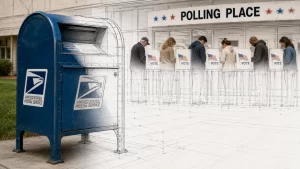
Consider the mail-ballot fight in particular. In a scathing 11-page ruling reinstating the block, U.S. District Judge Indira Talwani — sitting in Boston — observed the following: “The court is unaware of, and no party has proffered, any delegation Congress has made that would permit the USPS to regulate election mail.” She weighed the balance and concluded that immediate implementation “threatens disenfranchisement of millions of United States citizens who seek to vote by mail,” while the record contained “no evidence relating to fraudulent mail voting to support the rushed implementation.” A federal judge, sworn to constitutional restraint, could hardly have been more damning.
The DOJ voter-data grab is even more chilling. As Sara Chimene-Weiss of Protect Democracy put it when her organization sued: “Collecting, consolidating, and misusing highly sensitive personal voter data is part of the Trump administration’s strategy to usurp control of elections in order to baselessly cast doubt on and ultimately overturn any unfavorable results in the 2026 midterms.” Every judge to have ruled on these demands — in Arizona, Maine, Wisconsin, Michigan, Oregon, California, Massachusetts, and Rhode Island — has dismissed them as unlawful, per Protect Democracy’s tracker. New York Attorney General Letitia James called the demand what it is: an overreach. “This administration to want this personal information of all New Yorkers,” she told Spectrum News, “the answer is no.”
Ask yourself what leadership prioritizes making it harder for eligible Americans to vote. Ask yourself what president, elected to fight inflation and secure a border, spends his second year in office trying to make sure fewer people can cast ballots against him. The answer is a president who knows how few of them will vote for him if they can.
IV. The Election-Protection Infrastructure
The good news — and there is good news — is that the response to this administration’s assault on voting has been neither passive nor small. On September 17, Common Cause announced the largest nonpartisan Election Protection program in American history: more than 10,000 trained volunteers deployed across 25 states, working alongside a coalition led by the Lawyers’ Committee for Civil Rights Under Law, the NAACP, NALEO Educational Fund, State Voices, and the ACLU. Virginia Kase Solomón, Common Cause’s president and CEO, described the mission plainly: “We take direct legal action, we combat voter intimidation, and we provide millions of voters with the trusted real-time support they need to cast their ballots both safely and confidently.”
Call the Election Protection Hotline
The nonpartisan 866-OUR-VOTE hotline, staffed by trained volunteers and legal experts, is available in English, Spanish, Arabic, Mandarin, Cantonese, Korean, Vietnamese, Tagalog, Urdu, Hindi, Bengali, and Punjabi. Text or call. A single tip can help teams move fast to protect an entire polling place. Visit 866OurVote.org for more.
Common Cause
10,000+ nonpartisan poll monitors across 25 states, plus multilingual hotline coordination. Read their 2026 plan.
Lawyers’ Committee
Coordinates the national 866-OUR-VOTE legal hotline with attorneys ready to file for emergency relief. Coalition launch.
Brennan Center for Justice
Explains why ICE at polling places violates federal law and tracks every DOJ demand. Read the analysis.
Protect Democracy
Lead plaintiff on the voter-data database lawsuit; publishes a plain-English midterms FAQ. 2026 FAQ.
Indivisible
Runs the “Our Vote” midterm protection program with vote-early guidance and volunteer training. Join the campaign.
ACLU Voting Rights Project
Suing the DOJ over the national voter surveillance database. Senior attorney Ming Cheung: “No administration is above the law.” Case summary.
What can an ordinary voter do? A great deal, and none of it complicated. Verify your registration now — do not wait — through your Secretary of State’s website. Vote early, in person if that option is available to you; the earlier you vote, the fewer opportunities exist for anything to go wrong with your ballot. If you must vote by mail, request your ballot early and return it in person to a drop box or election office if possible. Know your rights: you cannot be turned away because you are still in line at closing time; you cannot be required to show identification beyond what your state’s law requires; you are entitled to a provisional ballot if there is any dispute about your eligibility. And if you see intimidation, disinformation, ICE agents near a polling place, or any effort to interfere with voting: call 866-OUR-VOTE immediately. A trained volunteer, backed by a legal team, will be on the line.
V. The Question of Fitness
There is one more question that any honest editorial about this moment must confront directly: whether the president attempting all of this is fit to hold the office at all. It is a question that Republicans in Congress have refused to ask. It is a question that the Constitution provides a mechanism to answer.
The 25th Amendment and the Duty That Congress Will Not Perform
Ratified in 1967 after the Kennedy assassination, the 25th Amendment to the U.S. Constitution provides a peacetime mechanism for removing a president who is unable to discharge the duties of his office. Section 4 allows the Vice President and a majority of the Cabinet — or, alternatively, a body designated by Congress — to declare the president incapacitated and transfer power. Congress may then vote to make that removal permanent by two-thirds majorities in both chambers.
On April 14, 2026, House Judiciary Ranking Member Rep. Jamie Raskin (D-Md.), joined by 50 co-sponsors, introduced legislation to establish the independent Commission on Presidential Capacity called for by Section 4. Raskin’s statement was direct: “Public trust in Donald Trump’s ability to meet the duties of his office has dropped to unprecedented lows as he threatens to destroy entire civilizations, unleashes chaos in the Middle East while violating Congressional war powers… We are at a dangerous precipice, and it is now a matter of national security for Congress to fulfill its responsibilities under the 25th Amendment.”
He is not the only voice. Sen. Chris Murphy (D-Conn.) called publicly for the Cabinet to invoke the amendment after Trump’s Easter 2026 Truth Social post threatening Iran; Sen. Ed Markey, Rep. Eric Swalwell, Rep. Sydney Kamlager-Dove, and Rep. Yassamin Ansari have all done the same. On May 5, more than 30 neurologists and psychiatrists entered a statement into the Congressional Record declaring the president “mentally unfit” and citing “grandiose and delusional beliefs,” “reckless threats of violence,” and “seemingly compulsive, manic-like late-night communications.” Even former Trump loyalists — including Marjorie Taylor Greene, Tucker Carlson, and Candace Owens — publicly demanded some form of intervention after the Iran threats.
The barriers are real. Republicans control both chambers of Congress, and Raskin’s commission bill will not pass in this term. Trump would veto it if it did. The Cabinet Trump has assembled is composed almost entirely of loyalists who have made clear they will never invoke Section 4 against him. The 25th Amendment path, as a practical matter, is closed.
The moral and constitutional case remains open. The Amendment exists precisely because the Framers understood that a president might become unable to discharge his duties for reasons other than physical incapacity, and that the country needed an orderly remedy. That the Republican Party has decided, as a matter of political self-preservation, to refuse to exercise that remedy does not erase the underlying reality. It merely transfers the responsibility. The remedy Republicans will not provide, voters must provide themselves — at the ballot box, in numbers so overwhelming that no clerk’s roll and no ICE agent and no USPS regulation can obscure the result. That is the assignment the 25th Amendment’s failure has handed to the American electorate.
Editorial Conclusion
A conservative federal judge, appointed by a Bush and trusted by a Pence, has told the country in the clearest possible terms that the 2026 midterms are the last off-ramp before an engineered constitutional crisis. He is not being alarmist. He is being precise.
The president attempting to engineer that crisis is underwater on every issue that got him elected, holding the lowest approval numbers of his political career, and openly deploying the machinery of the federal government against the right of Americans to vote him out. The question is no longer whether Donald Trump will accept a losing outcome. He has told us he will not. The question is whether the American people will render one so decisive that his refusal becomes a footnote rather than a coup.
Register. Verify. Vote early. Bring a friend. Save 1-866-OUR-VOTE in your phone. The Republic that Judge Luttig helped save in 2021 is being asked, in 2026, whether it deserves to keep being one. There is only one honorable answer, and only one place to give it: on the ballot, in numbers that leave no doubt.
Sources & References
- Judge J. Michael Luttig — “The Final Battle for America’s Democracy”
- MS NOW — Luttig: Country is “sleepwalking” into another insurrection
- YouTube — Judge Luttig full interview: “The time of America’s testing”
- The Daily Beast — Bush-Appointed Judge Warns of “Another Jan. 6”
- Heather Cox Richardson — Letters from an American, Sept. 12, 2026
- Kettering Foundation — Urgent Call to Action from Sr. Fellow Luttig
- NPR — Luttig’s 2022 Jan. 6 Committee Testimony
- Wikipedia — Approval-Rating Aggregator Table
- Forbes — Trump Approval Hits 33% in FT/Focaldata Poll
- AP-NORC — Trump Approval on Economy Remains Low
- Ipsos / ABC News / Wash. Post — 64% Disapprove of Trump on Tariffs
- USA Today via Yahoo — Sept. 2026 Polls Show Continued Decline
- Common Cause — Nation’s Largest Election Protection Program Launched
- Lawyers’ Committee — Election Protection Coalition 2026 Launch
- NC Newsline — 10,000+ Volunteers Deploy Nationwide
- Indivisible — Our Vote Midterm Election Protection Program
- Brennan Center — Sending ICE to Polling Places Is Illegal
- Protect Democracy — 2026 Midterm Election FAQs
- Protect Democracy — Suing to Block the DOJ Voter Database
- Votebeat — SCOTUS Blocks Mail-Ballot Restrictions
- The Hill — Court Won’t Restore Trump Mail-in Voting Plan
- NBC News — Judge Talwani Again Blocks Trump’s Mail-Voting Rule
- Ohio Capital Journal — DOJ Voter-Data Lawsuits Explained
- Spectrum News — AG Letitia James: “The answer is no”
- Mediaite — Raskin Files 25th Amendment Commission Bill
- House Judiciary Democrats — Raskin Letter Demanding Cognitive Evaluation
- The Hill (Opinion) — Growing Concerns Over Trump’s Mental Fitness
- MS NOW (Denver) — Denver Sues to Bar ICE From Polling Places
- Time — How Democrats Are Mobilizing Against Election Interference
Related News