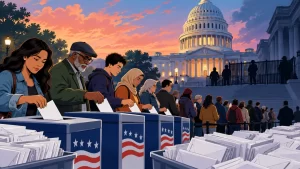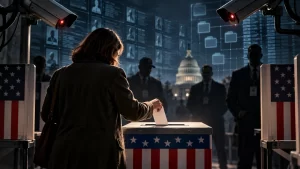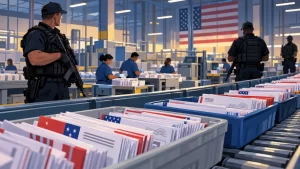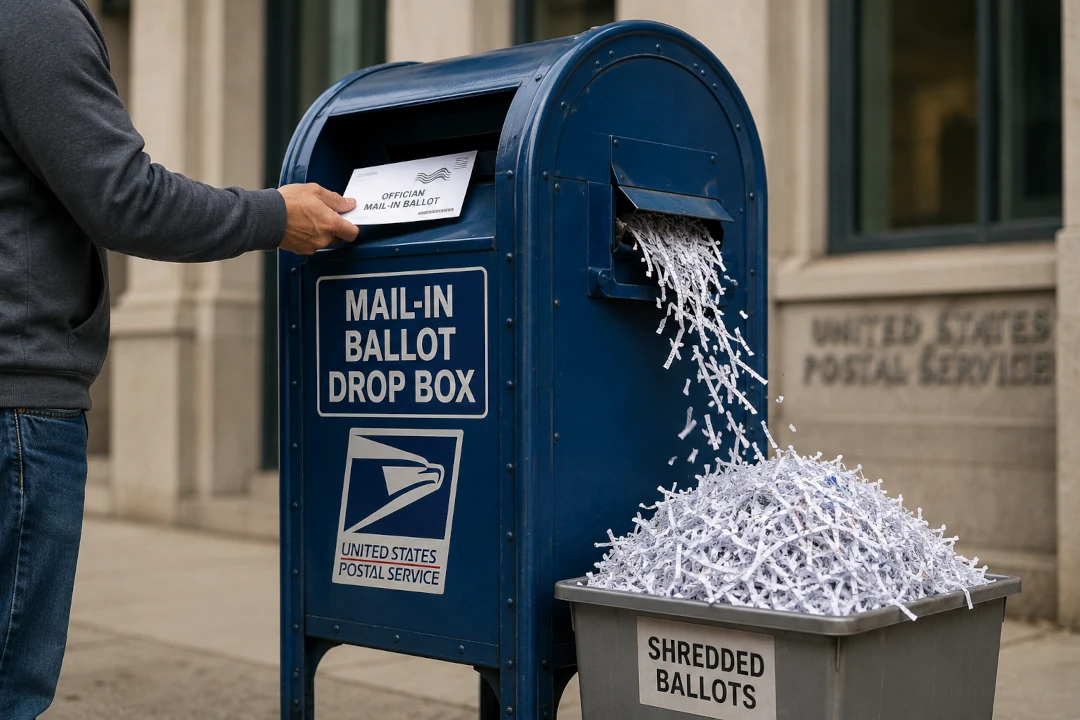
The Ballot Killer: Inside the Postal Service’s Secret Machine to Break the 2026 Vote
A federal whistleblower says the U.S. Postal Service kept building a rushed, error-riddled ballot-verification system after a court told it to stop — a “zero percent failure rate” design that would reject 10,000 mail ballots because one had a bad barcode. This is not incompetence. This is a plan.
On Tuesday morning, Senator Richard Blumenthal of Connecticut released a twenty-page whistleblower complaint that should be read as the most serious documented threat to the 2026 midterm elections yet made public. The complaint, delivered to his office by attorneys at Whistleblower Aid on behalf of an anonymous federal official with direct knowledge of the U.S. Postal Service’s operations, describes something worse than incompetence. It describes an executive branch agency being ordered — in defiance of a sitting federal judge — to hastily assemble a national ballot-screening apparatus so fragile it would refuse to mail 9,999 legitimate ballots because a single barcode failed to scan.
The whistleblower calls the operation “rushed, chaotic, and fundamentally flawed.” Postal Service employees, according to the complaint, describe it in cruder terms: internally, they call it a “sh*t show.” The head of the Senate Homeland Security Committee’s Permanent Subcommittee on Investigations calls it something else — “sabotage.” All three descriptions can be true at once, and all three point in the same direction: toward a White House that has decided the surest way to control a midterm election it fears losing is to break the machinery that delivers a third of America’s ballots.
What follows is an account of what the whistleblower says, what the courts have already ruled, what Congress is — and is not — doing, and why the constitutional case against this operation cannot be separated from the deeper constitutional question of whether the man ordering it is fit to govern.
I. What The Whistleblower Says
The disclosure, made public by Senator Blumenthal on September 1, describes the U.S. Postal Service’s new Federal Ballot Mail Portal — the online system states are supposed to use to submit voter and ballot data to the federal government before mail ballots go out. According to the whistleblower, USPS did not begin building the portal “in earnest” until June. A project that ordinarily requires nine to twelve months was compressed into fewer than three, and, per the complaint, given only four days of user acceptance testing.
The design is worse than the timeline. The complaint states that USPS built the portal to a “zero percent failure rate” tolerance — meaning that if a single ballot in a bulk mailing cannot be verified against the federal list, the entire batch is rejected and sent back to the state. Blumenthal offered a plain-English example: if a state hands the Postal Service 10,000 ballots and one voter has recently changed her name through marriage or moved, “USPS would refuse to mail the remaining 9,999 ballots as well.” There is, the whistleblower notes, no clear process by which a state or a voter can challenge a rejection.
The Build
USPS began serious development in June 2026, giving itself three months for what the whistleblower says normally requires nine to twelve months. Just four days of user testing preceded launch prep.
The Design Flaw
A single unverifiable barcode causes the portal to reject the entire batch of ballots. Whistleblower calls this “entirely unforgiving” and warns of “catastrophic failure.”
The Defiance
The whistleblower says USPS paused work for roughly a month after Judge Talwani’s June injunction, then resumed and continued through subsequent orders.
The Concealment
Per the disclosure, “some of the procedures USPS is planning… have been hidden from the public,” compounding the risk of mass disenfranchisement.
The whistleblower’s account did not go only to Blumenthal. The disclosure was also shared with the House Oversight Committee, which has legislative jurisdiction over the Postal Service, and with the USPS Inspector General. Representative Robert Garcia of California, the top Democrat on House Oversight, called the system “faulty, untested, and threatens to totally disrupt ballot delivery for millions of American citizens.” His committee has not yet said whether it will hold hearings — a decision that, in a Republican-controlled House, is not his to make.
“The main takeaway for me is that the Postal Service has designed a system to disenfranchise millions of Americans. One third of all Americans cast their ballots by mail, and the USPS puts all of their votes at risk.”
— Sen. Richard Blumenthal (D-CT), Sept. 1, 2026
II. The Court Orders They Ignored
To understand why the whistleblower’s allegations matter, it helps to review the trail of judicial rulings the Postal Service is now accused of defying.
The pattern documented by the whistleblower is stark: a month of compliance, then quiet resumption of work; another restraining order, and continued development. Judge Talwani’s rulings have been unusually direct about the constitutional stakes. In her August injunction, she found plaintiffs likely to succeed on three separate claims — that USPS lacked statutory authority to issue the rule, that the rule unconstitutionally imposed federal requirements on state election processes, and that it unconstitutionally prohibited state and local officials from using the mail to send lawful ballots.
The Trump administration’s response has been to argue technicalities. In an August 25 filing, government lawyers claimed that merely publishing the final rule did not violate Talwani’s injunction because the rule’s own language conceded it would not be implemented while the injunction was in place. The whistleblower complaint suggests the truth was less careful: the code was being written the whole time.
Get Involved Today
Contribute to our mission and turn your concerns into action.
III. The Backlash — And Why It Crosses the Aisle
Democratic condemnation was swift and near-total. Blumenthal called the operation “sabotage” and gave the Postal Service until Friday to respond to a detailed list of questions. Garcia demanded a permanent injunction. Senator Alex Padilla of California, the ranking member of the Senate Rules Committee, has spent months warning that the administration is engaged in a coordinated effort to “rig the outcome of the election.”
What is notable, and underreported, is the discomfort emerging within the Republican Party itself. Republican election attorney Ben Ginsberg — who represented George W. Bush in Bush v. Gore and has served as counsel to the RNC, the NRSC, the NRCC, and the Republican Governors Association — went on CNN after the Supreme Court’s August ruling and said the quiet part out loud. “Republicans are the older party and older folks like to vote by mail. They’re the rural party,” he warned. “Thanks to Donald Trump, there are many more low-propensity voters in the Republican Party.”
Senator Mike Rounds of South Dakota is doing more than talking. On August 7, he placed a hold on every Trump nominee to the Postal Service Board of Governors, demanding the agency fix mail-delivery collapses in his rural state before he releases the appointments. Senator Steve Daines of Montana has privately raised similar objections. State party operatives in Wisconsin, Michigan, and Pennsylvania — Trump-flipped battlegrounds — are quietly running the opposite campaign the president is running publicly, encouraging Republican voters to sign up for permanent mail ballots because they know the base cannot be turned out any other way.
The White House’s public posture has been dismissive. Spokesperson Lauren Bis told reporters that “the process of building software to carry out this new verification check is neither complex nor unique for USPS.” That is a talking point, not an answer. The whistleblower is not alleging that USPS cannot in principle build software. He is alleging that USPS built this specific system in a fraction of the time such systems require, ignored a judge’s order while doing so, and produced a product engineered for failure. The White House has not denied any of the specifics.
USPS itself — and its Trump-appointed Postmaster General, David Steiner — has declined to comment substantively. As of publication, the agency had not returned press inquiries from CBS News, NBC News, NPR, or Axios. Steiner has not addressed the whistleblower complaint in public. His silence is its own answer.
IV. Who Loses Their Vote
To grasp the human scale, some numbers are necessary. According to the States United Democracy Center, nearly one in three Americans voted by mail in 2024. Voters aged sixty-five and older cast forty percent of their votes by mail — the highest share of any age group. Roughly 905,343 mail ballots were cast by U.S. military members and citizens living abroad, protected under the 1986 Uniformed and Overseas Citizens Absentee Voting Act. Approximately one in four rural voters and one in three suburban voters relied on mail ballots.
These are not partisan constituencies. Both Donald Trump and Kamala Harris won states in 2024 where a majority of ballots were cast by mail. About one in four registered Democrats and one in five registered Republicans voted by mail. The population that stands to lose access first if the Postal Service’s flawed portal launches — elderly voters, rural voters, voters with disabilities, active-duty military, Americans overseas — is not a Democratic bloc. It is the electorate. It is the reason Republican operatives in swing states are, in Ben Ginsberg’s phrase, quietly bracing for “blowback.”
The consequences are already visible where postal service has degraded. Fair Elections Center research has documented how USPS’s earlier consolidation of processing centers led to ballot-delivery slowdowns; a University of Wisconsin Law School study of California’s November 2025 special election found the rate of late-arriving ballots was four times higher than in 2024, with the steepest increases in rural counties. Add to that infrastructure a portal designed to reject 10,000 ballots because of one, and the arithmetic of disenfranchisement writes itself.
V. The Legal Response
The legal architecture pushing back is substantial but strained. The coalition of twenty-three states and D.C., led by attorneys general in California, New York, Michigan, Pennsylvania, Arizona, Nevada, North Carolina, and Wisconsin, remains in active litigation. The League of Women Voters continues its parallel suit. Both cases have produced injunctions; the Supreme Court has lifted one and left the other, for now, standing.
The core constitutional argument is not novel — it is foundational. Article I, Section 4 of the Constitution — the Elections Clause — reserves to the states the power to prescribe the “Times, Places and Manner” of holding elections for federal office, subject only to alteration by Congress. Not by the president. Not by an executive order. Not by the Postmaster General. As Judge Talwani wrote, “the court is unaware of, and no party has proffered, any delegation Congress has made that would permit the USPS to regulate election mail.”
The Supreme Court’s August 24 order did not address any of that. The 6–3 majority ruled only that the plaintiff states had brought their case too early, before a final rule existed. Now the rule exists — 95 pages of it, formally published on August 26. The procedural obstacle the Court cited is gone. Justice Sotomayor, joined by Justice Kagan, dissented on the ground that harm was already occurring. Justice Ketanji Brown Jackson, writing separately, accused the majority of “contributing to electoral confusion on the eve of voting.” Her dissent reads, in retrospect, as a warning.
“Unable to Discharge the Powers and Duties of His Office”
The Twenty-Fifth Amendment, ratified in 1967, provides four mechanisms for the transfer of presidential power. Section 4 — never successfully invoked — permits the Vice President and a majority of the Cabinet (or a body Congress may by law establish) to declare in writing that the President is “unable to discharge the powers and duties of his office,” at which point the Vice President becomes Acting President. The framers of the amendment did not confine “unable” to physical incapacity. Its drafters, including Senator Birch Bayh, explicitly contemplated impairment of judgment.
Democratic lawmakers have argued for months that this constitutional threshold has been crossed. On April 14, House Judiciary ranking member Jamie Raskin (D-MD), joined by more than fifty co-sponsors, introduced legislation to establish the independent commission Section 4 explicitly authorizes Congress to create. On April 30, Senators Sheldon Whitehouse (D-RI) and Jack Reed (D-RI) entered into the Congressional Record a statement from thirty-six physicians — neurologists, psychiatrists, and cognitive-disorder specialists from Harvard, Tufts, Columbia, and George Washington — warning of the president’s “rapidly worsening, reality-untethered, increasingly dangerous decline.” Representative Raja Krishnamoorthi (D-IL) has called for immediate invocation.
The Constitutional Argument
The president who ordered the executive branch to build a system that would knowingly reject ballots by the thousand — a president who, according to the whistleblower, continued that construction after being ordered by a federal court to stop — is a president substituting personal grievance about a 2020 loss he still refuses to acknowledge for the constitutional duty to “take Care that the Laws be faithfully executed.” That is not policy disagreement. That is a categorical failure of the executive function the office exists to perform.
The Practical Barriers Are Real
Section 4 requires Vice President J.D. Vance and a majority of a Cabinet Trump himself appointed to act against him. That will not happen. The alternative — a Raskin-style congressional commission — requires legislation that a Republican House and Senate will not pass, and that Trump would veto if they did. Impeachment faces the same wall.
Why the Wall Does Not Nullify the Case
The purpose of naming the constitutional stakes is not to predict a removal that political arithmetic forbids. It is to establish, on the historical record, that a coordinated attempt to break the mechanics of a federal election — carried out in defiance of federal court orders — is precisely the sort of conduct the Twenty-Fifth Amendment’s drafters had in mind when they wrote the word “unable.” That the officeholders empowered to act will not act is a judgment on them, not on the standard. The Elections Clause of Article I, Section 4, and the Take Care Clause of Article II, Section 3, are being violated in real time. The Twenty-Fifth Amendment names the remedy the political system is refusing to use.
VI. What This Says About the Man Ordering It
Every element of this episode reveals the same set of priorities. A president who has voted by mail himself has ordered an agency to make it harder for other Americans to do the same. A president sworn to faithfully execute the laws has, according to a federal whistleblower, directed a subordinate agency to continue construction on a project a federal court ordered halted. A president who claims to fight for the “forgotten” American has targeted for disenfranchisement the elderly voter, the rural voter, the disabled voter, and the deployed servicemember.
He has done this while his own party’s operatives in the states he needs to hold quietly warn that the plan will hurt them, too. He has done this while the Supreme Court has explicitly declined to bless the underlying legality of the order. He has done this while a federal judge, whose orders he has treated as suggestions, keeps writing that the executive branch has no lawful authority to be doing any of it.
The whistleblower’s disclosure did not create this constitutional crisis. It documented one. The president’s priorities are visible in what the Postal Service has been ordered to build: not a fair election, but a controllable one. Not a democracy that includes the third of Americans who vote by mail, but a democracy narrowed to whoever the machinery agrees to count.
Editorial Conclusion
A federal agency has been credibly accused of defying a federal court’s order to build an untested, unforgiving, deliberately opaque system that will refuse to deliver lawful ballots to American citizens by the tens of thousands. It was designed under a rushed timeline set by the President of the United States, whose stated goal for years has been the elimination of the mail vote he himself has used.
This is not a policy dispute. It is an executive branch turning the machinery of the federal government against the franchise it is sworn to protect. Congress must compel testimony from Postmaster General David Steiner under oath. The courts must hold USPS in contempt if the whistleblower’s account of defied orders is verified. And every American — Democrat, Republican, or neither — should understand that the question on the table is no longer whether they agree with the president’s politics. The question is whether the vote itself survives him.
Sources & References
- U.S. Senate: Blumenthal Letter and Whistleblower Disclosure to Postmaster General David Steiner (PDF, Aug. 31, 2026)
- Votebeat: USPS Whistleblower Says Rushed New Mail Ballot Systems Could Disenfranchise Voters
- NBC News: Whistleblower Says USPS System Trump Ordered for Mail Ballots Is Flawed and Untested
- CBS News: Whistleblower Warns of “Potentially Catastrophic Problems” in Postal Service’s Ballot System
- PBS NewsHour: Whistleblower: Postal Service’s Work to Comply with Trump Order Is Rushed and Sloppy
- NPR: Whistleblower Claims USPS Plan for Trump’s Mail Voting Order Could “Derail” Midterms
- CNN Politics: USPS Whistleblower Describes New Plans for Voting by Mail Hidden from the Public
- Axios: USPS Whistleblower Warns New Ballot System Could Fail
- Rolling Stone: USPS Whistleblower Warns of Trump Mail-In Ballot Verification Scheme
- Oregon Capital Chronicle: USPS Whistleblower Predicts “Catastrophic” Effect on Elections Under Trump Vote-by-Mail Order
- Votebeat: Judge Blocks Key Pillars of Trump Executive Order Restricting Mail Voting in 2026
- Votebeat: Supreme Court Lifts 1 of 2 Injunctions on Trump’s Mail-Voting Executive Order
- Axios: Trump Administration Violated Court Order on Mail-Voting Rules, Judge Says
- The Hill: GOP Election Law Expert Ben Ginsberg — Many More “Low-Propensity Voters in Republican Party”
- The Hill: Trump Postal Service Board Nominees Held Up by Republican Senator Rounds Over Mail Delay Concerns
- States United Democracy Center: Nearly 1 in 3 Americans Voted by Mail in 2024
- Univ. of Wisconsin Law School: How Can States Address Federal Hostility to Mail Voting?
- The Hill: Concerns Grow Over Trump’s Mental Fitness for the Presidency — 36 Physicians, Raskin Bill, 25th Amendment
Related News