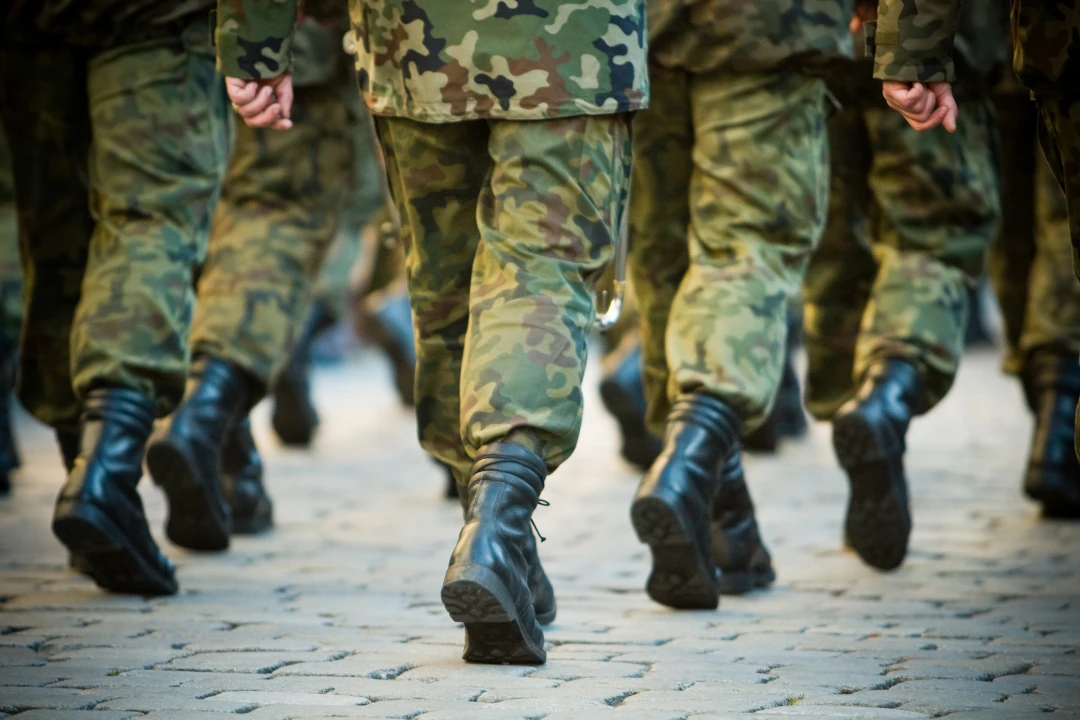
The Warrior Walkout: Troops Are Trying to Leave Pete Hegseth’s Military
Conscientious objector applications have surged sixfold since the Iran war began. Service members say they were ordered to break international law. The Defense Secretary calls the rules of engagement “woke.” This is what a broken chain of command looks like — and why the country cannot pretend otherwise.
Something is happening inside the American military that the Pentagon’s press office does not want you to know. Nearly six months into President Donald Trump’s undeclared war with Iran — and a full year into a shadow campaign of lethal boat strikes stretching from the Caribbean to the eastern Pacific — the number of U.S. service members formally seeking discharge as conscientious objectors has, in the words of the reporters who broke the story, skyrocketed. Not by a few percent. Not by a modest uptick. By a factor of six, according to the nonprofit that processes many of the applications, to a level unseen in the past quarter century of American military life.
The story, first reported by MS NOW’s Priya Sridhar and quickly picked up by The Daily Beast, describes a crisis of conscience inside the ranks that is not primarily political but moral. It is the sound of American troops — men and women who volunteered, who signed contracts, who wore the uniform willingly — telling their own chain of command that what they are being ordered to do is illegal, immoral, and un-American. And it is happening on the watch of a Defense Secretary who has publicly denounced the very concept of following the laws of armed conflict as “woke.”
This is not a partisan tantrum. This is the disintegration of the moral and legal architecture that has held the American military together since the end of the Second World War. And it is being caused, deliberately, from the top.
I. The Numbers the Pentagon Won’t Discuss
The Center on Conscience and War is a small, decades-old nonprofit based in Washington that helps service members navigate the labyrinthine process of applying for conscientious objector status. In an ordinary year, its staff assist roughly 50 applicants. Since February, when the Iran war began, they have assisted approximately 140 — a rate higher than at any point in the last 25 years, according to the organization’s Mike Prysner. The GI Rights Hotline at Quaker House reports the same pattern: a spike in calls from service members who describe their orders as immoral or unlawful.
The Center on Conscience and War reports conscientious objector applications have risen roughly sixfold since the Iran war began, the highest rate in 25 years. The New Republic
The administration acknowledges killing 223 people in at least 67 strikes on small vessels in the Caribbean and eastern Pacific, without providing public evidence of criminality. The Daily Beast
Hegseth has forced out at least half a dozen senior Army officers, according to sources cited by The New York Times, gutting the service’s expertise. The New Republic
A Pentagon official told Congress in April that the Iran war had already cost roughly $25 billion — and counting. LiveNOW/FOX
Sridhar spoke with five service members who have begun the objector process. Their reasons, in her reporting, were remarkably consistent: being ordered to violate international law; watching civilian casualties mount as a direct consequence of American strikes; being sent on extended deployments with no clear mission and no discernible strategy. One troop deployed in the Iran campaign told her they believed they had been asked to target civilian infrastructure — bridges, water facilities, telecommunications — a straightforward violation of international humanitarian law. Two others, participating in Hegseth’s boat-strike campaign, said they did not believe there was enough intelligence or justification to conclude that the people they were killing were, in fact, narco-terrorists.
The Pentagon’s response has been to deny that any problem exists at all. “There are zero retention concerns for Fiscal Year 2026,” press secretary Kingsley Wilson told NPR, insisting every service is meeting its targets. That claim, technically true for the recruits walking in the front door, dodges the entire substance of the story: the people quietly walking out the back. As experts told NPR, the service members starting the objector process today will not show up in retention statistics for months, in some cases years. By the time the data confirms what the applications already prove, the damage will be done.
“The Iran war was really the breaking point for them when they realized that they had to take action to make sure that they did not participate in something that they were going to regret for the rest of their lives.”
— Mike Prysner, Center on Conscience and War
II. The “Warrior Ethos” and Its Consequences
To understand why service members are applying to leave, one must understand what they are being asked to do — and by whom. In September 2025, Defense Secretary Pete Hegseth announced that the Pentagon, which he had already unilaterally rebranded the “Department of War,” would go, in his phrase, “on offense.” The doctrine, as he described it to assembled officers, would embrace “maximum lethality, not tepid legality,” and prize “violent effect, not politically correct” tactics. The rules of engagement, the framework of law and restraint that has governed American use of force for generations, he dismissed as “woke.”
This is not a stylistic disagreement. The rules of engagement exist because American soldiers, sailors, airmen and Marines are not assassins for hire. They are members of a constitutional military bound by the Uniform Code of Military Justice, the Geneva Conventions, and a long history of hard-won law that distinguishes lawful combat from war crime. When the Defense Secretary tells troops that legality itself is contemptible, he is not merely being rhetorically clumsy. He is instructing them to disobey the law.
Some senior officers refused. General Randy George, the Army Chief of Staff, was fired in April. The Pentagon has never given a coherent reason. But reporting by The Washington Post, later cited by The New Republic, indicates that George was pressured to drop an internal probe into possible violations, refused, and lost his job. He is one of at least six senior officers Hegseth has forced out. The Army has been without a permanent chief of staff for five months, in the middle of a war.
III. The Real Damage to Readiness
The White House and Pentagon insist that recruiting is at record levels — a claim that is, on its face, accurate. ABC News reported this month that the Army hit its fiscal 2026 goal of 61,500 active-duty soldiers, the Navy hit 45,000, the Air Force nearly 33,000. What Hegseth omits is that the recruitment rebound began in the last two years of the Biden administration, driven largely by a pay increase, and that recruiters interviewed by ABC said the war with Iran has not yet filtered into applicant conversations. The Military.com analysis was blunter: “as U.S. military operations in Iran expand and casualties rise, the recruiting rebound is colliding with a variable the services cannot control: public support for the war itself.” A Quinnipiac poll cited in the same piece found a majority of Americans opposed to U.S. military action against Iran.
Readiness is not a headline. Readiness is the quiet, invisible sum of institutional trust, technical expertise, retained talent, and lawful command. It is the difference between a military that can execute a difficult mission and a military that cannot. And on every one of those axes, the Hegseth Pentagon is bleeding capacity: senior officers purged, mid-career service members applying to leave on moral grounds, a chief of staff seat left empty for months, and — as The Hill has reported — munitions stockpiles depleted so severely by the Iran campaign that they are now constraining the President’s own military options.
This last point is not a talking point. It is a strategic disaster. According to former officials cited by The Hill, part of the reason Trump has not reauthorized a new bombing wave against Iran is that the U.S. does not have the weapons on hand to sustain one. The commander in chief has fewer munitions and, quietly, fewer willing troops than he did at the start of his war of choice — and the man responsible for that state of affairs is being told by the President he is doing a “tremendous” job.
Get Involved Today
Contribute to our mission and turn your concerns into action.
IV. The Young People Who Believed the Recruiter
Here is a truth that ought to matter more than it does in Washington: the American military is, for a substantial slice of this country, the last remaining ladder out. In rural counties where the factory closed a generation ago, in small towns where the hospital is failing, in city neighborhoods where a four-year college is priced out of reach, enlistment is not a philosophical choice. It is a job. It is health care. It is tuition. It is a way, for an 18-year-old with a diploma and no connections, to acquire skills, dignity, and a path.
Those young people signed up to defend the Constitution. They did not sign up to be told by their Defense Secretary that following the law is “woke.” They did not sign up to blow up small boats on the say-so of a Truth Social post. They did not sign up to be treated as expendable pieces in a President’s telegenic war. And now they, and their families, are watching the institution they trusted turn into something they no longer recognize.
If military service becomes synonymous with participation in unlawful violence, the ladder does not simply get harder to climb. It rots from the top down. Recruiters will visit the same high schools next fall. The pitch will be the same. But the parents in those living rooms will remember what happened to the last cohort — the boat strikes with no evidence, the Iran deployment with no strategy, the officers fired for asking whether an order was legal. And they will, quite reasonably, say no.
V. Congress: The Democrats Who Speak, the Republicans Who Do Not
To their credit, congressional Democrats have not been silent. When Trump threatened in April to destroy “a whole civilization,” more than 70 Democrats called publicly for his removal, either via the 25th Amendment or impeachment. Rep. Sarah McBride of Delaware wrote that “a president cannot be allowed to threaten genocide with the United States military.” Rep. Mark Pocan of Wisconsin posted that Trump was “too unhinged, dangerous, and deranged to have the nuclear codes.” Rep. Shri Thanedar of Michigan sent a formal letter to Vice President JD Vance and the Cabinet demanding they invoke Section 4 of the 25th Amendment. Rep. John Larson of Connecticut filed articles of impeachment.
Senator Ed Markey of Massachusetts went further, and took a step almost no sitting senator has taken in living memory: he directly addressed American service members, writing, “To the members of our military: remember, you do not have to follow illegal orders.” Sen. Ruben Gallego of Arizona, a Marine veteran, told NBC’s Meet the Press that the boat strikes amounted to “murder.” Sen. Andy Kim of New Jersey called Trump “unfit for office.” House Minority Leader Hakeem Jeffries convened a caucus briefing on the 25th Amendment led by Rep. Jamie Raskin of Maryland, the House’s most careful scholar of that provision.
“To the members of our military: remember, you do not have to follow illegal orders.”
— Sen. Ed Markey (D-Mass.), April 2026
The Republican silence, by contrast, has been near-total. Beyond a handful of populist outliers — even Marjorie Taylor Greene, of all people, publicly demanded the 25th Amendment — sitting Republican members have circled the president. That silence is not neutrality. In a moment when the Defense Secretary is telling troops the laws of war do not apply to them, silence is a vote for the doctrine. The Democrats have named the problem. What they have not yet done — because they do not have the votes and because the constitutional path runs through a Cabinet loyal to Trump — is force the country to reckon with it. That reckoning cannot be postponed forever.
VI. The President’s Priorities
What does Donald Trump actually want? On the evidence of the past year, the answer is: a war he can point to. Not a war he can win, not a war with defined objectives, not a war whose legal foundation he can articulate to Congress or to the country. A war for the cameras. A war for the truth-social feed. A war for the appearance of strength.
When told by senior military officials that stockpiles were running low, that the war would not be short, that retaliation was likely — warnings Defense Priorities analysts believe were delivered directly — the President did not adjust. He waved the reports away, called critical reporting “fake news,” and posted from his phone that Pete Hegseth was doing a “tremendous” job. He then continued to bomb civilian infrastructure in a country the United States is not, by any constitutional standard, at war with. Congress has never declared war on Iran. Congress has never declared war on Venezuelan fishing boats.
And still the President reaches for more force. More strikes. More escalation. With, as we now know, fewer munitions and fewer willing soldiers than he had at the start. This is not the pattern of a commander in chief exercising his powers with the gravity the office demands. It is the pattern of a man who mistakes cruelty for strength and impulse for strategy. The troops trying to leave his military are, in a sense, telling him what his generals cannot: the mission he is asking them to complete is not one an American soldier can complete with honor.
The 25th Amendment and a Commander Who Cannot Command
Section 4 of the 25th Amendment provides that if the Vice President and a majority of the Cabinet transmit to Congress a written declaration that the President “is unable to discharge the powers and duties of his office,” the Vice President immediately assumes those powers as Acting President. If the President contests the declaration, Congress decides — with a two-thirds vote of both chambers required to sustain the removal. The mechanism has never been used to involuntarily remove a sitting president.
The Democrats who have called for its invocation — including Sen. Ed Markey, Sen. Andy Kim, Rep. Jamie Raskin, Rep. Diana DeGette, Rep. Sarah McBride, Rep. Mark Pocan, Rep. Shri Thanedar, and Rep. John Larson — have anchored their argument not in policy disagreement but in fitness. The threats to destroy “a whole civilization.” The direction to strike civilian infrastructure. The public disparagement of the laws of war as “woke.” The purge of officers who refused to ignore possible violations. Each on its own is disqualifying. Together, they describe a President whose command of the armed forces has crossed from lawful direction into constitutional emergency.
The legal case is clear. The practical barriers are enormous. Section 4 requires the assent of a Cabinet Trump himself selected, and a Vice President — JD Vance — who has shown no willingness to break with him. Even the Democratic leadership acknowledges this. Rep. Raskin’s briefing to House Democrats was framed as constitutional education, not imminent action.
Why the Barriers Do Not End the Argument
None of this makes the constitutional case wrong. It makes it urgent. The 25th Amendment exists precisely because the Founders and the Congress that ratified the Amendment in 1967 understood that a president may become unable to perform his duties in ways impeachment cannot reach in time. A commander in chief who orders his own military to violate the laws of armed conflict, who fires the officers who refuse, whose Defense Secretary publicly ridicules the concept of lawful engagement, and whose troops are applying to leave in numbers not seen in a quarter century — that is not a political dispute. That is the failure mode the Amendment was written to address. The Cabinet’s refusal to act does not cleanse the record. It compounds it.
Editorial Conclusion
The skyrocketing number of American service members formally trying to leave Pete Hegseth’s military is not a personnel story. It is the sound of a constitutional republic’s armed forces telling their own commander in chief that his orders are unlawful. History will not remember the officials who looked away — the Republican senators who stayed silent, the Cabinet members who declined to act, the reporters who called it a discipline problem. It will remember the young enlisted troops who read the law, saw what they were being asked to do, and refused. The country owes them more than a bureaucratic discharge. It owes them a government worthy of the oath they took.
Sources & References
- The Daily Beast — Shock Military Exodus Under Pentagon Pete Hegseth Exposed
- MS NOW / Deadline White House — Troops allege Hegseth and Trump pushing them to violate laws as discharge requests surge
- The New Republic — Conscientious Objectors Trying to Flee Military Skyrocket Under Trump
- The New Republic — Did Hegseth Really Fire the Army’s Top Officer Over Kid Rock?
- NPR — There’s growing disquiet in the military. The Iran war made it worse
- The Hill — Munitions shortage constrains Trump’s military efforts against Iran
- The Hill — Democrats intensify calls to invoke 25th Amendment, impeach Trump over Iran threats
- The Hill — Democrats say Trump’s Iran threat cause for 25th Amendment removal or impeachment
- NBC News — Dozens of Democrats call for Trump’s removal after his Iran threats
- MS NOW — Over 50 Democrats push 25th Amendment as Trump threatens to kill “a whole civilization”
- Middle East Eye — US lawmakers call to remove Trump after “civilization will die” threat
- ABC News — New recruits are joining the military in big numbers, but not for the reason Hegseth says
- Military.com — The Recruiting Surge Was Engineered. Can It Last in a War with Iran?
- Crooks and Liars — “Skyrocketing” Number Of Troops Want Out Of Hegseth’s Military
- HuffPost — Troops Express Fears About Trump’s Iran Strategy
- LiveNOW / FOX — Hegseth congressional testimony on recruiting and Iran war cost
- NBC News — Sen. Ruben Gallego on boat strikes: “This is murder”
- Fox News — House Dem leaders open door to 25th Amendment; Raskin briefing scheduled
Related News