The “Bessent Put” and the Coming Reckoning: How Trump Is Driving the U.S. Economy Off a Cliff
Peter Schiff calls it “a recipe for massive QE and runaway inflation.” Wall Street calls it the “Bessent Put.” What it really is: a panicked, temporary fix that papers over the tariffs, the war-driven oil prices, and the ballooning deficits Trump refuses to address — while the American household pays the bill.
On Sunday night, two senior Treasury officials confirmed to CNBC what markets had already begun to fear: Treasury Secretary Scott Bessent is prepared to reach into the department’s nearly $1 trillion cash reserve — the Treasury General Account — to fund an aggressive campaign of long-dated bond buybacks, an unprecedented step that critics warn amounts to fiscal engineering in service of political survival. Within hours, Peter Schiff, chief economist at Euro Pacific Asset Management and one of the earliest voices to warn of exactly this scenario, offered the sharpest condemnation yet.
“This reckless plan will substantially shorten the average maturity of the national debt, increasing our exposure to rising short-term rates and making it even harder for the Fed to hike rates without exploding federal interest expense and budget deficits. It’s a recipe for massive QE and runaway inflation.”
— Peter Schiff · via Post on X, August 24, 2026
Schiff is not a member of the political left. He is a hard-money libertarian who has spent decades warning about federal debt, monetary debasement, and the political corruption of central banks. That is precisely what makes his warning so damning. When one of the most conservative economists in America looks at the Trump administration’s Treasury strategy and calls it “reckless,” the ideological cover Republicans have long used to defend Trump’s fiscal chaos collapses. This is not partisan hyperbole. It is arithmetic.
And the arithmetic is grim.
I. What Bessent Is Actually Doing
On August 19, the Treasury Department announced it would at least double the size of its long-dated bond buyback operations, from a maximum of $2 billion to at least $4 billion per operation, beginning September 9 and running through November. The move came one day after the 30-year Treasury yield hit 5.33% — its highest level since 2007 — and after weeks of what Bloomberg reporters described as a “buyers’ strike” in the long end of the curve.
Bessent, appearing on CNBC, called the operation a “Treasury Twist,” a name borrowed from a 1960s Kennedy-era Fed maneuver in which long-term bonds are purchased and offset with short-term issuance to bend the yield curve. Days later, senior Treasury officials told CNBC that the department is considering funding those purchases from the Treasury General Account — the government’s roughly $950 billion checking account at the Federal Reserve, which Bessent has quietly built up from the roughly $600 billion level maintained under the Biden administration.
The mechanics matter. In plain language: Treasury will buy back longer-dated bonds — the 10-year through 30-year portion of the market — and replace them with either short-term Treasury bills or a drawdown of the government’s cash buffer. The stated goal is to lower long-term yields, which have refused to fall despite the Fed’s rate cuts. The unstated goal is to lower mortgage rates and consumer borrowing costs ahead of the 2026 midterms.
The problem, as economist Peter Boockvar put it bluntly: “This is NOT a debt paydown, it is just a rearrangement of the maturity schedule of Treasuries.” Joe Brusuelas, chief economist at RSM, was even more direct: “Bessent is a political actor. His interest is purely short term and is organized around the upcoming election and not a return to price stability.”
Perhaps the most stunning aspect of the plan is Bessent’s own history. In 2024, when he was still a private hedge-fund manager, Bessent publicly excoriated then-Treasury Secretary Janet Yellen for tilting debt issuance toward short-term bills. He accused her of “putting her thumb on the scale of markets to keep down the costs of overspending” and of having “taken control of monetary policy” through Treasury issuance. He is now doing the same thing — only larger, louder, and more openly political.
II. Why the Fix Won’t Hold
The market’s initial reaction to the buyback announcement was a brief rally: yields dropped, futures rose, and administration officials congratulated themselves. Within twenty-four hours, that rally had evaporated. The 30-year yield climbed back to 5.27%. The 10-year hovered near 4.75%. Thirty-year conforming mortgage rates rose to 6.92% on Tuesday of this week — up 6 basis points from the previous week, in the opposite direction of what Bessent’s intervention was supposed to accomplish.
The reason is not mysterious. Long-term Treasury yields are not rising because of some technical malfunction in the bond market. They are rising because global investors are demanding a higher “term premium” — extra compensation for holding U.S. government debt — in response to the fundamental drivers of American fiscal risk. Those drivers are, in order of magnitude:
None of these underlying pressures is addressed by a buyback program. The Treasury is not retiring debt. It is not reducing the deficit. It is not lowering the price of a gallon of gasoline or a bag of groceries. What it is doing — and what Schiff, hedge-fund manager Peter Boockvar, Citadel Securities, and even the Treasury Borrowing Advisory Committee itself have all warned against — is manipulating the maturity structure of the national debt to buy time. And the shorter that maturity gets, the more exposed the entire federal budget becomes to every quarter-point move by the Federal Reserve.
“Bessent is a political actor. His interest is purely short term and is organized around the upcoming election and not a return to price stability.”
— Joe Brusuelas · Chief Economist, RSM US · via CNBC, August 19, 2026
III. How We Got Here: A Timeline of Escalation
IV. What This Means at the Kitchen Table
Wall Street will discuss the “Bessent Put” in the abstract vocabulary of yield curves and term premiums. Ordinary Americans will experience it as a bill. Here is what the “Treasury Twist” actually looks like from the outside of the Beltway.
Mortgages and housing. The 30-year fixed mortgage rate tracks the 10-year Treasury yield, not the federal funds rate. Bessent’s intervention has failed to move mortgages meaningfully lower — rates remain near their 2026 highs. Senator Elizabeth Warren has noted that Trump’s tariffs alone have raised housing construction costs by $17,500 per home. The average first-time homebuyer in America is now 40 years old — a record high. A generation is being priced out of the American dream.
Credit cards and auto loans. If short-term rates rise — and the Fed still has three dissenting governors who wanted a hike at the July meeting — every variable-rate product on an American household’s balance sheet gets more expensive. That is not a small population. The Federal Reserve Bank of New York reported in May that household debt has hit a record $18.8 trillion, with auto loan delinquencies at all-time highs and credit card delinquencies near their 2008 crisis levels.
Groceries and everyday goods. Federal Reserve researchers have concluded that tariff pass-through to consumers is now “effectively complete.” Every additional dollar spent on tariffed imports lands, sooner or later, on the American shopper. Goldman Sachs and Fed Chair Powell himself both stated last year that tariffs are responsible for the entirety of inflation’s persistence above the Fed’s 2% target.
Gasoline. Trump once used gas prices as a political weapon against Biden and Harris, promising to return them to $1.87 per gallon. Six months into his Iran war, they are above $4 — and now he is dismissing the anger as inconsequential. Meanwhile, five major oil producers have booked $65.5 billion in first-half 2026 profits, 65% higher than the same period last year.
Retirement savings. If the Fed is forced to cut rates to accommodate Bessent’s fiscal engineering — the “grand bargain” that macro investor Raoul Pal has described — the result is exactly what Schiff warned of: an inflationary regime that erodes the real value of every fixed-income asset held by American retirees. “Commodities now,” Schiff wrote, “CPI later.”
V. The Fed’s Impossible Position
Chair Kevin Warsh delivers his first Jackson Hole speech this Friday. He walks into it in one of the most compromised positions any Fed Chair has occupied in modern history.
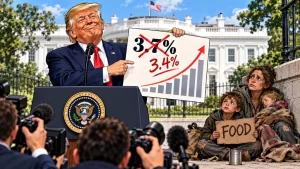
On one side: an inflation problem the Fed has not solved. Core inflation runs at 3.4%, well above the 2% target. Three regional Fed presidents — Beth Hammack, Neel Kashkari, and Lorie Logan — formally dissented at the July FOMC meeting, arguing for an immediate rate hike. It was the largest unified hawkish dissent since 2016.
On the other side: a Treasury Department that has now openly declared war on the long end of the yield curve, and a president who, as Bloomberg reported, has been making personal phone calls to Warsh demanding rate cuts. The Department of Justice, under Trump, has opened a criminal investigation into renovations at the Fed building — a pretext, in Powell’s own unprecedented video response, for political coercion.
If Warsh capitulates and cuts rates, he validates Schiff’s prediction: massive QE, runaway inflation, and the final destruction of the Fed’s hard-won independence. If he holds firm, he risks a further bond selloff that could push the 10-year toward 5.5% and the 30-year even higher — and Trump has already demonstrated he will fire anyone who fails to deliver political outcomes. As Bank of America analysts wrote this week: “The bond has been throwing haymakers.”
Get Involved Today
Contribute to our mission and turn your concerns into action.
VI. What Democrats Can — and Cannot — Do
Congressional Democrats have not been silent. In February, Senate Democratic Leader Chuck Schumer, Senator Elizabeth Warren (Ranking Member of the Banking Committee), Senator Ron Wyden (Ranking Member of Finance), and Senator Angela Alsobrooks demanded answers from NEC Director Kevin Hassett after Hassett suggested Federal Reserve staff should be “disciplined” for producing research documenting tariff costs. Sixteen Senate Democrats co-sponsored legislation to force refunds of the $175 billion in tariffs the Supreme Court ruled illegal. Democrats have introduced the ROAD to Housing Act, moved to block Trump’s Section 122 tariff extensions, and launched a 2026-long “affordability” agenda.
None of this has stopped Trump. And here is why: the president has claimed — and, for now, largely exercises — sweeping powers to raise tariffs by executive order, direct Treasury operations, and pressure the Fed, while Republican majorities in both chambers have refused to meaningfully constrain him. Schumer himself acknowledged the mathematical problem in his own 2026 cost-cutting launch remarks: even bipartisan bills like the Grassley-Cantwell effort to give Congress a veto on Section 232 tariffs will need “more Republicans to have it be veto-proof.”
The tools genuinely within Democrats’ reach are these: oversight hearings, formal record-building for future litigation and impeachment, blocking judicial and executive branch nominees, and — the tool Rep. Jamie Raskin introduced in April — the establishment of an independent commission on presidential capacity under the 25th Amendment.
When Fiscal Recklessness Becomes a Question of Capacity
The Twenty-Fifth Amendment to the U.S. Constitution, ratified in 1967 in the aftermath of the Kennedy assassination, provides the mechanism by which a president who is “unable to discharge the powers and duties” of the office may be removed. Section 4 grants the Vice President and a majority of the Cabinet — or such other body as Congress may by law provide — the authority to declare the president incapacitated and transfer power to the Vice President.
The economic reasoning is not usually where the 25th Amendment case is made. It is more commonly invoked around Trump’s Iran war rhetoric, his April Truth Social post threatening to extinguish “a whole civilization,” or the 36 physicians from Harvard, Tufts, Columbia, and George Washington who entered a joint statement into the Congressional Record declaring the president “mentally unfit” and citing his “grandiose and delusional beliefs” and “seemingly compulsive, manic-like late-night communications.” But the fiscal record deserves to be part of that assessment.
The Legislators Making the Case
Rep. Jamie Raskin (D-MD), Ranking Member of the House Judiciary Committee, introduced legislation on April 14, 2026 to establish an independent Commission on Presidential Capacity — the “such other body” the amendment explicitly contemplates. It has 50 co-sponsors. Rep. Raja Krishnamoorthi (D-IL) formally called on Vice President Vance to invoke Section 4 on April 7. Rep. Jasmine Crockett (D-TX) sent Vance a formal letter the same day. Senators Whitehouse and Reed entered the physicians’ statement into the record on April 30.
The Constitutional Argument
“Unable to discharge the powers and duties” is not a partisan judgment. It is a factual one. When a president pressures the Treasury Secretary into manipulating the maturity structure of the national debt for short-term political gain, telephones the Fed Chair to demand rate cuts, ignores a 6-3 Supreme Court ruling by simply re-imposing tariffs under a different statute, and refuses to address the root causes his own policies have created — that is not the ordinary exercise of contested policy. It is a pattern of impulsive, incoherent decision-making from a president whose own government economists warn of consequences he does not appear to grasp.
The Barriers, Honestly Named
The practical path is exceedingly narrow. Section 4 requires Vice President Vance and a majority of Trump’s hand-picked Cabinet to act — something no one seriously expects. Raskin’s commission bill will not pass a Republican-controlled House. Even if invoked, Trump could contest the removal, requiring a two-thirds vote in both chambers to sustain it. The political barriers are, by design, formidable.
Why the Case Still Must Be Made
The barriers do not negate the constitutional argument — they only postpone its resolution. The Twenty-Fifth Amendment exists precisely for moments when the ordinary tools of democratic accountability have been exhausted and the danger from an incapacitated executive continues to compound. Building the record now — in the Congressional Record, in oversight hearings, in the physicians’ statement, in the fiscal evidence Peter Schiff has just added — is how the country preserves the option for a future Vice President and Cabinet, or a future Congress, to act. To stay silent because the immediate vote count is unfavorable is to concede that the Constitution has no answer for the crisis it was written to address.
VII. What This Says About the Leadership of This Country
Strip away the ticker symbols and the acronyms, and this is what remains: a president who launched a war he could not end, imposed tariffs the Supreme Court called illegal and then imposed them again under a different statute, drove the deficit past $40 trillion while cutting taxes for the wealthy, pressured the Federal Reserve to abandon its inflation-fighting mandate, and now — through his Treasury Secretary — is quietly draining the government’s emergency cash reserve to prop up bond prices for political cover.
These are not the priorities of a leader focused on the American worker. They are the priorities of a man focused on surviving the next news cycle, the next market open, the next midterm election. And the bill for that focus will not arrive in Trump’s inbox. It will arrive in the mortgage payments, the grocery bills, the credit card statements, and the eventual, inflationary reckoning that Peter Schiff — a conservative — has now told us in plain English is coming.
Editorial Conclusion
When Peter Schiff — a lifelong hard-money libertarian and no friend of the American left — warns that the Trump administration’s Treasury strategy is a recipe for “runaway inflation,” the country should listen. This is not a policy dispute. It is a warning that the President of the United States and his Treasury Secretary are jointly using the machinery of the federal government to postpone consequences that will fall on ordinary Americans with compounding force.
The buybacks will not fix the tariffs. The tariffs will not fix the deficit. The deficit will not fix the war. And nothing Bessent does at the Treasury General Account will restore the credibility of a Federal Reserve the president is systematically dismantling by phone call and criminal referral.
The Constitution provided the country with a mechanism — the 25th Amendment — for exactly this scenario: a president whose conduct compounds the danger faster than the ordinary political process can respond. The path is narrow. The obligation to walk it is not.
Sources & References
- beInCrypto — Bitcoin Loses $80,000 as Critics Swarm Treasury’s $950 Billion Buyback Plan (Peter Schiff quote, Aug. 24, 2026)
- CNBC — Bessent could tap near $1 trillion Treasury General Account to fund bond buybacks
- CNBC — Treasury doubles debt buybacks as Bessent moves to steady bond market
- CNBC — Bessent moves to curb Treasury yields, putting new pressure on Warsh’s Fed
- CNBC — Bessent Treasury buybacks: What he could try next
- CNBC — Bessent’s bond gambit is instead stirring inflation worries
- Yahoo Finance / Benzinga — Trump’s Bond Buyback Push Puts Warsh in a Tough Spot — Schiff Says Treasury ‘Pulled the Rug Out’
- Fortune — Bessent becomes most interventionist Treasury chief in decades
- HousingWire — Mortgage rates jump as Treasury buyback plan fails to cut costs
- Federal Reserve — Detecting Tariff Effects on Consumer Prices in Real Time — Part II
- Council on Foreign Relations — Trade, Tariffs, and Treasuries: The Hidden Cost of Trump’s Protectionism
- Center for American Progress — Americans Pay the Price for Trump’s War While Oil and Gas Companies Get Rich
- Center for American Progress — The Trump Administration’s Interference With Federal Reserve Independence Carries Significant Risks
- Senate Democratic Leadership — Schumer, Alsobrooks, Warren, Wyden Blast White House for Fed Interference
- Senate Democratic Leadership — Schumer Floor Remarks on the Democrats’ Affordability Agenda
- The Hill — Senate Democrats unveil Trump tariffs refund legislation
- The Hill — GOP, Democrats lament $40 trillion debt as Congress struggles to act
- House Judiciary Democrats — Ranking Member Raskin Demands Cognitive Evaluation, Calls to Invoke 25th Amendment
- Rep. Krishnamoorthi — Krishnamoorthi Calls for Trump’s Removal Under 25th Amendment
- The Hill (Opinion) — Concerns Grow Over Trump’s Mental Fitness for Presidency
- Bloomberg — Can Trump Influence the Federal Reserve and Interest Rates?
- The Conversation — How Trump’s Efforts to Fire the Fed Chair Harm the Economy
- Protect Borrowers — American Families Hit Record Levels of Financial Distress
- MSNBC — Trump made gas prices a political weapon. Now he’s downplaying the pain.
Related News