“A Miscalculation”: Carney Suspends Trade Talks as Trump Ignites a War with America’s Closest Ally
The Canadian prime minister called the tariffs an economic attack, ordered his negotiators home, and pledged dollar-for-dollar retaliation. The president responded by insulting Canada’s sovereignty. What broke down was not merely a trade deal — it was the credibility of American leadership.
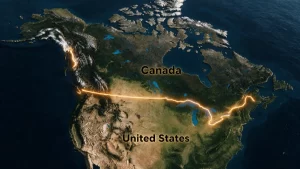
Just before midnight on Friday, Canadian Prime Minister Mark Carney did what no serious American ally has been forced to do in the modern era: he pulled his negotiators back from Washington and effectively declared that the United States could no longer be trusted to keep its word. Hours later, President Donald Trump’s new 50 percent tariffs on roughly $28 billion worth of Canadian goods took effect — hitting everything from cement and hockey sticks to dairy, wine, apparel, and building materials. By Saturday morning, Carney was standing at a lectern in Ottawa telling reporters that Canada was “at war” with its closest neighbor. “You are at war when you get attacked,” he said. “And we have been attacked.”
This is not the language of trade diplomacy. It is the language of a partnership that has been broken by one side and one side only. The disintegration of U.S.–Canada relations under Donald Trump is not a policy disagreement. It is a self-inflicted wound driven by a president who does not understand the trade balance he rails against, cannot be trusted to keep the deals he claims to have made, and appears to view a friendly democracy of 40 million people as a piece of land waiting to be annexed. Americans are about to pay the price — in their grocery bills, their mortgage payments, their gas tanks, and their standing in the world.
I. How the Deal Died
The collapse was theatrical in the way only Trump-era diplomacy can be. On Tuesday, the president told reporters at the White House that the United States and Canada had reached a “DEAL!” He paused the pending Section 338 tariffs for three days on the strength of that claim. By Friday night, there was no deal — only a Canadian prime minister ordering his team back to Ottawa and issuing a statement that the U.S. proposals in the final days were “uneconomic, unfair, and undermined the net benefits for Canada.”
In Carney’s telling — and Canadian officials have been unusually direct in laying it out — the Trump administration used the closing hours of talks to move the goalposts. Autos became a sticking point: Washington demanded concessions on tariff levels, on the treatment of Canadian content, and on which vehicles would be covered. Beyond commerce, U.S. negotiators pushed to weaken Canadian cultural protections, including support for French-language content on streaming platforms — a demand Ottawa considered a direct assault on national identity. Carney later summarized the American approach with a phrase that will follow this administration for years: “economic integration as a weapon.” The proof of a deal, he said, was written “in pencil.”
II. The Lies Behind the “Deal”
To understand how a trade agreement between the United States and Canada — the world’s largest and most integrated bilateral commercial relationship — ended in this state, one must first understand that the president of the United States has been lying about it, publicly and repeatedly, for more than a year.
CNN’s reporters have documented at least nine distinct false claims Trump has made about Canada since returning to office: that the U.S. trade deficit with Canada is “$200 billion” (actual figure: nowhere close); that Canada is one of the world’s highest-tariff nations (it ranks low globally); that Canadians want to join the United States (recent polling shows roughly 85% opposed, 9% in favor); that Canada “doesn’t take” U.S. agricultural exports (it is the world’s second-largest buyer of them); that Canada prohibits U.S. banks (more than a dozen operate there today). CBC News has separately reported that the Trump administration systematically misrepresents Canada’s “over-quota” dairy tariff rates — rates almost never triggered in practice — as the everyday tariff American farmers face. In reality, more than 97% of U.S.–Canada agricultural trade and 99% of manufactured trade occurs at zero duty under the USMCA, the agreement Trump himself signed in his first term.
“They asked too much, and they offered too little.”
— Prime Minister Mark Carney, August 22, 2026
The pattern is not incidental. It is the entire strategy. As Georgetown’s Jennifer Hillman — one of the legal scholars whose arguments helped invalidate the president’s earlier tariff regime — has observed, the administration has manufactured a fiction of Canadian mistreatment in order to justify tariffs that no honest reading of the trade data would support. And when Carney refuses to sign onto a deal drafted from that fiction, Trump does what he always does: he attacks the messenger. Within hours of Carney’s announcement, Trump was back on Truth Social with his familiar refrain about Canada becoming the 51st state, a threat he has now repeated so often that Canadian voters returned Carney’s Liberal Party to power in April largely on the strength of his willingness to say “never” to it.
III. What Americans Are About to Pay
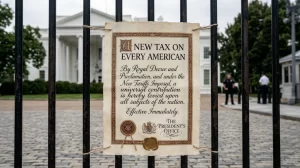
The Trump administration would like Americans to believe that tariffs are paid by foreign countries. This is not true, and it has never been true. Tariffs are taxes paid by American importers at the border, and those costs are passed through to American consumers, American manufacturers, and American workers.
The nonpartisan Tax Foundation now estimates Trump’s tariffs will cost the average U.S. household $840 in 2026 — on top of the roughly $1,000 they cost the average family in 2025. The Joint Economic Committee’s Democratic minority puts the number sharply higher: more than $2,500 per household this year alone if current collection rates continue. Between February 2025 and January 2026, American families collectively paid $231 billion in tariff costs. That is not a foreign country’s bill. That is a tax hike on the American middle class, and the largest one in a generation.
Housing & Lumber
$10,900 more per home
Canada supplies nearly 85% of all U.S. softwood lumber imports. The Congressional Joint Economic Committee warned that Trump’s tariffs on wood and materials could raise the cost of building a single-family home by roughly $10,900. Duties on Canadian lumber have already climbed from 14.5% to more than 45% including Section 232 add-ons, per the National Association of Home Builders.
Energy & Gas Prices
$5.2B on Canadian oil
Canada is by far the largest supplier of U.S. energy imports, providing 64% of U.S. crude oil imports by quantity in 2025 — 1.4 billion barrels a year. The American Action Forum estimates the cost of energy tariffs on Canadian imports at $5.2 billion, largely paid at the pump by U.S. drivers in the Midwest and Great Plains.
Groceries & Everyday Goods
Wine, dairy, apparel
The 50% tariffs cover wine, cheese, cement, clothing, hockey equipment, and household appliances. According to Newsweek’s reporting, the measures hit roughly 5% of all goods the U.S. imports from Canada — and Canada’s September 8 retaliation will target U.S. steel, dairy, and agricultural equipment.
U.S. Exporters & Farmers
Retaliation begins Sept. 8
Canada absorbs a substantial share of U.S. agricultural, industrial, and manufactured exports. Carney has said the retaliatory tariffs will be “concentrated in sectors such as steel, dairy, appliances, agricultural equipment, pulp and paper, and electronics” — targeting American producers in states where the president’s own voters live.
IV. The Legal Farce — From IEEPA to Smoot-Hawley
The most consequential fact about the president’s tariff regime is that the Supreme Court has already ruled a substantial part of it illegal. On February 20, 2026, in a 6–3 decision written by Chief Justice John Roberts, the Court held in Learning Resources v. Trump that the International Emergency Economic Powers Act did not authorize the sweeping tariffs Trump had imposed on virtually every trading partner. The ruling did not touch the president’s underlying appetite for tariffs; it simply held that Congress had never granted him this power.
Rather than accept the constitutional limits the Court had articulated, the administration went hunting for another legal weapon. It found one in Section 338 of the Tariff Act of 1930 — a provision so obscure that most trade attorneys had never encountered it and no U.S. president had ever invoked it in the 96 years since Congress wrote it. Section 338 is a relic of the Smoot-Hawley Tariff Act, the same 1930 statute historians widely blame for deepening the Great Depression. On July 20, Trump became the first president to use it, imposing 50% tariffs on Canadian autos, alcohol, and dairy that apply regardless of whether the goods qualify for duty-free treatment under USMCA — the trade agreement Trump himself signed.
Even conservative legal scholars have been skeptical. Peter Harrell and Jennifer Hillman of Georgetown — two attorneys who helped litigate the case that invalidated the IEEPA tariffs — have laid out the constitutional and statutory grounds on which Section 338 is likely to be challenged. As Bloomberg has reported, the provision has been dormant since roughly the 1950s, and the administration’s evidentiary case — that Canada is uniquely “discriminating” against American commerce — is thin at best. What the president has done, in effect, is reach for the most punitive tariff authority Congress ever wrote, and use it against an ally that is not, in any credible reading of trade law, doing what he claims.
Get Involved Today
Contribute to our mission and turn your concerns into action.
V. Congress Tries, and Mostly Fails, to Act
Democrats have been sounding this alarm for a year. In February, the House voted 219–211 to terminate the national emergency Trump used to justify his first Canada tariffs, with six Republicans — Reps. Kevin Kiley (R-CA), Thomas Massie (R-KY), Don Bacon (R-NE), Brian Fitzpatrick (R-PA), Jeff Hurd (R-CO), and Dan Newhouse (R-WA) — crossing the aisle. Rep. Gregory Meeks (D-NY), the ranking Democrat on Foreign Affairs, led the resolution. Rep. Richard Neal (D-MA), ranking member on Ways and Means, declared afterward that “the cracks are forming in his tariff scheme that’s teetered the economy.”
The Senate has now twice passed similar resolutions. But Trump vetoes them, and the two-thirds override math is not there. In April, Sens. Ron Wyden (D-OR), Ed Markey (D-MA), Jeanne Shaheen (D-NH), Mark Warner (D-VA), and 22 other Senate Democrats introduced the Tariff Refund Act of 2026, which would return with interest the roughly $175 billion in illegal tariff revenue the Supreme Court found the administration had unlawfully collected. In July, hours after Trump reached for Section 338, Wyden introduced the Congressional Trade Powers Reform Act of 2026, which would repeal both Section 122 of the 1974 Trade Act and Section 338 of Smoot-Hawley outright and create a Joint Committee on Tariffs and Trade with authority to review any presidential tariff proposal.
Speaker Mike Johnson has done what he always does: run cover for the president. He tried to block the February Canada vote from happening at all, and when it happened anyway he insisted, with a straight face, that Congress ought not “get in the way” of a president who was raising the cost of a two-by-four. What is happening now is the entirely predictable consequence of a Republican caucus that has, for a decade, treated the separation of powers as an optional feature. When one branch abdicates, the other branch expands. That is not a Democratic talking point. It is what the Framers warned would happen. Trump did not seize this power. It was handed to him.
“Donald Trump has pushed the boundaries of power on trade and tariff policies like no other president we’ve seen before. Congress must reassert its authority over trade and tariffs to stop any president from being able to unilaterally change the worldwide economy at the click of a button.”
— Sen. Ron Wyden (D-OR), Ranking Member, Senate Finance Committee
VI. The Longer Wound
Trade wars, once begun, do not end when a president does. The economic damage will linger, but the strategic damage will linger longer. Canada sends roughly 73% of its exports to the United States. It has spent seventy years building its economy around the assumption of a reliable American partner. That assumption has now, definitively, broken. Carney told reporters on Saturday that Canada has “recognized from the beginning that America has changed, and that we will not return to our old relationship.” Canadian ministers are already traveling to Europe to negotiate closer ties with the EU and the United Kingdom. Ottawa is exploring new export routes for Canadian oil and gas that would reduce U.S. leverage over Alberta’s energy sector for decades.
Countries watching this — Germany, Japan, South Korea, Mexico, the United Kingdom — are learning a lesson that will outlast this administration: a deal with the United States is written in pencil. It can be torn up on a Tuesday because the president misunderstands his own trade data, or on a Friday because he wanted a bigger concession on French-language streaming rules. The world’s reserve currency, the world’s deepest capital markets, and the world’s largest consumer economy have historically been able to demand a great deal in exchange for the privilege of trading with America. What no one previously believed the United States would demand is the surrender of a neighbor’s sovereignty. That is a line Trump has now crossed repeatedly and publicly, and other capitals are drawing their own conclusions about what to buy from America, what to sell to it, and how much of their national security to entrust to it.
When incapacity is measured not in a single moment, but in a pattern.
Section 4 of the Twenty-Fifth Amendment provides a mechanism the Framers did not have: a constitutional path to remove a president who is “unable to discharge the powers and duties of his office.” The mechanism requires the vice president and a majority of the Cabinet to certify, in writing, that the president is unfit. If the president contests that finding, Congress must resolve the question by a two-thirds vote of both chambers. It was written in 1967 to address exactly the situation where a president’s judgment can no longer be trusted with the powers of the office, but no clean political mechanism exists to remove him.
Since January, a growing number of congressional Democrats have argued that the current president meets that standard. In April, Rep. Jamie Raskin (D-MD), ranking member of the House Judiciary Committee, sent a formal letter to the White House physician demanding a comprehensive cognitive and neurological evaluation of the president. Sen. Andy Kim (D-NJ) has said flatly: “He’s unfit for office. I think the 25th Amendment, and if not, then impeachment.” Sen. Ed Markey (D-MA) and Reps. Eric Swalwell (D-CA), Yassamin Ansari (D-AZ), and Sydney Kamlager-Dove (D-CA) have all publicly called for the amendment’s invocation. A February Reuters/Ipsos poll found that a majority of Americans — including 30% of Republicans — now believe the president has become erratic with age.
The constitutional argument is not that any single trade decision, however damaging, would justify removal. It is that a pattern of decisions — publicly claiming a deal that did not exist; invoking a 96-year-old law no president has ever used; imposing tariffs that violate an agreement the president himself signed; repeatedly threatening the sovereignty of an allied democracy; and doing all of this against the near-unanimous advice of American economists and America’s own business community — describes a chief executive who has lost the capacity to weigh consequence against impulse. When such a president also happens to be the sole custodian of the country’s foreign relations and its nuclear arsenal, the Twenty-Fifth Amendment ceases to be a rhetorical instrument. It becomes the mechanism the Constitution provides.
The practical barriers are severe and must be named honestly. Vice President J.D. Vance and the current Cabinet will not certify anything of the kind. Republicans in Congress will not muster the two-thirds vote required to sustain such a finding over the president’s objection. This is not a mystery; it is arithmetic. But the barriers to invocation do not negate the constitutional case for it. They describe, instead, a political system that has decided the survival of one man’s presidency is more important than the survival of its own credibility as a trading partner, an ally, and a democracy. That is a description of a failure not of the amendment, but of the party sworn to uphold it. The moral and constitutional judgment stands regardless of whether the political will exists to act on it — and history will record which lawmakers, in this moment, chose the country over the caucus.
Editorial Conclusion
What collapsed at midnight Friday was not a trade deal. It was the working assumption, held on both sides of the 49th parallel for three generations, that the United States could be relied upon to keep its word to its closest friend.
The president invented a Canadian villain that does not exist, invoked a Depression-era statute no president had ever dared use, claimed a deal that was not real, and then blamed the country he attacked for refusing to be annexed. American families will pay for this at the pump, at the checkout, on their mortgage statements, and eventually in the strategic isolation of a country whose promises no longer carry weight. Congress has the constitutional authority to end this. It has thus far chosen not to. The question is no longer whether this administration understands global trade. It plainly does not. The question is whether the American political system still contains within it the capacity to protect the country from a leader who does not.
Sources & References
- NBC News— Canadian PM suspends trade talks with U.S., setting new 50% tariffs in motion (Aug. 22, 2026)
- NPR— As Canada readies retaliatory tariffs, Carney says nation is ‘at war’ with U.S. (Aug. 23, 2026)
- Fortune— Carney: U.S. used ‘economic integration as a weapon’ (Aug. 22, 2026)
- Fox Business— Carney says U.S. made last-minute ‘power play’ as trade talks collapse
- The Hill— Carney suspends U.S. trade talks; 50% tariffs move ahead
- Newsweek— Trump hits out after Carney rejects U.S.–Canada trade deal
- CNBC— Trump touts ‘DEAL!’ with Canada — here’s what we know (Aug. 19, 2026)
- Washington Post— Trump’s trade war with Canada: A timeline
- Yahoo/CNN— Fact check: Nine Trump false claims about Canada
- CBC News— How Trump uses disinformation in his trade war with Canada
- FactCheck.org— Trump’s misleading claim on Canadian dairy tariffs
- SCOTUSblog— Supreme Court strikes down IEEPA tariffs (Feb. 20, 2026)
- Bloomberg— What is Section 338? The tool Trump is using against Canada
- Reason / Volokh Conspiracy— Prospective legal challenges to Section 338 tariffs (Harrell & Hillman)
- Holland & Knight— 50% opening bid: Canadian imports subject to Section 338
- The Independent Institute— Trump invokes 1930 tariff law no president has ever used
- CBS News— House votes 219–211 to rescind Trump’s Canada tariffs
- House Ways & Means Democrats— Rep. Richard Neal statement on Canada tariff vote
- Senate Finance Committee— Wyden, Markey, Shaheen introduce Tariff Refund Act of 2026
- Senate Finance Committee— Wyden introduces Congressional Trade Powers Reform Act
- Tax Foundation— Trump tariffs tracker: rates, revenue, and household impact
- U.S. Joint Economic Committee (Minority)— Families could pay more than $2,500 in tariff costs in 2026
- National Association of Home Builders— New Section 232 tariffs on lumber and wood products
- Moneywise— Timber troubles: Trump tariffs and softwood lumber prices
- American Action Forum— Implications of U.S. oil and gas tariffs on Canada
- Congressional Research Service— U.S.–Canada trade relations (updated March 2026)
- House Judiciary Democrats— Rep. Raskin demands cognitive evaluation of Trump; 25th Amendment calls
- The Independent (via Yahoo)— Renewed calls to invoke the 25th Amendment
Related News