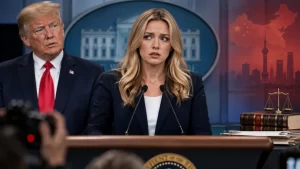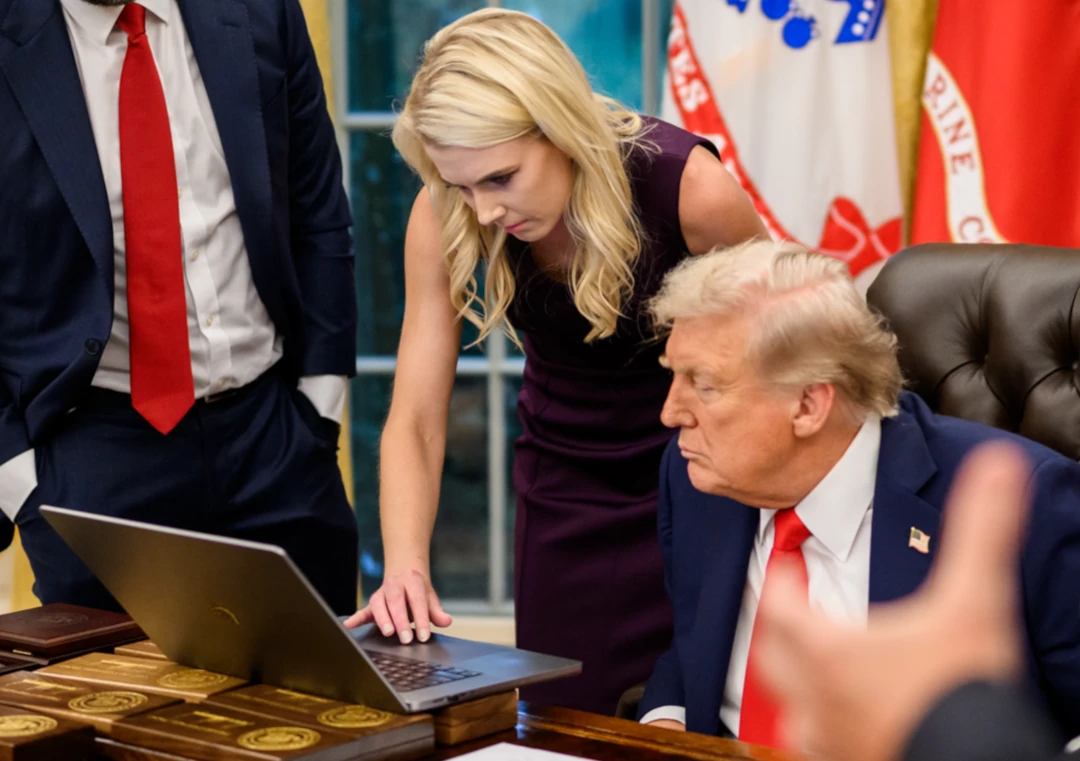
Natalie Harp sits ten feet from the president, curates the information he sees, and — until recently — worked in that role without ever seeking a security clearance. Her newly published letters, and the concerns of Secret Service, biographers, and even her own brother, describe something the White House refuses to name: a serious governance and national-security crisis hiding in plain sight.
The story of Natalie Harp is not, in the end, a story about Natalie Harp. It is a story about a president of the United States who has arranged the machinery of his own information intake around a single 35-year-old aide with no discernible national-security training, no willingness — for more than a year — to submit to the same background check every West Wing intern completes, and a documented emotional attachment to him so intense that the Secret Service reportedly flagged her letters as a security concern. And it is a story about a governing party that has decided, in response, to attack the journalists who are asking why.
The facts on the ground are no longer disputed by serious reporters. Harp, whose official title is executive assistant and special assistant to the president, sits within arm’s reach of Donald Trump for most of his waking hours. She travels with him almost everywhere. She has access to his Truth Social account and posts on his behalf. She curates the printouts, articles, and social-media snippets he reads. When Trump was secretly moved off Air Force One in a catering truck in Turkey last month over an alleged Iranian threat, leaving Secretary of State Marco Rubio, Treasury Secretary Scott Bessent, and much of the traveling staff behind as decoys, Harp was one of the small group who went with him.
That is not a scheduling assistant. That is a filter — and, increasingly, a filter with a lock on the door.
I. A Filter, Not a Functionary
To understand why the last week of reporting matters, you have to understand what Harp actually does. Colleagues have long called her the “human printer”, after her habit of trailing Trump with a portable device and handing him printouts of stories he might like. But MS NOW’s Aug. 19 report made clear that the label vastly undersells the role. A national security official told the outlet that Harp’s proximity to Trump gives her access to more sensitive information than nearly any other senior White House official. Senior staff, MS NOW reported, tried without success to limit her round-the-clock access to the president.
New York Times reporter Maggie Haberman, whose 2024 book with Jonathan Swan first drew wide attention to Harp, put it plainly on CNN this week: Harp “sits 10 feet away from the president. She is a stream of information to him.” Haberman told host Boris Sanchez that most of Harp’s colleagues have been uneasy with her for some time, and that the character of Trump’s second-term operation is defined, in part, by an aide whose job is to keep him supplied with quick, unfiltered, mood-shaping material.
France 24, summarizing the international reporting on Harp, described her role bluntly: she functions as a gatekeeper to the president by controlling the information that gets through — and, per those reports, tends to steer him toward right-wing material. She is not merely handing him articles. She is shaping the sensory field of a man with launch authority over the American nuclear arsenal.
“She sits ten feet away from the president. She is a stream of information to him.”
— Maggie Haberman, The New York Times, on CNN’s “The Source”
II. The Letters — and What They Reveal
On Thursday, The Daily Beast published in full two letters Harp wrote to Trump in 2023, obtained by author Michael Wolff during the reporting of his book All or Nothing. Portions of the letters had surfaced before — first in Wolff’s book, then in short extracts by Haberman in the Times — but this was the first time the American public could read the full text. There is a reason, on reading them, that the Secret Service reportedly began quietly flagging her correspondence years ago.
In one letter, written around the time she accompanied Trump on his 2023 trip to Scotland and Ireland, Harp addresses him as her “Guardian and Protector in this Life.” She tells him “you are all that matters to me” and promises she does not ever want to let him down. She grants him, in her own words, the absolute right to “cuss me out” because, she believes, no one on earth cares about her more than he does. She declares herself “unworthy” of him, and, invoking Jane Austen, tells him she could not have parted with him to anyone less worthy — before adding that she herself does not meet that bar.
These are not the words of a professional aide describing a professional relationship. They read, as Wolff and Haberman have each said, as the correspondence of a person in the grip of something. Wolff, appearing this week on The Daily Beast’s “Inside Trump’s Head” podcast to explain why he decided to release the full letters, called them “a red flag” and said sources inside the White House have “consistently expressed concern” about Harp. Haberman, on CNN, confirmed that the Secret Service had grown alarmed by some of the notes Harp left for Trump in his personal spaces during the years between his terms.
It is not our place, and it is not the place of any responsible outlet, to diagnose Natalie Harp from a distance. Her own estranged brother, Preston Harp, told CNN and the Daily Mail that his sister’s attachment to Trump reads to him as “very unhealthy” and said she has, in his view, sought a replacement father figure since the suicide of their father, Robert Harp, in 2020. That is a family speaking about a family member. What matters, for the country, is not the private diagnosis. What matters is that a person whose devotion has been publicly described by biographers, colleagues, and family as a “fixation,” an “obsession,” and a “cult-like” attachment now stands between the president of the United States and reality — with a badge that authorizes her to type in his voice on his official-adjacent social media account.
III. No Clearance, No Problem?
Every West Wing staffer, from the most junior scheduler to the chief of staff, goes through a federal background investigation. It is not a partisan process. It is not optional. It is the mechanism by which the United States government satisfies itself that the people with routine proximity to classified information and to the president of the United States are who they say they are, and have not been compromised.
For more than a year of Trump’s second term, Harp declined to complete that process. Two people familiar with the matter told MS NOW that her reasoning for refusing has never been made public. The White House counsel’s office grew alarmed. The Secret Service grew alarmed. Trump himself, per the reporting, had to personally intervene before she filled out the paperwork. Only then — reportedly in the last several months — did she begin the formal federal background investigation and receive a clearance.
Press secretary Karoline Leavitt’s response was to insist that “Natalie Harp has a security clearance like everyone else” and to call her a loyal and hardworking member of the team. White House spokesman Davis Ingle, asked about Wolff’s reporting, responded not with a defense of the process but with a personal attack, calling the Pulitzer-shortlisted biographer a “professional scumbag and serial liar” suffering from “Trump Derangement Syndrome.” That is not a national-security answer. It is a heckle.
The actual national-security professionals were more sober. David Axelrod, the former senior adviser to President Obama, wrote on X on Wednesday that if the reporting is accurate, an aide with that much daily proximity to the president who refused for over a year to submit to the clearance process is “a deadly serious issue.” Norm Eisen, the former White House ethics czar, told The Guardian the situation was “shocking”, warning that an aide with potential exposure to highly sensitive information should not have gone unvetted for that long. Richard Painter, President George W. Bush’s chief White House ethics lawyer, was more circumspect but pointed out to the same paper that Harp’s formal duties may not have involved classified material — a distinction that, in a White House, is nearly meaningless when the aide in question is physically within earshot of everything that crosses the president’s desk.
And there is a further question the White House has pointedly not answered: what kind of investigation, exactly, was conducted for someone the president had already publicly wrapped in his personal loyalty? A clearance rushed to completion under presidential pressure, in a White House whose personnel security office has been thoroughly politicized, is a clearance in name. It is a piece of paper produced to make a headline go away. It is not the vetting the American people are entitled to expect for the person who prints out reality for the commander in chief.
IV. The Locker Room, the Prison Offer, the Pattern
The behavioral record on which the concerns rest is not one incident. It is a pattern, documented over several years, in mainstream reporting and in books by Wolff, Haberman, and Swan.
The Bedminster locker room
Wolff’s book All or Nothing reports that when Harp was denied housing during a summer at Trump’s Bedminster golf club, she arranged a maid’s room, then relocated to the women’s locker room to stay closer to the main house. Reported by The Mirror US and widely republished this month.
“I’ll go to prison”
During Trump’s New York criminal trial, Wolff reports, Harp offered to post attacks on witnesses under her own name — and go to jail in Trump’s stead — to circumvent the gag order. Trump’s own lawyers reportedly stared at her as if she had “three eyes.” Detailed in reporting by Yahoo News.
Trump’s own words
According to Haberman and Swan’s Regime Change, Trump has told staff Harp is the only person who loves him as much as his wife and children, and has said “she’ll never leave me.” Summarized this week by the Times of Israel.
The Turkey decoy flight
The Washington Post reported that during a credible Iranian threat at the NATO summit, Trump was secretly moved off Air Force One into a smaller C-32A. Rubio, Bessent, and staff remained on the decoy. Harp was among the tiny group who went with the president. Covered by U.S. News.
A picture emerges from these episodes that is not a picture of a well-adjusted staffer with an unusually demanding boss. It is the picture — attested by multiple named reporters and by a family member on the record — of a person whose life has been narrowed to a single object of devotion, and whose willingness to sacrifice her own liberty for that object is treated inside the West Wing not as a warning but as a job qualification. That is not a criticism of Natalie Harp as a human being. It is a criticism of a president who saw the pattern, took the loyalty, and refused to enforce even the most basic safeguards.
Get Involved Today
Contribute to our mission and turn your concerns into action.
V. A Timeline of a Warning Nobody Heeded
VI. Why This Is Not Gossip, and Not Your Business to Ignore
The White House and its media allies are working, with visible urgency, to reframe this story as one about liberal snickering over a rumored romance. Communications director Steven Cheung’s response to Senator Ossoff was not a policy defense; it was a stream of schoolyard vulgarities. Eric Trump attacked CNN for interviewing Harp’s brother. The talking point being planted is simple: this is beneath the office, and beneath your attention.
It is not. There are three distinct national-security concerns raised by this arrangement, and none of them requires anyone to speculate about anyone’s personal life to be alarmed.
The first is information capture. A president who receives his news, his memos, and his social feed through a single devoted aide is a president whose worldview can be steered by that aide’s biases — conscious or not. When multiple outlets report that Harp tends to steer Trump toward right-wing content and prints only stories she believes will please him, that is not a personality quirk. It is a structural corruption of the process by which the commander in chief is supposed to receive competing information from a professional staff.
The second is foreign leverage. As The Daily Beast and Haberman have both reported, foreign leaders are now using Harp as a conduit to reach Trump directly. Any intelligence service in the world capable of reading English can identify her as the softest and most emotionally invested target of access in the West Wing. A person publicly documented to describe her boss as her “Guardian and Protector” and to sleep in a locker room to be near him is not a hard target. She is, in the vocabulary of counterintelligence, a person of concern — and she went a year without the vetting that would have surfaced whatever the professionals were worried about.
The third is proximity to the nuclear command chain. The president of the United States has sole launch authority. He does not need to consult Congress, the Joint Chiefs, or the cabinet to order the release of nuclear weapons. The last stretch of that chain runs through his own eyes, his own ears, and the small human circle around him. When the person tightest to that circle has spent years being described in Secret Service memos and biographers’ books as a person whose behavior alarms security professionals, that is not a tabloid concern. It is a democracy concern.
“If the person closest to the President and his thinking on a daily basis has no security clearance and refuses to submit to the process of getting it, it’s a deadly serious issue.”
— David Axelrod, former senior adviser to President Obama
VII. The Cover-Up: Attack the Messenger
Trace the White House’s response over the last week and a pattern emerges. When the Washington Post reported the Turkey decoy flight, the White House refused to name who traveled with Trump. When Senator Ossoff mentioned Harp in his Atlanta speech, communications director Steven Cheung answered with obscenities. When Wolff went on the record with the letters, spokesman Davis Ingle recycled a stock insult calling him a “scumbag.” When Preston Harp gave a family perspective on CNN, Eric Trump denounced the interview as “absolute trash.” When MS NOW published the security-clearance story, Karoline Leavitt issued a statement asserting that Harp “has a clearance” — which is not a denial of the underlying reporting but a redirection to the present tense.
None of these responses answers the questions Americans are entitled to have answered. Why did the president’s closest aide refuse for over a year to complete a background check? Who ran her investigation once she finally submitted, and what standard was applied? What role, exactly, does she play with respect to Trump’s Truth Social account and communications with foreign heads of state? Why was she among the tiny handful chosen for the secret Turkey extraction while the secretary of state was left on a decoy? These are not gossip questions. They are governance questions. And a White House that answers governance questions with insults is not defending its aide; it is defending itself.
VIII. What This Says About the Man in the Oval Office
Strip away Harp for a moment and consider what her existence, at this level of access, says about Donald Trump.
It says that the president of the United States has chosen — repeatedly, over the objections of his own counsel and his own protective detail — to be surrounded not by professionals with independent judgment but by a person whose loyalty is total and whose reference to him is religious. It says that he prefers a curated stream of flattering printouts to the daily intelligence briefing. It says that he responded to serious institutional concerns about a subordinate not by adjusting the arrangement but by personally intervening to smooth over the paperwork. It says, in the assessment of the 36 physicians from Harvard, Tufts, Columbia, and George Washington University who entered a statement into the Congressional Record this spring warning of his “rapidly worsening, reality-untethered, increasingly dangerous decline,” that this is the leadership style of a man whose grip on the office is not what it once was.
Ordinary Americans should care about this because it is their government. It is their nuclear arsenal. It is their foreign policy being conducted, in part, on a Truth Social account that a single fixated aide types into. It is their tax dollars paying that aide $150,000 a year to be closer to the president than the vetted professionals whose entire training is to protect the office. The White House would very much like ordinary Americans to look away and treat this as a tawdry side story. That is precisely why they should look at it directly.
The 25th Amendment case that the Harp story quietly strengthens
Section 4 of the Twenty-Fifth Amendment provides that the vice president, together with a majority of the cabinet — or, in the alternative, “such other body as Congress may by law provide” — may declare in writing that the president “is unable to discharge the powers and duties of his office.” Upon transmission of that declaration to the president pro tempore of the Senate and the Speaker of the House, the vice president assumes the powers of the office as acting president. The president may reclaim them, but if the vice president and the same body dispute the reclamation, Congress decides by two-thirds vote in each chamber.
Who has already invoked it
On April 14, 2026, House Judiciary Ranking Member Jamie Raskin (D-Md.), joined by fifty House Democratic co-sponsors, introduced legislation to establish the “other body” the Amendment contemplates: a bipartisan, seventeen-member Commission on Presidential Capacity, empowered to conduct a medical examination of the president and report its findings to Congress. On April 30, 2026, Senators Sheldon Whitehouse and Jack Reed (D-R.I.) entered into the Congressional Record a statement from thirty-six physicians — neurologists, psychiatrists, and cognitive-disorder specialists from Harvard, Tufts, Columbia, and George Washington University — describing the president as “mentally unfit” and calling, with reference to his sole nuclear authority, for the Amendment to be invoked “with the greatest urgency.”
The constitutional argument the Harp record supplies
The Amendment is not a partisan weapon; it is a fitness check. The Harp record does not itself prove incapacity, but it corroborates the pattern the physicians described. A president in full command of his faculties does not personally intervene to short-circuit the standard clearance process for an aide whose devotion has been flagged internally as a security concern. He does not organize his information intake around a single aide who prints only stories he wants to see. He does not choose, in an active foreign-security threat, to keep that aide at his side while leaving his secretary of state on a decoy plane. Each of these is a governance decision, and each is documented on the public record. Taken together with the physicians’ assessment, they describe a man whose judgment about his own office has narrowed to a point Congress cannot responsibly ignore.
The honest assessment of the obstacles
The practical barriers are severe and should be named. Vice President J.D. Vance will not initiate a Section 4 declaration. The cabinet, chosen for loyalty, will not sign it. The Republican-majority Congress will not pass Raskin’s bill, and if it did, Trump could veto it. The Amendment’s drafters did not design it to be easy, and in a moment of one-party control it is close to impossible.
Why the barriers do not negate the case
None of that means the constitutional case is not being made, or that it should not be made. The 25th Amendment exists precisely because the framers of the modern republic understood that a president could become unfit while the political system around him was too afraid, too complicit, or too partisan to act. The record being built today — the physicians’ statement, the Raskin commission bill, and now the Harp reporting — is not primarily for this Congress. It is for the next one, and for the historical record of a moment in which the machinery of American self-government was allowed to run on autopilot, with a “human printer” at the console. The moral and constitutional obligation to name the emergency does not depend on whether the current political configuration is willing to act on it.
IX. What Ordinary Americans Should Do With This
The public should refuse the frame the White House is offering. This is not a tabloid. This is not about whether the president is having an affair with his aide, a question no serious outlet has asserted and no honest reader needs answered to be alarmed. This is about whether the person of the president — the constitutional office, the nuclear-command chain, the daily information feed — has been quietly walled off from professional government and handed to a single unvetted individual whose emotional stake in him is documented in her own handwriting.
The public should demand answers, in oversight hearings, from the FBI on the actual quality of Harp’s rushed clearance investigation, from the Office of the White House Counsel on why the president’s personal intervention was required to enforce a basic rule that binds every intern, and from the Secret Service on why the concerns its agents reportedly raised for years were never elevated into a policy consequence. The public should treat every attempt by the White House to convert those questions into a fight with a reporter as an admission that it has no answer.
And the public should recognize that the story does not end with Natalie Harp. It ends with what her existence, at this level of access, reveals about the man who put her there and keeps her there. That is the fitness question the 25th Amendment was written to allow the country to ask. It is being asked. The record is being built.
Editorial Conclusion
The scandal is not that a young aide became attached to the president she serves. The scandal is that the president of the United States built the machinery of his own information, his own social media, and his own foreign contacts around that attachment, refused for over a year to enforce the most basic vetting on the person at its center, and answers every question about it with a schoolyard insult.
A republic that lets that stand is no longer running on the safeguards the Constitution built. The Twenty-Fifth Amendment exists for exactly this kind of quiet, self-imposed unfitness — and history, if not this Congress, will judge whether the country had the courage to name it.
Sources & References
- The Daily Beast — Natalie Harp’s Intimate Letters to Trump Revealed in Full (Aug. 21, 2026)
- The Daily Beast — Why I Decided to Release Natalie Harp’s Unsettling Letters: Michael Wolff
- MS NOW — Trump aide Natalie Harp worked at the White House without security clearance for a year
- MS NOW — Natalie Harp reportedly wrote letters to Trump gushing over him
- HuffPost — Maggie Haberman Says Secret Service ‘Alarmed’ Over Natalie Harp Letters
- Mediaite — Maggie Haberman Says Secret Service ‘Had Gotten Alarmed’ by Letters
- Time — Why Trump Aide Natalie Harp Is in the News
- France 24 — ‘She’ll never leave me’: Who is Natalie Harp, Trump’s most devoted aide?
- Times of Israel — Trump’s devoted ‘human printer’ thrust into spotlight by Ankara decoy flight
- U.S. News & World Report — Why Trump Aide Natalie Harp Is in the News
- South China Morning Post — Natalie Harp, Trump’s ‘human printer,’ in the spotlight after decoy plane incident
- Straight Arrow News — Natalie Harp’s personal letters to Trump surface as questions grow over her access
- IBTimes UK — Trump Aide Natalie Harp’s Access to Trump Under Fire: ‘Outrageous’ Handling of National Security
- The Mirror US — Natalie Harp allegedly spent summer in Trump’s Bedminster golf club locker room
- Yahoo News — The aide so obsessed with Trump, she sparked security concerns
- Internewscast (Daily Mail interview) — Trump Aide Natalie Harp’s Estranged Brother Reveals Family Feud and Tragedy Behind Their Rift
- Mediaite — House Democrats File Bill to Form 25th Amendment Commission on Trump’s Fitness
- The Hill — Concerns Grow Over Trump’s Mental Fitness for Presidency
- House Judiciary Democrats — Rep. Raskin’s April 10, 2026 letter to Physician to the President Capt. Sean Barbabella (PDF)
- Wikipedia — Natalie Harp (biographical overview with primary-source citations)
Related News