Airwaves for Sale: The FCC Just Handed the Country’s Local News to Trump’s Broadcast Loyalists
In a party-line vote, Chairman Brendan Carr scrapped a 22-year-old rule capping how much of the American television audience one company can own. The winners are the Trump-aligned station groups that already yanked Jimmy Kimmel off the air. The losers are the rest of us.
The Federal Communications Commission has always been an obscure agency to most Americans — the sort of place where lawyers argue about spectrum auctions while the rest of the country pays no attention. That obscurity has now become a weapon. On August 6, in a 2-1 party-line vote, the FCC’s Republican majority repealed the national broadcast ownership cap, a rule that for 22 years had prevented any single company from reaching more than 39 percent of U.S. television households. The commission’s lone Democratic commissioner, Anna Gomez, called the vote unlawful on its face. She is almost certainly correct. She is also, at this hour, almost entirely alone in a position to do anything about it.
What just happened is not, as Chairman Brendan Carr insists, a modernization of an outdated regulation. It is the deliberate, orchestrated dismantling of one of the last structural safeguards protecting local journalism from corporate capture — and it is happening at the exact moment the country needs local journalism most. Two of the biggest station groups in America, Sinclair and Nexstar, are political and financial allies of the president. Both moved to pull Jimmy Kimmel off the air last September within hours of a public threat from the FCC chairman. Both are now positioned to acquire even more of the local news stations that most Americans still rely on for information they trust.
The scale of what has been given away is difficult to overstate. Nexstar’s $6.2 billion acquisition of Tegna, closed in March with FCC approval, already put a single company in front of roughly 80 percent of American TV households. That deal alone was a bulldozer through the 39 percent limit — a limit set in federal statute, not agency whim. This week’s vote didn’t merely raise the fence. It tore the fence down entirely, then handed the deed to the people already inside the yard.
I. The Vote and What It Actually Did
The mechanics matter. The rule the FCC repealed had been written into federal law by Congress in 2004, then reaffirmed in 2012. It says, plainly, that no single broadcaster may own stations reaching more than 39 percent of U.S. television households. Congress set the number. Congress kept the number. The FCC’s own Democratic commissioner told reporters after Thursday’s vote that only Congress has the authority to change it.
Chairman Carr’s replacement is a “case-by-case review” — meaning that going forward, the FCC will decide which mergers to approve based on the FCC’s own judgment of the public interest. As CNN reported, this hands the chairman himself dramatically more discretionary power over which companies get bigger and which do not. It is, in the most literal sense, a transfer of power from the statute books to a single Trump appointee’s desk.
The Vote
Party-line vote on August 6, 2026. Republicans Brendan Carr and Olivia Trusty voted yes; Democrat Anna Gomez dissented, per Variety.
Rule Lifespan
The 39% cap was enacted by Congress in 2004 and reaffirmed in 2012. Only Congress, Commissioner Gomez argues, has the power to change it.
Nexstar Reach
After its March 2026 Tegna merger, Nexstar alone reaches roughly 80% of U.S. TV households, per its own SEC filing.
Sinclair Footprint
Sinclair Broadcast Group operates 178 stations in 78 markets, covering more than 40% of U.S. households, according to Britannica.
Commissioner Gomez did not mince words. Speaking to reporters after the vote, she said the FCC had exceeded its statutory authority — and that the move was designed both to reward broadcasters who cooperate with the president and to punish those who don’t. Per her remarks, this was never about balance, because balancing the ideological content of the news is not the FCC’s job in the first place.
“What this commission wants is power — the power to reward broadcasters who play ball, and punish those who don’t.”
— Anna Gomez, FCC Commissioner (D), August 6, 2026
II. Who Actually Owns America’s Airwaves
To understand why this vote matters, follow the money and the names. The two dominant beneficiaries are not neutral corporate actors. Sinclair Broadcast Group, controlled by the Smith family, has for decades been one of the most politically active broadcast owners in the country. As the Center for Public Integrity has documented, more than 95 percent of Sinclair’s corporate political contributions have historically gone to Republicans — a lopsided pattern unmatched by any other major television broadcaster. Sinclair executive chairman David Smith is a longtime Republican donor who, per Free Press, has used the network’s hundreds of local stations to promote the president’s political worldview. In 2024, Smith personally purchased The Baltimore Sun, which soon began publishing stories with the company’s trademark right-wing tilt.
Nexstar is not much different. The company’s PAC has given the overwhelming majority of its political contributions to Republican causes over multiple election cycles, and its CEO Perry Sook has donated roughly six times as much to Republican members of Congress as to Democrats, per federal records compiled by watchdog groups. When Chairman Carr suggested last September that ABC affiliates should drop Jimmy Kimmel, Nexstar was the very first station group to comply — while a $6.2 billion merger with Tegna sat pending before that same FCC.
This is not a paranoid reading of coincidence. It is the observable pattern: the biggest station groups aligned with the president got a green light for a mega-merger from Trump’s FCC in March, then got the underlying statutory limit that constrained that merger nullified in August. The companies most likely to acquire the next wave of local stations are the same companies that have already demonstrated they will yank programming the White House doesn’t like.
III. The Kimmel Precedent — What Consolidation Looks Like in Practice
Anyone who wants to see how this new consolidated broadcast landscape will actually behave does not need to speculate. The blueprint was drawn in September 2025. After Jimmy Kimmel made comments about the Charlie Kirk assassination that infuriated Republican audiences, Chairman Carr appeared on a conservative podcast and delivered a threat that has since been quoted in nearly every serious account of press freedom in the second Trump term: the FCC could do this the easy way or the hard way. Within hours, Nexstar announced it was pulling the show. Sinclair followed. ABC, owned by Disney, suspended the program indefinitely.
Kimmel eventually returned. But as the Columbia Journal of Law & the Arts documented, the episode was a stress test that the industry failed. When a Trump-appointed regulator gestured toward “news distortion” enforcement, the two largest station groups in the country capitulated within a news cycle. Senator Ed Markey publicly demanded Carr testify. Senator Elizabeth Warren and others sent letters to Nexstar and Sinclair asking whether the merger pending before Carr’s FCC had shaped their decision. The companies’ answers were not reassuring.
The now-repealed cap was one of the few remaining brakes on that dynamic. It said, in effect: no matter how eager you are to please the administration, there is a legal ceiling on how much of the country you get to speak to. That ceiling is gone. What replaces it is Chairman Carr’s personal judgment, applied case by case, to companies with clear financial incentives to earn his favor.
“Trump’s FCC Chair is trying to illegally rewrite the rules to make it easier for billionaires to line their own pockets while jacking up costs and controlling what Americans watch.”
— Sen. Elizabeth Warren (D-Mass.), August 7, 2026
IV. The Fifth Estate on Life Support
The idea of a free press as the “fifth estate” — a check on power that answers only to the public — depended on a specific structural condition. Ownership had to be plural. If one company owned every station in a market, or every station group across the country, then the theoretical freedom of the press collapsed into whatever that owner would tolerate. That is why the ownership cap existed in the first place. It was not a technical detail. It was constitutional plumbing.
Local broadcast news remains, for millions of Americans, the primary source of information about their communities and their government. It is where storm warnings live. It is where school board meetings get covered. It is where the closure of a hospital or the poisoning of a river first becomes news. When a single corporate parent controls the newsroom, editorial decisions get centralized — and, as Sinclair has demonstrated for years, “must-run” segments produced at corporate headquarters displace local reporting. In 2018, dozens of Sinclair anchors were forced to read an identical script denouncing “fake news” — a montage that went viral precisely because it revealed what mass consolidation actually sounds like.
Commissioner Gomez warned before the vote that this would destroy local newsrooms and silence community reporting. Frank Pallone, ranking Democrat on the House Energy and Commerce Committee, sent Carr a letter in February reminding him that only Congress can change the cap, and that eliminating it would produce unprecedented consolidation that benefits only the largest station owners at the expense of competition, localism, and diversity of voices. Rep. Diana DeGette of Colorado called Carr’s end-run around Congress disturbing. Matt Wood, general counsel for Free Press — the advocacy group that has already vowed to sue — said the plain purpose is to spur more consolidation involving companies the president views as ideological allies.
The court challenges are coming. Attorneys general from California, New York, Colorado, Illinois, Oregon, North Carolina, Connecticut, and Virginia have already sued to block the Nexstar-Tegna combination. A preliminary injunction from the Eastern District of California is currently pausing further integration of that merger. But litigation is slow, and consolidation is fast. Even a partial victory in court arrives too late for the local reporter laid off next month.
V. What This Costs the Average American
The temptation is to treat media ownership rules as a niche concern for policy wonks. That temptation should be resisted. The people who lose here are not abstract. They are viewers who will find that the “local” news they watch tonight was actually assembled at a corporate headquarters two thousand miles away. They are voters who will have fewer independent perspectives on the ballot initiative in their state. They are consumers who, as the state attorneys general have explicitly warned, will pay higher prices because reduced competition raises the fees broadcasters extract from cable and satellite carriers — costs that get passed straight down the bill.
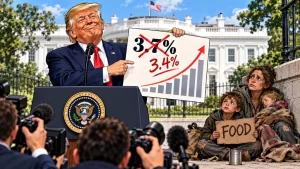
And the timing is what turns this from a policy failure into a political indictment. The FCC vote landed in the middle of what by any honest measure is a compounding domestic crisis. Inflation hit 4.2 percent in May, its highest level in three years, driven by energy prices that surged after the president’s military strikes on Iran in February. Gasoline is over four dollars a gallon. Mortgage rates have climbed with Treasury yields as inflation expectations reset. The war itself — a war of choice, launched without a congressional declaration — is now in its sixth month.
Inflation, May 2026
Highest in three years, per the Bureau of Labor Statistics — driven largely by energy costs since the Iran war began.
Gas Price
Average per gallon, and climbing, as Strait of Hormuz shipping disruptions continue, per NBC News.
Iran War Cost
Independent analysts have estimated the daily cost of the ongoing military operation against Iran at roughly $1 billion per day.
Asked in June about the inflation numbers, the president told reporters he loved the inflation. This is not a caricature. It is a direct quotation reported by multiple outlets. He said it would go away once his war was over. His war shows no sign of ending. And the American families paying the higher prices are the same American families about to see their local news operations swallowed into station groups aligned with the administration causing the pain.
That last point is not incidental. It is the point. When the same government that has bungled the war and mismanaged the affordability crisis also gets to decide which companies get to tell voters about the war and the affordability crisis, the accountability loop breaks. Consolidated broadcasters that owe their expansion to a friendly FCC do not, as a rule, produce hard-hitting coverage of that FCC. Priorities become inverted. The airwaves — which are, legally, public property leased to broadcasters under a public-interest standard — start functioning as an extension of the administration’s communications shop.
Get Involved Today
Contribute to our mission and turn your concerns into action.
VI. How We Got Here — A Timeline
A President Whose Judgment Is Now the Country’s Emergency
Section 4 of the 25th Amendment provides the mechanism the framers of the modern presidency built for exactly this situation. When the Vice President and a majority of the Cabinet transmit a written declaration to Congress that the President is unable to discharge the powers and duties of his office, those powers pass immediately to the Vice President as Acting President. It requires no impeachment vote. It requires no criminal charge. It requires, simply, an admission by the people closest to the President that the country cannot safely be run from where he is standing.
The public record now supporting that admission is unusually thick. On Easter Sunday of this year, the president posted a social-media threat to obliterate Iranian power plants and bridges in a message that even his own former allies described as unhinged. Within days, Rep. Jamie Raskin, ranking member of the House Judiciary Committee, formally demanded a cognitive evaluation from the White House physician. Rep. Raja Krishnamoorthi called on Vice President JD Vance and the Cabinet to invoke Section 4. Sen. Ed Markey, Rep. Sydney Kamlager-Dove, Rep. Yassamin Ansari, and Rep. Eric Swalwell had already called for the amendment’s use in January after the president’s threatening message to the Prime Minister of Norway. By April, more than 70 Democratic lawmakers had joined the call.
What the FCC vote adds to the case
This week’s vote is not, by itself, a psychiatric symptom. It is something arguably more damning: evidence of settled priorities. In the same six-month stretch in which the president has presided over an active war of choice, a three-year inflation high, and a widening affordability crisis, his FCC has devoted its energy to punishing a late-night comedian, greenlighting a merger for political allies, and now nullifying by fiat a statutory limit set by Congress. This is not the agenda of an administration focused on the country. It is the agenda of an administration focused on entrenching itself against the country’s ability to see it clearly.
The barriers — and why they don’t dissolve the case
The practical obstacles to invoking the 25th are real. Section 4 requires the Vice President and a majority of the Cabinet — appointees selected precisely for their loyalty. If the President contests the removal, Congress must sustain it by two-thirds vote in both chambers, a threshold no current whip count reaches. These are not small hurdles. They are the reason the amendment has never been used against a sitting president. But the fact that the mechanism is politically difficult does not mean the constitutional argument is weak. The framers of the amendment did not require ease of use. They required only that the country, and the officials closest to the presidency, be capable of naming what everyone can see.
What everyone can now see is this: a president who declared war without Congress, who says he loves the inflation his war produced, and whose FCC has spent the year converting the public airwaves into a loyalty program. The 25th Amendment exists precisely so that the constitutional order does not have to wait for a next election to correct itself. Whether the current Cabinet has the courage to use it is a question about the Cabinet, not about the amendment.
Editorial Conclusion
A functioning democracy cannot survive the merger of state power and broadcast power. The 39 percent cap was one of the last sandbags holding that flood back. The FCC just kicked it out.
The stakes are not partisan. They are structural. When the same administration that started a war of choice, presides over a three-year inflation high, and threatens comedians on podcasts also decides who owns the news stations covering all of it, the country is no longer being governed — it is being managed for a narrower audience than itself.
Congress must reassert its statutory authority over the ownership cap. The courts must halt the consolidation the FCC has now invited. And the Cabinet must answer, in daylight, why the constitutional remedy the 25th Amendment provides has not yet been used. The public airwaves belong to the public. It is well past time the public took them back.
Sources & References
- NBC NewsFCC scraps limit on broadcast TV ownership (Aug. 6, 2026)
- CNN BusinessFCC repeals national TV ownership cap, a win for Trump-aligned broadcasters
- VarietyFCC Eliminates TV Station Ownership Cap
- AxiosFCC votes to lift broadcast ownership cap
- The HillFCC votes to scrap national television ownership cap
- The DeskGomez remarks after ownership cap repeal
- Colorado Public RadioPallone & DeGette on FCC end-run
- Gizmodo“Unlawful on its face”: FCC eliminates cap
- DeadlineWarren statement on FCC vote
- PoynterNexstar-Tegna merger approval and state AG lawsuit
- CNBCNexstar-Tegna merger closes
- SEC / Nexstar 10-QFiling showing ~80% household reach post-merger
- Free PressWho Owns Sinclair — media ownership analysis
- BritannicaSinclair Broadcast Group — history and holdings
- Center for Public IntegrityBroadcasters’ political giving patterns
- Columbia Journal of Law & the ArtsKimmel preemption and FCC television regulation
- WashingtonianHow Brendan Carr became MAGA’s media watchdog
- Sen. MarkeyMarkey urges Senate testimony from Carr
- House Judiciary DemocratsRaskin demands cognitive evaluation of president
- Rep. KrishnamoorthiKrishnamoorthi calls for 25th Amendment invocation
- NBC NewsIran war fuels inflation, gas prices, mortgage rates
- MS NOWTrump “loves the inflation”; costs hit 3-year high
- FCC (Official)FCC — Replaces National Broadcast Ownership Cap (Aug. 6, 2026)
Related News