The Purge and the Ports: A Wartime Navy Beheaded
A ballistic-missile submarine commander gone. A Navy Secretary fired mid-blockade. A destroyer captain pulled off the line during a strike exercise. An Army Chief of Staff shown the door while the 82nd Airborne was still boarding planes. In the middle of a shooting war with Iran, the President and his War Secretary are dismantling the American chain of command — and the country is being asked not to notice.
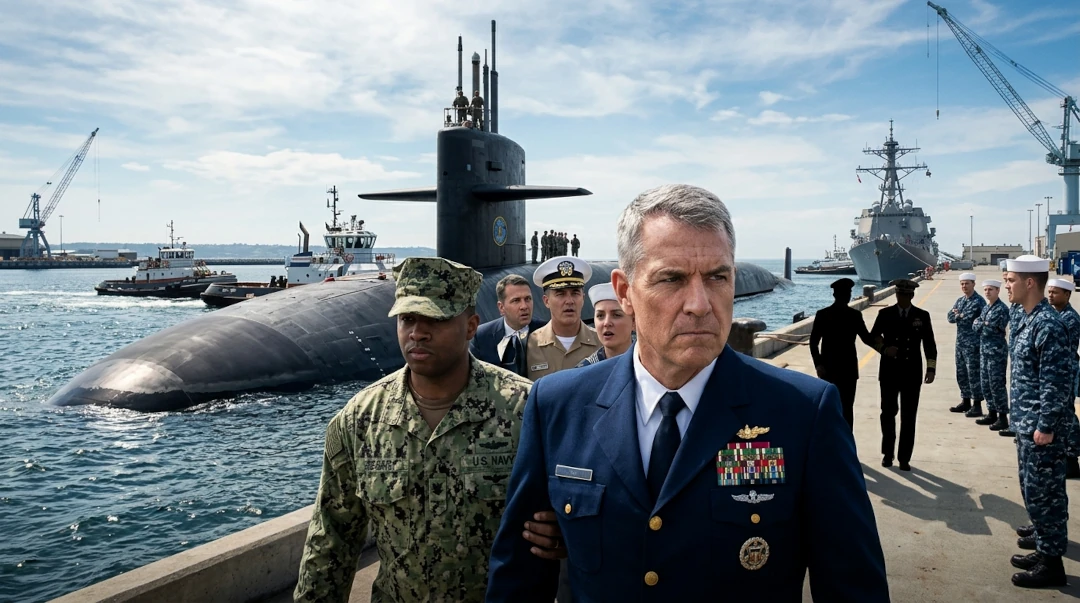
On July 30, 2026, at Naval Submarine Base Kings Bay, Georgia, the commanding officer of the USS West Virginia — one of fourteen Ohio-class ballistic-missile submarines that constitute the sea-based leg of the American nuclear triad — was relieved of his post. Commander Joseph Sammur had held command for less than a year. Submarine Squadron 20 removed him citing a “loss of confidence in his ability to command,” a phrase the Navy uses when it does not want to explain itself. According to USNI News, the relief followed an investigation into a maintenance issue. According to the Navy Times, no further specifics have been offered. To the American public, still less has been offered: an official press release stating that “the relief of the CO does not impact the ship’s mission or schedule,” and a temporary replacement named the same day.
The West Virginia is not a training vessel. She is a strategic nuclear deterrent — the type of platform that, alongside her sister boats, prevents wars from becoming apocalypses. That her commanding officer can be quietly removed, in the middle of a war and a naval blockade of Iran, and that the Navy considers this beneath detailed public explanation, is itself the story. It is also not an isolated incident. It is the visible piece of a pattern that has now consumed the Chief of Naval Operations, the Navy Secretary, the Army Chief of Staff, four-star generals, submarine commanders, destroyer captains, and the military’s top uniformed lawyers. It is a purge conducted mid-war. And it is being done, transparently, on political grounds.
I. Kings Bay, and What It Means
The dismissal of Cmdr. Sammur cannot be understood in isolation from the dismissal, last October, of Cmdr. Robert Moreno from the USS Wyoming, another Ohio-class boomer home-ported at the same base. As Stars and Stripes reported at the time, Moreno’s firing was one of a series that included the commander of the USS Santa Barbara — the littoral combat ship then deployed to the 5th Fleet’s area of responsibility in the Middle East — the Navy’s Chief of Naval Operations Admiral Lisa Franchetti, the head of Naval Special Warfare Command, and the commander of the Navy Reserve. Two of the boomers that carry the American second-strike deterrent have now lost their captains in less than ten months. In neither case has the Navy told the public why.
What is being asked of the American people is a quiet trust that this is normal. It is not normal. Firing patterns in the surface and submarine fleet do occur, but the density, timing, and secrecy of these relievings are without recent precedent — and they are occurring in the middle of what the administration has named Operation Epic Fury, the American war on Iran that began in February and has been suspended and reignited by presidential Truth Social post more times than the American public has been told casualty numbers.
II. The Phelan Ouster: A Navy Secretary Learns He Is Fired by Reading Twitter
The most revealing case, and the one the public should study most carefully, is the sudden departure of Secretary of the Navy John C. Phelan. On the evening of April 22, 2026 — with U.S. Navy forces actively conducting the blockade of Iranian ports the President had ordered after ceasefire talks in Islamabad collapsed — Chief Pentagon spokesman Sean Parnell announced on X that Phelan was “departing the administration, effective immediately.” No reason was given. Phelan had spoken to reporters just a day earlier at the Navy’s annual conference.
The reporting from CNN is worth reading closely. According to six sources familiar with the matter, Phelan did not resign. Defense Secretary Pete Hegseth informed him he needed to resign or be fired. Phelan appears not to have believed the message came from the President. He began telephoning White House officials to ask whether they had heard the news, and whether Trump was aware. He went to the grounds of the White House. He walked through the Eisenhower Executive Office Building looking for people he knew. He asked for a meeting with the President. The Washington Post described the exit as an “abrupt exit after 13 tumultuous months”. According to Military.com, Trump was reportedly displeased with shipbuilding progress and with what has been called the “Trump Class” battleship program — a source of frustration for Hegseth and Deputy Secretary Stephen Feinberg, who wanted a Navy oriented around smaller, unmanned platforms.
“Everybody knows about some of the Game of Thrones stuff going on with some of the other service secretaries and Hegseth. It seems like he wants to run the whole place.”
— Sen. Thom Tillis (R-N.C.), to The Hill, July 2026
This is a Navy Secretary — a Republican donor confirmed with bipartisan support who took office thirteen months earlier — who did not know he had been fired until a Pentagon spokesman posted about it. He was, in the words of Phelan’s own reported reaction, seeking confirmation from the President. He did not get it. He is now a private citizen, and the acting Secretary of the Navy is his former deputy, Hung Cao. The PBS NewsHour noted that the departure came the same week Trump had said U.S. Navy assets would blockade the Strait of Hormuz following the collapse of ceasefire talks. This is the civilian leadership of the Navy at war. The reader is invited to consider whether a healthy chain of command dismisses its own service secretaries by tweet.
III. The Mason, the Chief, and the Chaplain
The pattern precedes the West Virginia firing by nearly six months. On February 13, 2026 — days before the Iran war officially began under the codename Operation Epic Fury — Capt. Chavius G. Lewis, commanding officer of the guided-missile destroyer USS Mason, was relieved by Rear Adm. Alexis T. Walker of Carrier Strike Group 10. The Mason was in the middle of Composite Training Unit Exercise, the pre-deployment certification that determines whether a warship is ready to enter combat. As Military Times and USNI News both reported, no reason was given beyond the phrase “loss of confidence.” The Mason had a distinguished record: she had shot down Houthi missiles and drones in the Red Sea in the counter-Houthi campaign of 2023 and 2024. Her captain was pulled off the bridge, in the middle of certification, on the eve of a war.
Six weeks later — on April 2, 2026, during active U.S.–Israeli operations against Iran and while elements of the 82nd Airborne Division were deploying to the Middle East — Defense Secretary Pete Hegseth ousted the Army Chief of Staff, Gen. Randy George. He also fired Gen. David Hodne, head of the Army Transformation and Training Command, and Maj. Gen. William Green Jr., the Army’s chief of chaplains. No public reason was given. According to reporting from Common Dreams, Sen. Chris Murphy, a member of the Senate Armed Services Committee, said the ousted generals had been telling Hegseth that his Iran war plans were unworkable and deadly. According to The Christian Science Monitor, the firings marked the twelfth or thirteenth removal of a top general or admiral in the Trump second term. The Army had also been forced to see its vice chief of staff, Gen. James Mingus, pushed out the previous October.
Gen. Charles Q. Brown Jr.
Chairman of the Joint Chiefs of Staff, fired by Trump. Adm. Lisa Franchetti, the first woman to serve as Chief of Naval Operations, and Gen. Jim Slife of the Air Force removed the same week.
Capt. Chavius G. Lewis, USS Mason
Relieved during the destroyer’s pre-deployment Composite Training Unit Exercise — the certifying exam for entering combat. No reason offered. Two weeks later, Operation Epic Fury began.
Gen. Randy George, Gen. David Hodne, Maj. Gen. William Green Jr.
Army Chief of Staff, head of Transformation and Training Command, and the Army’s chief of chaplains — all fired in a single day while U.S. troops were engaged with Iran.
John C. Phelan
Learned of his own firing from a Pentagon spokesman’s social media post. Sought confirmation from Trump; never got it. The Navy at that moment was blockading Iran.
Cmdr. Joseph Sammur, USS West Virginia (Blue)
Commander of an Ohio-class ballistic-missile submarine relieved after less than a year in command. The second Kings Bay boomer to lose its skipper in ten months.
The Service Judge Advocates General
Top uniformed lawyers of the Army, Navy, and Air Force — the officers responsible for advising on the legality of military orders — were fired in the early months of the administration. No public reason given.
IV. A Chain of Command in Twelve Months
Compressed into a timeline, the pattern is more legible — and more alarming — than the drip of individual news stories has allowed the public to see:
V. Readiness, Morale, and What This Means to the Ship
The Composite Training Unit Exercise, the certification the Mason was in the middle of when her captain was removed, exists for a reason. It tests a strike group under stress. It builds the muscle memory a crew needs when Iranian anti-ship missiles are inbound over the Red Sea. As Military.com observed at the time, “even when the Navy emphasizes there is ‘no impact to operations,’ leadership transitions during major exercises can introduce friction.” What that sober phrase describes, in plain English, is this: a captain sets the rhythm and the standards of a warship, and when he is removed under unclear circumstances, sailors who trusted him now do not know why. That corrosive uncertainty is what militaries call a morale problem, and it is what generals call, when they are being candid, a readiness problem.
Sen. Thom Tillis, the North Carolina Republican who is not seeking reelection and has emerged as the loudest GOP critic of the Pentagon leadership, told The Hill that Hegseth is undermining the Department of Defense’s success “by undermining these brilliant people who spent their career in uniform.” Sen. Jack Reed, the ranking Democrat on the Senate Armed Services Committee, told Hegseth in open session that the Pentagon has been “paralyzed by infighting and stripped of expert staff” at the precise moment America needs stability. Sen. Jeanne Shaheen has noted that roughly 40,000 U.S. troops are stationed in range of Iranian missiles. Sen. Jacky Rosen and other Democrats have written to demand honest casualty reporting, saying the administration has failed to give timely updates on the war’s personnel and readiness impacts.
The public does not yet know the full American casualty count from Operation Epic Fury. CNN has reported at least four killed and 270 wounded in the “overseas operations” category from July 7 forward. Those numbers are conservative and incomplete, and the reason they are incomplete is that the Pentagon under Hegseth has stopped answering the questions Congress is asking. Democracies that fight wars and refuse to count their dead are not democracies that are winning wars.
Get Involved Today
Contribute to our mission and turn your concerns into action.
VI. Force Projection, and the Cost of Bluffing
Consider what the Iranian regime is watching. It sees an American Navy that in ten months has fired the commanders of two of its ballistic-missile submarines, its chief of naval operations, its head of Naval Special Warfare, its head of the Reserve, a destroyer captain during his certification exercise, and its civilian Navy Secretary. It sees a President who alternates public threats of civilizational annihilation with public announcements that he has, at the last minute, canceled the strikes. It sees ceasefires that Trump announces and Iran denies were ever agreed to. It sees the Iranian foreign ministry, quoted by CNN, saying “we have no negotiations with the United States at present.”
The projection of American force depends on adversaries believing the President means what he says and the chain of command can execute what he means. Neither belief survives what has happened this year. When Trump wrote on August 1 that the United States was “locked and loaded and ready” and then, in the same post, that he had agreed to cancel the attack, he confirmed to Tehran what Tehran already suspected: American threats can be waited out. That is not deterrence. That is the opposite of deterrence. And it makes the peace harder to negotiate, because the Iranian regime has less reason than ever to believe an American promise, whether that promise is of a strike or of a settlement.
“When you’re a leader, you better damn sure have people smarter than you in the room. He’s undermining the DOD’s success by undermining these brilliant people who spent their career in uniform.”
— Sen. Thom Tillis (R-N.C.), on Sec. Hegseth’s leadership
VII. What This Costs the American at the Gas Station
The consequences are not confined to the Pentagon and Tehran. The war has driven roughly 20 million barrels of daily oil transit through the Strait of Hormuz to near-zero at times, according to CNN’s ship-tracking data. That is not an abstraction. It is the price at the pump in Beacon and Buffalo and Bakersfield. It is the shipping costs baked into every consumer good in the Amazon warehouse. Senate Republicans, according to The Hill, are increasingly worried that “stubbornly high gas prices” will cost them the midterms — a candid admission that the political class understands what the ordinary voter feels every week. Hegseth has testified that the war has cost roughly $37.5 billion so far; the administration has now asked Congress for another $70 to $80 billion. That is money the American taxpayer will not get back, and it is being spent under the leadership of a Defense Secretary in whom, as Sen. Tillis has said publicly, he has lost confidence.
VIII. What This Says About Priorities
What is being purged is not incompetence. Gen. Randy George served under three presidents, fought in the first Gulf War, in Iraq, and in Afghanistan. He was a graduate of West Point and an infantry officer. Capt. Lewis had commanded two littoral combat ships. Cmdr. Sammur had trained at the Naval Reactors Division and served at U.S. Strategic Command. These are not the résumés of the incompetent. What they have in common is that they were, per NBC’s reporting and the reporting of Rachel Maddow’s team, either standing in the way of Hegseth’s ideological reshaping of the officer corps — his campaign against so-called “wokeness” — or, per Sen. Murphy, telling him that the President’s Iran war plans would not work. What is being rewarded is loyalty. Gen. Randy George was replaced by Gen. Christopher LaNeve, who had previously served as Hegseth’s personal military aide. The pattern is unmistakable.
What this reveals about the administration’s priorities is that they are not the priorities of a nation at war. They are the priorities of a royal court. In a court, the ruler cannot tolerate news he does not like; therefore the messenger is punished. In a nation at war, the President wants the officers who will tell him the truth, because the truth is what keeps sailors alive on submarines and infantrymen alive on the ground. This administration wants the officers who will tell it that the plan is working. That is why Chris Murphy’s assessment matters: the generals were fired because they said the plan would not work.
The 25th Amendment Is Not a Political Weapon. It Is a Fire Alarm.
The 25th Amendment to the United States Constitution, ratified in 1967 in the aftermath of the Kennedy assassination, provides in Section 4 that if the Vice President and a majority of the Cabinet — or a majority of “such other body as Congress may by law provide” — transmit a written declaration that the President “is unable to discharge the powers and duties of his office,” the Vice President becomes Acting President. It has never been invoked. It exists precisely for the case in which the elected head of state, while still constitutionally in office, cannot be trusted to hold the powers of the office. It is not a substitute for impeachment. It is a substitute for catastrophe.
Since April, calls to invoke it have come from an unusual coalition. Rep. Raja Krishnamoorthi (D-Ill.) issued a formal statement on April 7 calling on Vice President Vance and the Cabinet to act, describing a “dangerous pattern of reckless escalation, erratic decision-making, and general conduct that raises grave questions about his fitness to discharge the duties of the presidency.” Rep. Mike Quigley (D-Ill.) issued a parallel call. Rep. Alexandria Ocasio-Cortez, Rep. Ro Khanna, Rep. Melanie Stansbury, Rep. Yassamin Ansari, Sen. Ed Markey, Rep. Sydney Kamlager-Dove, Rep. Eric Swalwell, and Sen. Bernie Sanders have made similar public demands. According to Axios, over 70 lawmakers have publicly floated the amendment or impeachment since the April “civilization will die tonight” post. Ty Cobb, who served as White House counsel during Trump’s first term, told The Jim Acosta Show that the President is “clearly insane” and that the war highlights it. Rep. Marjorie Taylor Greene, former Rep. Joe Walsh, Candace Owens, and Alex Jones — figures who cannot be dismissed as partisan Democrats — have called for the same. According to Forbes, the coalition is bipartisan in a way not seen before this Presidency.
The Constitutional Argument
The case being made is not merely that Trump is unpopular. It is that a President who threatens the extermination of a civilization in the morning and cancels the attack in the afternoon, who fires the officers who tell him his plans will not work while his own troops are in range of enemy missiles, and who dismisses his own service secretaries by tweet without their knowledge, is a President who cannot be trusted with the launch codes he currently possesses. Cmdr. Sammur commanded a submarine that carries them. The 25th Amendment exists for exactly this kind of question.
The Practical Barrier
Section 4 requires the Vice President and a majority of the Cabinet. Vice President JD Vance would need to move against the President who chose him, and a Cabinet composed largely of loyalists would need to join him. There is no public indication either will occur. As CNN’s Zachary Wolf observed on April 7, “there are no indications any Cabinet officials are considering it right now.”
Why the Barrier Does Not Negate the Argument
That the mechanism is politically difficult does not mean it is constitutionally inappropriate. It means the framers built a safeguard designed to be difficult, and the people who currently hold the offices required to use it are unwilling to. That is a statement about them, not about the amendment. The reason Trump’s Cabinet will not invoke Section 4 is not that the case is weak; it is that the Cabinet has been selected for loyalty rather than for the willingness to act on constitutional duty. The correct response to that reality is not to stop naming the case. The correct response is to keep naming it — in Congress, in the press, and to the electorate — so that when the next opportunity for constitutional accountability arrives, whether through impeachment, through the ballot, or through a Section 4 vote that history may yet see, the record is unambiguous.
IX. The Future of the Free World
The American Navy is the connective tissue of the postwar international order. Its ballistic-missile submarines are the reason no great power has fought another since 1945. Its carrier strike groups are the reason a shipping lane in the Malacca Strait, in the Persian Gulf, in the Baltic remains open. When the American public reads that the commander of the USS West Virginia has been quietly relieved and the Navy will not say why, the reader in Kyiv reads it too. The reader in Warsaw reads it. The reader in Taipei reads it. So does the reader in Beijing and Moscow and Tehran. The American promise to the free world is that this Navy, and the officers who lead it, are professionals whose competence is not for sale and whose loyalty is to the Constitution rather than to a party. Every firing that goes unexplained, every service secretary dismissed by tweet, every general punished for honest advice erodes that promise. The Iranian foreign ministry is watching. The Chinese Politburo is watching. The Russian general staff is watching. The Kims are watching. And so are the eighteen crews of the American ballistic-missile submarine force, who need to know their own government has not lost its mind.
Editorial Conclusion
A President in his right mind does not fire the commander of a nuclear submarine, an Army Chief of Staff, and a Navy Secretary in four months while his own troops are within range of enemy missiles. A President serious about winning a war does not purge the officers who warn him the war plan will fail. A President who understands the office he holds does not learn to trust his generals by dismissing the ones who tell him the truth.
The firings at Kings Bay, at Mayport, and at the Pentagon are not a personnel story. They are a constitutional one. A commander-in-chief who cannot bear disagreement in wartime is a commander-in-chief whose fitness for the office must be measured against the standard the 25th Amendment was written to enforce. The Cabinet that will not measure him will be judged by history for its silence. And every American who understands that the Navy protecting them at sea is being led by fear rather than by competence has a duty — before the next threat, before the next launch code, before the next war — to say so out loud.
The Republic does not survive on the assumption that the man in the Oval Office is well. It survives on the willingness of the citizens who elected him, and the officials who serve under him, to act when he is not.
Sources & References
- USNI News — “Navy Relieves Commander of Sub USS West Virginia” (Aug. 3, 2026)
- Navy Times — “Navy fires commanding officer of USS West Virginia” (Aug. 3, 2026)
- U.S. Navy Press Release — Relief of USS West Virginia Commanding Officer (July 30, 2026)
- Military.com — “A Navy Commanding Officer Has Been Relieved for ‘Loss of Confidence'”
- CNN — “US Navy Secretary Phelan fired as naval blockade of Iran continues” (Apr. 22, 2026)
- Washington Post — “John Phelan out as Navy secretary after 13 months” (Apr. 22, 2026)
- PBS NewsHour — “Navy Secretary John Phelan is leaving, Pentagon says”
- Military.com — “What Led to Navy Secretary John Phelan Losing His Job?”
- Military Times — “Navy fires commanding officer of destroyer USS Mason”
- USNI News — “Destroyer USS Mason CO Removed from Command”
- Military.com — “USS Mason Commander Relieved: The Hidden Cost of ‘Loss of Confidence'”
- Stars and Stripes — “Navy removes commander of submarine USS Wyoming”
- Common Dreams — “‘Singularly Unqualified’ Hegseth Executes Purge of Top Military Brass”
- Christian Science Monitor — “With U.S. at war, Hegseth’s Army leadership purge raises questions”
- The Hill — “GOP senators warn confidence in Pete Hegseth eroding as Iran war drags on”
- The Hill — “Senate GOP expresses concern over Iran endgame after Hegseth hearing”
- Defense One — “Hegseth’s conflicting statements, evasions drain lawmakers’ patience”
- Office of Sen. Jacky Rosen — Letter on Iran war casualty transparency
- Forbes — “How The 25th Amendment Could Be Used To Remove Trump”
- Axios — “Trump 25th Amendment chatter erupts among Dems over Iran post”
- CNN — “An eclectic, bipartisan group suddenly calls for removing Trump using the 25th Amendment”
- Rep. Raja Krishnamoorthi — Statement calling for 25th Amendment
- Rep. Mike Quigley — Statement calling for 25th Amendment
- CNN Iran War Live Updates (Aug. 2, 2026)
- CNN Iran War Live Updates (Aug. 4, 2026)
Related News