The Trillionaire’s Ballot: How Elon Musk Bought In, Cashed Out, and Came Back
A South African–born billionaire, a president who once called him a friend and then an enemy, a Supreme Court that keeps loosening the tap, and a Democratic Party still searching for a wrench. What America’s most expensive elections tell us about who the country now belongs to — and who it does not.
Elon Musk said he was done with politics. In May of 2025, standing on a stage at the Qatar Economic Forum, the world’s richest man told an interviewer that he would be spending “a lot less” on political races going forward. He said he had done “enough.” He said, later, that he had gotten “a little too involved.” For those who believed a trillionaire could be shamed into deference to the ordinary voter, it was, briefly, a hopeful sentence.
Fifteen months later, according to reporting first surfaced by The New York Times and confirmed across the political press, Musk’s America PAC has been authorized to spend between $100 million and $120 million to prop up Republicans in at least eight states this November. Senate races in Alaska, Iowa, Maine, Michigan, and Ohio are already in the crosshairs. Conversations continue over Georgia, North Carolina, and Musk’s adopted home of Texas. House races in California, Wisconsin, and Washington are on the target list too. The operation will be run by Musk’s top political adviser, Chris Young, and it will function, in effect, as a shadow field arm of the Republican National Committee — a private turnout machine, financed by one man, executing on behalf of a party whose president once shared a “lovely dinner” with him at Mar-a-Lago in January and posted afterward that “2026 is going to be amazing.”
Amazing for whom? Not for the citizen who casts a ballot believing it counts as much as anyone else’s. Not for the working household that will be door-knocked by a canvasser paid out of a single man’s fortune. Not for the constitutional design that once treated elections as a contest of ideas rather than a contest of checkbooks. As former Labor Secretary Robert Reich observed in a weekend essay, Musk’s money is not merely a problem. It is a signal. A Republican candidate who “stinks of Musk,” Reich argued, “must be presumed to be against average working Americans.” That is not partisanship. That is arithmetic.
I. The Return of a Money Volcano
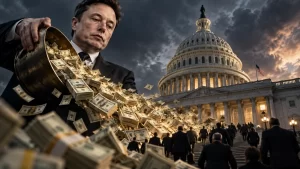
To understand the stakes of what is happening this fall, remember what happened in 2024. According to a Washington Post analysis of final Federal Election Commission filings, Musk spent at least $288 million to elect Donald Trump and other Republicans — the largest single-cycle personal outlay in American political history. CBS News pegged the figure at $277 million; CNN at more than $260 million; the precise number varies with the accounting, but the direction does not. One private individual, over a period of months, moved more money into a presidential race than most political parties in the Western world will move in a decade.
The money did not simply buy advertising. It bought infrastructure. America PAC has boasted that it knocked on more than 10 million doors across a half-dozen swing states in 2024, according to Axios. In the closing weeks of the campaign, Musk personally handed out oversized novelty checks to voters at rallies — a spectacle whose legality was, and remains, contested.
Beginning October 19, 2024, Musk’s PAC ran what it publicly described as a $1 million-a-day sweepstakes for registered voters in seven swing states who signed a petition backing the First and Second Amendments. Only registered voters were eligible. Only in states Musk needed. The Department of Justice’s Public Integrity Section warned Musk’s team in writing that the giveaway may have violated federal law, which forbids paying or offering to pay people to register to vote. Philadelphia District Attorney Larry Krasner sued to shut it down, calling it “political marketing masquerading as a lottery.” At the emergency hearing, Musk’s own attorney Chris Gober conceded that the winners were “not chosen by chance” — that they were, in fact, hand-selected paid spokespeople bound by nondisclosure agreements. The judge allowed the operation to run through Election Day. The underlying merits question — whether this was an illegal lottery under Pennsylvania law — was left for another day. That day may still come. But the check cleared, the votes were cast, and the political benefit was banked.
“There is no prize to be won… winners are not chosen by chance.”
— Chris Gober, Musk attorney, in open court, Philadelphia, November 4, 2024
Read that sentence again slowly. Musk’s legal team, in open court and under oath, confessed that the sweepstakes was a fiction — that the “winners” the world was watching collect million-dollar checks had already been chosen, and that “winning” was a piece of political theater dressed up as a lottery. What was sold to millions of Americans as a chance was, by his own lawyer’s admission, a script. That is what a democracy looks like when the very rich decide it is theirs to stage.
II. Wisconsin, or What Happens When Voters Are Told
The first serious backlash came in Wisconsin. In April 2025, Musk poured somewhere between $20 million and $25 million into a state supreme court race in which the outcome would determine partisan control of the court — one of the highest stakes down-ballot elections in the country. According to the Wisconsin Examiner, total spending on the race passed $100 million, making it the most expensive judicial election in American history. Musk personally traveled to Green Bay to campaign for conservative candidate Brad Schimel. He offered $100 to any Wisconsinite who would upload a photo of a person holding Schimel’s picture with a thumbs-up. He handed out $1 million checks to two Wisconsin voters at a rally. And he lost — badly. Progressive candidate Susan Crawford won by ten points.
In her victory speech, Justice Crawford said the quiet part loud. “As a little girl growing up in Chippewa Falls, I never could have imagined that I’d be taking on the richest man in the world for justice in Wisconsin,” she said. “And we won.” She called the race, plainly, an “unprecedented attack on our democracy, our fair elections and our Supreme Court” — and added the line that ought to be etched over every state house in the country: Justice does not have a price. Our courts are not for sale.
Wisconsin proved something that political observers had been arguing for years but rarely proven in a single contested race: when voters are told, in clear and unavoidable terms, that a single billionaire is trying to buy their election, they can be moved to punish it. The problem is that they almost never are told. In race after race, in cycle after cycle, oligarchic spending is filtered through third-party ad buys, shell corporations, and dark-money 501(c)(4)s designed precisely to keep the donor invisible. Wisconsin was an exception because Musk made himself the story. He arrived in person. He handed out the checks. The public got a face to be angry at.
III. The Reconciliation Nobody Should Ignore
For a moment in the middle of 2025, it appeared that even Musk’s own patience with the president he had helped elect had frayed. After a public falling-out over Trump’s “Big Beautiful Bill,” Musk floated the idea of starting a third party. He deleted, then partially restored, tweets calling for Trump’s impeachment and tying him to Jeffrey Epstein. He told the press he’d be pulling back on political spending. Some observers — and even some Democrats — allowed themselves the fantasy that the country’s most consequential donor had grown weary of politics altogether.
He had not. He was resting.
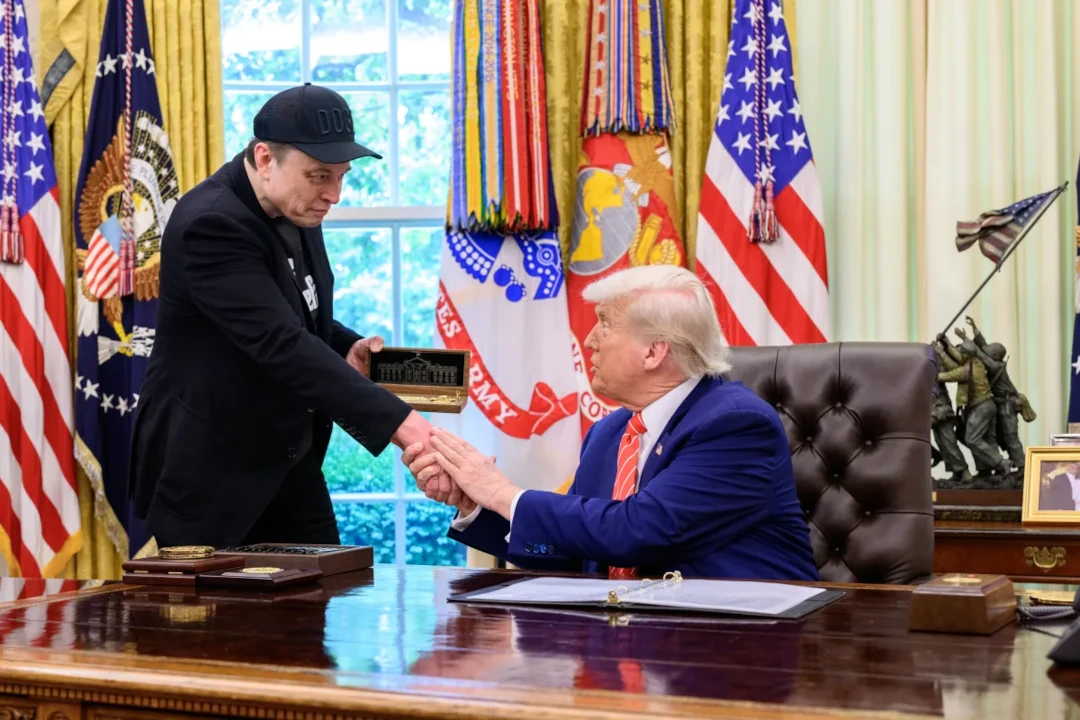
By September 2025, Musk and Trump were photographed shaking hands at Charlie Kirk’s memorial service in Glendale, Arizona. In November, Musk was a guest at a White House state dinner for Saudi Crown Prince Mohammed bin Salman. By January 4, 2026, the reconciliation was official: Musk posted a photograph of himself with Trump and the First Lady at Mar-a-Lago, captioned “Had a lovely dinner last night with @POTUS and @FLOTUS. 2026 is going to be amazing!” Days later, in the middle of the Iran crisis, Trump told reporters aboard Air Force One that if the United States needed help getting the internet to Iranian protesters, “we may speak to Elon.”
Then came the SpaceX $1.6 billion military contract, announced the same week that Musk quietly reactivated America PAC. The pattern is not subtle. A private citizen with tens of billions of dollars in federal contracts is bankrolling the president’s party. The president is, in turn, awarding those contracts to that private citizen’s companies. The circle is closed. The word for that circle — the word constitutional lawyers have used to describe such arrangements since the Republic was founded — is corruption. Not necessarily in the criminal sense. In the older, more damaging sense: the corruption of a public trust.
2024 Spending
Musk’s total personal outlay to elect Trump and Republicans, per Washington Post analysis of final FEC filings — the largest single-cycle donation in U.S. history.
2026 Authorization
The ceiling of America PAC’s newly authorized midterm spend, per Forbes and The Hill. Focus: door-knocking, direct mail, digital targeting in 8+ states.
Wisconsin Race
Total spent on the April 2025 Wisconsin Supreme Court race — the most expensive judicial election in American history, per the Wisconsin Examiner. Musk lost by 10 points.
Dark Money 2024
Record dark-money expenditures in the 2024 cycle, per Rep. Kevin Mullin’s DISCLOSE Act materials — a nearly 400-fold increase since 2006’s $5 million.
IV. The Roberts Court and the Long Loosening
None of this happens without the Supreme Court. It is worth being blunt about that. The architecture that allows a single individual to spend $288 million to elect a president was not built by Musk. It was built by five justices in January 2010, when the Roberts Court decided Citizens United v. Federal Election Commission and ruled that the government could not limit independent political expenditures by corporations or unions. As the Center for American Progress has documented, independent expenditures ballooned from about $500 million in the 2008 cycle to $4.5 billion by 2024. Dark-money spending — money whose donors are never disclosed — rose from under $5 million in 2006 to over $1.9 billion in 2024.
In 2014, in McCutcheon v. FEC, Chief Justice John Roberts himself wrote the plurality opinion striking down aggregate individual contribution limits. Same court, same trajectory, same theory: money is speech, and restricting speech is presumptively unconstitutional even when the speech in question is a wire transfer.
And then, on June 30, 2026, in NRSC v. FEC, the Court finished what Citizens United started. In a decision that struck down federal limits on coordinated party expenditures — the caps that had, for a quarter century, prevented political parties from functioning as unlimited money pass-throughs for their favored candidates — the conservative majority declared that a 2001 precedent called Colorado II was no longer good law. As the Campaign Legal Center put it in a scathing post-ruling statement, the decision turned political parties into “conduits for big donors.” Party committees may now spend without limit in direct coordination with the candidates who will, if elected, write the laws affecting those same donors.
The mechanics matter here. Before NRSC, a donor who wrote a large check to the RNC was limited in how much of that money the RNC could then spend in strategic coordination with a specific candidate’s campaign. That limit was the guardrail. It is gone. When Trump’s political adviser James Blair told Newsweek that Republicans believe the ruling has “created new opportunities to coordinate spending more strategically across party committees, candidates and allied groups,” he was not exaggerating. He was describing a new legal architecture that Musk’s $120 million will now flow through with almost no friction.
“The camel’s nose under the tent… the dominoes are going to fall, and you’re going to have to reconstruct campaign finance law from the ground up.”
— Attorney Roman Martinez, appointed amicus curiae in NRSC v. FEC, at oral argument
V. What Democrats Are Actually Doing (And Not Doing)
The Democratic answer to a Roberts Court dismantling campaign finance law and a private trillionaire buying congressional majorities has been, for the most part, the same answer Democrats have given for fifteen years: a bill. In March 2026, Senator Sheldon Whitehouse of Rhode Island, Representative Chris Pappas of New Hampshire, Representative Jamie Raskin of Maryland, and Representative Joe Morelle of New York reintroduced the DISCLOSE Act, updated for the modern political ecosystem to capture payments to social media influencers, require disclosure of donors above $10,000, and prohibit shell corporations designed to conceal election money. All 47 senators who caucus with Democrats co-sponsored it. So did 139 House Democrats.
Zero Republicans signed on.
Which is the entire story of Democratic campaign-finance politics in a single line. The party has the policy. The party has the votes within its own caucus. It does not have — and, absent filibuster reform or a majority in both chambers, cannot get — the sixty Senate votes required to move a disclosure bill past a guaranteed Republican filibuster. Senator Whitehouse has now introduced some version of the DISCLOSE Act in every Congress since Citizens United. Every version has died in the same place. In this sense, the DISCLOSE Act is less a piece of legislation than a public record of a party’s inability to overcome the Court and the Senate at the same time.
Meanwhile, the Democratic National Committee entered this election cycle $3 million in debt, according to reporting compiled from FEC filings. The Republican National Committee has $125 million on hand. Trump’s MAGA Inc. super PAC has another $382 million. And then Musk arrives with his own $120 million, on top of that. The GOP’s cash advantage heading into the fall is not a slight edge. It is a canyon.
Robert Reich’s proposal — the “Musk smell test” — is worth taking seriously as a piece of practical politics, precisely because Democrats have so few other tools. If voters cannot be given a fair fight by the campaign finance system, they can at least be told, loudly and specifically, which candidates in their state are being financed by a South African–born billionaire whose companies depend on federal contracts. Wisconsin proved that framing works when voters hear it. The remaining question is whether Democrats have the discipline, the coordination, and the media presence to make sure they hear it.
Get Involved Today
Contribute to our mission and turn your concerns into action.
VI. 2026, 2028, and the Path Not Yet Closed
The midterms will not be won or lost on Musk alone. Historically, the president’s party loses seats in the first midterm after a presidential victory. Trump’s approval has slid in most public polling. The economic and foreign-policy record of the first eighteen months of his second term — the tariffs, the Iran crisis, the mass firings at DOGE, the acquisition-of-Greenland saga — is not the record of a popular presidency. Democrats have real structural advantages heading into November, whatever the money picture looks like.
But those advantages have to be defended in real precincts, by real canvassers, against a $120 million turnout operation designed to identify and drag to the polls the exact conservative voters who would otherwise stay home. This is the terrifying elegance of what Musk has built. He is not spending money on television ads that everyone can see and rebut. He is spending money on data, doorbells, and direct mail — on the invisible plumbing of turnout. It will not show up in the ad tracking charts. It will show up on election night, in three-thousand-vote margins in Senate races that were supposed to be tossups.
If it works in 2026, it becomes the template for 2028. The presidential race will not be a contest between two candidates and their donors. It will be a contest between one candidate’s donors and another’s — and one side already has a trillionaire who has demonstrated that he considers the government both his customer and his political property. The other side has the DISCLOSE Act, again, for the ninth time.
VII. The Self-Styled Champion of “Free and Fair”
Donald Trump spent his first campaign, his four years out of office, and much of his second term declaring himself the champion of “free and fair elections.” He has claimed, without evidence accepted by any court, that the 2020 election was stolen. He has called for the arrest of election officials. He has, more recently, dismantled the Department of Justice’s Public Integrity Section — the very unit that warned Musk in 2024 that his voter giveaway may have been illegal — and the FBI’s foreign influence task force. He signed an executive order in early 2025 attempting to place voter-roll maintenance and mail-ballot deadlines under federal control, most of which has been enjoined in court.
And now he is embracing, publicly and enthusiastically, the largest private election-spending operation in the history of the Republic — one run by a man who has already been credibly accused of, and reportedly warned by federal law enforcement about, violating federal election law. There is no reading of this record on which Trump is, or has ever been, a champion of free and fair elections. He is a champion of elections that he wins. When those two categories overlap, he cheers the process. When they diverge, he attacks it. His alliance with Musk is the clearest statement of that priority he has yet made in his second term. He has not merely tolerated the wholesale purchase of an election. He has invited it, praised it, dined with it, and posted a photograph of it captioned amazing.
When Unfitness Is Not Only Cognitive, But Structural
The 25th Amendment to the Constitution, ratified in 1967, provides in Section 4 that the Vice President, together with a majority of the principal officers of the executive departments, may declare in writing that the President is “unable to discharge the powers and duties of his office.” Upon that declaration, the Vice President immediately assumes those powers as Acting President. Congress may then, by a two-thirds vote of both chambers, sustain the removal against the President’s objection.
The mechanism was originally imagined in the shadow of assassination and catastrophic medical incapacity. But its language — “unable to discharge the powers and duties” — is not narrowly medical. It reaches conduct so incompatible with the constitutional role of the presidency that a president cannot honestly be said to be discharging the office at all.
Since January of this year, dozens of members of Congress have publicly called for the Cabinet to invoke Section 4. Senator Ed Markey of Massachusetts issued the call in April, after Trump publicly threatened to eradicate an “entire civilization” in Iran. Senator Chris Murphy of Connecticut concurred, writing that “no President in control of his senses would publicly promise to eradicate an entire civilization.” Representative Ro Khanna of California wrote that “threatening war crimes is a blatant violation of our constitution and the Geneva Conventions.” More than 85 House and Senate Democrats signed on. Representative Jamie Raskin subsequently briefed the House Democratic caucus on the Amendment’s mechanics. Representative Sydney Kamlager-Dove of California, Senator Sheldon Whitehouse of Rhode Island, and others have echoed the concern. As Whitehouse put it, “the president is facing serious mental decline.”
The Case Beyond Cognitive Decline
The Musk alliance sharpens rather than dilutes that case. A president who invites a private citizen with $22 billion in active federal contracts — SpaceX alone landed a $1.6 billion Department of Defense award the same week America PAC reactivated — to spend $120 million on the election of the very legislators who oversee those contracts is not exercising the powers of the office in trust for the public. He is renting them. That is a structural incapacity, not a personal one. The office cannot be discharged in the constitutional sense when the officeholder has fused it with the interests of a single private financier.
The Honest Barriers
The practical obstacles are real and should not be minimized. Section 4 requires Vice President JD Vance and a majority of the Cabinet to initiate. Neither Vance nor any current Cabinet secretary shows any public willingness to do so. Republicans control both chambers of Congress and would not muster the two-thirds vote required to sustain removal over presidential objection. Senator Whitehouse himself has acknowledged that invocation “is not realistic right now, given his oddball Cabinet of sycophants and eccentrics, and Republican ‘spines of foam.'”
Why the Barriers Do Not Defeat the Argument
The constitutional case does not depend on the political case. The Framers of the 25th Amendment did not condition the Amendment’s meaning on the willingness of a particular cabinet to act. A president who has publicly threatened to erase a civilization, who has embraced a self-dealing alliance with a private trillionaire that federal law enforcement has already flagged as legally suspect, and whose second term has produced a documented pattern of erratic and increasingly punitive conduct, is failing to discharge the office in the sense the Constitution contemplates. That the Cabinet will not say so is a comment on the Cabinet, not on the Constitution. The record is being written for future citizens and future courts. It should be written honestly.
VIII. The Question Is Not About Musk
The temptation, at the end of an essay like this, is to make Elon Musk the villain and stop there. It is a satisfying story, and there is real accountability in it. He has, by his own money and his own hand, done more single-handed damage to the ideal of one-person-one-vote than any private citizen in modern American history. That fact should follow him.
But the deeper question is not about him. It is about a system that has, over sixteen years, been reshaped — first by a Supreme Court majority acting in the name of the First Amendment, then by a Republican Party willing to accept the resulting cash, and then by a Democratic Party unable to summon the votes to stop it — into a shape that makes a Musk not only possible but inevitable. If it is not Musk this cycle, it will be someone else next cycle. The infrastructure is built. The legal architecture is in place. The next trillionaire is already reading the FEC filings and running the math.
What is required, if this Republic is to remain a republic, is not merely the defeat of a candidate or the exposure of a donor. It is the reconstruction — legislatively, through disclosure; judicially, through eventual reversal of Citizens United and its progeny; and constitutionally, through the political will to say, out loud and with real force, that a country in which a single foreign-born billionaire can outspend a national political party is not the country the Framers described. That reconstruction is the work of a generation. The midterms in November are the beginning of that work, not the end of it.
The Sixteen-Year Trajectory
Editorial Conclusion
The question before the country in November is not whether Elon Musk should be allowed to spend $120 million to elect a Congress that oversees his federal contracts. He will. The law, as rewritten by five justices over sixteen years, permits it. The question is whether the American voter — informed, insulted, and awake to what is being done — will use the one instrument that has not yet been sold to answer him.
An election is not the private property of the highest bidder. A president is not the personal asset of his largest donor. A Constitution that has been contorted to enable both is a Constitution that must be defended by the people it was written for, in the last precinct the very rich have not yet purchased: the ballot itself.
The stink of Musk is on this administration. It is on this Republican Party. It is on this Supreme Court. In November, the country will decide whether it is prepared to smell it — or to hold its nose one more time.
Sources & References
- Robert Reich (Substack): “The Stink of Musk” — Aug. 3, 2026.
- The Hill: Musk’s super PAC to pour at least $100M backing Republicans in 8 states.
- Axios: Musk plans massive spending for GOP in midterms.
- Newsweek: Map shows states Musk’s midterm money machine could impact most.
- Forbes: Musk spending up to $120M helping GOP in midterms.
- ABC News: Musk readies major midterm investment for Republicans.
- Washington Post: Musk donated $288 million to 2024 election, final tally shows.
- CBS News: Musk spends $277 million to back Trump and Republican candidates.
- CNN: Musk spent at least a quarter-billion dollars to help elect Trump.
- CNN: Musk’s daily $1 million voter giveaway can continue, PA judge rules.
- BBC: US warns Musk political group that $1m voter giveaway may be illegal.
- Wisconsin Examiner: Record $100M spent on Wisconsin Supreme Court race.
- Al Jazeera: Wisconsin Supreme Court results: what happened and why it matters.
- Fox News: Trump and Musk share “lovely dinner” at Mar-a-Lago.
- PBS NewsHour: Supreme Court transforms campaign finance rules in NRSC v. FEC.
- Campaign Legal Center: Court strikes down key campaign finance provision.
- Center for American Progress: Is the Supreme Court preparing to undermine campaign finance reforms again?
- Sen. Sheldon Whitehouse: Reintroduction of the DISCLOSE Act of 2026.
- NBC News: Dozens of Democrats call for Trump’s removal after Iran threats.
- Axios: House Democrats file 25th Amendment commission bill.
- The New Republic: Musk runs to Trump’s aid after scoring huge SpaceX contract.
- Axios: How much Musk spent to elect Trump in 2024.
Related News