The Man Who Would Sell the World: Infantino, Kushner, and the Auctioning of American Influence
A private-equity carve-out of the World Cup. A cabinet-level lifeline. And a whispered promise to make a soccer executive the next Secretary-General of the United Nations. This is not diplomacy — this is a trade, and the currency is the credibility of the United States.
On Monday morning, according to the New York Post, FIFA President Gianni Infantino picked up the phone and did what desperate men do when their empires begin to crack. He called Washington. Specifically, he called the office of the Secretary of State of the United States of America, Marco Rubio, to ask the Trump administration to save his job. FIFA has since disputed the account through a statement reported by Fox News, insisting no such call was scheduled. But denial is not disproof, and even the denial is telling: the President of FIFA is now enmeshed with this White House so deeply that the question of whether he did or did not seek personal political rescue from a foreign head of state is genuinely open.
That is where American foreign policy is in the summer of 2026. That is what Donald Trump’s second term has produced. And it is only the surface of a story that runs downward into private-equity vaults, family conflicts of interest, and the quiet dismantling of the norms that once separated public office from private profit.
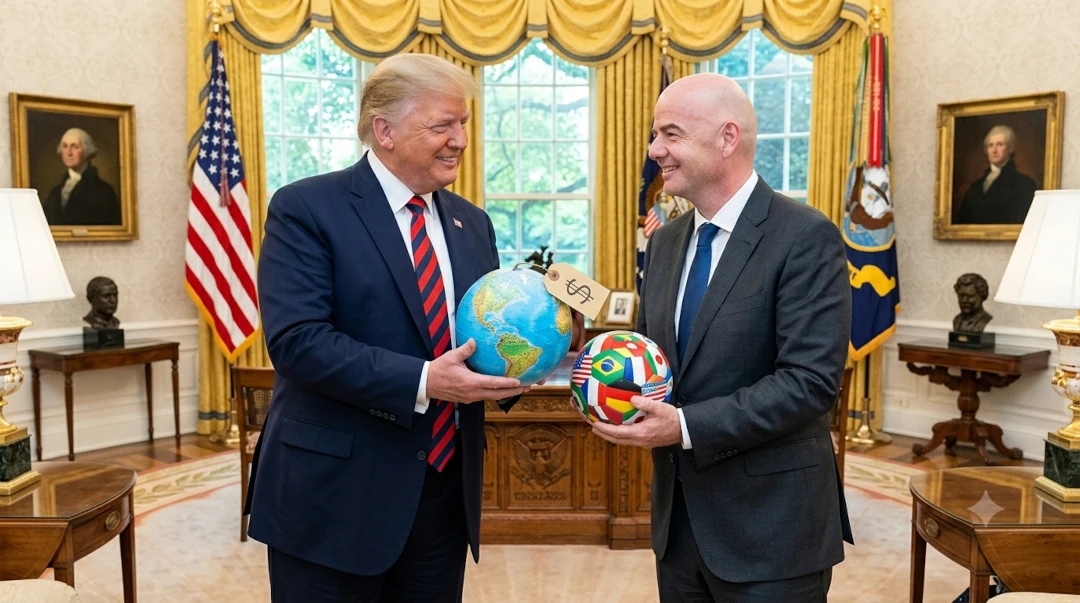
Underneath the FIFA leadership fight is a much larger transaction. Infantino has proposed spinning off FIFA’s commercial rights — broadcast, sponsorship, ticketing, and licensing for the world’s most-watched tournament — into a private entity called FIFA Forward Enterprise, then selling a twenty percent stake in it. The lead investor is Thrive Capital, the firm founded by Joshua Kushner. Joshua Kushner is the brother of Jared Kushner. Jared Kushner is the president’s son-in-law. This is what a grassroots petition and multiple soccer federations are now, correctly, calling a conflict of interest.
And Infantino’s asking price for going along? A hard look at the reporting suggests the answer is not money. It is a job — the top job in international diplomacy. The New York Post reported in July that President Trump has personally suggested that the FIFA president be nominated to succeed António Guterres as the next Secretary-General of the United Nations. The president’s own special envoy for global partnerships, Paolo Zampolli, publicly endorsed the idea. This is not a rumor floated by a partisan enemy. This came out of the White House.
I. The Deal Behind the Deal
To understand what is being auctioned, one must first understand what FIFA is. It is a Swiss non-profit that governs the sport played by more than half the human race. Its flagship event, the World Cup, generates broadcast rights and sponsorship revenues on the order of tens of billions of dollars per cycle. For a century, it has been a non-profit trust — imperfect, corruption-scarred, occasionally criminal, but structurally a public asset held in common by 211 national football associations.
The FIFA Forward Enterprise proposal changes that arithmetic. As Infantino described it on Instagram and Politico reported in detail, the plan would consolidate commercial and event operations under a new subsidiary and allow private investors — reportedly through a JPMorgan-brokered deal potentially valued at around twenty billion dollars — to purchase up to a twenty percent stake. The lead investor group would be led by Thrive Eternal, a Thrive Capital vehicle.
A source close to Thrive told CBS News that “Josh himself does not have any links with the administration, he does not have any political roles, he has not donated to them, he is not involved in any capacity” — and it is true that Joshua Kushner’s personal political giving has largely gone to Democrats. But the argument confuses individual donations with structural entanglement. Joshua Kushner is not being invited into a twenty-billion-dollar carve-out of the world’s most valuable sporting franchise because of his individual politics. He is being invited in because his last name unlocks doors that other last names do not.
The FIFA press release did not explain why Thrive was selected over other qualified bidders. That silence is not accidental. It is the diplomatic equivalent of a nod.
II. The Payoff: A Soccer Executive at Turtle Bay
The Secretary-General of the United Nations is the most senior civil servant in the international system. The role is created by Article 97 of the U.N. Charter: the General Assembly appoints the Secretary-General upon the recommendation of the fifteen-member Security Council. That recommendation is subject to the veto of any of the Council’s five permanent members — the United States, China, Russia, the United Kingdom, and France. In practice, no candidate can advance without American support.
Which means the president’s stated preference for who should hold that office is not idle speculation. It is currency.
According to the New York Post’s sourcing, Trump believes Infantino “is respected by everyone around the world” and possesses “a special ability to bring people together” — language reproduced across international outlets including Yahoo Sports, Türkiye Today, and Euronews. Zampolli, the president’s own envoy and a personal friend of Infantino, told the Post that Infantino’s record at FIFA showed he could “manage” the diplomatic complexity of a 193-nation body. As Euronews noted, the American president cannot install a Secretary-General unilaterally. But he can lend, or withhold, the weight of the United States. That weight is being offered.
“This is your prize, this is your peace prize. Mr. President, you definitely deserve the first FIFA Peace Prize for your action, for what you have obtained in your way, but you have obtained in an incredible way.”
— Gianni Infantino, FIFA President — presenting Donald Trump the inaugural FIFA Peace Prize, Kennedy Center, December 5, 2025
Read that quotation carefully. It is not the language of a neutral steward of the world’s game. It is the language of a courtier. And it was delivered in the same month the Trump White House began floating Infantino as the president’s preferred candidate to lead the United Nations — an organization already stripped of U.S. contributions and withdrawn from, by Trump’s own hand, in his current term.
Nothing about this is subtle. The FIFA president gives the American president a “peace prize.” The American president rewards the FIFA president with a nomination pipeline to the highest office in international diplomacy. In between, a member of the American president’s family stands to become a twenty percent equity holder in the commercial future of the World Cup. This is what a quid pro quo looks like when it is not hidden — when the parties have concluded, correctly, that no one is prepared to stop them.
III. The World Says No
What is remarkable is not the audacity of the scheme. Audacity is now the baseline of this administration. What is remarkable is that the rest of the world is refusing to play along. That refusal — from soccer federations, from foreign lawmakers, from ordinary fans — is the most important political fact in this story.
UEFA, the European soccer governing body, has threatened legal action against Infantino, Kushner, and others involved in the plan, according to a letter obtained by The Telegraph and reported by Politico. UEFA President Aleksander Čeferin personally boycotted the World Cup final in protest of Trump’s red-card intervention. Concacaf President Victor Montagliani, who also serves as a FIFA vice president, is now seriously considering a leadership challenge against Infantino, per The Athletic. Carlos Cordeiro, FIFA’s own representative on the White House World Cup task force, resigned in protest, telling ESPN he could not support selling a stake in the World Cup.
A Timeline of Compromise
December 5, 2025
July 6, 2026
July 19, 2026
July 22, 2026
July 27, 2026
July 30, 2026
August 3, 2026
Every one of these actors — European federations, sitting FIFA vice presidents, the president’s own hand-picked appointees, foreign lawmakers — has looked at what is being proposed and said, in polite institutional language, that this is corrupt. When former FIFA officials resign in protest at a proposed FIFA deal, the question is not whether something is wrong. The question is what will be done.
Get Involved Today
Contribute to our mission and turn your concerns into action.
IV. What This Costs America
Presidents build up American credibility across decades. It is spent in a season. When a foreign audience watches the United States Secretary of State’s calendar rearrange itself around the political survival of a sports executive whose family is doing a twenty-billion-dollar deal with the president’s in-laws, they are not seeing the world’s oldest democracy. They are seeing what they have long been told America was not.
The concrete effects arrive quickly. Allies quietly downgrade the level at which they engage. Adversaries begin to price in that the U.S. presidency is transactional and that access can be bought — not merely rented, as during the first Trump term, but purchased outright with equity stakes. American businesses operating abroad find the diplomatic protections they once took for granted grow thinner, because the officials who would normally intervene on their behalf are visibly for sale to someone else. Investors and pension funds — the ordinary retirement savings of ordinary Americans — bear the cost of a currency that no longer commands the premium a rules-based reserve currency once did.
Rep. Jamie Raskin, the ranking Democrat on the House Judiciary Committee, has put the underlying charge in the language that matters. In his July 27 investigation announcement, Raskin described “mounting evidence of corruption and a potential quid pro quo between FIFA and the Trump Administration.” His letter to Infantino included a formal preservation notice for all communications between FIFA personnel and Trump administration officials — including messages on disappearing platforms like Signal, Telegram, and WhatsApp. That is not a fishing expedition. That is the language of an investigator who believes the record already exists and is trying to keep it from being destroyed.
“Mounting evidence of corruption and a potential quid pro quo between FIFA and the Trump Administration.”
— Rep. Jamie Raskin, Ranking Member, House Judiciary Committee — July 27, 2026
Raskin cannot, in the current House, compel Infantino to appear. That is the practical political fact. But the record he is building — of a foreign sports body renting space in Trump Tower, awarding the president a personally lucrative “peace” prize, taking calls from the president to override match rulings, structuring a twenty-billion-dollar carve-out for the president’s in-laws, and seeking American cabinet-level protection in return for a nominee the president wants at the U.N. — will not disappear. It is the argument that a next Congress, if the voters send one, will use to compel the testimony that the current committee cannot.
The Constitutional Question the FIFA Affair Forces
Ratified in 1967, the 25th Amendment to the U.S. Constitution establishes an orderly process for addressing a president who cannot discharge the duties of office. Section 4 permits the Vice President, together with a majority of the Cabinet, to transmit a written declaration to Congress that the president is “unable to discharge the powers and duties of his office.” The Vice President then immediately assumes the presidency as Acting President.
The framers of the Amendment — writing three years after the Kennedy assassination — understood “inability” broadly. It is not limited to a coma or a stroke. It reaches, as Sen. Birch Bayh explained on the Senate floor in 1965, any circumstance in which a president is not capable of exercising the office in a manner “for the good of the country.” A president who has fused personal, familial, and commercial interests with the machinery of American foreign policy to the degree the FIFA affair now reveals is, by the framers’ own standard, a president who cannot be trusted to discharge his office for the good of the country. That is not a partisan claim. It is the standard the Amendment itself was designed to meet.
Lawmakers Who Have Already Called for Its Use
Rep. Jamie Raskin (D-Md.) introduced legislation in April 2026 to establish a 17-member bipartisan commission to evaluate presidential fitness under Section 4. Rep. Raja Krishnamoorthi (D-Ill.) formally called on Vice President JD Vance and the Cabinet to invoke the Amendment on April 7. Rep. Jasmine Crockett (D-Tex.) issued a formal letter to Vice President Vance on the same day, urging the same. Sen. Ed Markey (D-Mass.), Rep. Eric Swalwell (D-Cal.), Rep. Sydney Kamlager-Dove (D-Cal.), and Rep. Yassamin Ansari (D-Ariz.) publicly called for the Cabinet to act as early as January 2026.
The Constitutional Argument
The FIFA affair is not a stand-alone reason to invoke Section 4. It is the case study that clarifies a longer pattern: a president who has repeatedly demonstrated an inability to distinguish the office of the presidency from his family’s private commercial interests, and who now, in the fifth month of his second term, is engaged in what a ranking committee member of the House Judiciary Committee has publicly labeled a bribery and corruption scheme with a foreign sports federation. The specific mechanism the Amendment was designed for — a chief executive who is present in body but not discharging the office in a manner consistent with its duties — is precisely the mechanism the country now needs.
The Practical Barriers, Honestly Named
The barriers are real and it does no one any good to pretend otherwise. Section 4 requires the Vice President and a majority of the Cabinet — a Cabinet that Trump personally selected and that has to date shown no independent political will. If the president disputes the declaration, a two-thirds vote of both chambers of Congress is required to sustain it. Neither chamber currently holds a two-thirds Democratic majority. The Amendment is, in that sense, not a live weapon in this Congress.
But the barriers do not negate the case. They only clarify where the case must be pressed. The constitutional argument for invocation is being made now, on the record, by named members of Congress, so that when the political landscape shifts — through the ordinary mechanism of elections, or through the accumulated weight of scandal on Cabinet members who begin to fear the historical record — the argument is already built. The framers did not draft Section 4 because they thought invoking it would be politically easy. They drafted it because they thought there would come a day when its use would be constitutionally necessary regardless of ease. That day is now visible on the horizon, and the FIFA affair is one of the reasons.
V. What Is Actually at Stake
Take the FIFA story out and look at it in isolation, and it is an ugly little transaction — a soccer executive, a president’s in-law, a twenty-billion-dollar carve-out, a whispered U.N. nomination. It is not, on its own terms, the most important story of this presidency. But that is exactly what makes it clarifying. This is not the scandal. This is the everyday. This is what a Tuesday looks like now.
The country that once wrote the postwar rules — the country that built the U.N., the World Bank, the trading system, and the alliance networks that produced eighty years of relative peace — is now a country whose Secretary of State’s schedule accommodates the personal political survival of a foreign sports commissioner who is doing an equity deal with the president’s family. Every American who works for a company that exports abroad, every American whose retirement is held in a fund exposed to global markets, every American whose grandparent survived a war stopped by American diplomatic power — every one of them is quietly poorer for it. Not because a soccer deal will bankrupt them. Because the credibility of the American presidency, once cashed in, does not come back.
The story ends not with FIFA. It ends with the question every American has to answer in the next election cycle: what price is being paid for this, and who is paying it? The answer is not Gianni Infantino. The answer is not even the Kushners. The answer is the country.
Editorial Conclusion
A president who trades cabinet-level access for a family equity stake, and who dangles a U.N. nomination in exchange for a soccer official’s compliance, is not conducting foreign policy — he is conducting an auction. The 25th Amendment was written for a president who cannot discharge the office in the manner the office requires. The FIFA affair does not prove that case by itself. It illustrates it. The Constitution provides a mechanism. Congress provides the pressure. The voters provide the mandate. What has to happen now — investigations subpoenaed, testimony compelled, records preserved, elections won — is the ordinary work of a self-governing republic. The question is only whether we still are one.
Sources & References
- Daily VoiceFIFA Boss Seeks Trump Backing As Kushner Deal Sparks Legal, Leadership Fight: Reports (Aug. 3, 2026)
- New York PostFIFA’s Infantino begs Trump admin to save his job (Aug. 3, 2026)
- Fox NewsFIFA denies Infantino seeking Trump admin help as pressure mounts
- Politico EuropeUEFA threatens legal action against Infantino, Kushner over FIFA plan
- The Athletic / NYTInside the FIFA World Cup stake-sale fight
- ESPNCordeiro resigns from White House World Cup panel in protest
- Yahoo SportsFIFA president Gianni Infantino is Donald Trump’s choice for key UN role
- EuronewsCould Infantino really become UN Secretary-General if Trump backs him?
- MSNBC / AOLFIFA faces global anger over plan to give Kushner brother a financial stake
- CBS NewsUEFA boycotts FIFA over plan to sell World Cup stake to Kushner-led investors
- AxiosRed card on FIFA’s private equity plans
- House Judiciary DemocratsRanking Member Raskin Calls Foul on Infantino for Trump Bribery & Corruption Scheme (Jul. 27, 2026)
- House Judiciary Democrats (PDF)Rep. Raskin’s letter to Gianni Infantino (Jul. 26, 2026)
- Al JazeeraInfantino’s “Peace Prize” to Trump raises questions about FIFA’s neutrality
- TIMETrump’s FIFA intervention draws global backlash
- Washington PostNorway federation pushes toward FIFA ethics complaint over Trump role
- The HillConcerns grow over Trump’s mental fitness for the presidency
- Rep. KrishnamoorthiKrishnamoorthi Calls for President Trump’s Removal Under 25th Amendment
- Rep. Jasmine CrockettRep. Crockett Calls on VP Vance, Cabinet to Invoke the 25th Amendment
Related News