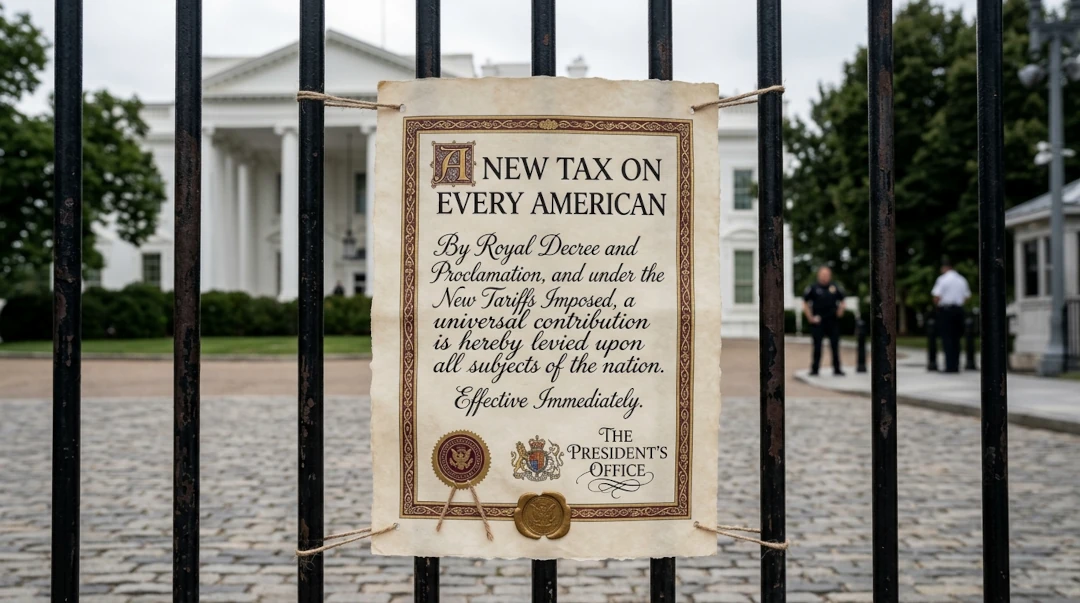
Tariffs by Decree: A Second-Term Presidency Answers the Affordability Crisis With a New Tax on Every American Household
Sixty trading partners. Ninety-nine percent of U.S. imports. A Supreme Court that already told him no. And a Congress that never voted. The forced-labor pretext is thin, the constitutional detour is deliberate, and the bill will land in your grocery cart within weeks.
On the same week that gas broke back above four dollars a gallon, that a fresh Cabinet-level ask for $200 billion in Iran-war supplemental funding was making its way through the Capitol, and that the Congressional Budget Office pegged the fiscal-year 2026 federal deficit at $1.4 trillion, the U.S. Trade Representative walked out at 5:16 p.m. Eastern on a Thursday and announced a new wave of tariffs on sixty economies covering essentially every dollar of goods entering the United States. The duties, set between 10 and 12.5 percent, took effect six hours and forty-five minutes later. Congress was not consulted. Congress was not asked. Congress did not vote. And Congress, on the plain text of Article I of the Constitution, is the only body that has the power to do this at all.
The pretext, according to the fact sheet issued by Ambassador Jamieson Greer’s office, is that these sixty countries have failed “to impose and effectively enforce a prohibition on the importation of goods produced with forced labor.” The mechanism is Section 301 of the Trade Act of 1974 — a statute that has never before been used to build, in the span of four months, a country-by-country tariff wall spanning nearly the entire global economy. As the CNBC reporting notes, the affected trading partners represent 99.4 percent of all U.S. trade. This is a global tariff regime dressed in the clothing of a targeted human-rights action, and every serious observer of trade law knows it.
What follows is an accounting of what was announced, what it will cost, what it is actually for, how it was designed to evade a Supreme Court ruling issued only five months ago, and why the Framers who wrote the Twenty-Fifth Amendment left the word “unable” undefined on purpose.
I. What Was Announced
At 12:01 a.m. Eastern on Friday, July 24, 2026, a temporary 10 percent global tariff imposed under Section 122 of the Trade Act of 1974 — a stopgap the administration erected within hours of losing at the Supreme Court in February — expired on its statutory 150-day timer. At exactly the same moment, a new regime under a different statute took its place. According to NBC News, the U.S. Trade Representative levied duties of 10 to 12.5 percent on 60 economies, covering essentially every important U.S. trading relationship: Canada, Mexico, the United Kingdom, India, Indonesia, Malaysia, Pakistan, Bangladesh, the European Union bloc, and dozens more.
Seventeen partners — those that could point to some legislative gesture against forced-labor imports — landed in the 10 percent tier. As ABC News reported, the remaining forty-one economies were dropped into the 12.5 percent tier for what the Office of the United States Trade Representative deemed insufficient enforcement. Cambodia, in a detail that captures the exercise perfectly, passed a special forced-labor regulation on July 1 for the express purpose of qualifying for the lower rate before the deadline hit.
Economies now facing 10% or 12.5% Section 301 duties, per the USTR announcement.
Portion of American import trade now subject to the new tariff regime, according to the CNN Business analysis.
Number of votes taken by the House or Senate to authorize the new duties before they took effect.
Yale Budget Lab’s annual estimate per household if Section 301 tariffs take hold — roughly double the current-law baseline.
II. The Cost to American Consumers
The single most important economic fact about tariffs, and the one the administration has spent eighteen months trying to obscure, is that tariffs are paid by the importer, not the exporter. That importer is almost always a U.S. company. That company, when it can, passes the cost along. The Federal Reserve Bank of New York studied the pass-through mechanics in a February 2026 report and concluded, in language that so upset the administration that it demanded professional discipline against the researchers, that ninety percent of the tariffs’ economic burden fell on U.S. firms and consumers. That finding was so politically inconvenient that Senate Democrats, led by Chuck Schumer, had to send a formal letter warning the White House against interfering with the Fed’s independent research staff, as documented on the Senate Democratic Leadership press page.
The Yale Budget Lab, whose ongoing tariff tracker is the closest thing this debate has to a scoreboard, estimates that the broader tariff regime — the previous framework plus Section 301 layered on top — will raise consumer prices by 0.4 to 1.1 percent and cost the average American household between $550 and $1,500 per year, as Forbes summarized on Friday. Those costs fall hardest on the bottom decile of earners, who spend a larger share of their income on the taxed categories — apparel, footwear, small electronics, autos, appliances. The Budget Lab’s own distributional model finds tariffs to be functionally regressive, hitting the poorest households at nearly three times the rate, as a share of income, that they hit the top decile.
This is landing on top of an affordability crisis that is already the number-one concern of American voters. The Cato Institute — no left-wing house — reports that consumer prices have climbed 24 percent in the last five years, that Washington has already dubbed 2026 “the year of affordability,” and that the President’s own approval on inflation and prices has, in Cato’s phrasing, deteriorated sharply. Gas is back above four dollars a gallon. Grocery bills remain punishing. Enhanced ACA premium subsidies expired December 31, dropping marketplace enrollment by 1.5 million and pushing premiums up dramatically for 2026. The administration’s response to all of it, this week, was to add a tax.
“As gas prices spike and families struggle with their grocery bills, Trump is tripling down on his chaotic tariff tax and pushing prices that Americans pay even higher. He’s about to slap new 10% tariffs on 60 countries, including all of our major trading partners.”
— Senate Democratic Leader Chuck Schumer, Senate Floor, July 22, 2026
III. The Effect on America’s Trading Partners
The diplomatic damage is real, and it is not evenly distributed. Canada — America’s largest trading partner, a treaty ally, and a country that has already absorbed a 25 percent tariff under the earlier IEEPA regime and a 35 percent rate briefly last year — was placed in the 10 percent tier. Mexico, the United Kingdom, and India were placed there as well. The European Union, whose bloc-wide response is now being coordinated in Brussels, was moved into the 12.5 percent tier. Ambassador Greer’s own office reported that China’s commerce ministry rejected the forced-labor determination outright and called for the parties to “meet each other halfway.”
The forced-labor framing has predictably enraged some of the most cooperative partners the United States has on human-rights enforcement. Canada already operates one of the more aggressive forced-labor import prohibitions in the world. To be lumped in with the accused, and to have that accusation used as the legal predicate for a new consumer tax on Americans, is a diplomatic insult delivered in bad faith. It also puts every one of these countries on notice that trade agreements previously entered into with this administration in exchange for IEEPA-tariff relief — the twenty or so framework deals Congress never approved — are worth exactly what the White House says they are worth on any given morning.
The Congressional Research Service, which does not editorialize, put it plainly in its March 2026 analysis: the trade agreements struck by the administration in return for IEEPA tariff reductions “could arguably be less legally and politically durable than trade agreements, like USMCA, that have been approved by Congress.” That is the diplomatic universe the administration has built: one in which foreign governments cannot rely on any American commitment because no American commitment has been ratified by the branch of government the Constitution assigns to make them.
Get Involved Today
Contribute to our mission and turn your concerns into action.
IV. The End Goal, If There Is One
Ask five different officials in this administration what these tariffs are for, and you will get five different answers. Sometimes it is national security. Sometimes it is reshoring manufacturing. Sometimes it is negotiating leverage. Sometimes it is revenue to offset the tax cuts in the 2025 reconciliation act. This week, the stated reason was forced labor — a moral cause the administration has never before treated as central, and which becomes politically convenient the moment it can be invoked to justify duties covering ninety-nine percent of imports.
The internal contradiction was flagged, remarkably, by the President’s own Treasury Secretary. Scott Bessent, speaking with Andrew Ross Sorkin at DealBook in December, described the tariffs as a “shrinking ice cube” — an unstable revenue source that would inevitably melt as importers shift supply chains and consumers substitute cheaper alternatives. Veteran market strategist Ed Yardeni, in a widely circulated year-end note reported by AOL Finance, predicted the affordability crisis itself would eventually force the administration to reverse course.
None of these public rationales — leverage, reshoring, forced labor, revenue — cohere with the others. A tariff imposed as leverage for a deal is meant to be lifted when the deal is reached. A tariff imposed to reshore manufacturing is meant to be permanent. A tariff imposed as revenue is meant to be predictable. A tariff imposed for human rights is meant to be lifted when the human-rights condition is remedied. These are mutually exclusive theories of the case, and running all four simultaneously is not strategy. It is improvisation dressed as strategy.
V. The Supreme Court Said No. This Is How He Went Around It.
On February 20, 2026, the Supreme Court decided Learning Resources, Inc. v. Trump by a vote of 6-3, with Chief Justice Roberts writing for the majority. The Court held that the International Emergency Economic Powers Act (IEEPA), the statute the administration had used to build its first round of global tariffs in 2025, “does not authorize the President to impose tariffs.” As SCOTUSblog reported, the ruling wiped out roughly $200 billion in duties that had already been collected. In the ruling’s most quoted line, the Court explained that the power to impose tariffs is “very clear[ly] a branch of the taxing power” reserved to Congress under Article I of the Constitution.
The administration’s response, on a call with reporters the same afternoon, is worth reading in full. As CNN Business reported from the July 23 briefing this week: “The president is not going to allow his trade policy and overall objectives to be undermined simply because one tool may be limited by a court or something else.” Read that sentence again. The President’s own senior staff, on the record, describe a Supreme Court ruling — a 6-3 constitutional decision authored by the Chief Justice — as “one tool” that has been “limited.” Not as a limit on his authority. As an inconvenience to be routed around.
The Congressional Research Service, in its March 2026 briefing, described the strategy in the flat language of the professional analyst: USTR “could potentially utilize the findings of these investigations to impose a regime of country-specific tariffs similar in scope to the global tariffs imposed under IEEPA in 2025.” That is exactly what has happened. The Court struck down one legal theory. The administration built a new one on a different statute, using the same personnel, targeting the same countries, hitting the same imports, and generating substantially similar revenue. This is not compliance with a Supreme Court decision. This is textbook evasion.
VI. A New Tax Without Representation
The Framers wrote Article I, Section 8, Clause 1 in the shadow of the Stamp Act. “The Congress shall have Power To lay and collect Taxes, Duties, Imposts and Excises.” Duties. Imposts. Those are tariffs. The placement of that power in the legislative branch was not accidental. As Reason’s Volokh Conspiracy has argued, the taxing clause “stems from centuries of conflict in Great Britain (and the colonies) about the location of the power to tax, and from the American Revolution’s rejection of Parliament’s effort to impose ‘taxation without representation’ on the colonies.” That principle is not an ornament. It is the founding grievance of the country.
What the Trump administration has now built is what one European constitutional-law journal has called a “shadow fiscal state” — a parallel taxing regime designed and executed solely by executive discretion, without congressional legislation, whose economic burden is borne, on the Fed’s own numbers, by American consumers. In substance, this is a national consumption tax passed by press release. Congress never debated it. Congress never voted on it. And the majorities in Congress that would have to consent to it under the Constitution have never had the chance to say yes or no.
Even members of the President’s own party understand this. Senator Rand Paul has repeatedly introduced legislation — the No Taxation Without Representation Act — that would restore congressional control over new tariff impositions. Senator Mike Lee and Representative Warren Davidson have proposed a Global Trade Accountability Act. Six House Republicans, as documented in the reporting on the resolution to repeal the Canada tariffs, crossed the aisle to oppose the President on trade. This is not a partisan concern. This is a structural one, and every serious institutionalist in Congress, of either party, understands the trap.
“The Supreme Court decision striking down the harmful Trump Tariffs is a big victory for the American people. And another crushing defeat for the wannabe King.”
— House Democratic Leader Hakeem Jeffries, February 20, 2026
VII. What This Does to the National Debt
The administration will argue that the tariffs raise revenue and therefore reduce the deficit. That argument has a very short leash. The Congressional Budget Office estimated in its February 2026 baseline that higher tariffs would reduce cumulative deficits by roughly $3 trillion over the 2026-2035 window. That estimate assumed the IEEPA tariffs were legally sustainable. They were not. When the Supreme Court struck them down, CBO revised the projections and found, in a March 5 blog post, that the termination of the IEEPA duties would increase primary deficits by an estimated $1.6 trillion, with an additional $0.4 trillion in debt-service costs — a $2 trillion swing.
Meanwhile, the 2025 reconciliation act — the “One Big Beautiful Bill” that permanently extended the 2017 tax cuts and added new defense and homeland-security spending — is projected by CBO to add $4.7 trillion to the deficit over the same window. That is the real budget picture: a large, permanent tax cut passed by Congress and signed into law, and a large, extralegal tariff regime imposed by executive fiat, both applied to the same fiscal patient at the same time. The tariffs cannot mathematically make up the loss unless they are permanent, universal, and unchallenged. The administration knows all three conditions are shaky. Importers have already filed nearly 2,000 refund lawsuits over the invalidated IEEPA duties.
CBO’s own director, in the February 2026 Budget and Economic Outlook, projected federal debt held by the public rising from 101 percent of GDP this year to 120 percent by 2036, and 175 percent by 2056 — higher than at any point in the nation’s history, including the peak of World War II. The Bipartisan Policy Center’s most recent deficit tracker warned that the average interest rate on the debt could exceed the growth rate of the economy as soon as fiscal year 2031, opening the door to a “debt spiral.” A tariff regime built on the wrong statute, resting on legally shaky pretexts, and collectible only for as long as the courts and the Congress allow, is not a serious answer to that.
CBO’s revised estimate after $70B in IEEPA tariff refunds began flowing in May and June.
CBO’s baseline projection — the highest in American history, exceeding the WWII peak.
Ten-year deficit impact of the 2025 reconciliation act — the “One Big Beautiful Bill” tax package.
Pentagon’s running tally — with a fresh $73B ask now moving through reconciliation.
VIII. The Democratic Response — And the Defectors
Senate Democratic Leader Chuck Schumer has, to his credit, been clear and consistent on the tariffs from the beginning. He has vowed on the Senate floor, in remarks documented on the caucus’s own site, that Senate Democrats will block any effort to extend the Section 122 stopgap and that Democrats will not lend a hand to the Section 301 workaround. House Democratic Leader Hakeem Jeffries has led the caucus in the House, whipping the resolution that would have repealed the earlier Canada tariffs and picking up six Republican defectors in the process. Elizabeth Warren, Ron Wyden, and Angela Alsobrooks have written directly to the White House demanding an end to what they called the administration’s effort to “prohibit Americans from learning the cost of its tariff regime.”
But the Democratic caucus is not united. When the House voted this Wednesday, July 22, on the $95 billion budget resolution unlocking $73 billion in fresh Iran-war funding — a package that also includes $12 billion in farmer bailouts explicitly designed to soften the domestic damage the tariffs are doing to agriculture — six Democrats crossed the aisle to vote yes on the accompanying National Defense Authorization Act. Earlier in the year, on a war-powers resolution to immediately end the Iran conflict — the conflict that is being partly financed by these tariff receipts and by the $200 billion Pentagon supplemental request — four Democrats broke ranks: Representatives Henry Cuellar, Jared Golden, Greg Landsman, and Juan Vargas, as Axios reported.
These defections matter because they are what enables the entire architecture. If every Democrat in both chambers voted as a bloc against the war funding, against the tariff extensions, and against the reconciliation vehicles that route around the filibuster, Speaker Mike Johnson would not have the votes. The margin is that thin. What Democratic leadership has to do — and what it has not yet fully done — is discipline the defectors and force a caucus vote on tariffs on the merits, on the floor, so that the American public can see which members of Congress are willing to defend the taxing power that the Constitution assigns to them and which are not.
The tariffs and the Iran war are the same story. Both are unauthorized. Both are being funded, in part, by revenue extracted from American consumers without a vote of their representatives. And both continue only because a president is willing to route around the branches of government that would say no, and because just enough members of the opposition party are willing to let him.
The Twenty-Fifth Amendment, the Meaning of “Unable,” and Why the Drafters Left It Undefined
Section 4 of the Twenty-Fifth Amendment provides that the Vice President, together with a majority of the Cabinet, may transmit to the President pro tempore of the Senate and the Speaker of the House their written declaration that the President is “unable to discharge the powers and duties of his office.” That word — unable — is nowhere defined in the amendment. That was deliberate.
As the American Constitution Society’s expert reader’s guide to the amendment records, the drafters “expressly disclaimed any intent to define ‘inability.’ They purposefully set forth a flexible standard intentionally designed to apply to a wide variety of unforeseen emergencies.” Representative Richard Poff of Virginia, one of the amendment’s principal architects in the House, testified for the record that Section 4 was meant to apply not only in cases of physical unconsciousness but also where “the President, by reason of mental debility, is unable or unwilling to make any rational decision, including particularly the decision to stand aside,” as PolitiFact documented earlier this year.
Senator Birch Bayh of Indiana, the primary architect in the Senate, was equally clear about the breadth of the term. As Just Security’s constitutional analysis summarizes, Bayh built into the record the principle that inability “does not have to be permanent to be critical.” The amendment “was designed to preserve the continuity of government: to avoid a constitutional gap, not to provide a political weapon.”
How the Tariff Episode Fits the Standard
The question is not whether the President dislikes the Supreme Court’s tariff ruling. The question is whether a President who publicly instructs his own senior staff to treat a 6-3 constitutional decision as “one tool that may be limited by a court or something else” — and who then, within a hundred and fifty days, engineers a new tax regime designed to produce an economically equivalent result under a different statute — is discharging the duties of the office as the Constitution defines them. That office includes, in Article II, the obligation to “take Care that the Laws be faithfully executed.” A ruling of the Supreme Court is such a law.
That is compounded by the affordability picture. This is a President responding to a cost-of-living crisis that his own Treasury Secretary describes as unsustainable, that voters overwhelmingly rank as their number-one concern, and that is being made materially worse by his own tariff regime, by imposing more of the same tariffs. He is compounding, not correcting.
Named Lawmakers Who Have Discussed Section 4
Senator Chris Murphy of Connecticut publicly called for consideration of the Twenty-Fifth Amendment following the President’s Truth Social posts threatening to attack Iranian civilian infrastructure, as PolitiFact reported. He was joined at various points by Senator Elizabeth Warren, Representative Jamie Raskin, and Representative Dan Goldman, whose public statements have called for both formal cognitive assessments and Section 4 review.
The Honest Assessment of the Barriers
Section 4 requires the Vice President plus a majority of the Cabinet. That means the Vice President, JD Vance, plus at least eight of the fifteen department heads Trump himself appointed. As a matter of raw political mathematics, the barrier is real, and honest observers must say so. If the President then challenges the declaration, a two-thirds vote of both houses of Congress is required to sustain removal — a supermajority no faction currently commands.
But the difficulty of invoking the amendment does not defeat the constitutional argument. The Framers of the Twenty-Fifth built in the difficulty precisely to prevent frivolous use. They also, deliberately, left the operative word open — so that future Americans facing situations they could not have imagined would have the tool available. What they could not have foreseen was that a President would treat the taxing power itself as a personal instrument, meet a cost-of-living crisis with new taxes on the very people already crushed by it, and openly instruct his officials to route around a ruling of the Supreme Court. That the tool is politically difficult to reach does not make the case for reaching for it any less real.
Editorial Conclusion
What happened at 12:01 a.m. Friday morning was not a trade policy. It was a demonstration — that this President is willing to raise taxes on every American household by executive order, in defiance of a 6-3 Supreme Court ruling, without a single vote of Congress, at the exact moment an affordability crisis is crushing the working families he was elected to help.
The Constitution places the taxing power in Congress for a reason. The country fought a revolution over it. The Supreme Court reaffirmed it in February. And this week, the White House answered by simply changing the statute cited on the paperwork.
The stakes are not partisan. They are structural. A presidency that treats a Supreme Court ruling as an inconvenience, a Congress as an obstacle, and the affordability of American life as expendable in service of a personal trade obsession has crossed a line the Framers drew for exactly this moment. What is required is not patience. What is required is that Congress reclaim the power the Constitution gave it, and use every tool the Constitution provides — including the Twenty-Fifth Amendment the drafters left deliberately open — to defend the republic against a leadership that no longer recognizes any check on itself.
Sources & References
- NBC News — “U.S. sets new tariffs at 10% to 12.5% on 60 trade partners,” July 24, 2026.
- CNN Business — “Trump imposes new tariffs targeting dozens of countries,” July 23, 2026.
- ABC News — “Trump set to impose sweeping tariffs on 60 trade partners,” July 23, 2026.
- CNBC — “Trump imposes ‘sweeping’ new tariffs on 60 trade partners as global duties expire,” July 23, 2026.
- USTR — “USTR Takes Action in Forced Labor Section 301 Investigations,” July 23, 2026.
- The White House — “Presidential proclamation on Section 301 forced-labor actions,” July 23, 2026.
- NBC News — “Supreme Court strikes down most of Trump’s tariffs,” February 20, 2026.
- SCOTUSblog — “Supreme Court strikes down tariffs,” February 20, 2026.
- Congressional Research Service — “Section 301 of the Trade Act of 1974,” 2026.
- Yale Budget Lab — “The State of U.S. Tariffs,” updated July 2026.
- Yale Budget Lab — “State of U.S. Tariffs: April 8, 2026.”
- Forbes — “Trump’s New Forced Labor Tariffs: Who Pays, Who Wins,” July 24, 2026.
- Congressional Budget Office — “An Update About CBO’s Projections of the Budgetary Effects of Tariffs,” March 5, 2026.
- Congressional Budget Office — “The Budget and Economic Outlook: 2026 to 2036,” February 2026.
- Senate Democratic Leadership — “Schumer Floor Remarks on Trump Tariffs,” July 22, 2026.
- House Democratic Leadership — “Leader Jeffries on Trump Tariffs,” February 21, 2026.
- NPR — “House passes Pentagon funding bill and Iran-war blueprint,” July 22, 2026.
- PBS NewsHour — “House Republicans adopt $95 billion Iran-war package,” July 22, 2026.
- Axios — “House Democratic defectors on Iran war powers vote,” March 24, 2026.
- Cato Institute — “Cato Handbook on Affordability: Introduction,” April 2026.
- PolitiFact — “Could the 25th Amendment be invoked against Trump?,” April 6, 2026.
- Just Security — “How the Twenty-Fifth Amendment Applies Today,” May 27, 2026.
- American Constitution Society — “The Incapacitation of a President and the Twenty-Fifth Amendment,” 2020.
- Reason / Volokh Conspiracy — “The Tariffs Imposed by President Trump Are Unconstitutional,” April 30, 2025.
Related News