Cameras Off: When the Networks Said No
Two of America’s biggest broadcasters refused to hand over primetime to a President determined to relitigate an election he lost six years ago. A third cut the feed before he finished. What happened Thursday night is not a media story — it is a fitness story, and the country is running out of time to name it.
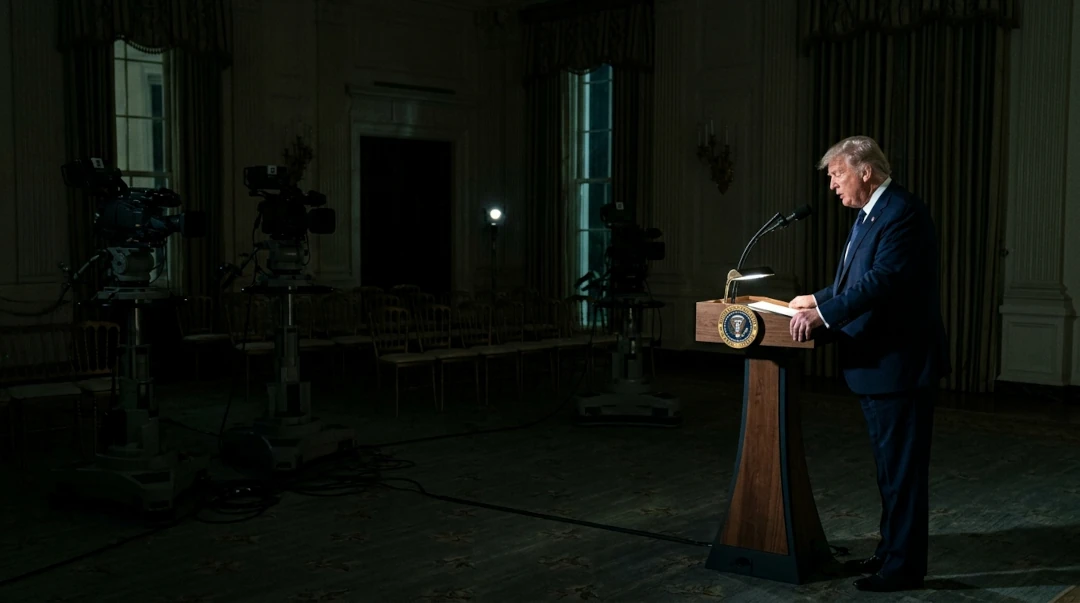
The White House asked for eight minutes at nine o’clock and expected the country to sit still for it. Instead, on Thursday evening, ABC News and NBC News told the President of the United States that his primetime address on so-called “election security” would not be broadcast live on their networks — they would carry it on their streaming platforms only, with fact-checking, and cover any actual news it produced. CNN made the same call. MSNBC carried the opening minutes and then cut away. CBS aired it after a heavy on-air disclaimer that “much of what the president has said on this topic has been false,” and then pulled the plug five minutes before the President finished speaking.
What Donald Trump delivered in the twenty-five minutes the country did hear was, by every serious accounting, a rehearsal of grievances he has been reciting since November 2020. NPR reported he “raised claims that the country’s voting systems are vulnerable to being ‘rigged and stolen,'” without providing new evidence of a single fraudulent vote cast in any election. FactCheck.org called the speech an exercise that “offered no evidence that widespread fraud had occurred,” and noted that Trump’s own Cybersecurity and Infrastructure Security Agency concluded in 2020 that the election was “the most secure in American history” — a finding the President openly mocked from the East Room.
This is what the sitting President of the United States chose to do with a national primetime address four months before a critical midterm election. Not immigration policy. Not Iran. Not the cost of groceries. Not the wildfire smoke that had triggered air-quality alerts across the Northeast that same week. He chose to declassify a stack of documents that his own intelligence community had internally debated, and to insinuate — again — that the 2020 election was stolen. The Nation’s assessment was blunt: the speech was “long on claims of shadowy conspiracies by China and the Deep State and short on actual evidence.”
That is the raw material. The country’s most experienced broadcast news operations looked at it, weighed their obligations to their viewers, and made a decision that would have been unthinkable in any prior presidency: they declined the microphone.
I. What the networks actually did
The refusal was not uniform, and the shape of each refusal matters. ABC News told its viewers the speech would run only on ABC News Live and ABC News Radio, with “comprehensive, anchored coverage” — and that its Special Report team was “prepared to break into network programming” only “should significant developments occur.” NBC News took the same posture, routing the address to NBC News NOW. CNN carried the speech only as a “news event,” treating it as raw material to be analyzed rather than broadcast in full.
CBS was the exception, and even that exception came with warnings. Anchor Tony Dokoupil opened the network’s coverage with what amounted to a public disclaimer, telling viewers directly: “much of what the president has said on this topic has been false. Most notably, of course, the claim that he won the 2020 election when, of course, he did not.” He continued: “There is an argument that it’s irresponsible to air the president’s speech tonight.” CBS aired approximately nineteen minutes of the twenty-six-minute speech before dumping out to fact-check the President’s claims about Chinese interference — and cut away, notably, shortly after Trump called on the other networks to lose their government licenses.
Network 01 · ABC News
Streaming only
Carried on ABC News Live and ABC News Radio. Broadcast channels ran regular programming. Special Report team “prepared to break in” only if warranted. Read the network’s statement.
Network 02 · NBC News
Streaming plus special report
Carried on NBC News NOW streaming platform, followed by a “special report” on the network. NBC’s regular Thursday schedule remained intact. Details reported by Axios.
Network 03 · CNN
News event, not address
Cable channel did not air the speech live. Live feed offered on CNN.com and CNN All Access streaming; on-air treatment framed as analysis and expert commentary. Confirmed via Snopes reporting.
Network 04 · CBS News
Aired with warning, cut early
Dokoupil delivered a rare on-air disclaimer before airing the speech, aired roughly 19 of 26 minutes, and cut away before the address concluded to fact-check China-interference claims. CNN Business recap.
That five networks — including two of the “big three” broadcasters — made this call is not, in the abstract, unprecedented. As Axios noted, ABC, CBS, and NBC all declined to run President Biden’s 2022 speech about threats to democracy. Broadcasters have always exercised editorial judgment. What is unprecedented is the pattern: the country’s most conservative-leaning newsroom, CBS News under a Paramount ownership that is actively seeking regulatory approval for a merger with Warner Bros., found the address so unreliable that it needed to warn its own viewers about it in advance and cut it short.
“Much of what the president has said on this topic has been false. Most notably, of course, the claim that he won the 2020 election when, of course, he did not. There is an argument that it’s irresponsible to air the president’s speech tonight.”
— Tony Dokoupil, CBS News, opening the network’s coverage · July 16, 2026
II. What the speech actually contained
The country deserves an honest inventory of what the President asked for twenty-five minutes of its time to say. He alleged that the People’s Republic of China had “carried out what is believed to be the largest compromise of election data in history.” He suggested American voting machines were “easily compromised.” He claimed, based on a White House fact sheet, that more than 250,000 non-citizens were registered to vote in California, Pennsylvania, New Jersey, and Nevada. He called California “worse than any third-world country.” He revived the falsehood that he won in 2020.
Every one of these claims has been examined. CBS’s own on-air fact check noted that the intelligence document Trump cited about voting-machine vulnerabilities referred to a Venezuelan election system not used in the United States. The Center for Election Innovation and Research told FactCheck.org that the 250,000 figure was “an irresponsible” comparison built from commercial data that experts say cannot produce reliable matches without unique identifiers. Al Jazeera’s summary was that the President had “fired off dubious claims against targets big and small.”
The Washington Post reported that Trump had “promised major revelations on election integrity but largely revived familiar claims of fraud, criticized media outlets and urged passage of legislation that would curtail voting.” The Post noted the speech’s central legislative demand: the SAVE America Act, which would require documentary proof of citizenship to register for federal elections and sharply restrict mail voting — a bill critics have long argued would disenfranchise millions of eligible voters, particularly married women whose current identification documents don’t match their birth names.
Democratic Senator Mark Warner of Virginia, the top Democrat on the Senate Intelligence Committee, appeared on CBS after the speech and refused to soften the point. “I was embarrassed that the President of the United States went before our whole country, and networks like yours carried this as news, as opposed to a rehash of falsehoods,” Warner told Dokoupil. Representative Jason Crow of Colorado was equally direct: “President Donald Trump continues to lie, distort the truth to try to sow doubt and suppress the 2026 election.” Senate Minority Leader Chuck Schumer accused the President of trying to “lay the groundwork to rig the 2026 elections and undermine democracy.”
III. The retaliation, and what it revealed
The President’s response to the networks’ editorial judgment was the most revealing moment of the evening. Standing in the East Room, he told the country: “They want to continue this fraud for whatever reason. They want to keep it going. They want to protect the radical left. Fraud like this should mean a revocation of their licenses. They use our public multi-billion dollar in value airwaves for absolutely no money. They pay nothing.”
This is not, as Reuters and the FCC’s own Democratic commissioner both noted, how the American constitutional system works. FCC Commissioner Anna Gomez, the only Democrat currently on the Commission, responded within hours: “It is ridiculous to call for broadcasters to lose their license simply for making the same editorial decisions they’ve made under presidents of both parties, especially when the remarks were still available to anyone who wanted to watch them online. Those editorial decisions are protected by the First Amendment, and the FCC has no authority to punish a station for refusing to air a blatantly political speech. This is a naked attempt to bully broadcasters, and the FCC should have no part in it.”
The threat did not arrive in a vacuum. The Trump-aligned FCC chair, Brendan Carr, has already opened investigations into ABC’s The View and ordered ABC to submit the licenses of its eight owned-and-operated stations for early renewal — a procedural step that opens those licenses to public challenge. Carr is also investigating Comcast, NBC’s parent company. The Honolulu Star-Advertiser, reprinting AP wire coverage, noted that the FCC could move as early as next month to begin withdrawing the licenses for Disney’s eight ABC stations. Greg Lukianoff, CEO of the Foundation for Individual Rights and Expression — an organization that has spent decades defending speech on both left and right — called the threat “yet another direct attack on the First Amendment.”
Consider the sequence with clear eyes. The President of the United States delivers a speech built substantially on documented falsehoods. Two networks decline to broadcast it live because doing so would require them to hand their platform to those falsehoods in real time. The President then, in the same speech, calls for those networks to be stripped of their licenses. His FCC chair has already put those licenses in play. This is not a First Amendment abstraction. This is the machinery of a regulatory agency being pointed at editorial decisions the President did not like.
Get Involved Today
Contribute to our mission and turn your concerns into action.
IV. A timeline of a single evening
What happened between roughly 8:45 PM and 10:00 PM Eastern on July 16 tells a story that no one paragraph can compress. Set it out honestly:
The White House announces a primetime address without providing detail. Broadcasters, whose license affiliates are already under FCC scrutiny, are asked to preempt regular programming for a speech the President’s team declines to preview. ABC, NBC, and CNN inform their audiences they will not carry it live on their primary broadcast platforms.
CBS anchor Tony Dokoupil opens the network’s special report by telling viewers that “much of what the president has said on this topic has been false” — a rare pre-emptive on-air disclaimer before a sitting president’s address. Fox News carries the speech live; some Fox affiliates in major markets pick up the feed as well.
Trump speaks for approximately twenty-five minutes from the East Room. He alleges Chinese compromise of U.S. election data, claims voting machines are “easily compromised,” attacks California, and calls the 250,000-noncitizen figure a national scandal — a claim the White House refuses to explain methodologically.
The President turns on the networks that declined to air him. “Fraud like this should mean a revocation of their licenses,” he says. He threatens the licenses of ABC and NBC by name — despite the fact that those networks do not hold FCC licenses; their local affiliates do.
CBS cuts away from the President — roughly five minutes before Trump finishes speaking — and begins fact-checking his claims about Chinese interference. The network airs approximately 19 of the 26 minutes of the address.
Sen. Mark Warner (D-VA) appears on CBS and calls the speech a “rehash of falsehoods.” Sen. Chuck Schumer, Rep. Jason Crow, and dozens of other Democratic lawmakers issue statements accusing the President of laying groundwork to contest the 2026 midterms.
FCC Commissioner Anna Gomez publicly rebukes the President in a statement calling his license-revocation demand unconstitutional. Reason magazine, FactCheck.org, NPR, PolitiFact, the Washington Post, Al Jazeera, and CBS’s own newsroom publish independent fact-checks debunking the speech’s central claims.
“I was embarrassed that the President of the United States went before our whole country, and networks like yours carried this as news, as opposed to a rehash of falsehoods. It is incumbent upon you and any responsible journalist to push back on these falsehoods.”
— Sen. Mark Warner (D-VA), on CBS News, live · July 16, 2026
V. What the priorities reveal
Presidents choose what to spend their national attention on. In the days before this speech, the country was living through wildfire smoke from Canadian fires triggering air-quality alerts across the Northeast; the ongoing war with Iran was in its second year; consumer prices remained a top concern for American families; and the President’s own administration was defending a Middle East policy that had drawn open criticism from members of his own party. Any one of those crises would have merited a primetime address.
The President chose, instead, to relitigate 2020. He chose to attack CBS, ABC, NBC, CNN, and the state of California from the East Room. He chose to call for federal licensing retaliation against networks that made routine editorial decisions. He chose, in a speech billed as being about “election security,” to insinuate that the coming midterm elections — the ones his own party is set to defend — cannot be trusted.
This is not the behavior of a president focused on the discharge of his office. It is the behavior of a man consumed by a grievance that predates his current term, whose focus has visibly narrowed, and whose response to disagreement has escalated from criticism to the invocation of state power against private companies. It is the pattern that dozens of members of Congress have been describing publicly since April — and it is why the constitutional conversation about presidential capacity is no longer hypothetical.
“Unable to discharge the powers and duties of his office” — and why the drafters refused to say what that means
The Twenty-Fifth Amendment, ratified in 1967 after the Kennedy assassination laid bare the constitutional gap on presidential incapacity, contains one word that governs its most consequential provision: unable. Section 4 permits the Vice President and a majority of the Cabinet — or “such other body as Congress may by law provide” — to declare that a sitting President is “unable to discharge the powers and duties of his office.” The Amendment never defines “unable.” It never defines “inability.” That was a choice.
The Fordham University Law Clinic’s landmark study — conducted in consultation with Professor John D. Feerick, a principal drafter of the Amendment — put the point unambiguously: “While the amendment’s framers generally contemplated Section 4’s employment in the case of the President’s mental or physical incapacitation, they also expressly disclaimed any intent to define ‘inability.’ They purposefully set forth a flexible standard intentionally designed to apply to a wide variety of unforeseen emergencies.” Yale Law School’s constitutional analysis reached the same conclusion: “the framers specifically rejected any definition of the term [unable], prioritizing flexibility.” The Congressional Research Service has repeatedly reaffirmed that the framers “intentionally left ‘inability’ undefined to preserve flexibility.”
This matters because the entire argument against invoking the Amendment in cases like this one rests on a definition the drafters deliberately refused to write. When critics say Section 4 was intended only for stroke or coma or bullet wound, they are describing the drafters’ typical example — not the drafters’ limit. The Amendment’s own text and history make plain that “unable” was left broad on purpose, to cover emergencies that a 1967 Congress could not foresee. A President who spends primetime relitigating an election he lost six years ago, who threatens the licenses of private broadcasters for editorial judgments, who tells the country that its elections cannot be trusted while his own FCC opens formal proceedings against the networks that declined to platform him — that is not the emergency the drafters had in front of them in 1965. But it is precisely the sort of emergency they wrote the Amendment to be able to reach.
The legislators already on record
This is not a speculative constitutional exercise. In April 2026, Rep. Jamie Raskin (D-Md.), the ranking member of the House Judiciary Committee and a constitutional law professor before his election, introduced legislation to establish the “Commission on Presidential Capacity to Discharge the Powers and Duties of Office” — the “such other body” the Amendment itself contemplates. The bill drew fifty Democratic co-sponsors on introduction. As Axios reported at the time, “more than 85 House and Senate Democrats called for Trump to either be impeached or removed through the 25th Amendment” earlier this year after Trump publicly threatened that “a whole civilization will die tonight.”
Rep. Raja Krishnamoorthi (D-Ill.) called on Vice President JD Vance and the Cabinet to invoke the Amendment, citing “a dangerous pattern of reckless escalation, erratic decision-making, and general conduct that raises grave questions about his fitness.” Rep. Jasmine Crockett (D-Tex.) wrote to Vance declaring it “indisputably apparent to the American public that the President is deranged.” Rep. Eric Swalwell (D-Calif.), Rep. Sydney Kamlager-Dove (D-Calif.), Rep. Yassamin Ansari (D-Ariz.), and Sen. Ed Markey (D-Mass.) have all called for the Amendment’s invocation.
The barriers — and why they don’t dissolve the case
Nothing about this path is easy. Section 4 requires Vice President Vance and a majority of a Cabinet the President himself appointed to act against him — the same structural weakness that has led scholars to argue the Amendment as written “essentially asks political appointees to commit political career suicide.” Congressional confirmation requires a two-thirds vote in both chambers. In a Republican-controlled Congress, that math does not close. Raskin himself has acknowledged this openly: “There is not a single Republican who has called for impeachment or indicated to us interest in impeachment at this point.”
But procedural difficulty is not the same as constitutional impropriety, and the political path being hard does not make the moral and constitutional case wrong. The 25th Amendment exists because the framers of 1967, working under the shadow of a president shot in the head in a motorcade, wanted a permanent mechanism to protect the country from a chief executive who could no longer discharge the office — however that inability presented itself. That they refused to write a narrow medical definition into the constitutional text was not an oversight. It was the point. When the President of the United States uses a national primetime address to attack the free press and demand regulatory retaliation while declining to speak to any of the actual crises facing the country, the question is not whether that meets some clinical threshold. The question is whether he is discharging the office. On Thursday night, on the country’s own airwaves, the answer was on public display.
Editorial Conclusion
Two of the country’s largest broadcasters did not refuse Donald Trump on Thursday because they oppose him politically. They refused him because their standard for what constitutes news — and their obligation not to broadcast known falsehoods live to millions of Americans — could no longer be reconciled with what he was going to say. That is a professional judgment, and it is protected by the First Amendment.
The President’s response — a public demand that the federal government revoke their licenses — is a professional judgment too. It tells the country exactly what his priorities are: not policy, not governance, not the wars he is prosecuting, not the fires burning in his own citizens’ skies. His priority is the platform, and the punishment of anyone who declines to hand it over.
The Twenty-Fifth Amendment was written in language broad enough to reach this. Congress has the constitutional authority — Section 4, in plain text — to constitute the body that can act when a Cabinet appointed by the President will not. That authority does not disappear because the political map is difficult. The stakes are no longer partisan. They are structural. Whether or not the current Congress will act, the constitutional case for acting is not going anywhere. And the country deserves editorial boards, network executives, elected officials, and citizens who are willing to name what they saw on Thursday night for what it was.
Sources & References
- Axios — “Some TV networks won’t air Trump’s speech live” · axios.com
- The Daily Beast — “Biggest TV Networks Deliver Crushing Blow to Trump’s Primetime Address” · thedailybeast.com
- The Hill — “NBC, ABC, CNN won’t carry Trump speech on networks” · thehill.com
- CNN Business — “How the TV networks handled Trump’s highly unusual prime-time address” · cnn.com
- Mediaite — “Tony Dokoupil Kicks Off CBS Coverage With Heavy Disclaimer” · mediaite.com
- The Daily Beast — “MAGA-Coded CBS Admits Trump Speech Is BS—But Shows It Anyway” · thedailybeast.com
- AOL / The Independent — “CBS cuts away from Trump’s election fraud speech” · aol.com
- NPR — “Trump repeats claims, cites election ‘vulnerabilities’ in speech” · npr.org
- FactCheck.org — “FactChecking Trump’s Election Security Speech” · factcheck.org
- CBS News — “Fact-checking Trump’s speech on election security” · cbsnews.com
- NBC News — “How we fact-checked Trump’s election integrity speech” · nbcnews.com
- The Washington Post — “Trump revives election-fraud claims in White House speech” · washingtonpost.com
- Al Jazeera — “Key takeaways from Donald Trump’s controversial speech on election security” · aljazeera.com
- The Nation — “Trump’s Election Fraud Speech Was a Sick Joke—and a Threat” · thenation.com
- NewscastStudio — “Trump threatens broadcast license revocations for ABC, NBC” · newscaststudio.com
- Raw Story — “Raging Trump smacked with ‘brutal’ response after demanding networks lose licenses” · rawstory.com
- Reason — “Trump threatens to revoke ABC and NBC licenses” · reason.com
- Axios — “Trump threatens TV broadcast licenses after networks skip speech” · axios.com
- Mediaite — “Trump’s Election Speech Ignites Wave of Furious Democratic Backlash” · mediaite.com
- Fox News — “Dokoupil clashes with Warner after senator ripped CBS” · foxnews.com
- House Judiciary Democrats — “Raskin Introduces Legislation Establishing Independent Commission on Presidential Capacity” · house.gov
- Axios — “House Democrats file long-shot 25th Amendment bill targeting Trump” · axios.com
- TIME — “Jamie Raskin on Trump, the 25th Amendment, and constitutional limits” · time.com
- Rep. Krishnamoorthi (Official) — “Krishnamoorthi Calls for President Trump’s Removal Under 25th Amendment” · house.gov
- Rep. Crockett (Official) — “Crockett Calls on Vice President Vance, Cabinet to Invoke the 25th Amendment” · house.gov
- Just Security / Fordham Law — “The Incapacitation of a President and the Twenty-Fifth Amendment: A Reader’s Guide” · justsecurity.org
- Landmark Legal Foundation — “Primer on the 25th Amendment” (citing Yale Law School study) · landmarklegal.org
- Snopes — “Did major TV networks ‘refuse’ to air Trump’s July 16 speech?” · snopes.com
- Honolulu Star-Advertiser (AP) — “Trump threatens to revoke licenses of networks for not carrying speech” · staradvertiser.com
Related News